
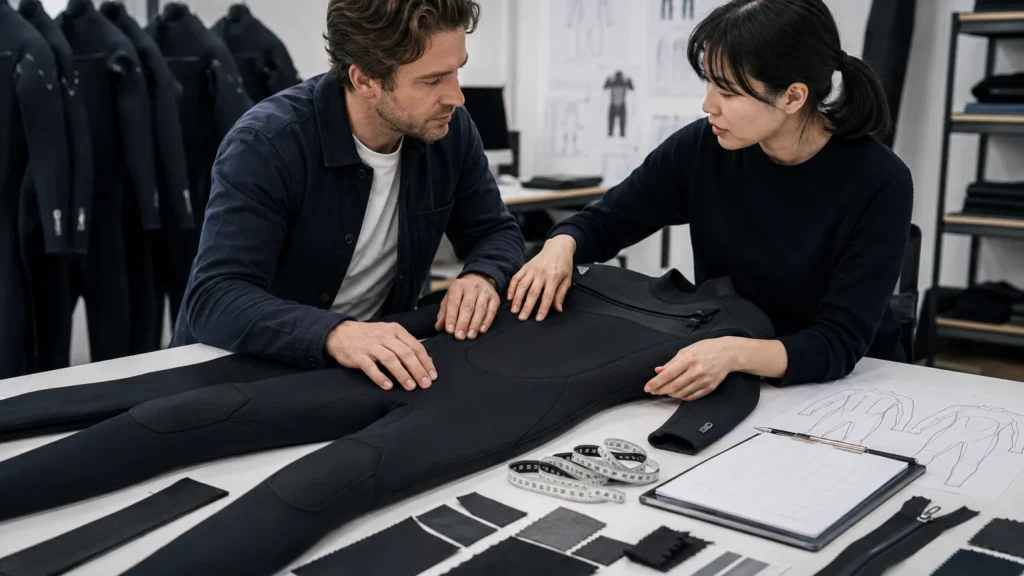
Short answer: A useful wetsuit tech pack template gives a manufacturer one controlled source for the product brief, technical drawings, panel map, materials, thicknesses, seam construction, measurements, grading, artwork, labels, packaging, quality requirements and approval status. The RFQ should add quantity by style, color and size, sample requirements, target timing, trade terms and commercial assumptions. Send the same revision to every supplier, identify all open items and do not release bulk production until the governing specification and sealed sample are approved in writing.
Download the editable Wetsuit Tech Pack + RFQ Template. The workbook contains dedicated sheets for the technical brief, measurements, bill of materials, RFQ quantities and commercial terms, plus a version-and-approval log.
A clear tech pack does more than make a wetsuit look understandable. It lets a factory assess feasibility, expose missing decisions, build a sample against measurable requirements and quote the same scope that competing suppliers are quoting. That reduces false price comparisons, uncontrolled substitutions and disputes about what the approved product was meant to be.
What is a wetsuit tech pack?
A wetsuit tech pack is the controlled product specification used by a brand and manufacturer to develop, sample, quote and reproduce a wetsuit. It explains what the product must be, how it should be constructed and how the parties will decide whether a sample or production unit meets the agreed requirements.
The pack is not merely a presentation drawing. A visual concept can show style and color while leaving the factory to guess foam thickness, stretch direction, lining, panel junctions, seam method, zipper specification, measurement landmarks, tolerance, artwork scale and inspection criteria. Every unanswered technical decision can change cost, performance, sample timing or manufacturability.
If you are still converting an idea into those decisions, use the custom wetsuit design-to-tech-pack guide to structure the product brief, technical views, panel map, measurements, first prototype and revision loop.
A good pack therefore separates three types of information:
- Confirmed requirements: values and references the supplier must follow.
- Manufacturer proposals: details the supplier may recommend but the buyer must approve.
- Open decisions: missing or conflicting inputs that must be closed before the next approval gate.
If your team is still choosing the development model, first compare OEM vs ODM wetsuits and private-label manufacturing. An OEM pack usually begins with more complete buyer-owned specifications. An ODM brief may start with intended use, references and commercial targets, after which the manufacturer develops more of the technical solution. The final controlled specification still needs the same clarity before bulk production.
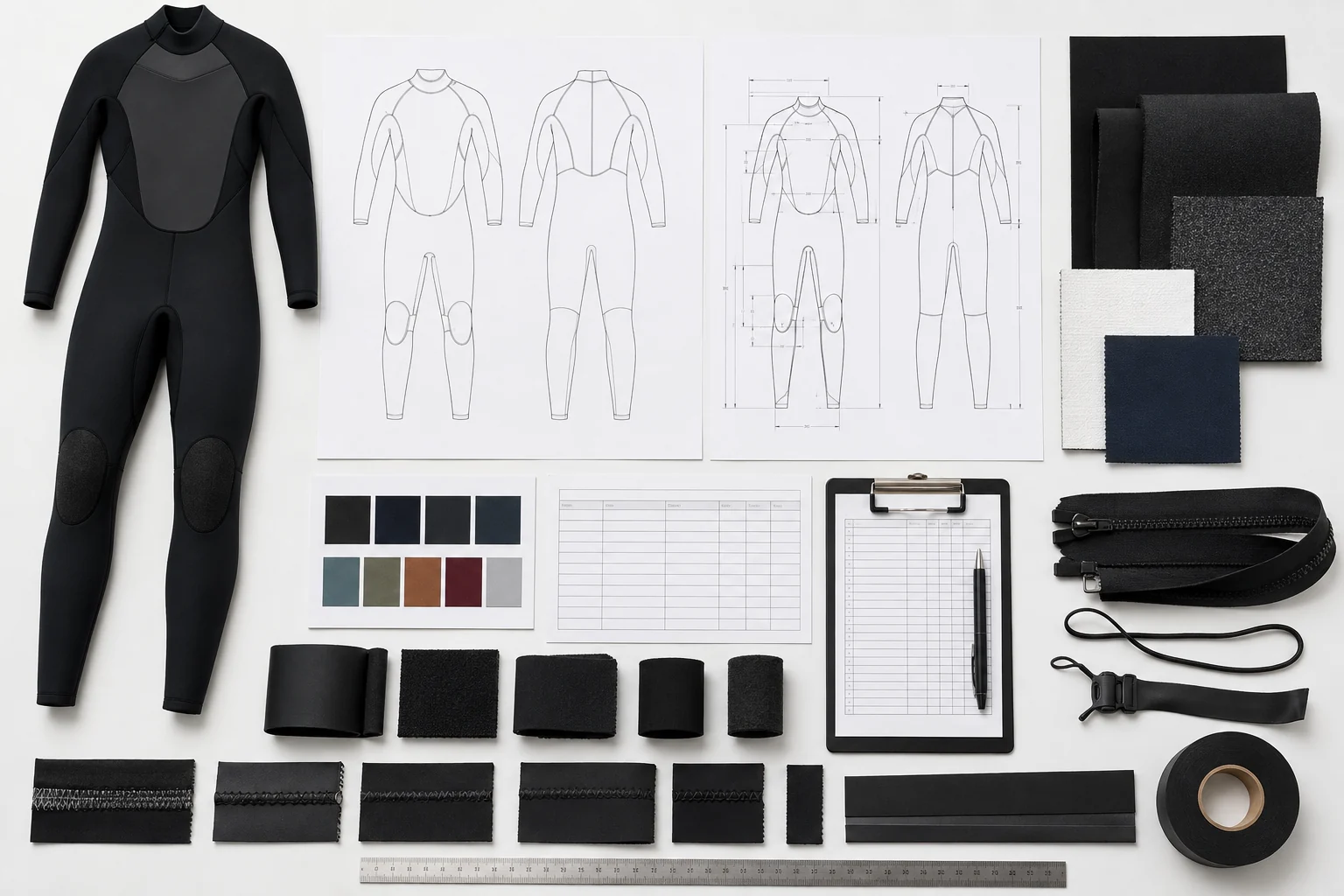
Minimum files for an accurate wetsuit RFQ
A supplier can give a preliminary range from a short brief, but a comparable production quotation needs a defined scope. Send the same core package to every shortlisted manufacturer.
| Document | What it should contain | Why the factory needs it |
|---|---|---|
| Product brief | Intended activity, user, water conditions, fit intent, target market and performance priorities | Defines the design problem and prevents unsuitable material or construction assumptions |
| Technical flats and panel map | Front, back and detail views with panel boundaries, entry, reinforcements and callouts | Shows what must be patterned, cut, joined and costed |
| Measurement specification | Point names, landmarks, method, unit, target values, size range and tolerances | Creates a repeatable fit and dimensional inspection method |
| Bill of materials | Foam, linings, laminations, thread, tape, zipper, pads, trims, labels and packaging | Removes hidden substitutions from the quotation |
| Artwork package | Vector files, dimensions, locations, colors, print method and revision | Controls scale, placement, process and approval |
| RFQ sheet | Quantity by style, color and size; sample stage; timing; testing; packaging; trade terms | Makes commercial offers comparable and exposes independent minimums |
| Version log | Revision number, date, change, reason, requester and approver | Prevents an outdated drawing or sample comment from becoming the production instruction |
If you have not yet selected suppliers, use the 12-point wetsuit manufacturer audit scorecard before sharing confidential files or paying for samples.
1. Define the product, user and intended conditions
Start with the use case, not the colorway. State whether the product is for surfing, diving, freediving, triathlon, rental, training or another activity. Add the expected water and air conditions, duration of use, target user, mobility priorities, abrasion exposure, buoyancy or compression considerations, entry preference and intended selling market.
This information helps the technical team evaluate whether the proposed thickness distribution, lining, seam method and coverage support the intended function. It also reveals priorities that may conflict. For example, maximum stretch, maximum durability, low cost and heavy thermal protection cannot always be optimized simultaneously.
Write measurable priorities where possible. “Premium” and “high performance” are not specifications. Identify which areas require mobility, warmth, durability, fast transition, compression resistance or easy donning, then rank those priorities when tradeoffs exist.
2. Draw every view and control the panel map
Include clean front and back technical flats plus enlarged details for the collar, entry, zipper, cuffs, ankles, knees, junctions, reinforcement and any unusual construction. Number the panels or connect every callout to a defined bill-of-materials item.
The panel map is especially important for a wetsuit because a line in the drawing may represent a style seam, a thickness transition, a material change, a reinforcement edge or only artwork. The factory should not have to infer which interpretation is correct.
For each panel or zone, state:
- material and lining reference;
- finished or nominal foam thickness, as applicable;
- stretch or grain orientation where relevant;
- joining and seam-sealing method;
- reinforcement, pad or tape requirement;
- artwork or color reference; and
- the drawing revision that controls the detail.
Ask the supplier to identify any proposed construction change in writing. A manufacturability proposal is useful, but it should not become an unrecorded substitution.
3. Build a bill of materials and thickness map
The bill of materials, or BOM, should give every physical component a unique item number. Avoid a line such as “3 mm premium neoprene” without defining the foam and fabric system. The same nominal thickness can behave differently when foam density, stretch, lining, lamination and finishing change.
For help selecting and documenting CR, SCR, limestone, Yamamoto or natural-rubber systems, use our wetsuit material selection guide.
A freediving or spearfishing tech pack should never say “open cell” alone. Define the inner surface, outer layer, foam and thickness by panel using the buyer questions in our open-cell vs closed-cell wetsuit specification guide.
For each main material, record the supplier or agreed reference, foam type, thickness, color, outside fabric, inside fabric, lamination, surface finish and approved swatch or sample ID. Do the same for zipper, puller, hook-and-loop, thread, seam tape, knee pad, printed transfer, labels and packaging.
When a named Yamamoto grade or another limestone-based material is proposed, add the identity, evidence and approved-claim fields from this Yamamoto and limestone material-verification checklist instead of writing only a brand or feedstock label.
If the shortlist includes Yulex or another natural-rubber route, add the exact material product, converter, chain-of-custody evidence, trademark permission and approved claim wording. The Yulex and neoprene sourcing comparison provides the fields needed to keep material, certification and marketing approvals separate.
If the material shortlist includes both CR and SCR, use this CR and SCR material comparison to define the supplier grade, comparable test evidence and substitution controls that belong in the BOM.
Use a separate thickness map when more than one thickness appears in the garment. Label the target thickness by panel and explain whether the stated value is nominal raw material, supplied laminated material or an agreed finished measurement. If thickness variation matters to performance or compliance, define the test method and acceptance rule with a qualified laboratory or adviser.
INSEAKU supports material selection and has material-lamination capability. The quoted route should still name the agreed materials, any approved equivalents and the records used to identify them. See the wetsuit manufacturing process for how material confirmation, lamination, cutting and assembly connect to later quality controls.
For a detailed way to assign thickness by panel, define the measurement basis and validate 3 mm, 5 mm or 7 mm constructions, use our wetsuit thickness specification guide and downloadable panel worksheet.
4. Specify seams, entry and every critical component
Do not use one general note for all seams unless one construction genuinely applies everywhere. Mark the method by location. Depending on the product, INSEAKU can produce flatlock, glued-and-blind-stitched, taped and other specified seam constructions. Capability does not mean every method belongs in every wetsuit; the project specification selects the required route.
Before drawing the seam map, use our wetsuit seam construction comparison to decide where flatlock, GBS, tape or liquid sealing belongs.
Call out:
- panel bonding and gluing requirements;
- stitch type, thread and stitch exposure;
- internal or external tape and termination details;
- seam reinforcement at stress points;
- zipper brand/reference, size, orientation and backing;
- puller, cord, loop, flap and closure details;
- collar seal, cuff and ankle finish;
- knee pad material, position and edge construction; and
- any component for drainage, attachment or adjustment.
If the supplier may propose an equivalent component, require the proposal to include its specification, effect on price and timing, and a physical sample or evidence appropriate to the risk. Approval should be explicit, not inferred from silence.
Use the downloadable worksheet in our chest zip vs back zip wetsuit brand guide to specify zipper make, model, length and orientation together with barriers, drainage, reinforcement and sample acceptance checks.
5. Define measurement points, tolerances and grading
A size chart alone is incomplete when it does not explain how each value is taken. State whether the numbers are body measurements or finished-garment measurements, whether the garment is measured flat or as a circumference, which landmarks form the start and end points, what material condition and tension apply, and what unit is used.
ISO 8559-1 describes anthropometric measurement definitions used in clothing product development, while ISO 8559-2 addresses primary and secondary dimensions for size designation. They are useful references for consistent language, but a brand still needs a product-specific finished-garment measurement method for its wetsuit.
Include a tolerance for every critical finished measurement. One blanket tolerance is rarely appropriate for all locations. A neck opening, zipper length, torso length and overall garment dimension can require different controls. Identify whether tolerances are bilateral, one-sided or graded by size.
INSEAKU completes pattern making and size grading in-house. For a buyer-supplied pattern, the pack should identify the source file, version, seam allowance and material assumptions. For a manufacturer-developed pattern, the parties should record the approved measurement chart and pattern version. A change in foam thickness, stretch or seam construction can require pattern adjustment even when the visual design is unchanged.
Use the complete wetsuit size grading guide to turn these tech-pack fields into a controlled size architecture, grading review and sample-approval plan.
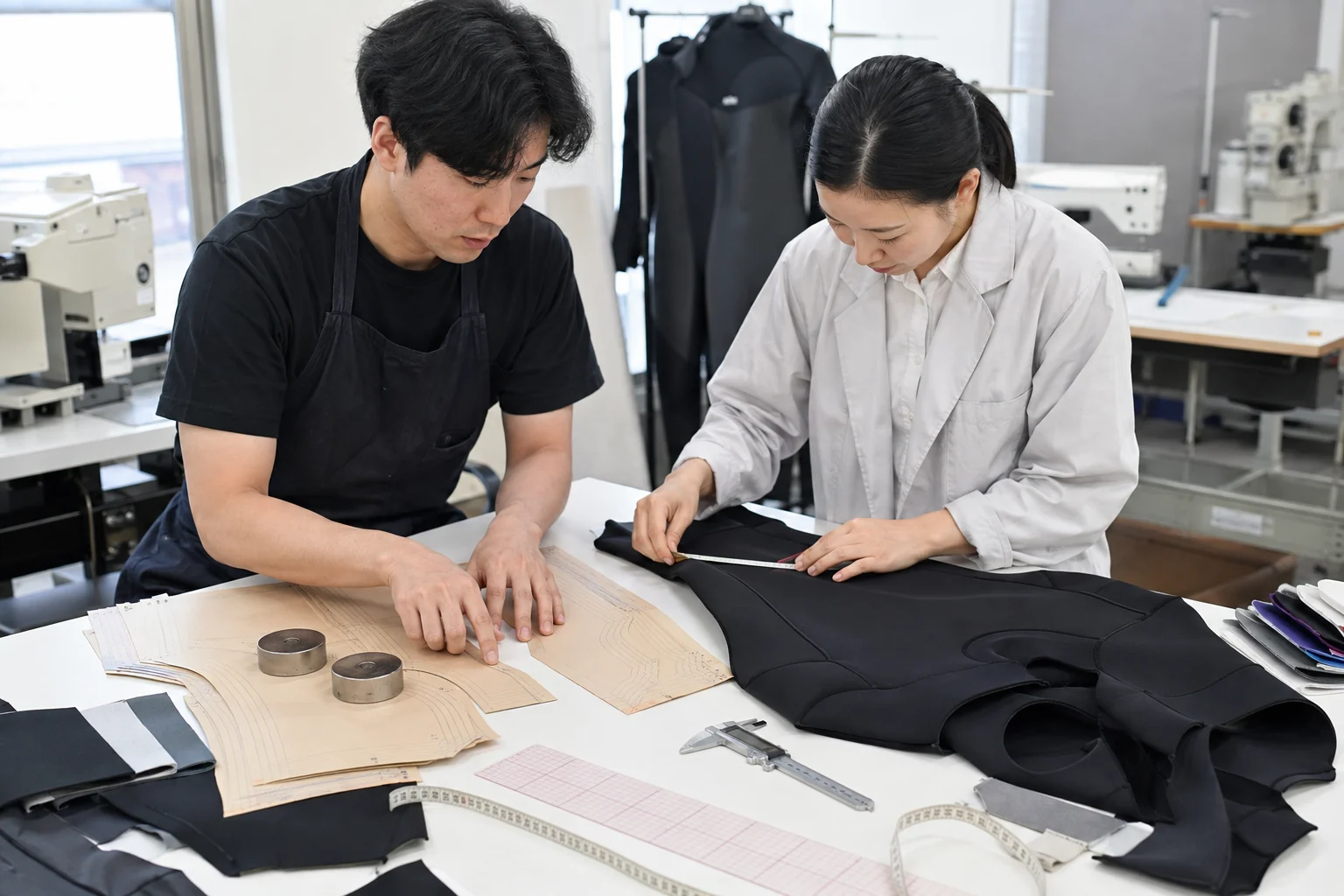
Do not confuse body measurements with garment measurements
Body measurements describe the intended wearer. Finished-garment measurements describe the product. Wetsuits may use negative ease, material stretch and compression to achieve fit, so the two sets of numbers should not be copied into each other without pattern and fit analysis. Label both systems clearly when both are included.
Grade deliberately, then verify more than the base size
State the base size, grade rules and any non-linear adjustments. Do not assume every measurement increases by the same amount. During development, identify which sizes require a physical sample or size-set review and which can be approved through recorded grading and measurements.
Convert the measurement and grading requirements into sample decisions with a wetsuit fit testing protocol covering garment measurements, movement checks, leak diagnosis and written approval.
6. Control artwork, labels and packaging
Supply vector artwork where the selected process requires it. Name every file with the style and revision, show the physical placement and dimensions on the garment, and state the required color reference and application method. INSEAKU can support multiple printing methods, but the chosen method must match the approved artwork, material and durability requirement.
Before freezing these fields, compare the main wetsuit logo printing methods and record the approved substrate, process, strike-off and acceptance evidence.
For each logo or graphic, specify:
- file name and revision;
- finished width and height;
- location measured from defined seams or landmarks;
- color standard and permitted variation;
- print, transfer or application method;
- orientation and mirror rules;
- sample approval method; and
- any durability or performance test.
Separate product MOQ from packaging MOQ. INSEAKU’s custom packaging can have a minimum of 1,000 units, depending on the packaging specification and supplier. If the wetsuit order is smaller, ask how unused packaging will be stored, paid for, transferred or disposed of, and whether a standard packaging option is available.
List every label and packaging item in the BOM: brand label, size label, care/content label, barcode, hangtag, insert, bag, hanger, inner carton and master carton marking. Regulatory and language requirements depend on the product and destination, so the buyer should confirm them with qualified advisers before approval.
For products sold in the United States or European Union, map each required field to the physical product, packaging, instructions, online offer and supporting evidence. Use the U.S. and EU wetsuit labeling checklist before freezing label artwork or requesting a pre-production sample.
For a children’s style, also record intended age, destination market, design hazards, applicable tests, warnings and traceability before label artwork is approved. The market-specific kids wetsuit compliance checklist connects those decisions to the BOM, evidence file and sample-release record.
7. State how the sample and production will be checked
A requirement is incomplete when neither party knows how to verify it. Mark critical-to-quality items in the tech pack and connect each one to an inspection method, test method, tolerance or approved reference.
INSEAKU’s stated quality route can include incoming-material checks, measurement checks, cutting checks, seam and zipper review, logo and artwork review, workmanship inspection and packing checks. Project-specific functional or laboratory tests should be listed separately with the method, sample quantity, responsible party, laboratory, timing and acceptance criterion.
Attach a project-specific wetsuit QC checklist to the RFQ so suppliers quote the same inspection scope, defect rules, records and release conditions.
For visual standards, use controlled photos or physical references and explain what they demonstrate. A photo cannot replace a dimension or test method, but it can clarify workmanship, alignment, edge finish, print appearance and acceptable surface variation.
Define the sample stages before development starts. These may include a prototype, fit sample, revised sample, size set, pre-production sample and sealed sample. Give each stage a purpose. A first development sample is a learning tool, not automatic permission for bulk production.
8. Add quantities and commercial assumptions to the RFQ
The technical pack defines the product. The wetsuit RFQ template defines what the supplier is being asked to quote. Use one row for every style-and-color combination and show the size breakdown, total quantity, sample requirement, target completion or delivery date and destination.
When a range includes swim and surf styles, our triathlon wetsuit vs surfing wetsuit development guide explains which activity, panel, surface and entry requirements should be specified separately.
For a coordinated accessory line, use our private label neoprene accessories checklist to add hood openings, glove pairing, footwear interfaces and explicit order units to the brief.
After suppliers return their offers, use this wetsuit quote comparison checklist to reconcile exclusions, development charges and recurring costs against the same RFQ revision.
Ask for the basis of every minimum. INSEAKU’s standard starting MOQ is 50 pieces per style and color. Sizes may be mixed within those 50 pieces, but different colors cannot be combined to reach the minimum. A material, print, trim or packaging supplier may impose another minimum that should be stated separately.
Rental operators should also attach a rental wetsuit fleet size-mix, identification and total-cost plan so suppliers quote the same operating requirements.
Sample pricing is quoted case by case because the product, materials, construction and development work differ. At INSEAKU, a sample fee may be credited against a bulk order when the same style and same color reaches 300 pieces. The quotation should state the sample stage, amount, payment terms and exact credit condition.
INSEAKU sample development can start from approximately seven working days after materials and specifications are confirmed and payment is received. Complex patterns, special materials, printing, multiple sizes, revisions or unresolved approvals can require more time.
Normal bulk production is approximately 30 working days after the sealed sample has been approved in writing and the required bulk-order deposit has been received. The confirmed schedule depends on style, materials, quantity and production allocation and must appear in the written quotation. International transport is separate from production time.
For the complete commercial explanation, read wetsuit manufacturer MOQ, sample cost and production lead time.
| RFQ field | Minimum clarification |
|---|---|
| Quantity | By style, color and size; identify whether repeat quantities are forecasts or firm orders |
| Price | Currency, unit basis, validity, price breaks, included packaging and exclusions |
| Development | Sample type, price, revision allowance, timing and fee-credit conditions |
| Bulk timing | Definition of day one, approval dependencies and whether stated days are working or calendar days |
| Delivery | Incoterms rule, named place or port, edition, requested date and transport mode |
| Testing | Method, quantity, laboratory, payer, timing and pass/fail criterion |
| Payment | Sample and bulk milestones, currency, bank costs and any balance-release condition |
| Ownership | Background IP, new patterns/artwork/files, physical tools, confidentiality and permitted use |
| Change control | Who may request and approve changes and how price and schedule impacts are recorded |
Use the selected Incoterms® rule together with a precise named place or port and the applicable edition, such as Incoterms® 2020. The ICC explains that these rules allocate specified obligations, risks and costs between seller and buyer; they do not replace the sale contract or define product specifications, payment, intellectual-property ownership or every consequence of delay.

How does a wetsuit tech pack become a quotation?
A responsible wetsuit tech pack manufacturer should review the files before treating the quote as firm. At INSEAKU, the practical sequence is:
- Receive and register the files. Record the style, buyer, revision and attachments.
- Review the product brief. Confirm intended use, target user, market and performance priorities.
- Check technical completeness. Compare drawings, measurements, BOM, artwork, quantities and timing for missing or conflicting inputs.
- Assess manufacturability. Review patterns, panel geometry, materials, lamination, seams, printing, components and proposed inspection route.
- Issue an open-item list. Separate confirmed requirements from alternatives and unanswered questions.
- Confirm the quotation basis. State the selected materials and construction, MOQ basis, sample terms, production timing, packaging, testing, trade terms and exclusions.
- Start development after approval and payment. Use the confirmed revision as the sample input.
If a supplier sends a price before reviewing the measurement chart, material system, construction and quantity split, ask what assumptions were used. The lowest preliminary number may represent the least complete scope rather than the lowest cost for the same product.
Use one revision system from inquiry to production
Give the complete pack a revision number and date, not just the artwork file. When a change occurs, update the affected sheet or drawing, record the change and issue one new controlled package. Do not send several files named “final,” “latest” and “final revised.”
Once your brief is ready, use our comparison of private label wetsuit manufacturers to identify suppliers whose published capabilities match the project, then send each candidate the same revision.
Once the input package is controlled, use the wetsuit sample approval checklist and workflow to connect prototypes, revisions, the pre-production sample and sealed-sample authorization to those document versions.
A simple naming structure is:
Brand_StyleCode_Document_Revision_YYYY-MM-DD
For example:
BrandA_WS101_TechPack_V0.3_2026-09-07.pdf
The approval record should identify the exact tech-pack revision, measurement chart, BOM, artwork files and physical sample being approved. If the buyer approves with conditions, record and close those conditions before bulk release.
INSEAKU starts bulk production only after the buyer has approved the sealed sample in writing, the specification is confirmed and the production order is in place. The sealed sample and controlled specification work together: the sample shows the agreed physical result, while the documents preserve measurable requirements and approved details that may not be visible in one garment.
Before bulk completion, convert those references into a batch-inspection and AQL plan that identifies the lot, sample selection, defect classes, Ac/Re criteria, measurement method, packing checks and authorized shipment decision.
Protect confidential information before sharing it
WIPO recommends defining confidential information and permitted use and, where appropriate, putting confidentiality arrangements in place before sensitive information is disclosed. A project NDA should not be assumed to settle ownership of new patterns, designs, files or physical tools. State ownership, permitted reuse, exclusivity, return or destruction, and post-termination obligations in writing with qualified legal advice.
Common wetsuit tech-pack mistakes
| Mistake | Why it creates risk | Better control |
|---|---|---|
| Only a mood board or product photo | The factory must infer construction, measurements and materials | Add technical flats, callouts, BOM and measurement sheet |
| “Neoprene” without a material system | Foam, fabric and lamination differences affect price and performance | Define each layer and approved reference by panel |
| One thickness note for the whole design | Transitions and mixed panels are unclear | Use a thickness map linked to panel IDs |
| Measurements without landmarks | Buyer and factory can measure the same item differently | Define method, unit, condition, tension and tolerance |
| Logos shown only in a rendering | Scale, location, color and production method remain ambiguous | Attach vector files and dimensioned placement callouts |
| Quantity shown only as one total | Style, color and component minimums cannot be evaluated | Break quantity down by style, color and size |
| No open-item list | Assumptions are hidden inside the quote or sample | Label each item Confirmed, Open or N/A |
| Changes sent through scattered messages | Different departments may work from different instructions | Update one revision and maintain an approval log |
| Sample approval stated as “looks good” | The approved files and unresolved exceptions are unknown | Issue dated written approval tied to sample and document IDs |
Wetsuit RFQ checklist before you send the files
Use this final review before requesting a firm quotation:
- One style code and one current revision appear on every controlled document.
- The product brief defines use, wearer, environment, fit and performance priorities.
- Front, back and detail drawings show the complete panel map and construction callouts.
- The BOM defines foam, linings, lamination, seams, zipper, pads, trims, labels and packaging.
- The thickness and material assigned to every panel are clear.
- Measurements state landmarks, method, unit, size values and tolerances.
- The base size and grading assumptions are identified.
- Artwork files are vector-based where required and include dimensions, location, color and method.
- Quality requirements identify measurable checks, test methods or approved references.
- Quantity is split by style, color and size.
- Sample stage, sample pricing request and approval route are stated.
- Target timing distinguishes development, bulk production and transport.
- The RFQ states currency, Incoterms rule and named place, payment assumptions and exclusions.
- Confidentiality, design/pattern/file ownership and permitted use are addressed.
- Every unresolved point is marked Open and assigned to an owner.
Download the Wetsuit Tech Pack + RFQ Template, complete the yellow input cells and send one controlled revision to each shortlisted supplier.
Buyer FAQs
Can I request a wetsuit quote without a complete tech pack?
Yes, a manufacturer may give a preliminary range from a product brief, reference sample or concept. The response should identify its assumptions and open items. A firm comparable quotation requires enough information to define materials, construction, size range, quantities, branding, packaging, testing and timing.
What file formats should I send?
A PDF is useful as the controlled human-readable pack. Keep editable source files for technical drawings, patterns and artwork in the formats agreed with the manufacturer. Supply vector artwork when the selected print or application process requires it. Include file names and revision numbers in the approval record.
Does the brand need to provide finished patterns?
Not always. In an OEM project, the buyer may provide patterns or only the design and measurement requirements, depending on the agreed scope. In an ODM project, the manufacturer may develop the pattern from the approved brief. INSEAKU completes pattern making and size grading in-house; the quotation should state who supplies or develops each deliverable and who may use it.
How detailed should the measurement chart be?
Detailed enough for two trained people to measure the product the same way. Include landmarks, direction, flat or circumference method, material condition, tension, unit, size values and location-specific tolerances. Add diagrams for any point that could be interpreted differently.
Should I put a target price in the RFQ?
A realistic target can help the factory propose a suitable material and construction route, but it should not replace a complete specification. Ask the supplier to separate confirmed requirements, proposed alternatives and exclusions so you can understand how the price was reached.
When should a tech pack be frozen?
Freeze the production specification after the approved sample and all accepted revisions have been incorporated. The bulk-release record should identify the final tech pack, measurement chart, BOM, artwork, packaging files and sealed sample. Later changes need written change control because they may affect cost, timing, fit or quality.
Is the tech pack the same as the purchase contract?
No. The pack defines product requirements and approval references. The sale or manufacturing agreement should also address price, payment, delivery, ownership, confidentiality, remedies, applicable law and other commercial or legal terms. Use qualified advisers for project-specific legal and regulatory requirements.
Turn the completed pack into a controlled RFQ
Before contacting INSEAKU, download the template, complete the fields you already control and mark the rest Open. Then send your product brief and files for a manufacturing review. Include the intended activity, target market, style and color count, size range, quantity, materials or performance priorities and target timing. INSEAKU can then confirm the development route, open questions and written quotation basis.
If the tech pack is part of a first commercial collection, the guide on how to start a wetsuit brand shows where specification work fits alongside positioning, range planning, startup cost, supplier approval and launch timing.
References and further reading
- ISO 8559-1:2017 — Anthropometric definitions for body measurement
- ISO 8559-2:2017 — Primary and secondary dimension indicators
- WIPO — Guide to Trade Secrets and Innovation: trade secret management
- International Chamber of Commerce — What the Incoterms® 2020 rules do and do not do
Last reviewed: September 7, 2026. INSEAKU reviewed the company-specific service definitions, pattern-development capability, material-lamination capability, MOQ basis, sample terms, indicative timing, packaging minimum and production-approval workflow used in this article. Project-specific terms remain subject to the written quotation and agreement.