
Short answer: Good bulk wetsuit order planning turns a total buying quantity into a controlled list of style, color and size quantities. Start with the intended customer and available demand evidence, separate the size curve from the color split, convert the allocation into whole garments, then confirm minimum-order requirements and production documents. A total such as “300 wetsuits” is not a complete purchase instruction.
This guide is for brands, importers and procurement teams deciding how many units of each variant to order. It covers the wetsuit size assortment, color depth, rounding and release checks. It does not prescribe body measurements or grading increments, and it does not claim that one size ratio works for every market.
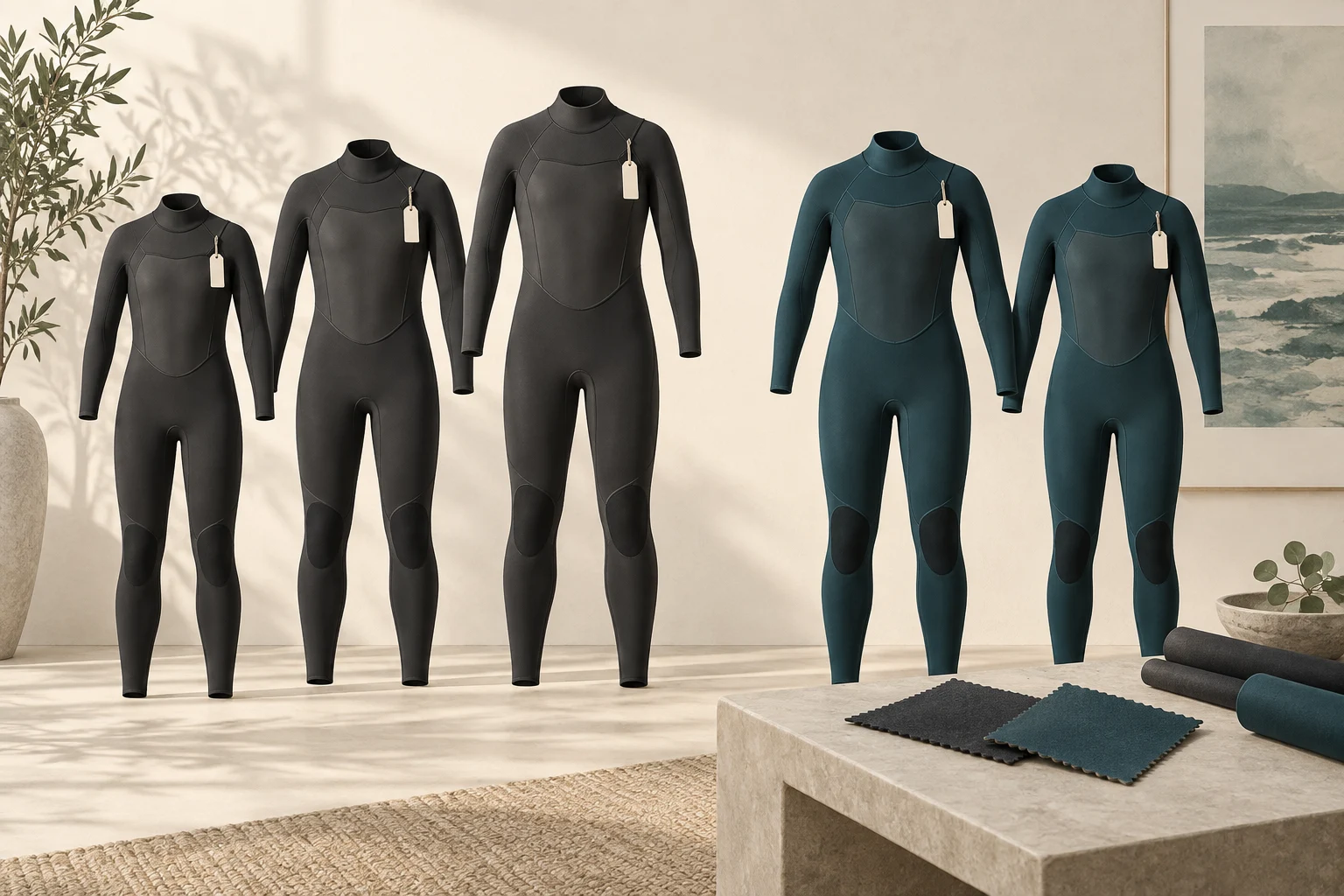
Download the editable Bulk Wetsuit Order Planner. It contains a blank two-color order matrix and a separate, clearly labeled allocation example that demonstrates whole-unit rounding. Replace the example assumptions with evidence for your own project.
1. Define the order scope before assigning quantities
Decide what belongs in one planning group. A men’s full suit, a women’s full suit and a children’s shorty should not automatically share a size curve. Different patterns, thicknesses, entry systems or fit populations may also need separate quantity plans, even when the garments use the same brand name.
Identify the style code, specification revision, color reference, size-chart revision, unit of sale and intended delivery window. If a two-piece product is sold as a set, say whether the quantity counts sets or individual garments. A detachable accessory or spare item should not silently become part of the suit count.
In catalog terms, a size-and-color combination is a product variant. Shopify’s official variant documentation uses that distinction when describing products with size and color options. You can apply the same discipline to an RFQ regardless of which ecommerce platform your brand uses.
Keep one quantity owner and a dated revision. When the plan changes from a sample discussion to a purchase order, remove superseded spreadsheets from the approval chain. Link the matrix to the wetsuit tech pack and RFQ checklist so that the order quantities refer to the same product being quoted.
2. Build a demand view that explains its limitations
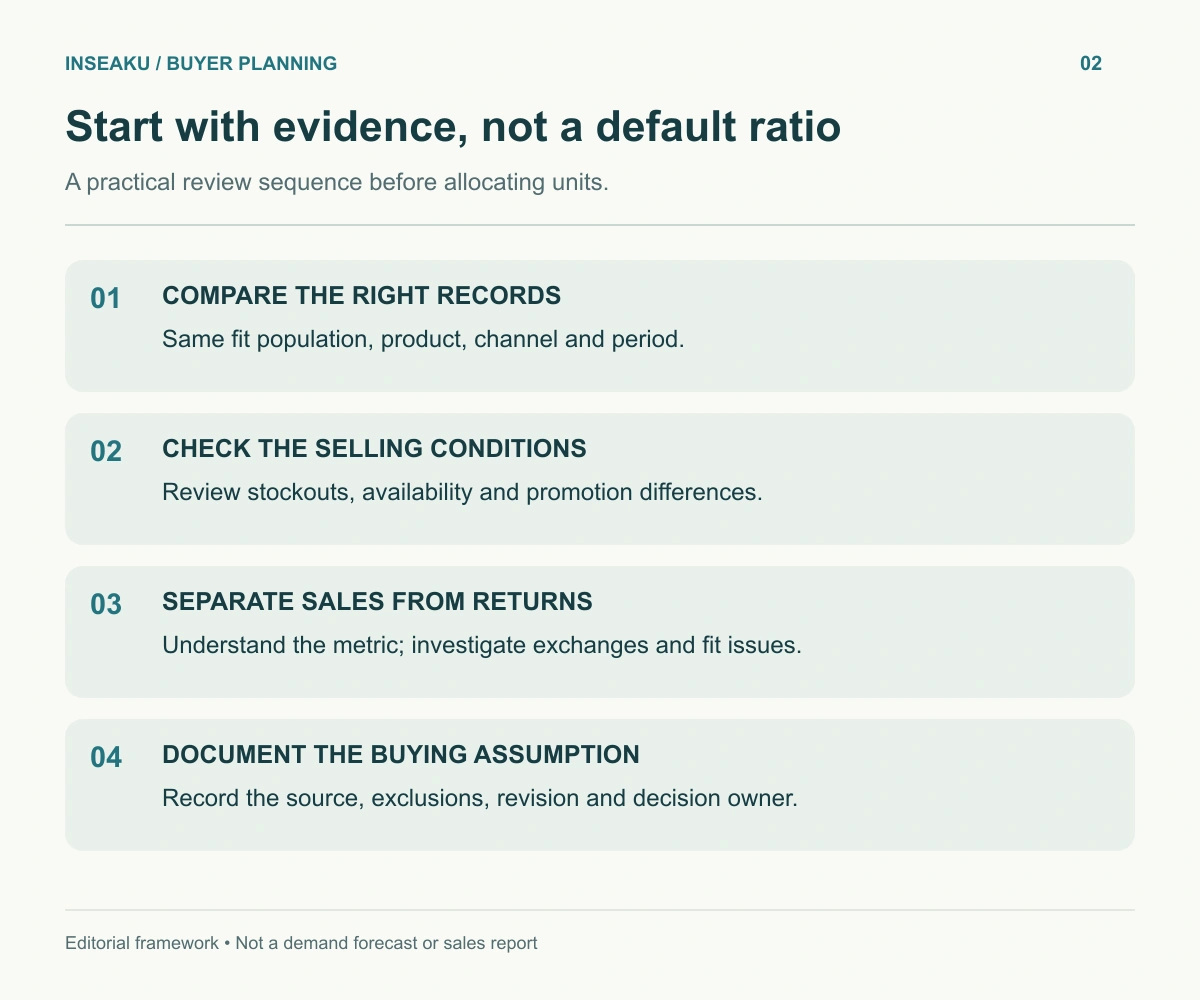
Use evidence from the closest comparable product, customer group, channel and selling period. Relevant inputs may include confirmed wholesale orders, historical variant-level sales, preorders, fit-session requests and documented lost sales. Keep confirmed commitments separate from forecasts. Do not count a preorder again inside a forecast that already includes it.
Before calculating a size share, check what the records actually measure. Did a size sell slowly, or was it unavailable? Did customers keep it, exchange it for another size or return it because the fit was wrong? Were two colors offered for the same number of weeks at comparable prices? Low recorded sales are not proof of low underlying demand when the selling conditions were different.
Shopify’s inventory-report definitions distinguish quantity sold, ending inventory and estimated inventory coverage. Its quantity-sold metric does not incorporate inventory adjustments such as returns, so a procurement review must understand the report definition rather than assume it represents retained customer demand.
For a first order without history, record a testable buying assumption rather than presenting a guess as a forecast. A narrower launch assortment, retailer commitments or a small fit study may provide a more manageable starting point, subject to supplier feasibility. State the evidence source, period, exclusions and person responsible for updating the plan.
3. Build the wetsuit size assortment separately from the size chart
A size chart defines the fit or measurements associated with a size. A size assortment defines how many units you buy in that size. Mixing the two decisions can hide a fit problem inside the purchasing plan. Ordering more large suits will not repair an incorrect medium pattern or an unclear measurement guide.
Confirm the intended size range and approved measurement references before assigning a buying ratio. Do not assume that “M” means the same fit across suppliers, genders or collections. Use the fit testing protocol to document the sample and size evidence separately from quantity allocation.
For an established product, start with a comparable retained-sales view and investigate stockouts and exchanges before adopting its proportions. For a new product, label the proportions as a provisional hypothesis. Avoid a generic bell curve copied from unrelated apparel: neoprene fit, activity, target customers and your offered size range can change the buying decision.
Keep each ratio tied to its population. A five-size example is not a recommendation to exclude extended, short or tall sizes. If your confirmed range includes those options, add them to the planning model and revalidate the allocation rather than hiding their demand inside adjacent sizes.
4. Allocate colors without losing sight of each variant
Color allocation is a separate decision from the size curve. First set the planned total for each color. Then allocate sizes within that color using the best available evidence. Using one shared curve for every color can be a transparent initial assumption, but do not mistake it for a proven relationship.
Hypothetical example: one style, one approved fit block, two colors and five sizes. The total is 300 individual wetsuits: 180 black and 120 teal. To demonstrate the arithmetic, both colors use the assumed size shares XS 10%, S 20%, M 35%, L 25% and XL 10%. These are not INSEAKU sales, an actual order, a recommended market ratio or an MOQ.
| Size | Assumed share within each color | Black units | Teal units | Total units |
|---|---|---|---|---|
| XS | 10% | 18 | 12 | 30 |
| S | 20% | 36 | 24 | 60 |
| M | 35% | 63 | 42 | 105 |
| L | 25% | 45 | 30 | 75 |
| XL | 10% | 18 | 12 | 30 |
| Total | 100% | 180 | 120 | 300 |
The example creates ten size-color variants, not two products with interchangeable stock. Its largest combined size allocation is M at 105 units. That is a consequence of the assumed 35% share, not evidence that M is the best-selling wetsuit size.
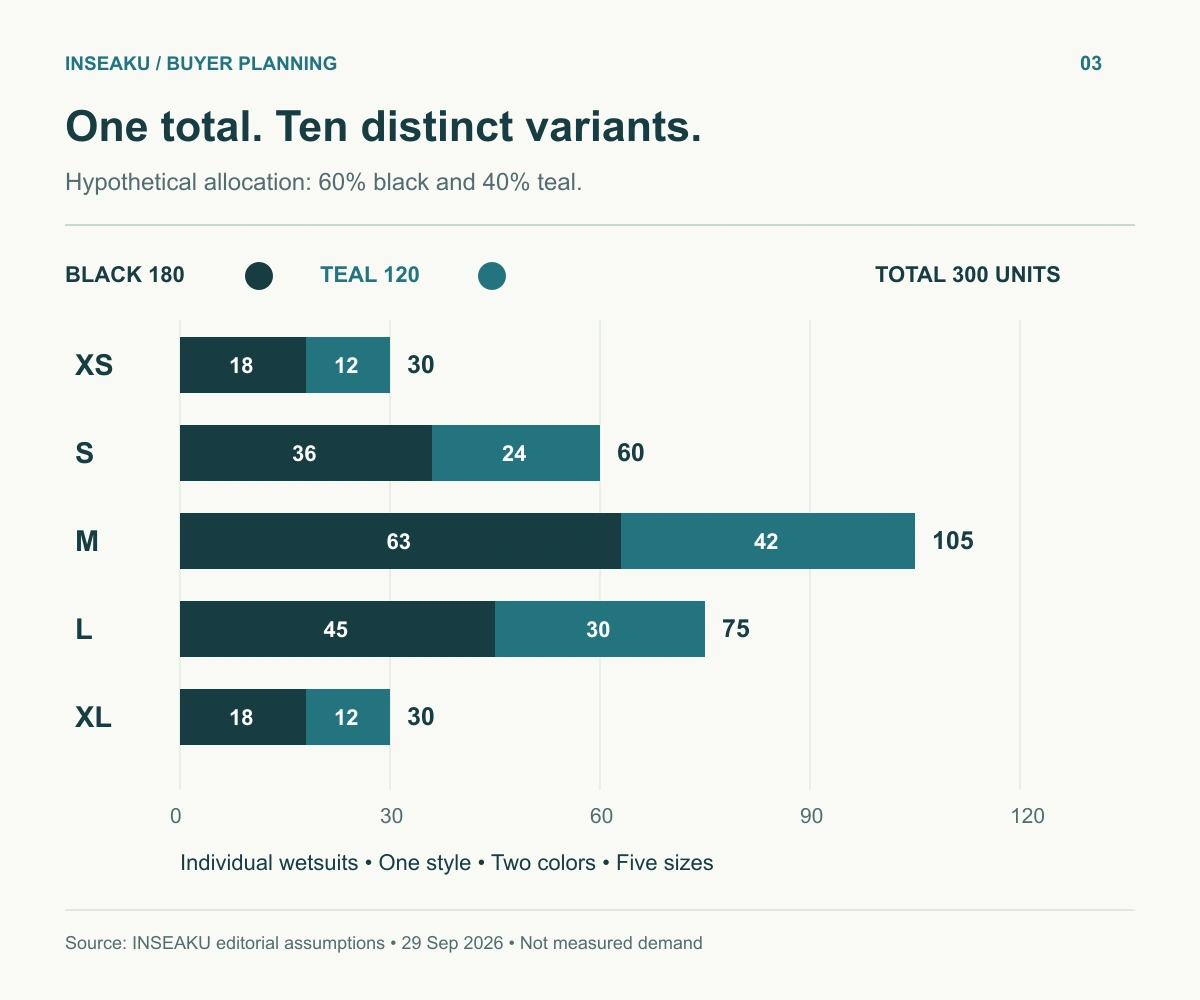
Adding colors multiplies the number of lines that need evidence, identification and reconciliation. Where the budget cannot support the proposed assortment, reconsider the launch range or delivery stages with the supplier. Do not reduce every cell mechanically until some variants become commercially impractical.
5. Convert percentages into whole garments and reconcile the total
Percentages do not always produce integer quantities. Independently rounding every cell can change the agreed order total. Use a documented rounding method, inspect the result and record any commercial adjustments afterward.
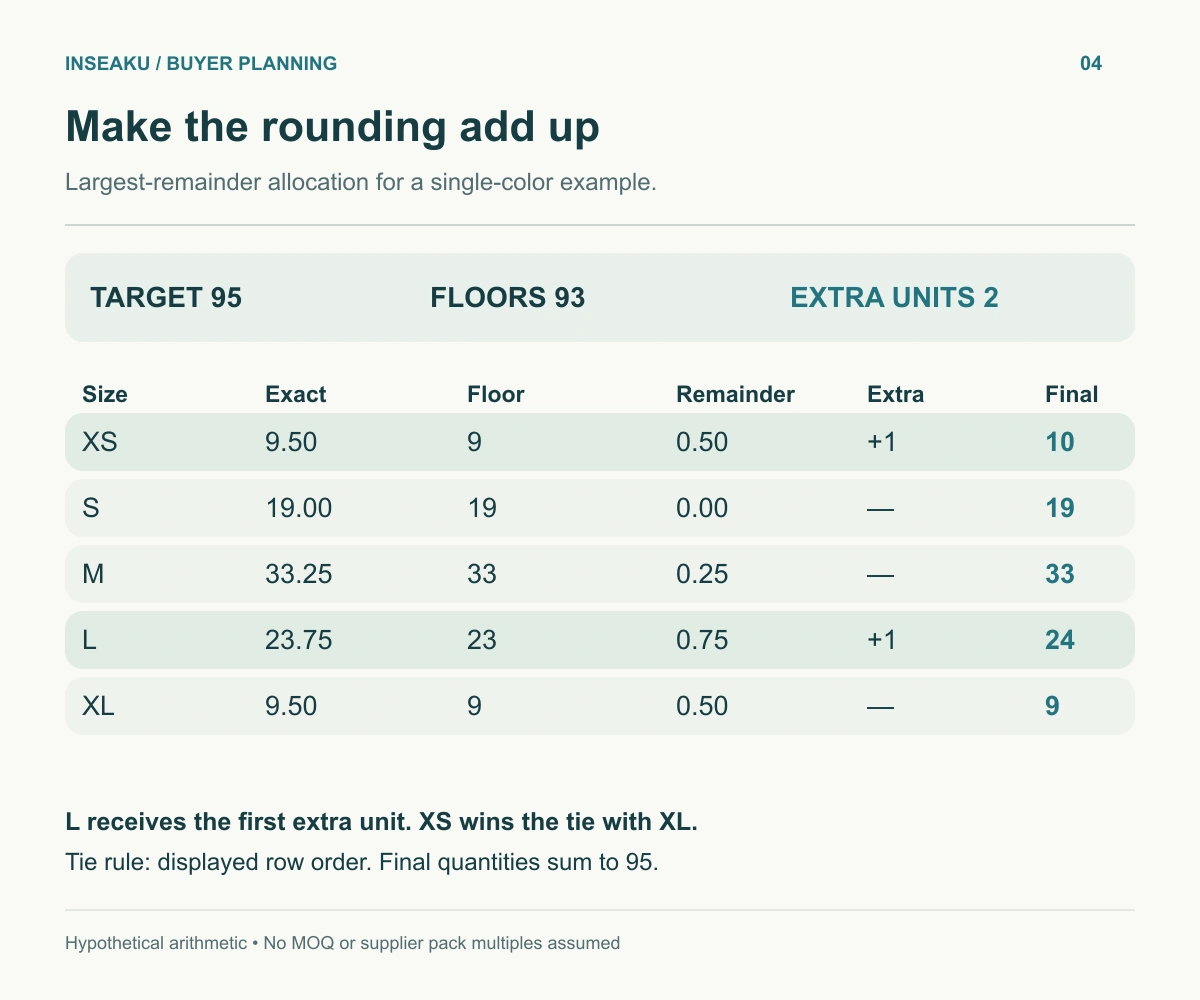
A practical method is to calculate the exact allocation, round each result down, then assign the remaining units to the largest fractional remainders. For equal remainders, use a documented tie order. The downloadable helper uses the displayed size-row order. That tie rule is arithmetic, not a statement that the earlier size has greater demand.
For a separate 95-unit, single-color example using the same assumed shares, the exact quantities are 9.50, 19.00, 33.25, 23.75 and 9.50. Rounding down gives 93 units. The first extra unit goes to L, whose remainder is 0.75. The second goes to XS under the declared tie rule, ahead of XL at the same 0.50 remainder. The final quantities are 10, 19, 33, 24 and 9, totaling 95.
Rounding is not the final commercial decision. If a supplier requires particular multiples or minimum quantities, revise the feasible matrix explicitly. Do not silently increase the purchase quantity, reduce an agreed color total or move units between sizes merely to make a spreadsheet display a balanced result.
6. Confirm what the MOQ applies to
Ask whether the minimum applies to the full order, a style, a color, a material, a print setup or an individual size. Those scopes are not equivalent. An order can satisfy a total minimum while still missing a material-color requirement. Conversely, do not assume that a stated style minimum must be repeated for every size.
Request written confirmation for the actual construction and assortment. Note any custom-color material requirement, component minimum, permitted size mix, reorder condition and delivery split. Ask whether samples, spare units or promotional units count toward the quoted production quantity. Use the MOQ, sample cost and lead-time guide as context, then obtain current project terms.
When a proposed line is not feasible, compare explicit alternatives: fewer colors, a different available material, a revised quantity or a different launch schedule. Record the quantity and cost consequences before approval. A lower unit price does not by itself justify buying stock that your demand evidence cannot support.
For replenishment, review usable unallocated stock and confirmed inbound supply that will arrive within the relevant window. Keep quarantined, allocated or late-arriving units separate. Align commitments and forecast definitions so neither demand nor supply is counted twice. Do not simply repeat the previous gross order because its total was convenient.
7. Carry variant identity through labels and packing records
Every row of the approved plan must map unambiguously to a physical product. Use stable style, color and size identifiers in the purchase order, item label, packing list and receiving record. If a color’s marketing name changes, retain a controlled mapping rather than letting “Ocean,” “Teal” and a factory color code become three unexplained descriptions.
GS1 US’s apparel guidance describes identifying size and color variants with distinct GTINs. An internal SKU and a GS1 GTIN serve different identification roles; do not invent a GTIN by treating an arbitrary internal code as a valid barcode number. Confirm your retail partners’ requirements and the assigned identifiers before label approval.
Agree whether cartons contain a single variant or a documented mixed assortment. The packing list should make shortages and substitutions visible at variant level. A delivery can contain the correct total number of suits but the wrong size mix. Do not accept a total-only check as evidence that the purchase order was fulfilled correctly.
8. Complete bulk wetsuit order planning before release
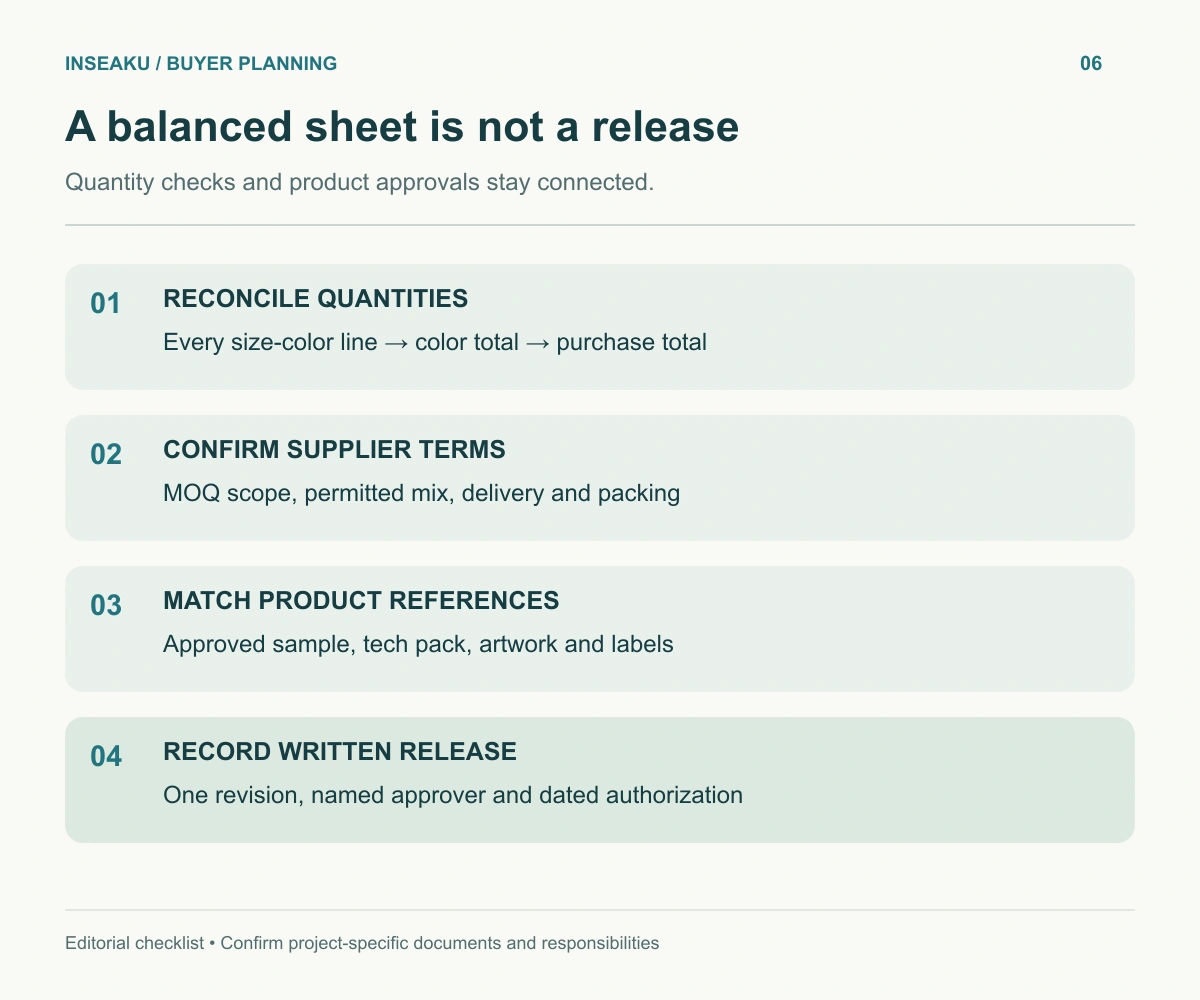
Before production release, reconcile each size-color quantity to its color total and the overall purchase quantity. Confirm the product revision, approved sample, artwork, labels, packing method and delivery scope. Record the approver and date. Quantity approval and sample approval are related but separate: a balanced matrix does not validate an unapproved garment.
The workbook’s Order matrix provides two color rows and five editable size headings for one style. Enter zero where no units are intentionally ordered; do not leave an unknown quantity blank and treat it as zero. Totals remain unavailable while required counts are missing or invalid. Compare each calculated row total with its target before using the numbers in your RFQ.
The Allocation helper starts with the labeled 95-unit example. Change the target and shares to explore an allocation; it does not automatically write quantities into the order matrix. This separation keeps an exploratory calculation from becoming an accidental purchase instruction. Confirm the result and supplier constraints before copying any values.
Keep the approved matrix alongside the sampling approval record and agreed quality-control requirements. After receipt and sale, review actual variant movement, availability and return reasons. Update the next order from that evidence instead of treating the first size curve as permanent.
If you are building a first collection, use the private-label wetsuit brand procurement guide for the wider launch decisions. To review a proposed assortment, explore INSEAKU’s wetsuit sampling and bulk-production services and send us your style, color and size quantity matrix. Include the intended delivery window and unresolved assumptions so feasibility can be confirmed before the order is committed.
Frequently Asked Questions
What is the best size ratio for a bulk wetsuit order?
There is no universal ratio. Use evidence for the intended fit population, product, channel and selling period, and investigate availability and returns. The percentages in this article only demonstrate the calculation.
Should every wetsuit color have the same size assortment?
Not automatically. A shared curve can be an explicit starting assumption when evidence is limited. Where reliable color-specific demand differs, use separate curves and document the reason.
Does MOQ mean the same minimum for every size?
Only if that is the confirmed supplier term. Ask which level the minimum applies to and whether sizes may be mixed. Do not infer a per-size minimum from a total-order or style minimum.
Why can rounded size quantities exceed the order total?
Rounding each allocation independently can add or remove units. Use an allocation method that reconciles to the target, then separately review any supplier minimums or ordering multiples.
Can the next order use last season’s quantities unchanged?
Review them first. Stockouts, new fit information, color changes, unsold inventory, inbound stock and customer commitments may change the appropriate mix. Keep the evidence period and product revision identifiable.
References and Further Reading
Sources checked on 29 September 2026. These official documents support variant identification and report interpretation, not a universal wetsuit size curve or the example buying quantities.
- Shopify Help Center — Variants. Explains product-option combinations such as size and color and inventory management by variant.
- Shopify Help Center — Inventory Reports. Defines quantity sold, ending stock, sell-through and inventory-coverage measures, including reporting limitations.
- GS1 US — Apparel and General Merchandise. Explains identification of apparel variants, including color and size, through GTINs and shared product information.