

Short answer: In a CR vs SCR neoprene wetsuit comparison, CR identifies chloroprene rubber, while SCR is commonly used by suppliers for a chloroprene-and-SBR blend or another supplier-defined blended foam series. CR-grade foam is usually the first candidate when a brand prioritizes low restriction, recovery and demanding use. SCR may reduce material cost and can suit price-sensitive products when the specific grade meets the required stretch, compression, durability and care targets. Neither acronym is a complete specification. Compare the named supplier grade, finished laminate and test conditions before deciding.
The most important purchasing point is that “SCR” is not one universal recipe. Polymer ratio, compound, blowing process, cell structure, density, hardness and quality level can vary. CR is also sold in multiple grades. A low-density soft CR candidate and a firmer CR candidate will not produce the same suit, even though both quotations say CR.
What do CR and SCR mean in wetsuit sourcing?
CR is the standardized abbreviation for chloroprene rubber. ISO 1629 establishes the industry system of symbols for base rubbers, and chloroprene-rubber manufacturers such as Denka list wetsuits among the applications for CR. In wetsuit sourcing, a supplier may describe a foam as CR, full CR or 100% CR. Ask what that statement covers. A finished foam still contains the compound, cell-forming system and other ingredients required to manufacture it, so the purchasing specification should identify the supplier’s exact grade rather than relying on a purity slogan.
SCR is different. In the wetsuit-material market, it is commonly used for a series that combines CR and SBR or otherwise modifies a lower-cost base. The label does not reveal the blend ratio, compound design or physical properties. Some supplier catalogs show multiple SCR ratios under the same broad family. Another supplier may use different codes or construction methods. Treat SCR as a prompt to ask questions, not as a fixed material standard.
SBR means styrene-butadiene rubber. It can be used in blended foams and lower-cost material systems, but an SBR-rich candidate should still be evaluated for the exact product. Avoid assuming that every SCR sheet is simply halfway between CR and SBR. The relationship is not a dependable linear scale.
CR vs SCR neoprene: quick buyer comparison
| Buying factor | CR-grade candidate | SCR candidate | Evidence to request |
|---|---|---|---|
| Material identity | Supplier grade based on chloroprene rubber | Supplier-defined blended or modified series | Supplier, grade code, current data sheet and composition statement |
| Cost position | Usually higher material cost | Often selected to reduce material cost | Quote the same thickness, face fabrics, lamination and quantity |
| Stretch and recovery | Often considered for performance-oriented mobility | Can range from adequate to strong depending on grade and laminate | Comparable tensile/elongation data plus finished-laminate and garment checks |
| Compression behavior | Varies by foam density, hardness, cell structure and grade | Also varies; the acronym does not define recovery | Agreed compression or thickness-recovery method under the same conditions |
| Best-fit program | Common starting candidate for demanding surf, dive, freedive or triathlon products | Potential fit for balanced-price programs, general water sports or selected rental products | Sample suit tested against the intended use and care cycle |
| Main sourcing risk | Paying a premium without defining the actual grade | Treating all SCR blends as equivalent | Locked bill of materials, retained reference and change-control rule |
This table shows likely sourcing positions, not guaranteed outcomes. A carefully selected SCR laminate can outperform a poorly matched CR laminate for a particular garment. Conversely, a low quote can disappear once a material creates pattern changes, extra sampling, higher reject rates or early replacement.
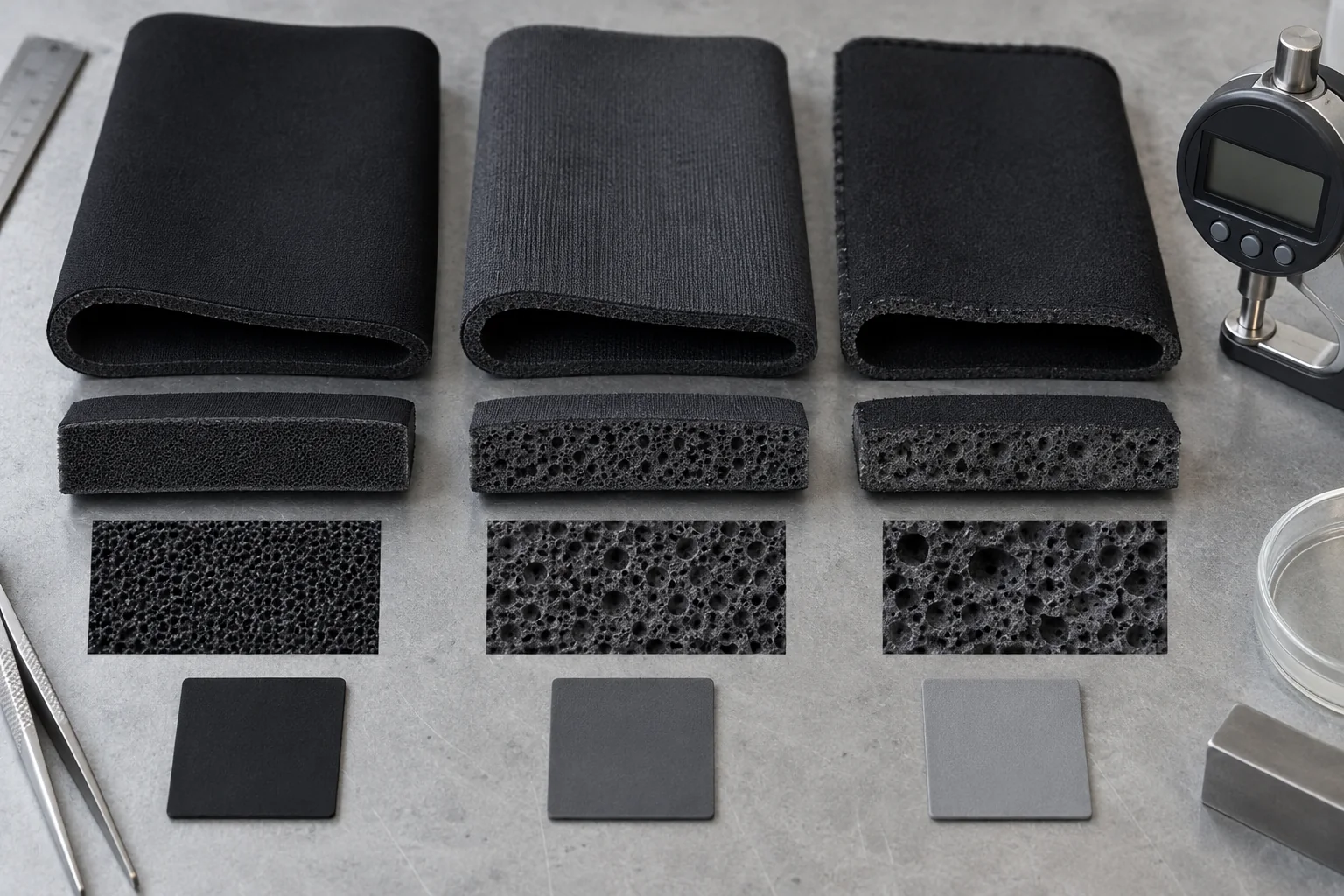
Why the supplier grade matters more than the acronym
A buyer cannot build a repeatable product from “3 mm CR” alone. Within one material family, suppliers may offer soft, standard and firm grades with different density, hardness, elongation, tensile strength, tear strength, water absorption and compression-set values. Pacific Eagle’s published CR range, for example, lists several CR grades with materially different stated hardness, density and elongation values. That does not establish a universal CR range; it demonstrates why the grade code must be controlled.
The finished wetsuit panel adds more variables:
- bare-foam thickness and finished laminated thickness;
- outer and inner knit construction, weight and stretch direction;
- single- or double-sided lamination;
- adhesive system and lamination conditions;
- surface coating, smooth skin, open cell or printed face;
- foam density, hardness, cell structure and color;
- panel direction, pattern reduction and seam construction; and
- conditioning, age and temperature when the sample is measured.
A useful wetsuit material selection specification controls the whole system. It also prevents a supplier from replacing one CR or SCR grade with another that shares the category name but changes fit or performance.
Compare material cost and total product cost separately
SCR is often proposed because its material price is lower. That can be a valid commercial decision, but compare like with like. A quote for bare foam cannot be compared directly with a laminated sheet that includes premium high-stretch fabric. A lower-priced sheet may also have different usable width, minimum order, color minimum, lamination cost or cutting yield.
Build the comparison from these cost drivers:
- Quoted material basis: sheet, square meter, yard, kilogram or another unit.
- Usable area: sheet dimensions minus defects, edges and direction constraints.
- Consumption: pattern area by size, panel direction and planned marker efficiency.
- Processing: fabric, lamination, coating, splitting, printing and freight.
- Development: swatches, lab work, material strike-offs and sample rounds.
- Quality effect: cutting loss, delamination, surface defects or rejected panels.
- Commercial effect: warranty, replacement and brand-positioning risk.
Do not assign a fictional service life to calculate cost per wear unless you have field data. For a new program, record the assumptions separately and run a pilot or controlled launch. The first decision can be based on cost per approved suit; lifecycle conclusions should wait for repeat-use evidence.
Stretch is a system property, not a CR badge
Buyers often describe CR as stretchy and SCR as stiff. That can be a useful screening expectation, but it is not a purchasing specification. Stretch performance depends on the foam grade, thickness, direction, face fabric, lamination, pattern and test method. A high-stretch fabric cannot rescue a foam that does not meet the target. A restrictive face fabric can also limit a soft foam.
Ask for both material-level and garment-level evidence. ISO 37:2024 and ASTM D412 cover tensile stress-strain properties of vulcanized or thermoplastic rubber. ASTM specifically notes that results depend on test conditions such as extension rate, temperature, humidity, specimen geometry and conditioning, and that tensile properties alone do not directly predict total end-use performance.
For a wetsuit program, define:
- bare foam or finished laminate specimen;
- machine/cross direction or panel orientation;
- specimen shape and thickness;
- conditioning and test speed;
- elongation, stress at a chosen extension and recovery/set result;
- number of cycles if repeated extension is relevant; and
- the garment zones where mobility must be confirmed.
A CR neoprene wetsuit manufacturer should connect the quoted foam to a finished sample. The same rule applies to an SCR neoprene wetsuit manufacturer. Shoulder rotation, paddling, squatting, zipper entry and neck/wrist comfort are evaluated on the garment, not on a data sheet alone.

Compression, thickness and thermal claims need defined conditions
Wetsuit insulation depends on the complete suit, including thickness, trapped water, fit, flushing, seams, surface, activity and exposure. It is not responsible to claim that one CR or SCR label guarantees a water-temperature range. Diving adds pressure and depth considerations that a flat-room-temperature stretch test does not address.
Compression set is one material property that can help compare elastic recovery after controlled compression. ISO 815-1:2019 and ASTM D395 describe compression-set methods, but their standard applications and conditions are not a universal simulation of diving. ASTM D395 notes that compression-set tests mainly represent static compressive stress, while dynamic deformation may require other approaches.
For a relevant sourcing comparison, the buyer and supplier should agree what question the test is answering. Possibilities include:
- thickness before compression, immediately after release and after a recovery period;
- set after a defined compression percentage, time and temperature;
- repeated compression or pressure exposure using a project-specific protocol;
- visual cell damage, delamination or surface change; and
- finished-garment evaluation after the intended use and care cycle.
Keep supplier data sheets useful but comparable. Two numbers cannot be ranked if the specimen, temperature, duration, compression, recovery time or calculation differs.
Which wetsuit programs suit CR or SCR?
Performance surf and SUP suits
Low restriction through shoulders, chest and hips often makes a CR-grade or other verified high-mobility material a strong starting candidate. The decision still depends on the outer knit, panel layout and seam system. For a product line with several price points, a brand may use different approved grades by model rather than applying one foam to every surf and SUP wetsuit.
Diving, freediving and spearfishing
Evaluate compression behavior, thickness map, surface configuration, fit and depth profile. Open-cell, smooth-skin and lined constructions change handling and durability. A CR candidate may be preferred for a demanding program, but grade-specific evidence remains more useful than the category alone. Review the finished build against the intended diving wetsuit use.
Triathlon and open-water products
Shoulder mobility, buoyancy distribution, surface drag, transition, edge design and competition rules all matter. Material selection should follow a thickness map and garment testing. Do not present “CR” as automatic proof of legal thickness, buoyancy or speed.
Rental fleets and schools
Rental buyers need repeatable sizes, easy identification, abrasion control, cleaning compatibility and replacement consistency. An SCR candidate may support a target purchase price, while a CR candidate may support comfort or recovery goals. The correct choice depends on the operating cycle and field results. Use the rental wetsuit planning guide to connect material choices with inventory and maintenance.
Entry-level products and accessories
Price-sensitive warm-water suits, shorties, boots, gloves and accessories may justify SCR or SBR-rich candidates when the sample meets the defined requirement. Do not automatically transfer that decision to a cold-water full suit, high-mobility surf suit or professional dive program.
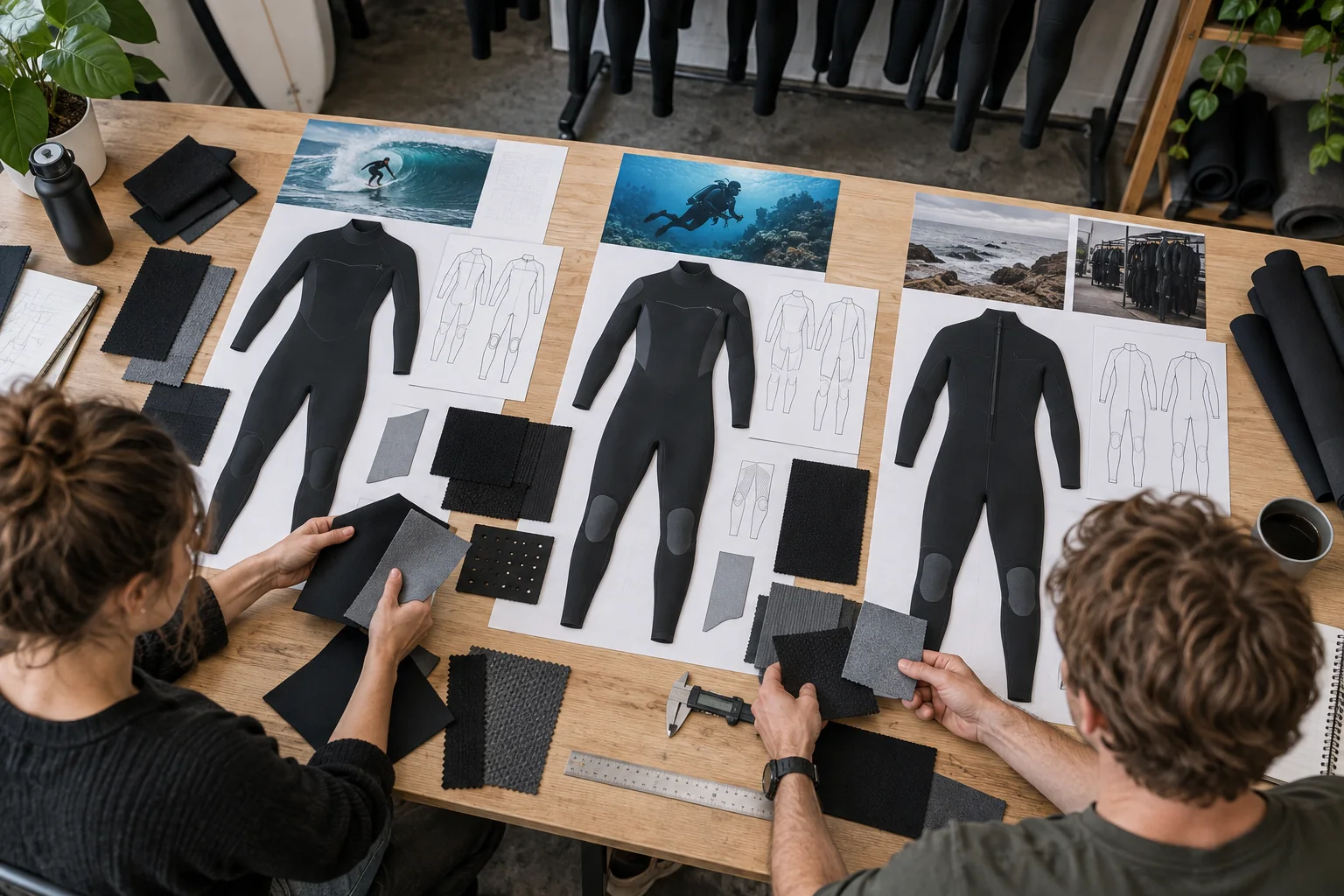
What should a CR or SCR material RFQ include?
Write the RFQ so that two suppliers can quote the same requirement. Include:
- product category, user, activity and intended conditions;
- supplier name and material grade, or a clearly marked open-equivalent request;
- supplier definition of CR, SCR or SBR for that grade;
- bare-foam and finished-laminate thickness with tolerance and measurement method;
- density or hardness with method and units;
- required tensile, elongation, tear, compression/recovery or water-absorption evidence;
- outer and inner fabric, weight, composition, stretch direction, color and finish;
- lamination and adhesive requirements;
- size range, thickness map and panel direction;
- quantity by style, color and size;
- material MOQ, color MOQ, lead time and validity of the quoted grade;
- sample, retained swatch and substitution-approval process; and
- required compliance or claim documentation for the target market.
The wetsuit tech pack and RFQ checklist provides the wider product-control structure. INSEAKU’s custom wetsuit manufacturing services can connect material review, pattern development, sampling and bulk production for the confirmed project.
How should buyers compare material samples?
Start with one written comparison plan. Prepare candidates at the same nominal thickness and with the same face fabrics where possible. If that is not possible, label the difference rather than attributing every result to the foam chemistry.
- Verify identity. Record supplier, grade, batch or lot, date, thickness, color, fabrics and lamination.
- Condition consistently. Store specimens for the agreed time and environment before measuring.
- Measure the same properties. Use the same method, specimen direction, units and equipment.
- Compare physical swatches. Review hand feel, thickness, surface, stretch and recovery without treating touch as a laboratory result.
- Build representative samples. Use the intended panel direction, seams, zipper and print/branding route.
- Evaluate the garment. Check fit, mobility, donning, flushing, surface durability and care response.
- Record the decision. Approve, revise, reject or approve with a named deviation.
Use the current wetsuit quality control framework to carry the approved supplier, grade and laminate into incoming-material checks, cutting control and first-piece approval. A test result that is not tied to the production material cannot control the order.
Freeze the approved material and control substitutions
Material approval should identify the exact physical swatch and document version. Keep a retained reference when practical. Link it to the bill of materials, tech pack, sample ID and quotation. Bulk production should use the approved grade and laminate unless both parties authorize a change in writing.
If the approved foam becomes unavailable, the supplier should provide a change proposal that identifies:
- old and proposed supplier/grade;
- reason for substitution;
- property and cost comparison under compatible conditions;
- effect on thickness, color, fabric, lamination, pattern, seams and printing;
- new sample or test evidence required;
- MOQ and timing impact; and
- authorized buyer decision.
This change-control step should be part of the broader wetsuit manufacturing process. An unrecorded material substitution can invalidate fit, test and sample decisions that were made earlier.
Download the CR vs SCR comparison workbook
Use the INSEAKU CR vs SCR Neoprene Material Comparison Workbook to record project requirements, identify candidate grades, compare test results, calculate material cost per suit and document sample approval. Yellow cells are buyer inputs, blue cells hold supplier or factory evidence, and formulas summarize readiness and weighted scores.
Common sourcing mistakes
- Buying “premium CR” without a grade code: the order has no repeatable material identity.
- Assuming SCR has one fixed ratio: supplier definitions and properties vary.
- Comparing mismatched laminates: fabric and adhesive differences are mistaken for foam differences.
- Ranking data from different methods: test conditions make the numbers non-comparable.
- Using elongation at break as a comfort score: finished-suit restriction and recovery are not captured by one maximum value.
- Choosing only by sheet price: yield, processing, quality loss and product positioning are ignored.
- Approving a swatch without a garment: pattern, seams, zipper and panel orientation remain untested.
- Allowing silent substitutions: the production material no longer matches the approved sample.
Frequently asked questions
Is CR always better than SCR for wetsuits?
No. CR is often a strong starting candidate for performance-oriented products, but “better” depends on the specific grade, laminate, garment design, test result, use and budget. A verified SCR grade can be appropriate for a defined program. Compare evidence rather than category names.
Does SCR mean a fixed percentage of CR and SBR?
No universal percentage should be assumed. Ask the supplier to define the grade and provide a current data sheet or written composition statement. If the ratio is commercially confidential, require the physical-property values and change-control evidence needed to manage the product.
Can a buyer identify CR or SCR from a cut edge?
Appearance, feel and cell structure can reveal differences between samples, but they do not reliably verify polymer composition or grade. Use traceable supplier documents, purchase records and controlled testing.
Which is cheaper, CR or SCR?
SCR is commonly positioned below CR in raw-material cost, but the actual quote depends on grade, thickness, fabric, lamination, color, quantity, freight and processing. Compare the same finished construction and calculate cost per approved suit.
Which material stretches more?
Many CR grades are selected for high mobility, but stretch depends on the exact foam and laminate. Compare candidates under the same method and test the finished garment. Elongation at break alone does not equal comfort or recovery.
Should rental wetsuits use SCR?
Not automatically. Rental programs balance purchase price, broad fit, surface durability, cleaning, drying, repair and replacement consistency. Test the candidate material against the real operating cycle and keep the approved grade available for replenishment.
Does CR guarantee a warmer wetsuit?
No. Warmth depends on thickness, fit, flushing, seams, exposure, activity and the complete material system. Grade-specific compression and recovery evidence can inform the decision, but a CR label does not create a universal temperature rating.
Compare material options for your next wetsuit program
Send INSEAKU the product category, intended use, target price position, thickness map, preferred fabrics, quantity by style/color, size range, required tests and delivery timing. If you already have CR or SCR data sheets, include the supplier and grade. The team can compare feasible material routes and define the swatch, sample and approval evidence required before bulk production.
Request a CR vs SCR material and manufacturing review.
Technical references
- ISO 1629:2025 — Rubber and latices, nomenclature
- Denka — Chloroprene rubber characteristics and applications
- ISO 37:2024 — Tensile stress-strain properties of rubber
- ASTM D412-16(2021) — Rubber tension testing
- ISO 815-1:2019 — Compression set at ambient or elevated temperatures
- ASTM D395-18(2025) — Rubber compression set
- Pacific Eagle — Example CR supplier grade data