

Short answer: A useful wetsuit material selection guide should compare the complete material system—not just a foam name. Specify the exact foam supplier and grade, thickness and tolerance, density or hardness, outer and inner fabrics, lamination, surface finish, color, intended use, test method and approved reference. CR, SCR, SBR, limestone-derived chloroprene, Yamamoto materials and natural-rubber systems can all suit particular products, but none guarantees warmth, stretch, durability or a credible environmental claim by name alone.
For a water-sports brand, material selection is both a product-engineering decision and a sourcing-control decision. The same nominal thickness can feel and perform differently when the foam formulation, cell structure, lining stretch, adhesive, panel geometry and seam construction change. A buyer therefore needs comparable samples and written evidence before approving a bulk bill of materials.
To turn material choices into a coordinated surf collection, use our surf wetsuit specifications guide to define entry, core and performance models in one range matrix.
This guide explains how INSEAKU works with CR, SCR, SBR, limestone neoprene, Yamamoto neoprene and genuine natural-rubber foam, including Yulex® options. It also covers nylon, polyester, high-stretch, thermal, smooth-skin, open-cell and recycled-fiber linings; thicknesses from 1.5 mm to 7 mm; lamination choices; material testing; traceability; MOQ and timing.
What is a wetsuit material system?
A wetsuit material is not simply a sheet of “neoprene.” The finished panel is a system whose parts interact:
- Base foam: chemistry or feedstock description, supplier, grade, density or hardness, cell structure and color.
- Thickness: nominal thickness, permitted tolerance and any body-zone thickness map.
- Outer face: nylon, polyester, high-stretch knit, smooth skin or another specified surface.
- Inner face: standard knit, high-stretch, thermal lining, open-cell surface or another product-specific solution.
- Lamination: single- or double-sided construction, adhesive system and peel-performance requirement.
- Assembly: panel orientation, seam type, thread, glue, tape, reinforcement and components.
- Verification: approved swatch, color reference, test evidence, sample version and bulk traceability.
A material can test well as an isolated sheet yet produce a poor garment if its stretch direction, lining, panel geometry or seam method is wrong. Conversely, a carefully engineered combination can meet its intended use without relying on the most expensive trade name. To see where these decisions enter production, review our guide to the wetsuit manufacturing process.
How do CR, SCR and SBR wetsuit materials differ?
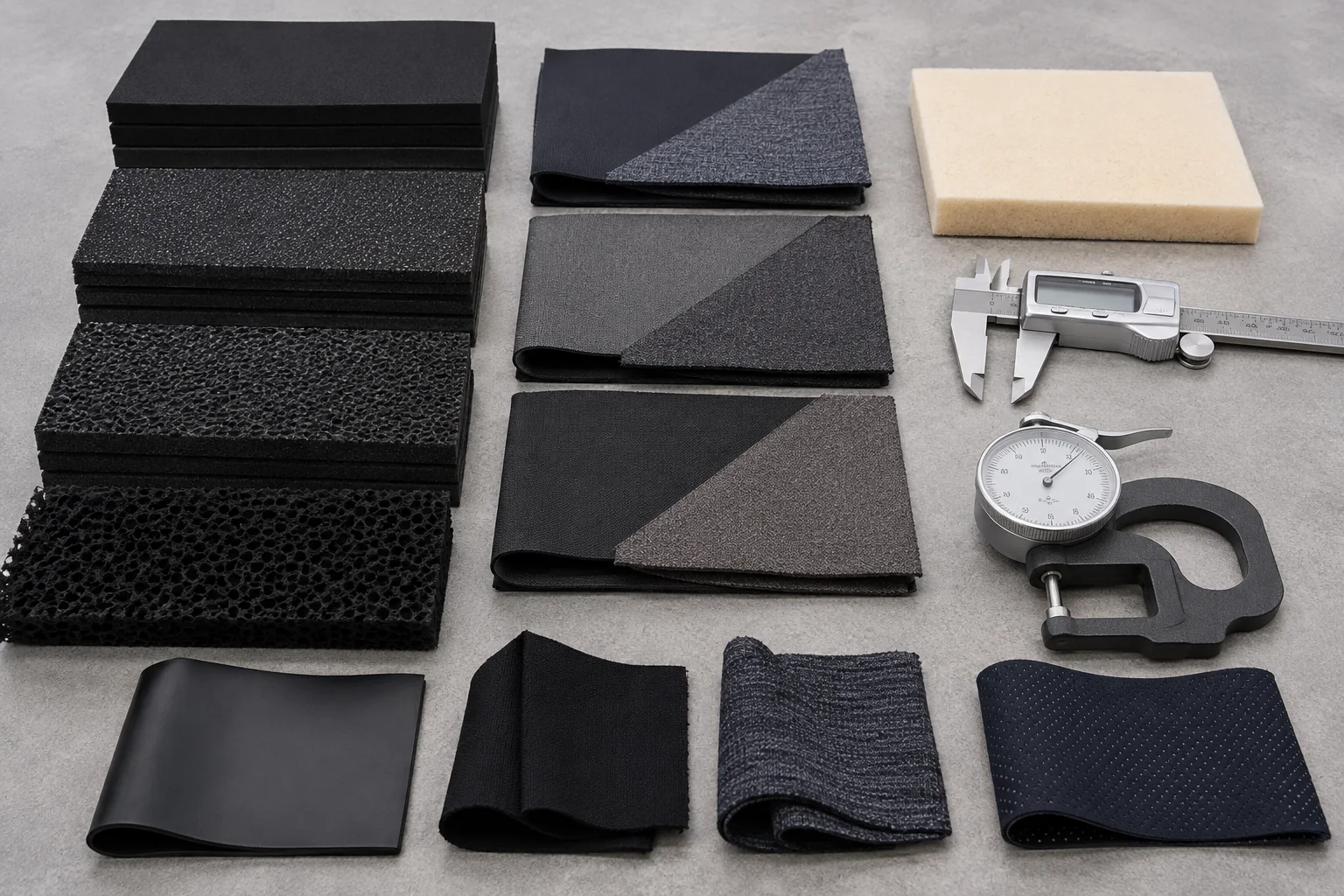
The labels CR, SCR and SBR are useful starting points, but purchasing by acronym alone is risky. The exact formulation, supplier grade and construction determine the property profile. In particular, “SCR” can be used by suppliers for blended or modified formulations with different ratios and properties. Ask every supplier to identify what its code means and provide a current data sheet or agreed test result.
For a focused cost, stretch, compression and use-case comparison, read the CR vs SCR neoprene comparison for wetsuit brands and record each candidate by supplier grade rather than acronym alone.
| Material label | How a buyer should interpret it | Typical sourcing question | Main control risk |
|---|---|---|---|
| CR | Chloroprene-rubber foam; commonly associated with neoprene wetsuit construction. | Which supplier, grade, density, stretch and thickness tolerance are quoted? | Treating all CR grades as equivalent. |
| SCR | A supplier-defined blended or modified foam designation; composition and performance can vary. | What does SCR mean for this supplier, and what evidence defines the grade? | Comparing acronyms while the underlying formulas differ. |
| SBR | Styrene-butadiene-rubber-based foam or a system identified by the supplier as SBR. | Is it appropriate for the target stretch, compression, durability and cost requirements? | Using a price-led substitution without retesting the garment. |
A CR neoprene wetsuit manufacturer should be able to connect a quoted material to a supplier, grade and controlled sample. The same applies when an SCR neoprene wetsuit manufacturer or SBR supplier makes a performance claim. Do not accept “premium,” “high stretch” or a color-coded grade as sufficient evidence unless the terms are defined in the specification.
Do not approve an unrecorded substitution
Foam changes can affect pattern dimensions, fit, buoyancy, compression, seam behavior, print appearance and adhesive performance. If a quoted material becomes unavailable, require a written change proposal, comparable evidence and—when the change can affect fit or function—a new sample or controlled validation. Bulk cutting should follow the approved bill of materials and reference sample.
Is limestone neoprene the same as Yamamoto neoprene?
No. “Limestone” describes a feedstock or manufacturing route used for some chloroprene-rubber materials; it is not a universal grade or performance standard. Yamamoto is a specific material supplier and brand. Yamamoto states that it uses limestone-based CR, but that does not make every limestone-derived foam a Yamamoto product.
When working with a limestone neoprene wetsuit manufacturer, ask for the actual supplier, grade, thickness, density or hardness, stretch direction, lining and test evidence. When specifying Yamamoto, record the exact grade and obtain supplier or purchasing evidence appropriate to the order. INSEAKU can source official Yamamoto material and support supplier, grade and documentation verification for the confirmed project.
What a branded-material specification should contain
- Brand and exact material grade—not only the brand name
- Nominal thickness and permitted tolerance
- Foam color, density or hardness and required property values
- Outer and inner fabrics with color references
- Single- or double-sided lamination and adhesive requirement
- Approved swatch and sample version
- Required purchasing, certification or traceability documents
- Rules for substitutions and buyer reapproval
A buyer searching for a Yamamoto neoprene wetsuit manufacturer should verify more than access to a showroom swatch. Confirm whether the specified grade is available for the required quantity and date, whether it is laminated as agreed, and whether the proof supplied relates to the material actually ordered.
Use the Yamamoto vs limestone neoprene verification guide to separate manufacturer, grade, surface treatment, supply evidence and environmental-claim approval before sampling.
What should brands know about natural-rubber and Yulex® wetsuit materials?
Natural-rubber foam is a distinct material route and may be selected for product, sourcing or brand-positioning reasons. Yulex® is not a generic synonym for natural rubber. It is a branded material system with defined products and supply-chain requirements. Yulex describes its foam as made from natural rubber sourced from FSC- and PEFC-certified plantations.
INSEAKU can work with genuine natural-rubber foam and true Yulex® material when specified and available. Any hangtag, logo, certification or environmental wording must follow the material owner’s current rules and the documented chain of custody. A generic natural-rubber source should not be marketed as Yulex®, and possession of a supplier certificate should not automatically be presented as certification of every future product or batch.
Brands comparing the two supply routes can use our Yulex vs neoprene wetsuit buyer guide to review material identity, comparable performance evidence, cost, chain of custody, trademark permission and environmental-claim scope.
Control environmental claims separately from material selection
Terms such as “eco-friendly,” “green,” “recycled” or “sustainable” are too broad to use without scope and evidence. For recycled-fiber linings, standards such as RCS and GRS address recycled-content verification and chain of custody; GRS also includes additional processing requirements. The buyer should confirm the certified organization, material, transaction evidence, product-claim eligibility and current logo rules before publishing a claim.
Likewise, OEKO-TEX® STANDARD 100 concerns testing for harmful substances within the scope and product class stated on a valid certificate. It should not be converted into a general claim about the entire factory, all materials or overall environmental performance.
How should brands match wetsuit materials to intended use?
Start with the activity, environment, user, fit intent and failure risks. INSEAKU can recommend a material system for surfing, diving, freediving, spearfishing, triathlon, rental and children’s wetsuits, but the final selection should be approved against a written product brief and sample.
Material performance must be evaluated with the joint design. Compare GBS, flatlock, taped and liquid-sealed wetsuit seams before finalizing thickness, lining and stretch requirements.
| Product use | Material priorities to define | Questions for sampling |
|---|---|---|
| Surfing | Mobility, panel stretch, warmth, seam durability and repeated entry/exit. | Does the lining and panel map support paddling without excessive looseness or restriction? |
| Scuba diving | Thermal system, compression behavior, fit at depth, seam construction and abrasion zones. | Are thickness, buoyancy and compression assumptions appropriate for the target diving conditions? |
| Freediving | Low restriction, close fit, surface choice, glide and careful donning requirements. | Does the open-cell, lined or smooth-surface configuration match the user’s handling and durability needs? |
| Spearfishing | Warmth, mobility, abrasion reinforcement, camouflage or print system and field durability. | Do print, coating, reinforcement and adhesive remain compatible with the selected foam? |
| Triathlon | Shoulder mobility, buoyancy distribution, hydrodynamic surface, transition and competition rules. | Has the thickness map and finished garment been checked against target-event requirements? |
| Rental | Durability, easy care, broad fit coverage, size identification and replacement consistency. | Can the material withstand the defined cleaning, drying and usage cycle? |
| Children’s wetsuits | Fit, mobility, skin-contact comfort, component safety, labeling and applicable market requirements. | Are the size range, trims and compliance plan appropriate to the age group and destination? |
There is no reliable universal rule that one foam name or thickness fits every water temperature. Activity level, wind, exposure time, circulation, individual physiology, fit, flushing, seam design and local conditions all matter. A brand should validate its own temperature guidance and avoid presenting a marketing chart as a safety guarantee.
How should a brand choose wetsuit thickness?
INSEAKU can manufacture common thicknesses including 1.5 mm, 2 mm, 3 mm, 4 mm, 5 mm and 7 mm. A garment may use one nominal thickness or a mapped combination. Do not specify thickness without a measurement method and tolerance, because the finished laminated panel may be measured differently from the bare foam.
| Nominal option | Common development role | What must still be confirmed |
|---|---|---|
| 1.5–2 mm | Lightweight mobility-focused products or selected flexible zones. | Coverage, stretch, durability, seam choice and intended conditions. |
| 3 mm | General-purpose construction or a zone in a multi-thickness suit. | Fit, flushing control, lining and activity-specific thermal target. |
| 4–5 mm | Greater insulation or strategic body zones where more material is acceptable. | Mobility, compression, entry system and panel transitions. |
| 7 mm | Cold-water or application-specific construction requiring substantial thickness. | Fit, dexterity, buoyancy, compression, seam design and safe intended use. |
A “3/2 mm” or similar description is incomplete unless the tech pack shows which panels use each thickness. The pattern may need adjustment when foam thickness, stretch or lining changes, even if the visual design remains unchanged.
Material data must be connected to the assembled garment. See how a wetsuit stretch-recovery and fit review can be specified before bulk production.
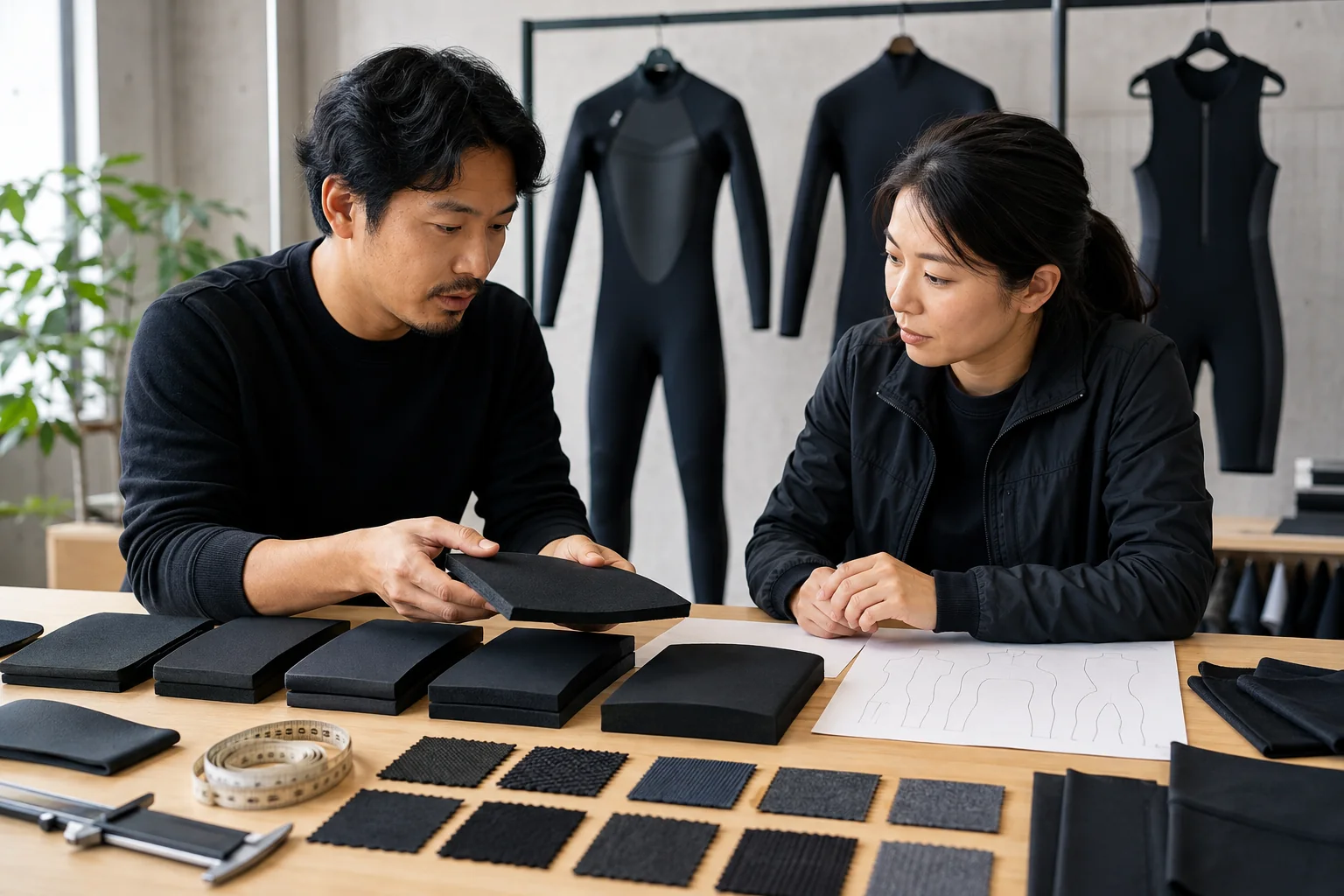
To turn the material decision into a production-ready 3 mm, 5 mm, 7 mm or zoned construction, follow our guide to choosing neoprene thickness for wetsuit product lines.
Which lining and surface finish should you specify?
The fabric or surface on each side affects stretch, hand feel, abrasion, drying, donning, printing, glue behavior and appearance. Specify the exact combination rather than writing only “high-stretch neoprene.”
For a practical product-level comparison of unlined cut-foam and textile-lined interiors, including donning, handling and freediving or spearfishing use cases, read the open-cell vs closed-cell wetsuit buyer guide.
| Option | Possible role | Buyer checks |
|---|---|---|
| Nylon lining | Versatile laminated face used in many wetsuit constructions. | Weight, knit, stretch direction, color, hand feel and abrasion. |
| Polyester lining | Surface selected for particular print, color, hand or cost requirements. | Stretch, colorfastness, print compatibility and recovery. |
| High-stretch lining | Mobility-focused zones or full-suit construction. | Test the laminated system, not fabric stretch alone; assess recovery and seam interaction. |
| Thermal lining | Interior comfort and thermal-system design. | Placement, water retention, drying, stretch and skin feel. |
| Smooth skin | Exterior or seal areas requiring a smooth rubber surface. | Tear sensitivity, handling, coating, print and seam design. |
| Open cell | Unlined foam surface used in selected freediving or spearfishing products. | Donning instructions, surface durability, hygiene and customer suitability. |
| Recycled polyester or nylon | Fiber-content option for projects with documented sourcing requirements. | Certified scope, chain of custody, transaction evidence and authorized claims. |
INSEAKU can provide material color cards, with the cost charged to the buyer. A color card is useful for narrowing choices, but the production approval should identify a coded swatch or material reference under agreed viewing conditions. Screen colors and unreferenced photographs are not reliable production standards.
Why do lamination and adhesive choices matter?
Lamination joins the foam to one or two fabric faces. INSEAKU has an in-house material-lamination process and can support single-sided or double-sided constructions, water-based or solvent-based adhesive routes, and customer-specified systems subject to technical review and availability.
The adhesive is part of the performance system. A buyer should define or verify:
- Foam, fabric and adhesive compatibility
- Required peel strength and conditioning method
- Heat, moisture, aging and use conditions relevant to the product
- Color migration, strike-through or visible surface effects
- Any chemical, restricted-substance or market requirement
- Whether a customer-nominated material has been validated on the actual construction
“Water-based adhesive” is a process description, not automatic proof of complete-product safety or environmental superiority. The finished material and product still need evidence appropriate to the buyer’s claim and destination market.
How should wetsuit materials be tested, approved and traced?
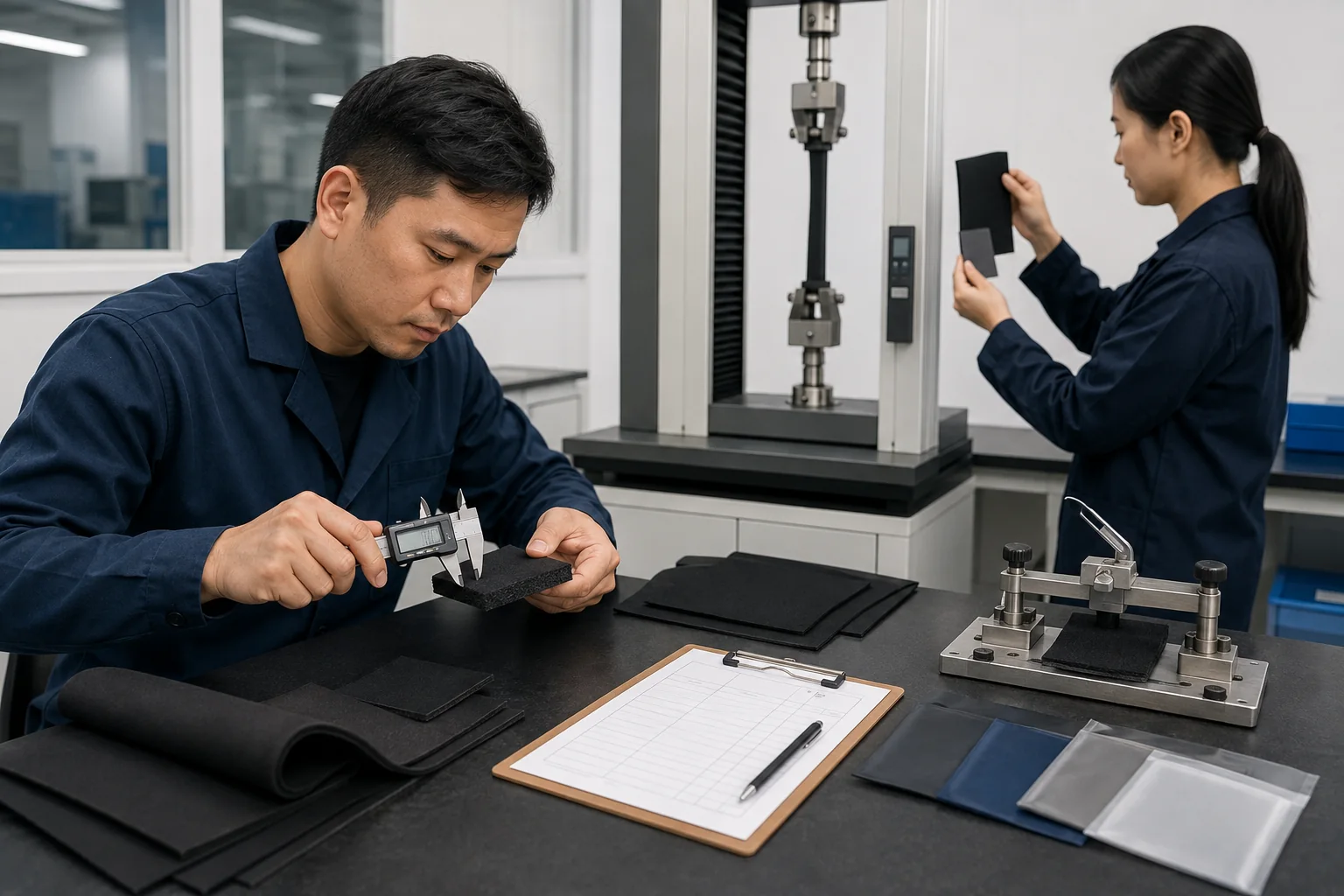
Testing should answer project-specific risks. INSEAKU can arrange or perform checks including thickness and tolerance, density or hardness, elongation, recovery, tensile strength, tear strength, lamination peel strength, water absorption, colorfastness, shrinkage and third-party chemical testing. The parties must agree the specimen, conditioning, test method, units, acceptance limit, laboratory and responsibility for cost.
| Check | What it helps control | What to record |
|---|---|---|
| Thickness and tolerance | Panel consistency and the intended thickness map | Measurement method, location, sample condition and permitted range |
| Density or hardness | Foam feel and repeatability indicators | Method, units, conditioning and grade target |
| Elongation and recovery | Mobility, pattern behavior and permanent deformation risk | Direction, load or extension, cycles and acceptance criteria |
| Tensile and tear strength | Material integrity under controlled loading | Specimen direction, method and minimum result |
| Lamination peel strength | Bond performance between foam and fabric | Face tested, conditioning, rate and minimum result |
| Water absorption | Project-specific material comparison | Method, exposure and calculation basis |
| Colorfastness and shrinkage | Appearance and dimensional stability | Relevant exposure, color reference and limits |
| Third-party chemical testing | Specified market or buyer restricted-substance requirements | Exact product/style, component scope, standard, edition and report date |
Separate style certification from batch traceability
INSEAKU can trace materials by supplier, material model or grade, color and batch. Its usual certificate practice is one certificate for a product style, not a newly issued certificate for every production batch. Buyers must state before quotation if they require batch-specific tests, transaction certificates, laboratory reports or other documents.
A style-level certificate should not be represented as proof that every later batch was separately tested. Confirm the certificate holder, product/style, covered components, standard and edition, report or certificate number, validity and issuing organization. Then maintain incoming-material and batch records appropriate to the production order.
Once the material specification is approved, define how every batch will be verified in the incoming-material and wetsuit quality inspection checklist.
For a broader supplier-evidence framework, use our 12-point wetsuit factory audit scorecard.
Use a controlled approval hierarchy
- Written specification: defines the intended material system and acceptance criteria.
- Coded material swatch: establishes an agreed physical reference.
- Development sample: checks fit, function, workmanship and appearance.
- Test evidence: addresses agreed high-risk properties and claims.
- Sealed sample and confirmed BOM: freeze the production reference.
- Bulk incoming and production records: connect approved references to the order.
Verbal approval or an uncoded photograph is not enough. Revisions should state the version, change, owner, effect on cost or timing and whether reapproval is required.
What material information belongs in a wetsuit RFQ and tech pack?
Give every shortlisted supplier the same structured specification. A useful material section should include:
- Product category, intended activity, target user and destination market
- Foam chemistry or route, supplier and exact grade—or an explicit request for alternatives
- Thickness map, permitted tolerances and measurement method
- Density or hardness and other required physical-property targets
- Outer and inner fabric supplier/code, fiber claim, knit, weight, stretch and color
- Surface finish, lamination sides and adhesive restrictions
- Seam construction, reinforcements, zippers, prints and trims that interact with the material
- Color-card, swatch, sample and approval stages
- Test methods, limits, laboratory or certification requirements
- Substitution rules, traceability records and documents required before shipment
- Estimated quantity by style, color and size; target sample and delivery dates
Use our copy-ready wetsuit tech pack template and RFQ checklist to organize these fields. If your team needs the manufacturer to help develop the material system rather than manufacture a frozen specification, first compare OEM, ODM and private-label wetsuit development so each responsibility is named.
How do material choice, MOQ, sample cost and lead time interact?
INSEAKU’s normal garment MOQ starts at 50 pieces per style and color, with sizes mixable within those 50 pieces. There is generally no separate material MOQ for the options described in this guide. However, a supplier’s stock, production run, special color, branded material, custom fabric, print, zipper or other component can still create a purchasing constraint, surcharge or longer schedule.
For dive-center fleets, evaluate each material route with the rental wetsuit cost-per-use framework, including utilization, cleaning, repair and early-retirement assumptions.
Material color cards can be supplied at cost. Sample prices are quoted by product rather than published as a fixed material-price list. INSEAKU does not publish fixed material prices because grade, thickness, lining, lamination, color, test evidence, quantity and current sourcing conditions change the actual quotation.
Sample development can start from approximately seven working days after materials and specifications are confirmed and payment is received. “Starts from” is important: special material procurement or components can extend the schedule. For example, a specified YKK zipper may need to be ordered and can prevent completion within seven working days.
For the complete commercial rules—including sample-fee credit at qualifying quantities and the normal bulk-production timing—read our guide to wetsuit manufacturer MOQ, sample cost and production lead time.
Wetsuit material selection FAQs
Which wetsuit material is best?
There is no universally best material. The appropriate system depends on intended use, fit, thickness, stretch, compression, lining, surface, seam construction, durability target, sourcing evidence, claim requirements, budget and schedule. Compare defined grades through controlled samples and agreed tests.
Our swim versus surf wetsuit development comparison shows how intended use changes the questions buyers should ask about exterior faces, panel construction and contact areas.
Is limestone neoprene automatically warmer or more sustainable?
No universal conclusion follows from the word “limestone.” It identifies a material route, not one standardized grade. Warmth and performance depend on the full garment system. Any environmental comparison needs a defined boundary, current evidence and qualified claim language.
Is every limestone wetsuit made with Yamamoto material?
No. Yamamoto is a specific supplier and brand, while other suppliers also offer limestone-derived chloroprene materials. Specify the exact supplier and grade, and verify purchasing evidence for branded-material claims.
Is Yulex® the same as generic natural-rubber foam?
No. Yulex® is a branded natural-rubber material system. A generic natural-rubber product should not use the Yulex name or logo unless the genuine material and applicable authorization and documentation are in place.
Can one wetsuit use different thicknesses and linings?
Yes. A body-zone map can combine thicknesses or lining systems to balance mobility, insulation, durability and cost. Each panel, direction, surface and transition should be identified in the tech pack and validated in the sample.
Can INSEAKU recommend materials for different sports?
Yes. INSEAKU can recommend systems for surfing, diving, freediving, spearfishing, triathlon, rental and children’s wetsuits. Recommendations become production requirements only after the buyer approves the written specification, material references and sample.
Can buyers request material testing?
Yes. Available checks include thickness, density or hardness, elongation, recovery, tensile, tear, peel strength, water absorption, colorfastness, shrinkage and third-party chemical testing. Methods, limits, samples, cost and laboratory must be agreed for the project.
Does INSEAKU issue a material certificate for every batch?
Normally, INSEAKU provides one certificate per product style rather than one new certificate per batch. Batch traceability by supplier, grade, color and batch is a separate control. Buyers requiring batch-specific reports or certificates should state that requirement before quotation.
Turn a material name into a controlled specification
The most reliable sourcing question is not “Which neoprene is best?” It is: “Which documented material system meets this product’s intended use, and how will the approved system be reproduced?” Send INSEAKU your product category, market, target user, thickness map, preferred foam or performance target, lining, colors, quantities, tests and timing. We can then review material availability, propose a sample route and identify the evidence needed before bulk approval.
The sketch-to-specification wetsuit design workflow shows how to assign the selected foam, lining, thickness and stretch direction to numbered panels, then carry those decisions into the BOM and sample review.
Send your wetsuit material brief for a manufacturing review.
References and further reading
- Yamamoto — Limestone Rubber
- Yulex — Frequently Asked Questions
- OEKO-TEX® — STANDARD 100
- Textile Exchange — Recycled Claim Standard and Global Recycled Standard
- ISO 845 — Cellular plastics and rubbers: determination of apparent density
- ISO 1798 — Flexible cellular polymeric materials: tensile strength and elongation at break
Last reviewed: September 8, 2026. INSEAKU confirmed the material capabilities, standard MOQ, color-card policy, sample-timing conditions, testing options, traceability and usual certificate practice stated in this article. Project-specific availability, specifications, certification scope, claims, price and timing remain subject to the written quotation and agreement.