

Short answer: A Yulex vs neoprene wetsuit decision is not simply “natural equals better” or “synthetic equals more durable.” Yulex® identifies a branded natural-rubber material system. In wetsuit purchasing, neoprene usually refers to a conventional chloroprene-rubber foam. Their polymer sources and claim frameworks differ, but the performance, cost and delivery risk of a finished wetsuit depend on the exact foam grade, thickness, density, face fabrics, adhesive, lamination, pattern and construction.
For a useful comparison, request two fully identified candidates built to the same product specification. Compare documents, laminated material and sample suits under the same test conditions. A supplier statement such as “eco rubber,” “plant based” or “premium neoprene” is not a repeatable specification.
What do Yulex and neoprene identify?
Yulex is a brand and controlled material route
Yulex describes its foam as being made from renewable natural rubber sourced from FSC- and PEFC-certified plantations. Its current product resources distinguish Yulex Prime, a certified natural-rubber solid grade used to make foam, from other Yulex material forms. That brand identity matters commercially: a generic natural-rubber foam should not be quoted, labeled or marketed as Yulex merely because it comes from tree latex.
The Yulex brand guidelines say users should obtain a trademark agreement, follow current logo rules and get approval for use of the trademark. The company’s trademark page also states that on-product use of Yulex marks or logos requires approval. Therefore, material authenticity and marketing permission are separate approval gates.
Neoprene is used broadly in the wetsuit market
Neoprene began as a trade name, but the wetsuit market commonly uses the word for chloroprene-rubber foam and sometimes even for foam-laminate constructions more generally. In a purchase specification, use the supplier’s exact material name and grade rather than relying on the market shorthand. Record whether the candidate is CR, a blend, natural-rubber based or another identified elastomer system, then record the foam and laminate details separately.
A comparison between a named Yulex foam and “neoprene” without a manufacturer or grade is unbalanced. One side is controlled by brand, product and sourcing documents; the other side is an unknown range of materials. First identify the conventional candidate, then compare like with like.
How do you make a Yulex vs neoprene wetsuit comparison valid?
The correct comparison unit is the finished candidate used in the intended wetsuit—not the polymer name alone. At minimum, freeze these variables:
- foam manufacturer, product family and grade;
- declared polymer or compound basis and supporting document;
- nominal thickness and agreed measurement method;
- density or hardness range where the supplier makes it available;
- outer and inner fabrics, knit construction, weight and stretch direction;
- adhesive and lamination route;
- surface treatment, skin, emboss or coating;
- color, roll or sheet format and usable dimensions;
- sample ID and the material lot used;
- wetsuit pattern, seam, panel layout and test size.
If candidate A uses a low-stretch jersey and candidate B uses a high-stretch jersey, a stretch result cannot be attributed to the foam system alone. If the patterns or thickness maps differ, fit, mobility and warmth feedback are not controlled. A credible comparison changes one decision variable at a time or clearly documents every difference.
Yulex and conventional chloroprene foam: buyer comparison
| Purchase question | Verified Yulex candidate | Identified chloroprene candidate | Buyer control |
|---|---|---|---|
| Material identity | Named Yulex material or foam route with current documents | Named manufacturer, grade and compound/foam description | Approved BOM line, data sheet, sample ID and batch record |
| Feedstock statement | Natural rubber from a documented supply route; verify exact scope | Depends on the identified chloroprene production route and supplier statement | Do not convert a feedstock statement into a whole-product claim |
| Performance | Depends on foam grade, thickness, fabric and construction | Depends on the same variables | Comparable laboratory results plus sample-suit validation |
| Trademark and labels | Current Yulex approval and co-branding rules may apply | Named supplier marks may also require permission | Keep material purchase, trademark and certification approvals separate |
| Environmental statement | Use only approved, scoped wording supported by current evidence | Request claim basis, boundary, method and date from the named supplier | Claim register with legal/market review |
| Cost | Varies with grade, certification route, fabric, quantity, yield and freight | Wide range by grade, source, fabric, quantity and yield | Compare landed cost per accepted suit, not sheet price alone |
| Availability | Confirm approved converter, format, color, MOQ, lead time and allocation | Confirm the same fields for the named supplier and grade | Approved backup and no-substitution clause |
| Certification | Certificate/claim scope must connect to the material and transaction | Any certification must be checked in the same way | Certificate number, holder, validity, product group and invoice claim |
Which supply-chain and trademark evidence should a buyer request?
A credible file connects the raw-material claim to the converted foam, the laminated roll, the sample suit and the bulk production lot. The exact records vary by supplier, but a practical evidence trail can include:
- Material offer: current product name, grade, technical data and declared composition or material basis.
- Authorized route: named supplier, converter or distributor and written confirmation that the offered material is authentic.
- Certification evidence: certificate holder, certificate number, validity, scope and the applicable transaction claim.
- Commercial records: quotation, purchase order, invoice, packing list or delivery note linking the material name to quantity and date.
- Receiving records: roll/sheet label, lot number where available, quantity, thickness, color and retained swatch.
- Conversion records: fabric and lamination specification linked to the received foam batch.
- Sample and bulk linkage: sample ID, approved BOM revision and production batch traceability.
- Brand-use permission: current approval for names, marks, logos, hangtags and marketing copy.
The Forest Stewardship Council’s natural-rubber guidance explains that chain-of-custody certification tracks certified sourcing through manufacturing, while promotional logo use can require a promotional licence. A certificate image from an upstream party does not automatically authorize a finished wetsuit to carry a logo or claim. The transaction, product group and claim route must line up.
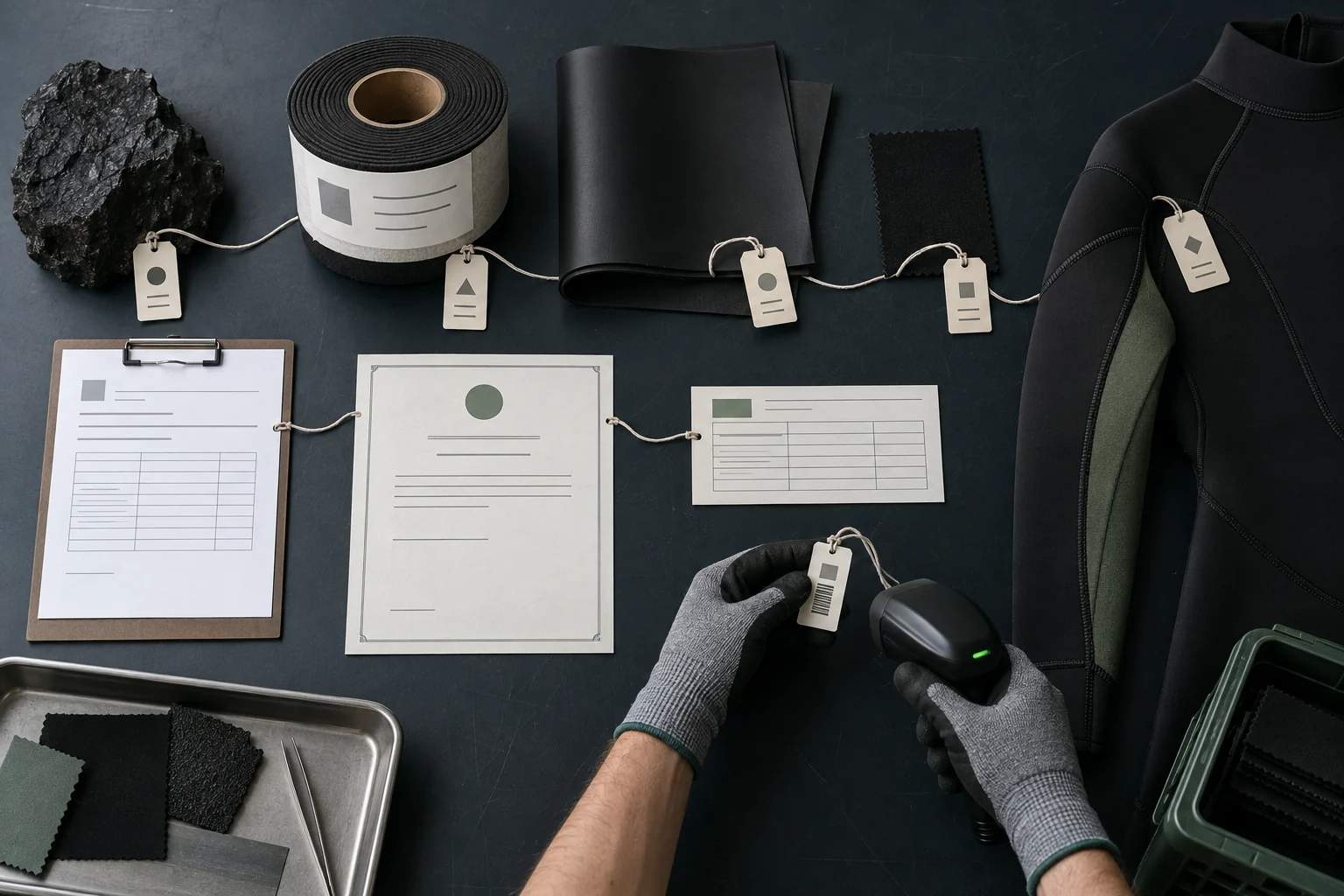
Questions that expose a weak supply claim
- Is this exact material Yulex-branded, or is it another natural-rubber foam?
- Who owns the certificate, and does its scope cover the material and activity in this transaction?
- What claim appears on the supplier invoice or delivery document?
- Which converter laminates the foam, and how is the batch identity preserved?
- Is trademark approval held by the brand, factory, converter or another party?
- Does the approval cover the planned product, market, logo placement and campaign period?
- What evidence will ship with each bulk order?
Record “not confirmed” instead of filling evidence gaps with assumptions. A project can continue with a generic natural-rubber candidate, but it must not inherit Yulex identity, certification or marketing language unless those are independently verified.
How should performance be compared?
No material family guarantees a single stretch, recovery, warmth, buoyancy, softness or service life. Results change with compound design, cell structure, density, thickness, surface and textile lamination. The finished wetsuit also adds pattern strain, seam stiffness, panel junctions, coatings, zippers and reinforcements.
Start by defining the product’s required functions. A triathlon suit may prioritize shoulder mobility, controlled buoyancy and fast removal. A surf suit may balance mobility, thermal design and seam durability. A diving suit can place more weight on compression behavior at the intended use profile. A rental suit may emphasize repeated use, cleaning, abrasion zones, identification and repairability.
Comparable test evidence
Ask both candidates for test method, specimen construction, conditioning, temperature, direction, thickness and result units. The current ISO 37:2024 defines tensile stress-strain testing for vulcanized and thermoplastic rubbers, including tensile strength and elongation at break. ISO 815-1:2019, confirmed current in 2025, covers compression-set methods at ambient or elevated temperatures. These standards can support a test plan, but a foam-laminate or finished-suit specification may require different or additional methods. Agree the method with a qualified laboratory or material specialist.
| Property or risk | Evidence to request | Control note |
|---|---|---|
| Thickness | Measurement method, location, conditioning and tolerance | Separate foam thickness from finished laminate thickness |
| Stretch and recovery | Direction-specific result for foam and/or laminate; cyclic recovery where relevant | Match warp/weft orientation and fabric construction |
| Tensile and tear | Method, specimen, failure mode and conditioned result | Do not compare unlike specimen shapes or units |
| Compression behavior | Defined time, temperature, strain, recovery and repeated-cycle condition | Use a product-relevant protocol; do not translate one lab number directly into depth performance |
| Lamination adhesion | Peel or bond result after agreed conditioning and aging | Control adhesive, fabric and process—not foam alone |
| Abrasion and snagging | Face-fabric test plus wear-zone sample review | Outer fabric and reinforcement dominate many observed failures |
| Aging | Heat, UV, ozone, hydrolysis or storage protocol as relevant | Record duration, exposure and acceptance criteria |
| Chemical requirements | Destination-market test report for the defined material/product scope | Confirm sample identity, issue date and applicable limits |
| Fit and function | Same pattern, size, construction and user protocol | Use the fit and leak validation protocol before bulk approval |
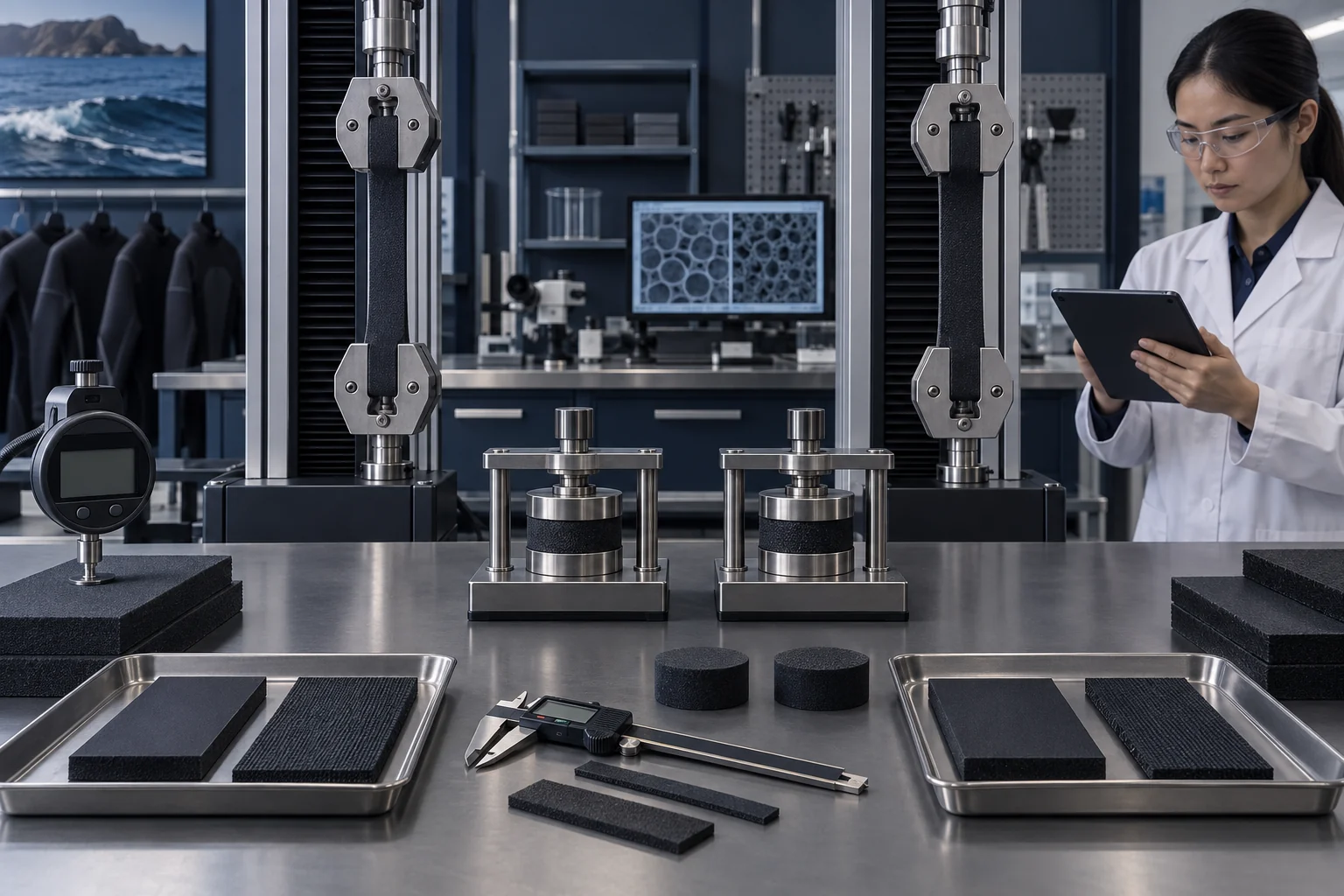
For production control, connect the approved test report to incoming inspection. The wetsuit quality control checklist explains how IQC, in-process checks and final inspection can preserve an approved specification instead of relying on the appearance of a sample.
Does Yulex cost more than neoprene?
There is no durable universal percentage. Price depends on the Yulex grade or conventional grade, certification and conversion route, face fabrics, color, format, order quantity, usable yield, freight, exchange rates, allocation and testing. A low sheet price can become an expensive suit if the usable area is poor, the format increases cutting waste, or a high defect rate reduces yield.
Normalize quotations to the same commercial basis:
- same nominal thickness and tolerance;
- same outer and inner fabric specifications;
- same sheet/roll dimensions and Incoterm;
- same color, finish and surface treatment;
- same testing and documentation scope;
- same accepted-quality basis;
- estimated marker yield and cutting loss;
- landed cost, rework risk and cost per accepted suit.
Ask separately for material MOQ, color MOQ, lamination MOQ, sample quantity and production MOQ. A foam supplier may support a material, while the converter’s fabric or color minimum drives the actual order threshold. Also request quoted lead time, capacity reservation, quotation validity and the consequence of a supply interruption.
Plan substitution before you need it
A sustainability-led product promise can be damaged by an undocumented last-minute substitution. Define whether substitutes are prohibited, conditionally permitted or pre-approved. Any candidate substitute should go through document, performance, fit, claim and sample review. The bulk purchase order should state that no material, grade, fabric, adhesive or certification route may change without written approval.
How should environmental claims be reviewed?
Material choice and marketing claim are related, but they are not the same decision. The fact that one input is renewable or certified does not prove that the finished wetsuit is “eco-friendly,” biodegradable, carbon neutral, recyclable or better in every environmental category.
ISO 14021:2026 provides principles and documentation requirements for self-declared environmental claims and emphasizes accurate, relevant, verifiable and non-misleading statements. In the United States, the FTC Green Guides summary cautions against broad, unqualified “green” or “eco-friendly” claims and says claims should be specific and substantiated.
Use a claim register, not adjectives
For every planned web, hangtag, packaging or sales claim, record:
- the exact proposed wording;
- the product, component and market it covers;
- the evidence owner and source document;
- the measurement method, comparison basis and date;
- required qualification or explanatory text;
- certification and trademark permission;
- legal or compliance reviewer;
- approval status and expiry/review date.
Prefer a narrow, evidenced statement—for example, identifying the documented material used in a named panel or product—over a whole-product promise. If a supplier provides a carbon or impact comparison, verify the functional unit, system boundary, geography, year, allocation, energy assumptions and reviewed version before repeating it. Do not combine numbers from unrelated studies.
Biodegradability deserves particular caution. Even Yulex’s current FAQ notes that vulcanized natural rubber may not biodegrade in a reasonable time. A finished wetsuit also includes fabrics, adhesives, inks, trims and other components. Do not use an unqualified biodegradable claim for the complete product without product-specific evidence and market review.
Which material route fits different wetsuit programs?
Surf and SUP: compare shoulder and torso mobility, seam system, lamination adhesion, surface durability and repeated flexing. A natural-rubber story can be relevant to the collection, but the finished construction must pass wear and fit validation.
Triathlon and open water: control thickness zoning, buoyancy distribution, neck and shoulder mobility, coating/skin durability and removal. Test a matched pattern; a different material may require pattern or panel adjustments rather than a one-for-one swap.
Diving: define intended use, thickness, compression behavior, thermal design, seam and reinforcement requirements. A supplier’s general foam comparison is not a depth or safety guarantee.
Freediving and spearfishing: decide whether the construction uses open-cell, lined or coated surfaces and whether the selected material is available in the required format. The open-cell versus closed-cell guide explains why inside-surface construction must be specified separately from the foam family.
Rental and school fleets: compare cleaning resistance, abrasion zones, seam serviceability, size identification and replenishment consistency. The lowest material cost is rarely the same as the lowest cost per use.
Use the broader wetsuit material selection guide when natural rubber is one candidate among CR, SCR or other commercial foam routes. For a production discussion, INSEAKU’s wetsuit development and bulk-production services can connect the material brief to sampling, pattern, branding, quality control and order planning.
What belongs in the RFQ and sample approval?
The RFQ should make evidence deliverable—not optional. Add these fields to the wetsuit tech pack and RFQ:
- candidate ID and commercial material name;
- manufacturer, converter, distributor and manufacturing country;
- foam grade, polymer/material basis and nominal thickness;
- outer/inner fabrics, colors, weights and stretch directions;
- adhesive, lamination and surface treatment;
- data-sheet version and required performance reports;
- certificate holder, number, scope, validity and invoice claim;
- trademark/logo/hangtag approval owner;
- exact approved environmental copy by destination market;
- material, color and production MOQ;
- sample and bulk lead time, quote validity and capacity reservation;
- substitution rule and change-approval process;
- retained swatch, roll/sheet label and batch records required for bulk.
Use approval gates
- Gate 1 — identity: candidate and supply route are named; current data are received.
- Gate 2 — evidence: certification, transaction and trademark requirements are mapped.
- Gate 3 — material: finished laminates are compared under aligned conditions.
- Gate 4 — sample suit: fit, mobility, seams, surface and use-case tests pass.
- Gate 5 — claims: every public statement is approved for wording, evidence, scope and market.
- Gate 6 — bulk release: golden sample, BOM, limits, incoming controls and no-substitution rule are signed.
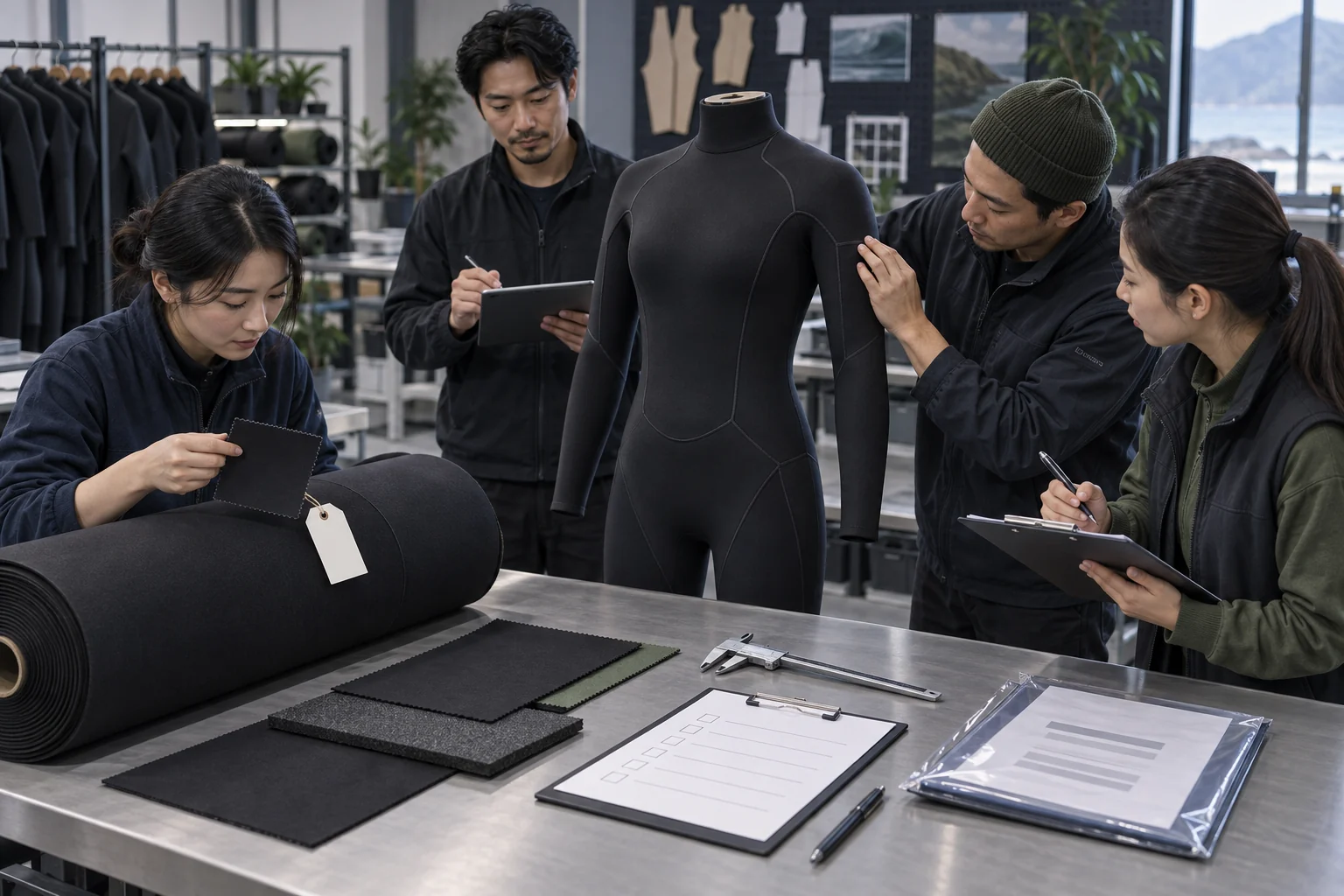
Download the Yulex and neoprene sourcing workbook
Use the editable workbook to register candidates, check supply evidence, compare performance on a controlled basis, approve environmental claims and connect the sample to the bulk lot.
Download the Yulex vs neoprene supply and claims workbook (.xlsx)
The workbook is a decision-support tool, not a certificate, test report or legal opinion. Replace the example rows with current project evidence and obtain qualified review for the target markets.
Frequently asked buyer questions
Is Yulex the same as natural-rubber wetsuit foam?
No. Yulex is a brand with named materials, controlled brand assets and a documented supply/claim framework. Natural-rubber foam is a broader material category. A non-Yulex natural-rubber foam may still be a valid candidate, but it should be identified by its actual manufacturer and grade.
Is every Yulex wetsuit FSC certified?
Do not assume so. Check the exact material, certificate holder, chain-of-custody route, transaction claim, product scope and label authorization. A source certification does not automatically transfer every possible logo or whole-product statement to the finished wetsuit.
Does Yulex always stretch more or feel softer than neoprene?
No universal result should be assumed. Stretch and hand feel depend on the selected foam grade, density, thickness, surface, fabrics and lamination. Compare equivalent constructions with aligned methods and sample suits.
Can a brand say “neoprene-free”?
Only after confirming what the statement means, the composition of the full product, the target market and the evidence. A wetsuit includes foam, fabrics, adhesives, trims, inks and coatings. Review both the literal statement and the impression it may create.
Can a Yulex foam be substituted into an existing neoprene pattern?
It may require pattern, panel, seam, lamination or process adjustment. Build a controlled development sample and repeat fit/function approval rather than treating the change as a paperwork-only material swap.
Which candidate is cheaper?
Compare current quotations for fully matched constructions. Include minimums, cutting yield, testing, freight, defects, rework, lead time and landed cost per accepted suit. A generic percentage is not a reliable purchasing basis.
What is the most important purchase-order control?
Name the approved material and finished construction, connect it to the approved sample and require written approval before any material, supplier, grade, fabric, adhesive, certificate route or claim changes.
Reference framework
- Yulex FAQ — current brand description of Yulex materials and sourcing statements.
- Yulex Brand Guidelines and Trademark Guidelines — current requirements for marks, logos and approval.
- FSC Natural Rubber — chain-of-custody and labeling overview.
- ISO 37:2024 — tensile stress-strain properties for rubber.
- ISO 815-1:2019 — compression-set methods; confirmed current in 2025.
- ISO 14021:2026 — self-declared environmental claims.
- FTC Green Guides summary — U.S. guidance on environmental marketing claims.
Last source review: September 19, 2026. Standards, certificates, supply, trademark rules and market requirements can change; verify current editions and project-specific applicability before publication or purchase.