
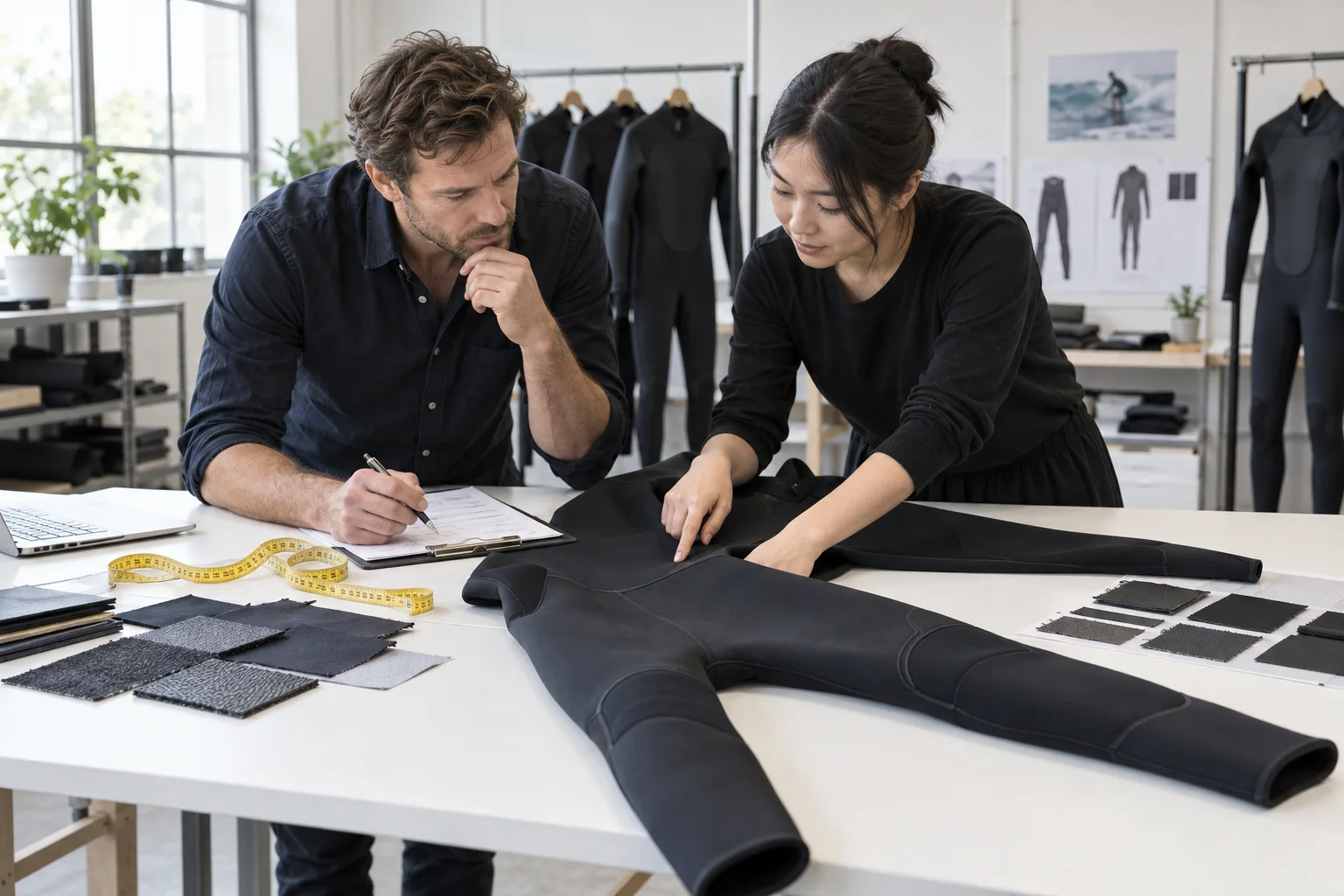
Short answer: A controlled custom wetsuit sampling process turns a product brief into an approved production reference through named stages, dated revisions and written approval gates. At INSEAKU, sample development can start from approximately seven working days after materials and specifications are confirmed and payment is received. The first sample is not automatic permission for bulk production. The buyer and factory review the agreed fit, measurements, construction, materials, artwork and workmanship, close or document every revision, approve the pre-production or sealed sample in writing, and only then release the confirmed specification and production order to bulk manufacturing.
The exact route is project-specific. A straightforward private-label style may need fewer development rounds than a new ODM pattern, while custom components, special materials, multiple sizes, artwork revisions or ordered items such as certain YKK zippers may extend the schedule. The goal is not to force every project through an identical number of samples. It is to make the purpose, evidence, owner and approval status of every stage unambiguous.
What is the custom wetsuit sampling process?
The custom wetsuit sampling process is the sequence used to translate commercial and technical requirements into a repeatable product. It connects the product brief, tech pack, materials, pattern, size rules, sample versions, test evidence, comments and final written authorization. A strong process makes three things visible at every stage: what is being reviewed, which version governs and who can approve the next action.
| Stage | Main question | Typical evidence | Approval result |
|---|---|---|---|
| 0. Confirmed inputs | Is the factory working from a complete, current brief? | Tech pack, measurements, material and artwork references | Approved to start development |
| 1. Development prototype | Can the concept be built as intended? | First sample, build notes and open-issue list | Revise, hold or advance |
| 2. Fit and construction review | Do fit, measurements, mobility and construction meet the brief? | Measurement report, fit observations and seam/component review | Approved points and dated corrections |
| 3. Revised sample or size set | Were corrections implemented without introducing new errors? | Revision log, updated files and comparison record | Version accepted or another round requested |
| 4. Pre-production sample | Does the near-final build represent the intended bulk method? | Final materials, approved artwork, measurements and workmanship | Ready for sealed-sample decision |
| 5. Sealed sample | Is the physical reference approved for production? | Identified sample plus governing document versions | Dated written approval |
| 6. Bulk release | Are every required approval, specification and commercial condition in place? | Release checklist, production order and required deposit record | Authorized production start |
This table is a control framework, not a promise that every project needs seven physical samples. One garment can sometimes answer several gates, and complex developments may need extra prototypes or a size set. Name the stages in the quotation or development plan so that “sample approved” cannot be interpreted differently by the buyer and manufacturer.
For projects covering both categories, use the triathlon and surfing wetsuit development checklist to define separate sample evidence, entry checks and any event-rule review before approval.
If the project includes hoods, gloves or footwear, use the neoprene accessory development checklist to approve each item and its intended equipment combination separately.
Keep sample and development charges separate from recurring garment prices when you compare wetsuit manufacturing quotes, and record any sample-fee credit conditions in writing.
Gate 0: freeze the inputs before sample development
A sample cannot validate an undefined product. Before the development clock begins, confirm the product category and intended use, target user, pattern source, measurement chart, material construction, foam thickness, lining and stretch requirements, seam method, entry system, reinforcement, graphics, labels, packaging and expected test or inspection plan.
Before commissioning samples, our wetsuit manufacturer recommendations and comparison can help you select candidates with relevant development capabilities and clarify what each sample program includes.
The controlled input package should also identify:
- project type: OEM, ODM, private label or a written hybrid scope;
- file name, revision, date and owner for the tech pack and measurement chart;
- approved materials and acceptable alternatives;
- base size, required sample size and any size-set requirement;
- artwork scale, placement, colors and print method;
- sample purpose and the decision expected at the next gate;
- buyer and factory contacts authorized to issue or accept changes; and
- open items that prevent final approval but do not prevent learning.
If the branding route is still open, review the wetsuit logo method-selection framework before approving the artwork strike-off and pre-production sample.
For a practical briefing structure, use the wetsuit tech pack and RFQ checklist. It helps keep technical requirements, quantities and commercial assumptions in one controlled package before development starts.
Gate 1: review the development prototype
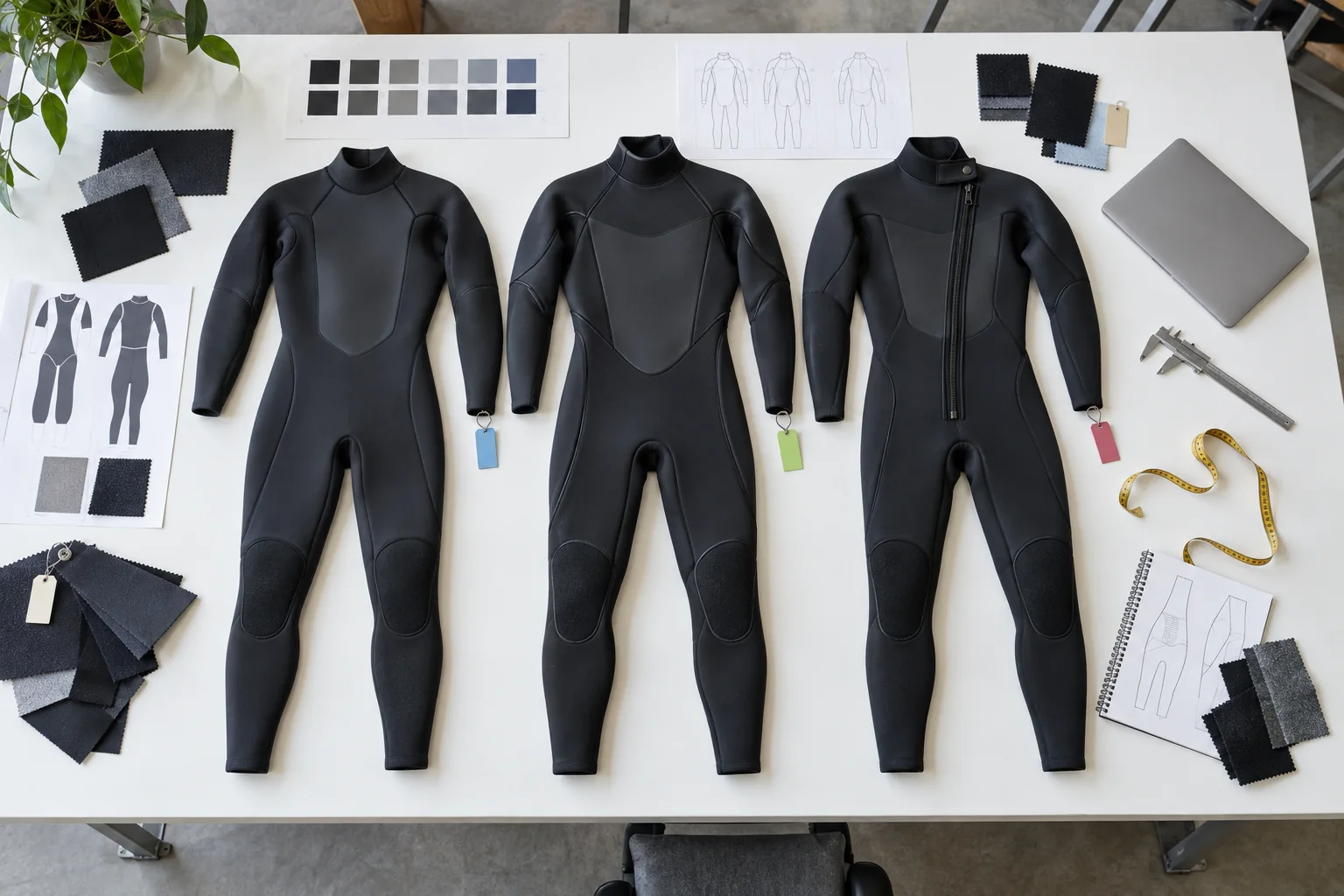
The first development sample is a learning tool. Its job is to reveal whether the proposed pattern, panel arrangement, material route, seam construction, entry system and components can work together. It should not be treated as an automatic production standard simply because it looks acceptable in a photograph.
Before reviewing it, record the sample ID, product code, revision, date, size, material reference and construction route. If any temporary material or component is used, identify it in writing. Otherwise, a buyer may approve a visual result while assuming the sample already contains the final production inputs.
A useful prototype review separates three outcomes:
- Accepted: the point is confirmed and should not change without authorization.
- Revise: a specific correction, measurement or replacement is required.
- Open: evidence or a buyer decision is still missing, so the point is not yet approved.
Gate 2: review fit, measurements, mobility and construction
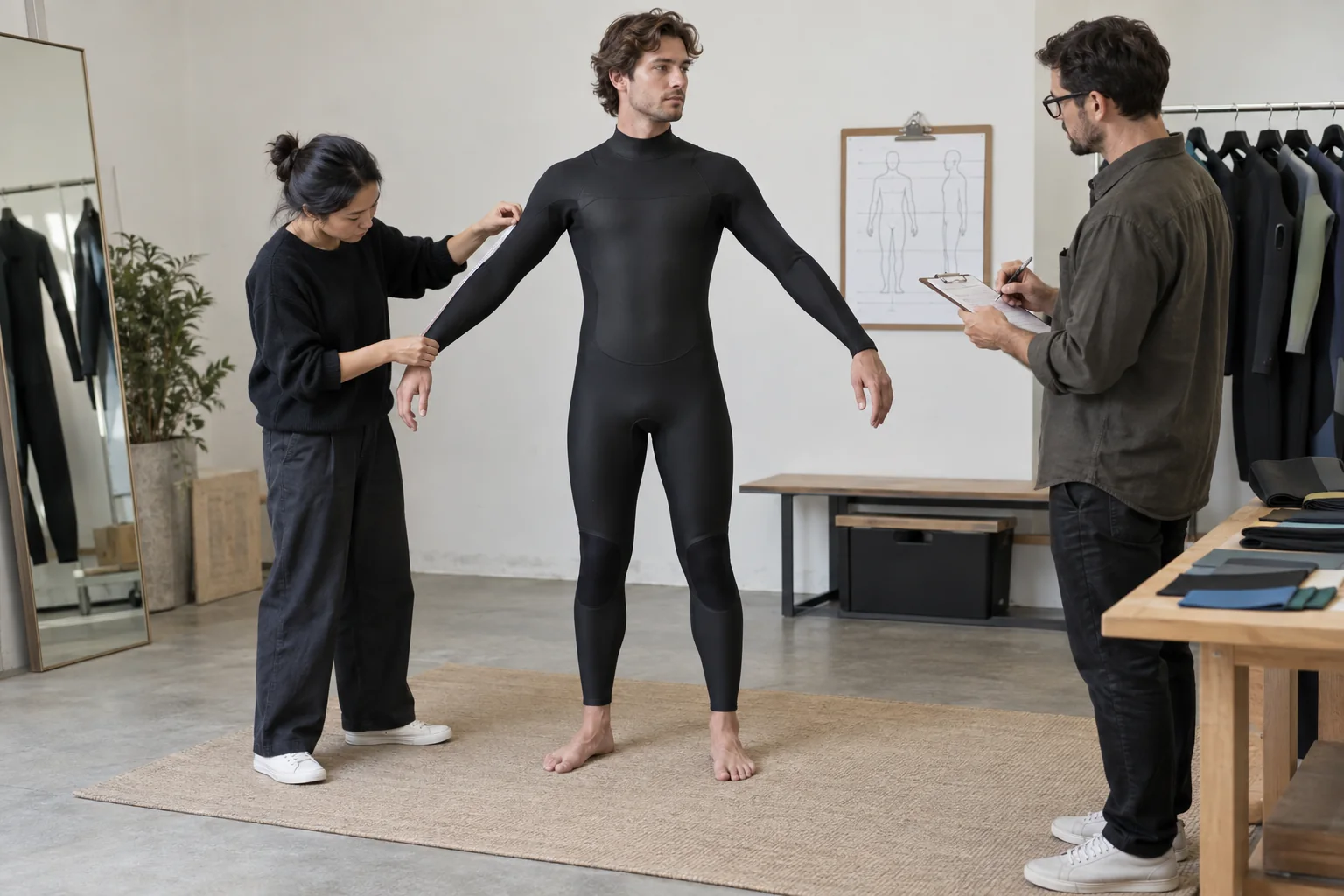
A fit sample review should compare the garment with the intended user profile and the approved measurement method. INSEAKU generally does not require a live-person fitting for every sample. When a fit review is needed, a fixed fit model can be used to improve consistency, and the buyer’s requirements determine the scope. Measurements, pattern geometry and construction evidence remain important because one person cannot represent an entire size range.
Review the agreed points of measure with the garment in a defined condition and record both the target and actual values. Check the neck, shoulder, torso, crotch, knee and limb relationships; entry and zipper operation; range of motion; seam position; panel tension; reinforcement; print or logo placement; and workmanship. If the project requires leak-related checks, the method may include local seam water-pressure or air-pressure testing, bubble inspection, visual and manual inspection, or qualified third-party laboratory work, depending on the product and customer quality plan.
Do not write “fit is tight” or “sleeve feels wrong” without evidence. State the size, location, measured result, intended correction, responsible party and due date. For a more detailed evaluation sequence, use the wetsuit fit testing protocol.
For a two-piece spearfishing program, use the spearfishing wetsuit sample-acceptance checklist to review jacket and trouser fit, inner surfaces, loading-pad placement and camouflage against one controlled specification.
Gate 3: control sample revisions and approvals
Revision control prevents an approved correction from disappearing in the next sample. Give every sample and document a unique version. Consolidate buyer comments into one dated master list rather than distributing conflicting instructions across email, messaging apps and annotated photographs.
Each requested change should record:
- sample and document version affected;
- requirement or nonconformity being addressed;
- requested action and objective acceptance criterion;
- owner and target date;
- effect on pattern, material, artwork, price or schedule;
- implementation evidence; and
- buyer disposition: accepted, revise again, open or not applicable.
When a change affects several files, update the complete controlled set. For example, moving a seam may change the pattern, panel map, measurements, print placement and reinforcement. Approving a new pattern while leaving old artwork or measurement files active creates competing production instructions.
ISO 10007 provides guidance on configuration management across a product’s life cycle. This article applies the underlying version-control principle as a practical project recommendation; it does not state that INSEAKU or a specific project is certified to that standard.
Gate 4: approve the pre-production sample
INSEAKU makes a pre-production sample before bulk manufacturing in addition to development samples. Its purpose is to confirm the near-final product and the production basis before volume work begins. The stage should use the agreed materials, pattern revision, construction, components, graphics and branding unless a documented exception is accepted.
A pre-production review should answer:
- Are the style, size and sample ID correct?
- Do materials and components match the approved references?
- Do finished measurements comply with the agreed chart and allowed tolerances?
- Are seam construction, entry system and reinforcement correct?
- Are graphics, labels and packaging aligned with approved files?
- Have earlier revision items been closed?
- Are required product-specific checks complete or clearly assigned?
- Does any deviation remain, and who has authority to accept it?
If one color, material or component behaves differently, it may require separate evidence even when the pattern is shared. Likewise, a size-set review may be needed when grading risk cannot be resolved from the base size alone. The decision should follow the project’s risk and written quality plan, not a universal assumption.
Gate 5: turn the approved sample into a controlled reference
The sealed sample is the approved physical reference used with the confirmed specification. It shows the agreed appearance and workmanship, while the tech pack, measurement chart, bill of materials, artwork files and quality plan preserve measurable requirements that one garment cannot fully communicate.
The need to keep those references connected is illustrated by a real final-inspection case from INSEAKU QC Supervisor Xuemei Zhang: a one-letter logo-label error matched the approved pre-production reference but conflicted with the customer’s original artwork.
Written approval should identify the sample rather than say only “looks good.” A useful approval record includes the project and style, sample ID and revision, size and color, governing document revisions, approval date, approver, accepted exceptions and the action authorized. Keep dated photographs if they help identify the approved reference.
If the buyer approves with conditions, close those conditions or incorporate them into controlled production documents before bulk work proceeds. Statements such as “approved except for zipper” are risky when the zipper affects pattern, construction, material availability, cost or timing. The final reference set should show exactly which decisions remain open and whether production is permitted.
Gate 6: authorize bulk production with a release checklist
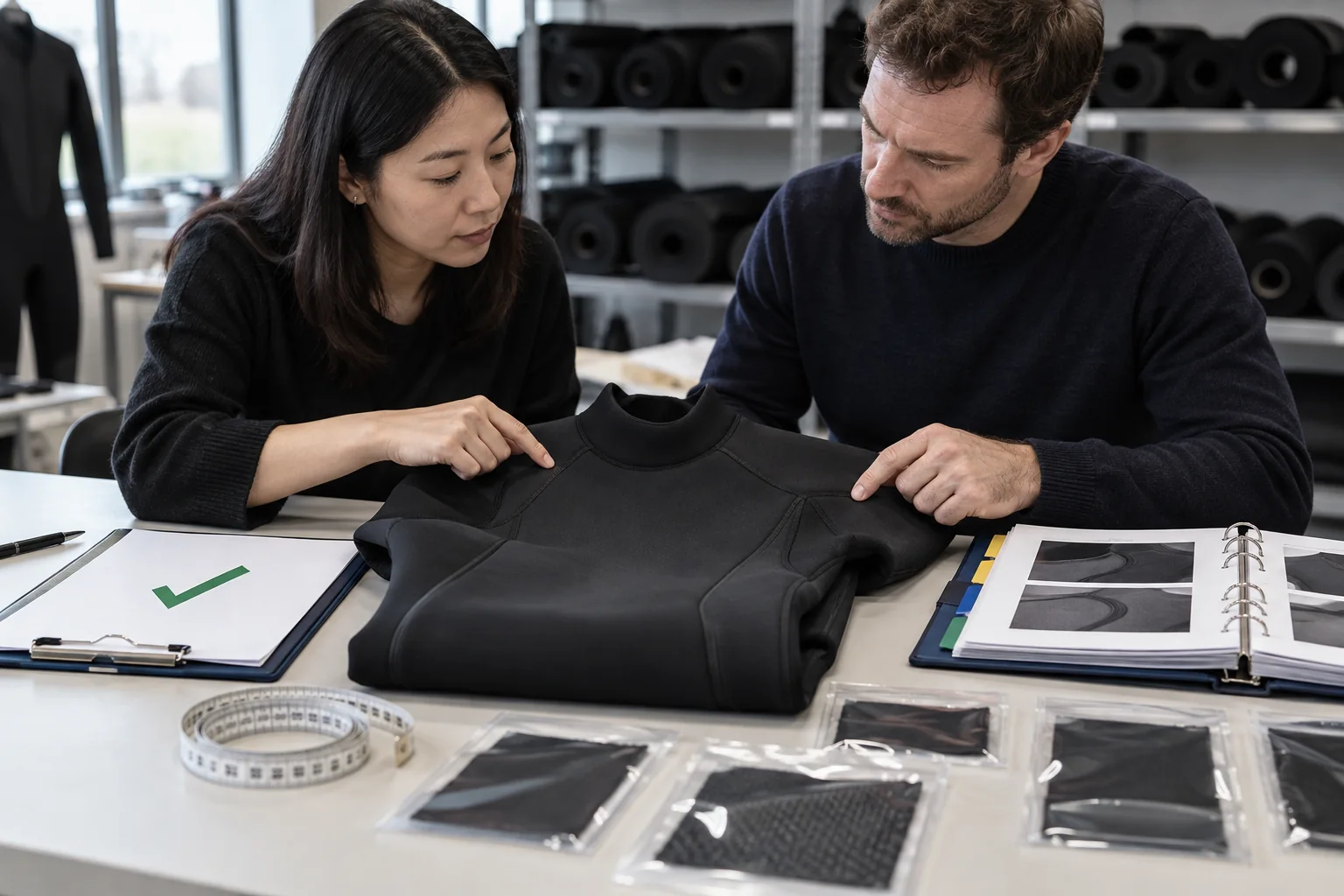
At INSEAKU, bulk production is based on the customer’s written approval of the sealed sample, the confirmed specification and the production order. The required bulk-order deposit must also be received before the normal production clock begins. These conditions protect both parties from starting volume work while the product or commercial authorization is still changing.
A suggested bulk-release checklist should verify:
- final style, color and size breakdown;
- approved sealed-sample ID and location;
- current tech pack, measurement chart, pattern and BOM revisions;
- approved material, component and artwork references;
- labels, packaging and shipping-mark files;
- closed revision log and accepted deviations;
- quality plan, inspection method and any third-party testing responsibility;
- production order, payment status and confirmed schedule; and
- name and date of the authorized written release.
Checklist completion does not replace authorized approval. A spreadsheet can show that required evidence is present, but only the named buyer and factory representatives can release the project under the agreed commercial terms.
How long does wetsuit sample development take?
INSEAKU’s sample development can start from approximately seven working days after materials and specifications are confirmed and payment is received. “Starts from” is important: it is not a guaranteed completion time for every product. Complex patterns, special materials, custom printing, multiple sizes, revision rounds and buyer-response time can extend the schedule. Components that must be ordered, including certain YKK zipper requirements, may also prevent completion within seven working days.
Sample pricing is quoted case by case because product and development requirements vary. The sample fee can be credited against a qualifying bulk order when the same style and color reaches 300 pieces, subject to the written quotation and order terms. INSEAKU’s standard production MOQ starts at 50 pieces per style and color, with sizes mixable within those 50 pieces; different colors do not combine to reach one MOQ.
Normal bulk production is approximately 30 working days after the sealed sample is approved and the required bulk-order deposit is received. The actual schedule depends on style, materials, quantity and capacity allocation and is confirmed in the written quotation. International transportation is separate from production time. For the full commercial explanation, read the guide to wetsuit manufacturer MOQ, sample cost and production lead time.
Download the wetsuit sample approval checklist
Use the downloadable workbook to maintain one sample register, review evidence, revision log and bulk-release record. Adapt it to the product, contract and customer quality plan; do not treat a completed template as automatic production authorization.
Download the INSEAKU Wetsuit Sample Approval and Bulk Release Checklist (.xlsx)
Common sampling failures and how to prevent them
| Failure | Risk | Control |
|---|---|---|
| No sample ID or revision | The team cannot prove which garment was approved | Label each sample and link it to dated documents |
| Feedback in several channels | Instructions conflict or are missed | Issue one consolidated revision log |
| Approval based on photographs only | Measurements, materials and workmanship may be unverified | Define evidence and physical-reference requirements |
| “Approved with changes” but no closure | Bulk starts with unresolved instructions | Close conditions or record a formally accepted deviation |
| Old files remain active | Production teams use different specifications | Freeze one governing document set and archive superseded copies |
| Sample timing confused with total lead time | Launch planning excludes reviews, revisions and transport | Build a project calendar with separate clocks and dependencies |
Custom wetsuit sampling process FAQs
How many wetsuit samples are required before bulk production?
There is no universal number. The route depends on product novelty, pattern and material risk, sizes, components, artwork and the customer’s approval plan. A simple project may combine stages, while a new development may need a prototype, revised or fit sample, size set, pre-production sample and sealed sample.
Is the first development sample the sealed sample?
Not automatically. The first sample is normally used to learn and identify corrections. It becomes an approved production reference only when required reviews are complete, accepted changes are incorporated and the buyer issues clear written approval tied to the correct sample and files.
What is the difference between a pre-production sample and a sealed sample?
A pre-production sample is a near-final build reviewed before bulk manufacturing. A sealed sample is the physical reference that has received the required written approval and is identified with the final governing documents. Depending on the project, the accepted pre-production sample may become the sealed sample.
Does INSEAKU fit every sample on a person?
No. INSEAKU generally does not require a live-person fitting for every sample. A fixed fit model may be used when needed, and the scope follows the product and customer requirements. Measurements, pattern checks and construction evidence remain part of the review.
When can INSEAKU start making a sample?
Sample development can start from approximately seven working days after materials and specifications are confirmed and payment is received. Special materials, ordered components, complex development or revisions can require more time, which should be confirmed in writing.
Who should approve the sample?
The buyer and factory should name authorized representatives in the project record. Feedback may come from several specialists, but the final approval should be consolidated, dated and traceable to one sample and one controlled set of files.
Can bulk production begin before sealed-sample approval?
INSEAKU’s normal control is to begin bulk production only after the buyer has approved the sealed sample in writing, the specification is confirmed, the production order is in place and the required deposit has been received.
Start your sample program with controlled inputs
Send INSEAKU your intended use, product type, target market, design status, measurement chart, materials, construction, size range, graphics, quantity and required timing. The team can then review the appropriate OEM, ODM or private-label manufacturing service, identify missing inputs and define the sample stages and commercial terms in writing.
Request a custom wetsuit sample and manufacturing review
References and further reading
- ISO 10007:2017 — Quality management: Guidelines for configuration management
- ISO 9001:2015 — Quality management systems requirements
- WIPO — Guide to Trade Secrets and Innovation
Last reviewed: September 14, 2026. Factory-specific statements reflect information confirmed by INSEAKU for this article. Project-specific requirements, pricing, timing and approvals remain subject to the written quotation, specification and agreement.