
Short answer: The key difference in a triathlon wetsuit vs surfing wetsuit comparison is the activity the finished garment must support. A triathlon wetsuit is developed around sustained swimming, body position, shoulder movement and removal before the bike leg. A surfing wetsuit must support paddling, board contact, duck diving, pop-ups and time spent waiting between waves. Both need suitable fit, mobility and thermal performance, but they should not share an unchanged specification just because they use neoprene.
For private-label brands, the useful question is not which category is universally better. It is which design decisions, samples and evidence your intended customer needs. This guide turns that distinction into eight development checks, from the first product brief to the production reference.
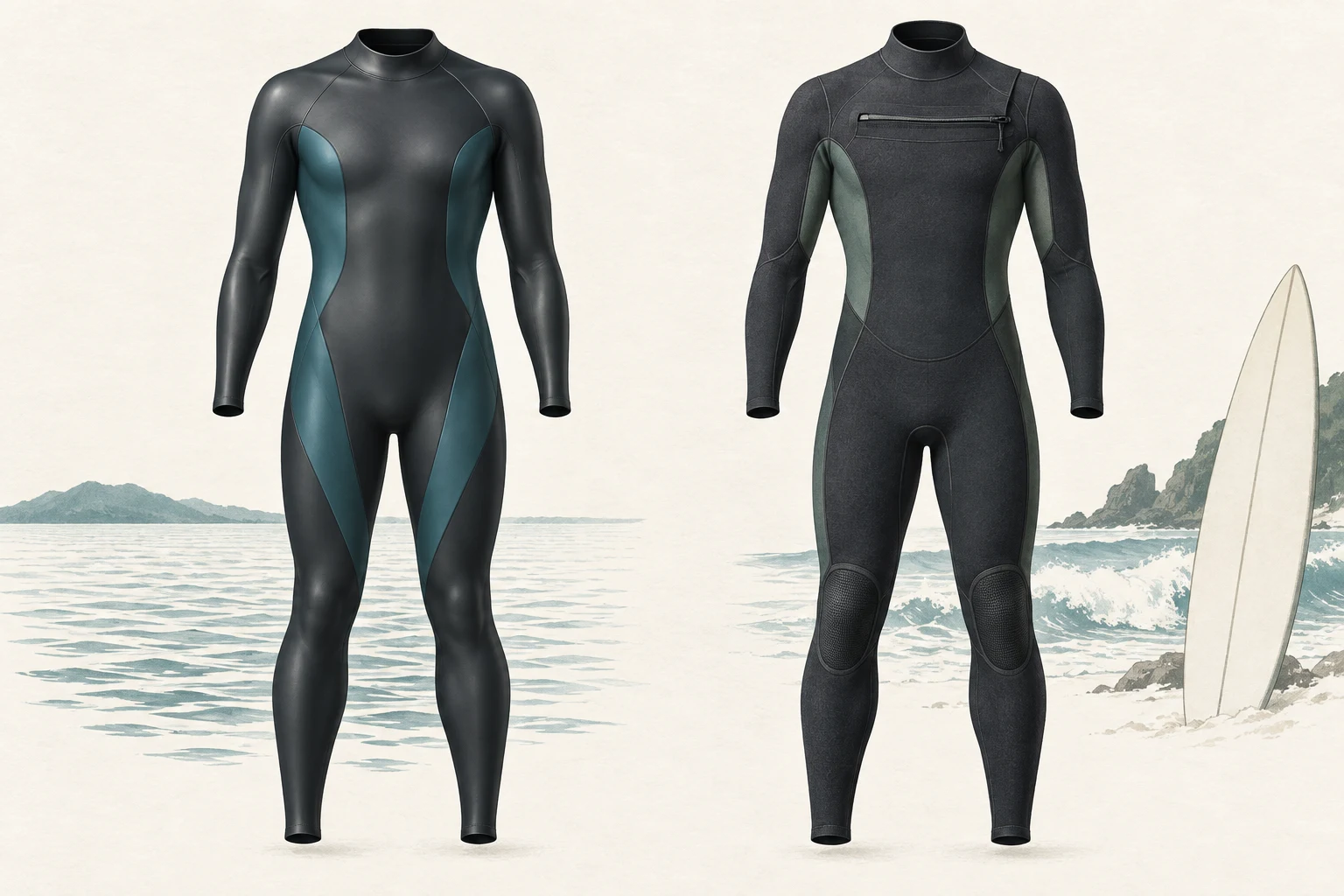
Terminology: A triathlon wetsuit is not a tri suit. The latter is the garment worn across swimming, cycling and running; a wetsuit, when permitted, is worn for the swim and removed for the following disciplines. This article compares neoprene wetsuits, not tri suits, swimskins or swimrun suits.
Download the editable Triathlon and Surf Wetsuit Development Brief. It includes a side-by-side specification sheet and an approval register. Blank fields are for your project inputs; the workbook is not a race-eligibility certificate.
Triathlon wetsuit vs surfing wetsuit: the buyer’s comparison
| Decision | Triathlon development brief | Surfing development brief |
|---|---|---|
| Primary use | Sustained swim, intended swimmer profile and transition | Paddling, board handling, riding and session conditions |
| Panel plan | Mobility and intended buoyancy distribution, subject to applicable rules | Warmth, paddling mobility and contact-area construction |
| Exterior | Specify the actual swim-oriented finish and its care limits | Specify contact resistance and any exposed smooth-skin zones |
| Entry and openings | Reach, sealing and controlled removal when wet | Entry access, movement and resistance to flushing |
| Functional sample checks | Swim posture, repeated stroke movement and transition handling | Paddle posture, pop-up movement, knees and board-contact areas |
| Approval evidence | Versioned specification, fit evidence and intended-event rule review | Versioned specification, fit evidence and intended-use evaluation |
This is a qualitative procurement framework, not a performance scorecard. A specific model may use different solutions. Neither a thickness label nor a smooth-looking surface establishes suitability on its own.
1. Define the activity before selecting a reference suit
Start with the user, water environment, expected session and sales claim. For a triathlon project, identify the swimmer profile and whether the product is intended for training, named competitions or both. For surfing, record the intended conditions, experience level and board use. Avoid an initial brief that says only “premium stretch” or “suitable for all water sports.” Those phrases leave the supplier to guess which compromises you will accept.
Choose a reference because it demonstrates a relevant feature, not because every part should be copied. Mark the shoulder construction you want to investigate, the opening you want to change and the surface you do not want. A reference’s material brand, price or visual similarity does not establish access to the same components or the right to use its proprietary technology names.
Make the intended exclusions equally clear. If a swim-oriented product has not been evaluated for board contact, do not add surfing to its product listing. If a surfing suit has not been assessed against the rules of a named event, do not market it as automatically race legal. Put those decisions in the wetsuit tech pack and RFQ before requesting a development quote.
2. Review shoulder movement in the correct posture
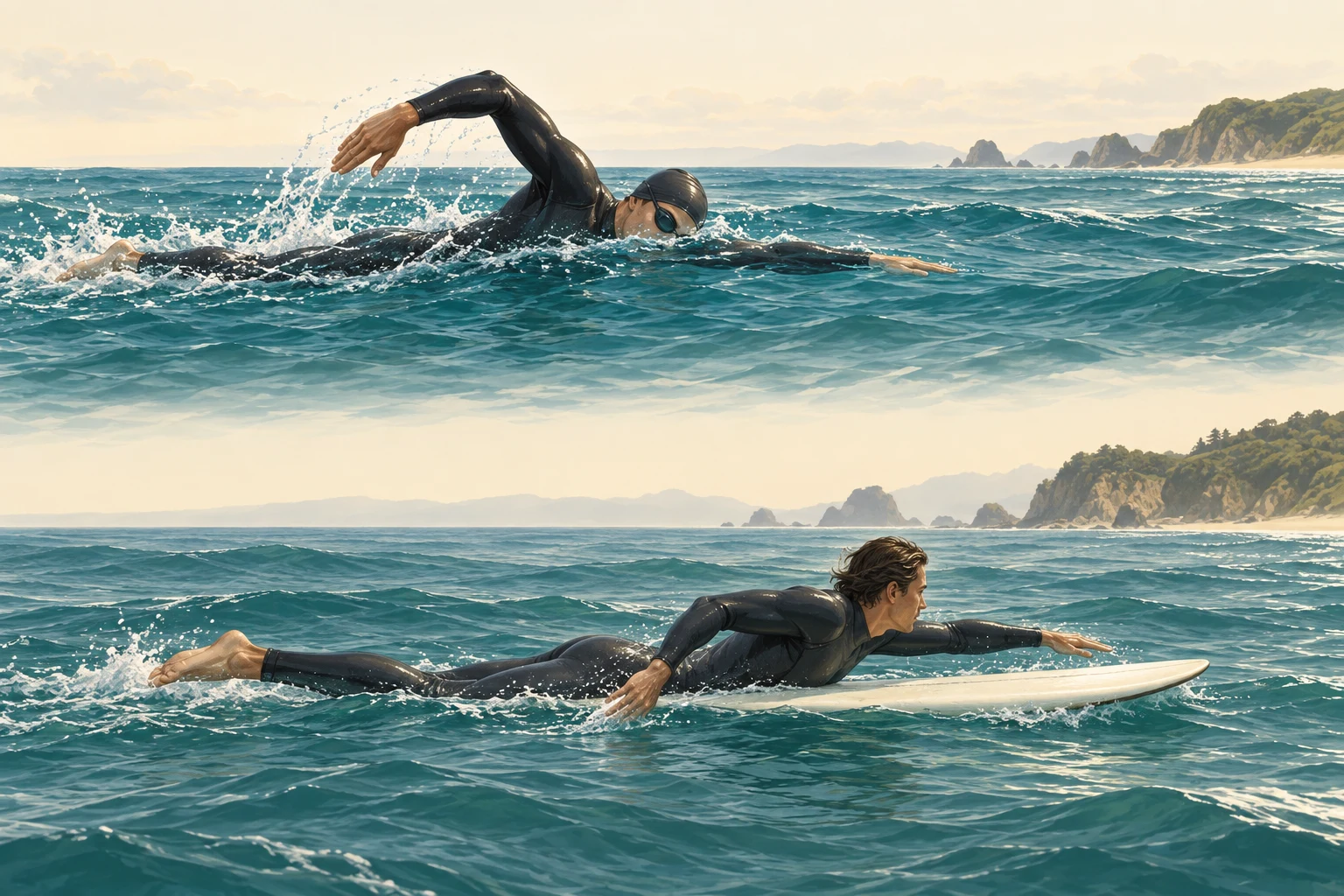
Both swimmers and surfers use repeated arm movement. The distinction is not that one category needs flexibility and the other does not. It is the posture, motion sequence and interaction with the rest of the garment. Swimming includes reach, rotation and recovery. Surf paddling combines arm movement with a prone position on a board, while the pop-up adds another movement requirement.
During pattern review, examine the shoulder, underarm, upper back and torso together. A flexible material swatch cannot show how seams, lining, print coverage and garment tension will behave once assembled. Changing a chest panel can also change what the wearer feels at the shoulder.
Define a sample evaluation with the intended wearer profile, sample size and revision recorded. Use repeatable movement tasks and capture where pulling, bunching or discomfort occurs. Where the project needs live fit or in-water evaluation, agree who will conduct it and under what conditions; do not assume every factory sample receives these tests. Our fit testing protocol explains how to separate measurement review, live fit confirmation and specialist testing.
3. Specify the exterior, lining and wear zones separately
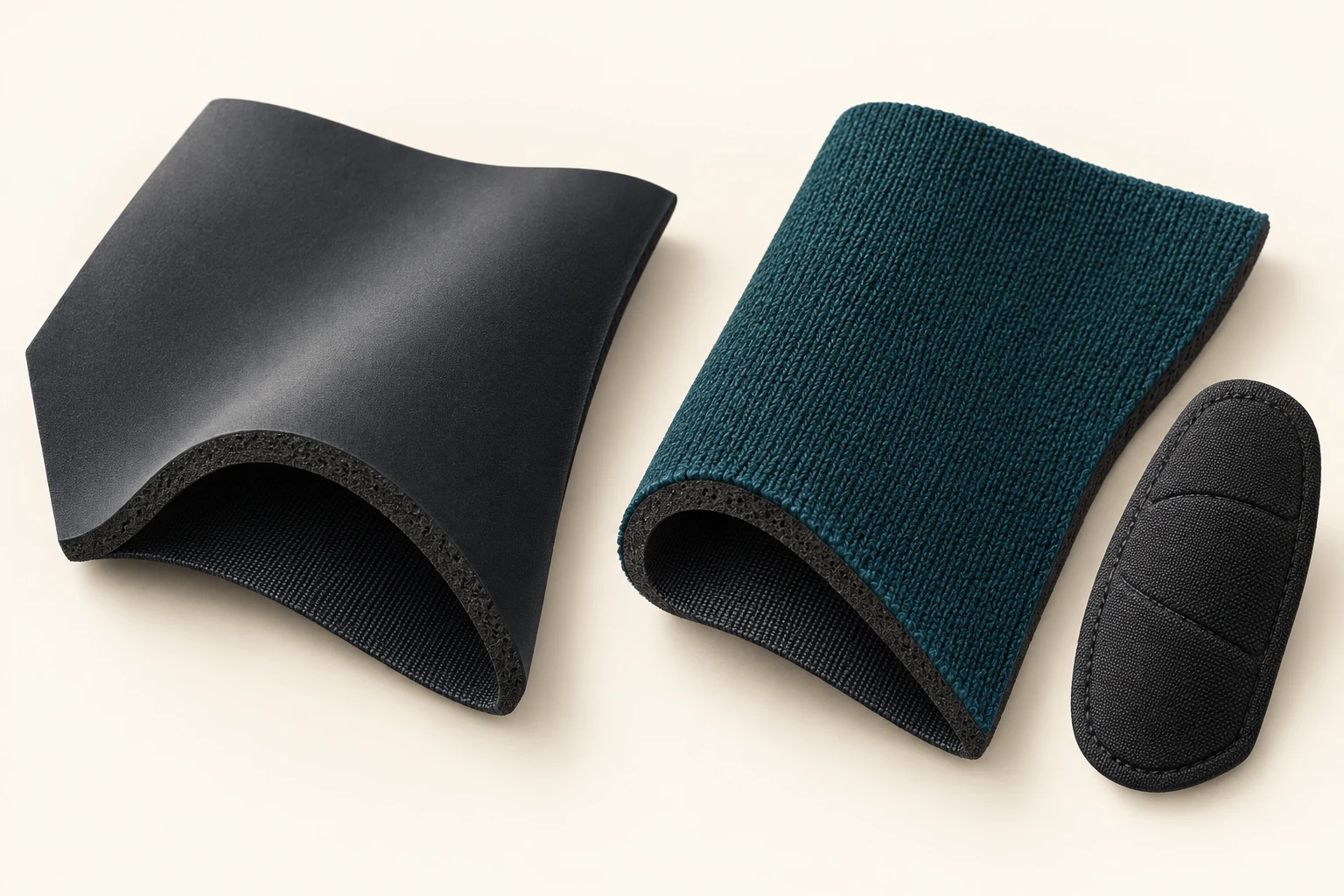
“Smooth skin,” “coated” and “textile faced” are not complete material specifications. Record the foam, outer face, inner lining, finish and adhesive system as separate fields, with exact supplier references where available. Ask what the proposed combination changes in handling, stretch, printing and care.
Official product descriptions illustrate the different emphases. Orca describes its Athlex Float V2 using differentiated buoyancy, elastic upper-body materials and a swim-oriented surface treatment. Its care guidance also limits the intended activity to swimming and warns against rough-surface contact. These are model-specific statements, not proof that all triathlon suits have identical construction.
For a surf example, Orca’s Tango 3:2 V2 identifies an abrasion-oriented exterior, knee reinforcement and sealed seam construction. The procurement lesson is to describe contact zones explicitly. A dark outer surface alone cannot tell a buyer whether a panel is suitable for repeated board contact.
Request representative material and seam samples before settling on a finish. If a project needs measured abrasion, stretch, bond or coating-durability performance, specify an agreed method and acceptance criterion with the appropriate testing provider. Do not replace that evidence with a hand-stretch demonstration. Use the material selection guide to document the full construction.
4. Build a panel map instead of ordering by one thickness label
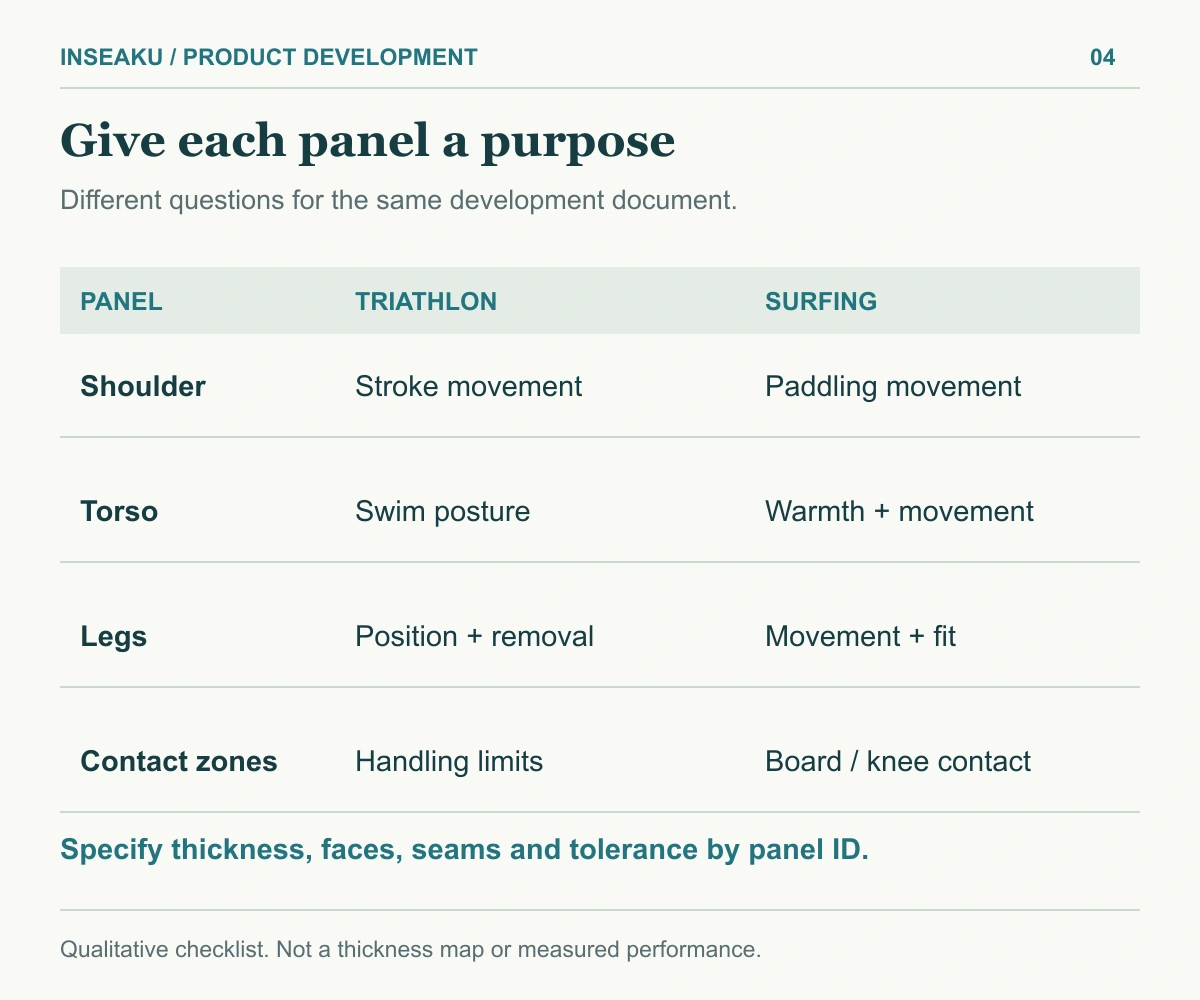
For triathlon development, ask how the proposed panel arrangement relates to the intended swimmer’s position and movement. More buoyancy in a particular region is a design choice to evaluate, not a universal upgrade. For surf development, review warmth, movement and contact requirements together. Do not treat a thicker panel as automatic evidence of a warmer or more durable finished garment.
Assign every pattern panel an ID. Record its nominal thickness, permitted tolerance, measurement method, foam reference, inner and outer faces, and seam connection. Keep the measurement definition consistent: a foam specification and a finished laminated-panel measurement should not be silently treated as the same quantity.
Use the map to expose gaps. Is the knee reinforcement a separate material? Does a printed shoulder need a new movement check? Has a lining substitution changed the construction being approved? These questions are more useful than assigning both products the same “high stretch” label.
5. Evaluate the entry system and wet removal
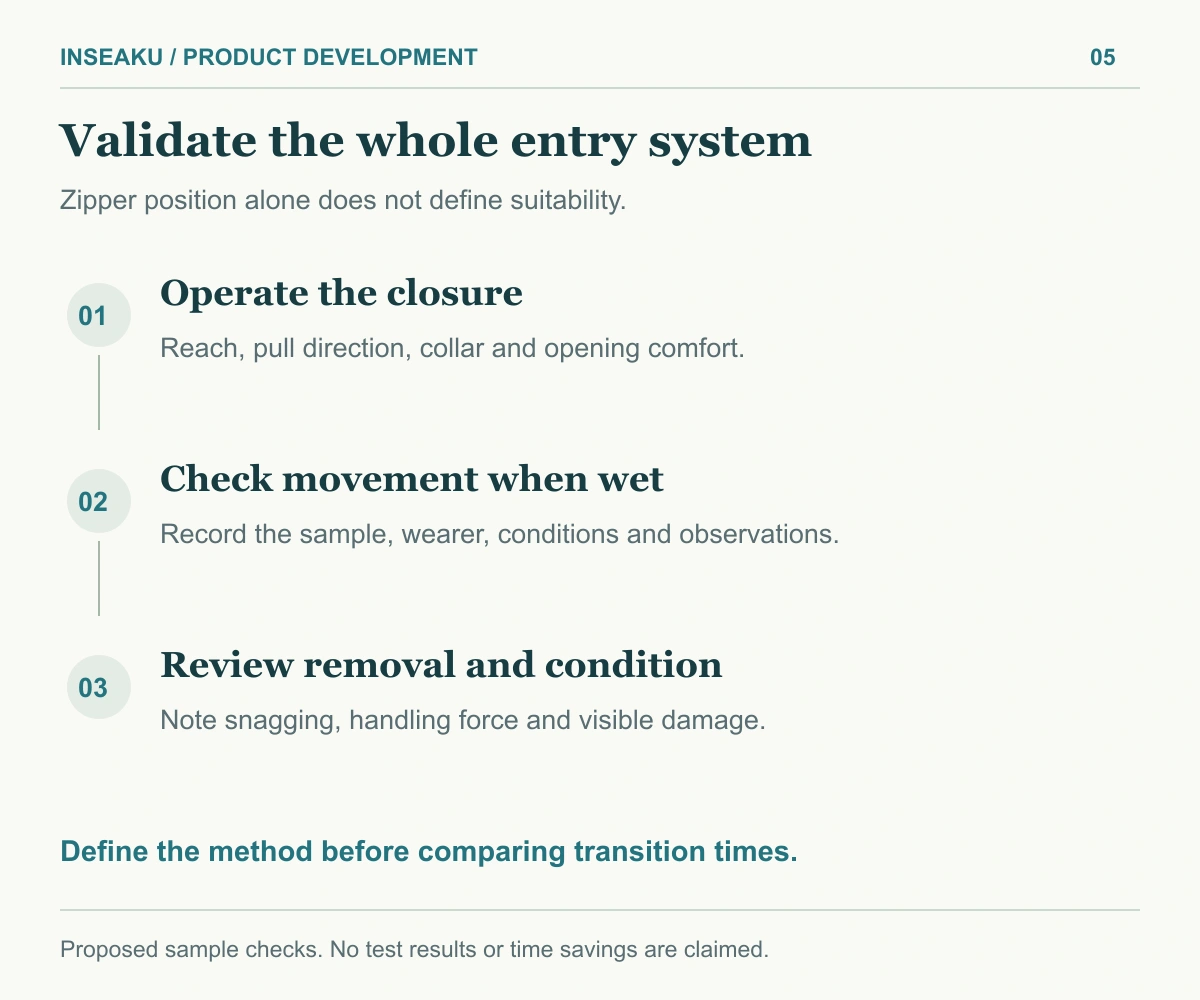
A zipper position does not identify the product category reliably. Surf suits can use back-zip, chest-zip or zipless entry. A swim-oriented back zip also needs its own specification for reach, closure, neck finish and removal. Do not approve either garment from an exterior zipper photograph alone.
O’Neill’s entry-system guide discusses access and flexibility trade-offs across these surf constructions. Treat it as context for comparing options, not as a universal promise that one entry system always fits better or keeps every wearer warmer.
For triathlon sampling, review whether the intended wearer can locate and operate the closure, remove the sleeves and pass the ankles through without damaging the garment. Record any catching or excessive pulling when wet. For surfing, evaluate access, the opening barrier and movement in the intended use sequence. A dry fitting-room check does not settle water-entry behavior.
If transition time is a product-development metric, define the start and finish points, wearer, underlying clothing, wet condition and number of repetitions before comparing samples. Keep timing records separate from marketing claims. A single quick removal is not evidence of a guaranteed time saving.
6. Separate race restrictions from product performance
Race eligibility is an additional requirement for a competition-oriented triathlon wetsuit. The World Triathlon FAQ states a 5 mm maximum wetsuit thickness and applies that limit to overlapping areas of a two-piece suit. It also distinguishes when wetsuits are permitted or mandatory and identifies coverage restrictions. These points are a reason to review the governing rules, not a shortcut to declaring any product approved.
Before freezing a competition brief, record the governing organization, event, athlete category, applicable rule edition and review date. Confirm the actual requirements with the organizer or relevant technical official. Do not apply one temperature threshold to every athlete, distance or competition, and do not infer compliance from a nominal thickness printed on a hangtag.
A supplier’s material certificate, a fit report and an event’s equipment rules answer different questions. Keep their records separate. If a product will be advertised for both training and competition, ensure the claim states its scope and does not imply that the wetsuit will be allowed on every race day.
7. Approve the finished assembly, including graphics
Materials and fit decisions remain provisional until the assembled sample has been reviewed. Confirm seam construction, lining, zipper installation, collar finish, cuffs, ankles and artwork against the current documents. Check logos on the actual face material and in their final placement; an artwork proof alone does not demonstrate adhesion or preserve the movement of a printed panel.
For a swim-focused style, pay particular attention to shoulder and upper-body changes, opening comfort and removal. For a surf style, include the planned contact areas and knee construction. Both require a documented response to defects. “Looks good” is not a substitute for identifying the sample, approved revision and unresolved exceptions.
Use the logo application guide for print-development questions and the sampling approval process for version control. Agree the inspection scope through the wetsuit quality-control checklist. Live wear trials or specialist material tests must be expressly arranged; this guide does not claim they are routine checks on every INSEAKU sample.
8. Send a category-specific RFQ and retain the approval record
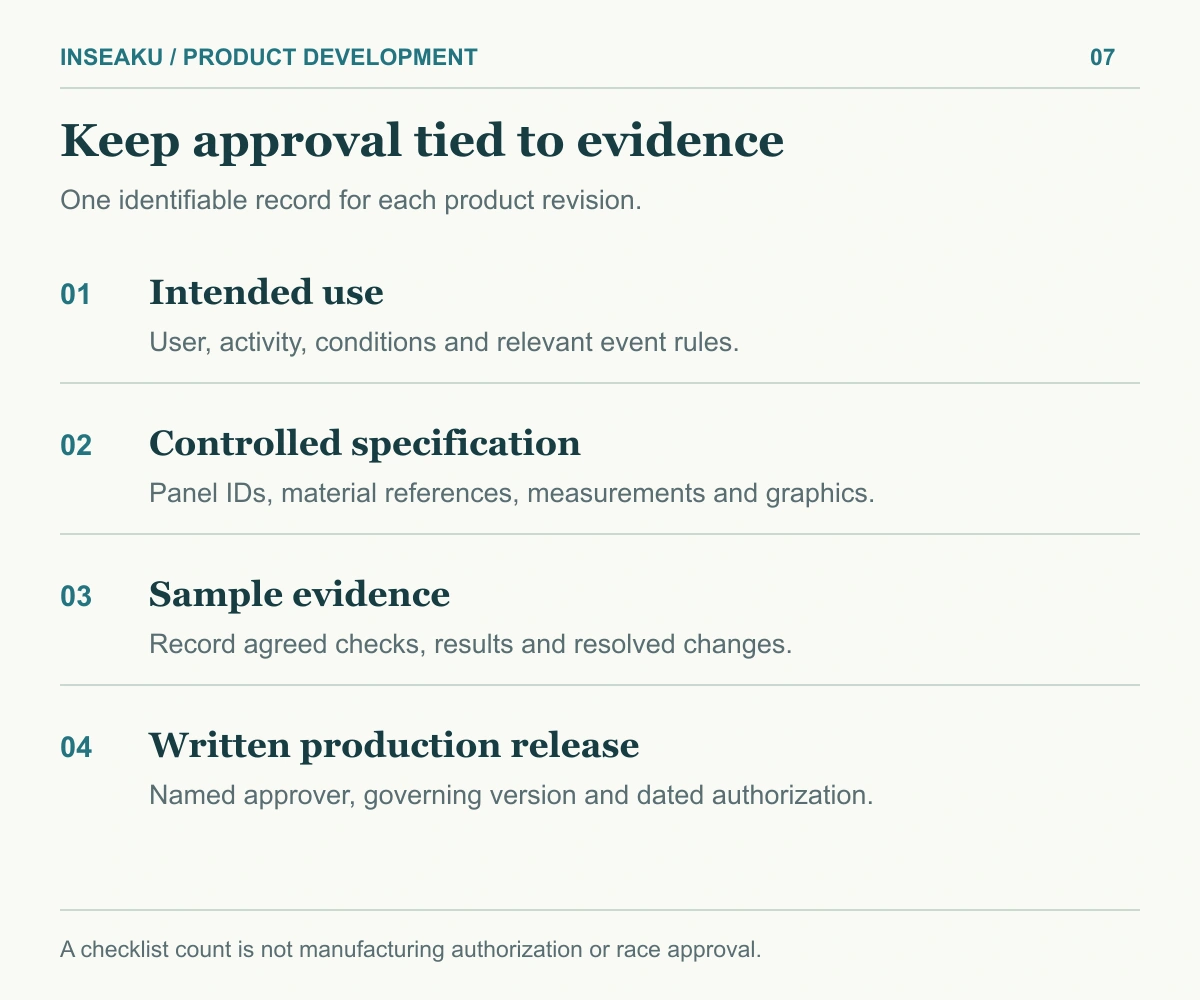
Send separate technical briefs for the swim and surf products, even if they share a brand, color palette or supplier. Shared artwork can reference one controlled file, but each style needs its own panel map, material list, measurements, intended-use statement and sample requirements.
The downloadable workbook provides two practical areas. Design brief places the two category specifications side by side, with a reference field for drawings or evidence. Approval register records eight review areas, owners, evidence references and decisions. Its open-item count tracks documentation status only. A row is not closed until its status, evidence, owner and dated decision are recorded; no spreadsheet result authorizes manufacturing by itself.
Include order quantities, size and color assortment, required samples, packaging and delivery scope in the RFQ. Ask which material combinations and constructions the supplier can support, which require development and which need external testing. Availability, MOQ, price and timing must be confirmed for the actual project.
To discuss feasibility, explore INSEAKU’s custom wetsuit design and manufacturing services, then send the project brief to our team. Include the intended activity, reference features, proposed materials, size range, quantities and any named-event requirements. The first useful response is a confirmed scope with open questions identified, followed by a sample plan that addresses them.
Frequently Asked Questions
Can a surfing wetsuit be used for a triathlon?
Possibly, but do not assume suitability or eligibility. The actual suit must meet the applicable event requirements, and the wearer should assess swimming comfort and removal. A surf product’s category label alone neither approves nor disqualifies it.
Can a triathlon wetsuit be used for surfing?
Check the manufacturer’s intended-use and care guidance. A swim-focused surface may not be specified for repeated board contact. Do not advertise crossover use without suitable construction and evaluation evidence.
Is a thicker triathlon wetsuit always better?
No. Thickness distribution is only one part of the design. The intended swimmer, movement, fit, construction and applicable race restrictions all matter. A maximum permitted thickness is not a recommended thickness for every panel.
Are all surf wetsuits chest zip and all triathlon wetsuits back zip?
No. Surf entry systems include back zip, chest zip and zipless constructions. Specify and assess the actual opening and closure rather than using zipper position as the product definition.
Can one approved sample cover both product categories?
Only if the agreed scope and evidence genuinely cover every intended use and construction. A shared color or material does not establish that. Distinct styles should retain identifiable samples, specifications and approvals; crossover claims need their own supporting evidence.
References and Further Reading
Sources checked on 29 September 2026. Brand pages describe those brands’ products; they are not independent test reports or endorsements of INSEAKU. The development checklist and diagrams are editorial guidance.
- Orca — Athlex Float V2 Men Triathlon Wetsuit. A model-specific example of buoyancy distribution, upper-body elasticity, surface treatment, transition features and swimming-use care limits.
- Orca — Tango 3:2 V2 Men Surf Wetsuit. A surf-specific example of exterior fabric, knee reinforcement and seam construction.
- O’Neill — Do I Need a Back Zip, Front Zip or Zipless Wetsuit?. Context for surf entry-system access and flexibility trade-offs.
- World Triathlon — Triathlon FAQs. Wetsuit thickness, coverage and use guidance. Confirm the governing rules and event instructions before making eligibility claims.