
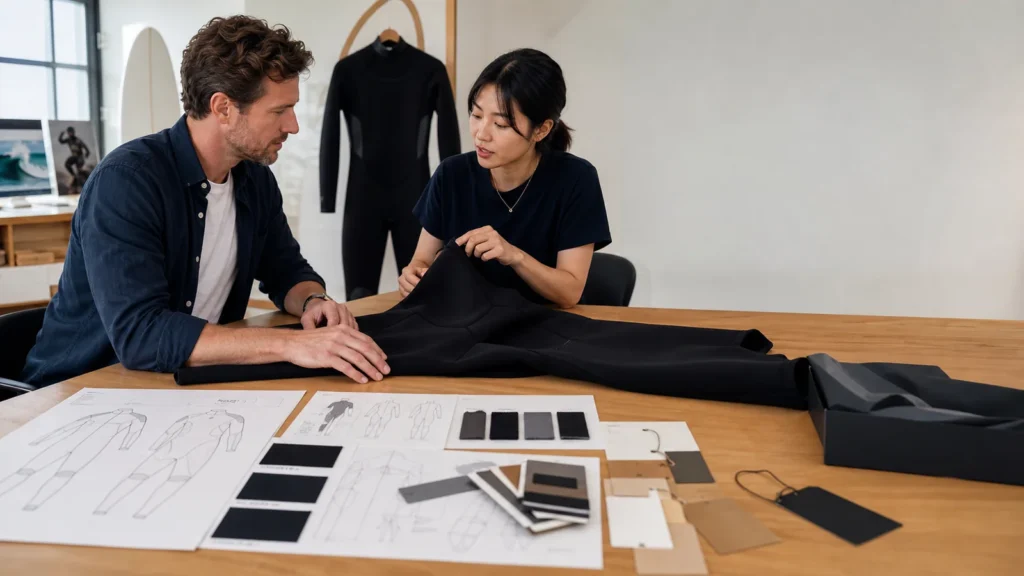
Short answer: When comparing OEM vs ODM wetsuits, do not choose by the acronym alone. At INSEAKU, OEM means the buyer provides the design and specifications; ODM means the manufacturer supports development from a product idea through design, samples and production; and private label means applying your brand, labels and packaging to a proven wetsuit solution. Put the actual deliverables, customization limits, intellectual-property terms, sample approvals, MOQ and lead-time assumptions in writing before development begins.
These three manufacturing routes can produce a good wetsuit, but they start with different inputs and assign different work to the brand and manufacturer. The right choice depends on what your team already owns, how much product differentiation you need, how quickly you want to launch and which development risks you are prepared to manage.
This guide is for water-sports brands, retailers, importers, dive centers and product teams choosing a development route. If you are still comparing factories, begin with our guide on how to find a wetsuit manufacturer, then use this comparison to define the project you will ask shortlisted suppliers to quote.
OEM vs ODM Wetsuits: Quick Comparison with Private Label
The simplest distinction is the project’s starting point. OEM starts with a buyer-controlled specification. ODM starts with a product objective that still requires development. Private label starts with a proven base solution that will be adapted and branded for the buyer. Actual boundaries should always be confirmed in the quotation.
For buyers comparing private label vs OEM wetsuits, the key question is how much product engineering already exists and who will own the development work.
| Decision factor | OEM wetsuits | ODM wetsuits | Private-label wetsuits |
|---|---|---|---|
| Starting point | Buyer design, tech pack or controlled specification | Buyer concept, use case, reference product or performance brief | Manufacturer’s proven base style or solution |
| Manufacturer’s main role | Review manufacturability, sample, produce, inspect and deliver | Help translate the idea into design, pattern, specification, samples and production | Configure available options, add branding and prepare a retail-ready presentation |
| Typical customization | High, within material, equipment, safety and commercial constraints | High, but development responsibility must be defined | Focused on selectable materials, colors, logos, labels and packaging |
| Pattern and fit work | Buyer-controlled pattern or pattern developed to the buyer’s approved specification | Manufacturer supports pattern and fit development from agreed inputs | Usually begins from an existing fit platform, with agreed modifications |
| Development workload | Higher on the buyer before the first quotation | Shared between buyer and manufacturer | Lower when the base solution requires few changes |
| Time to a production-ready sample | Efficient when the tech pack is complete and internally consistent | Longer when concept, pattern or performance decisions remain open | Usually the most direct route when a suitable base style is available |
| IP questions | Buyer files, approved adaptations and manufacturer background tools must be separated in writing | Newly developed design, pattern and know-how require explicit ownership and permitted-use clauses | Buyer owns its brand assets; rights to the base design and exclusivity must be stated separately |
| Best suited for | Brands with a defined product and technical control | Brands that need development support or a new product architecture | Brands, retailers or programs prioritizing a faster, lower-complexity launch |
Important: none of these columns is a guaranteed cost or timeline. A simple OEM project can move quickly; an incomplete OEM tech pack can create more revisions than a well-defined ODM project. Compare the work actually included, not the model name.
How INSEAKU defines OEM, ODM and private label
Supplier websites and sales teams sometimes use OEM and ODM in opposite ways. That makes an unlabeled comparison unreliable. For clarity, the following definitions match the service model used in INSEAKU quotations and project discussions:
- OEM manufacturing: you provide the design and specifications. INSEAKU reviews manufacturability and handles sampling, production, quality control and delivery.
- ODM development: you provide the market need, product concept, references and commercial targets. INSEAKU supports the route from concept and design through samples and full-scale production.
- Private label: you select an appropriate proven wetsuit solution and add agreed branding, labels and packaging, with defined options for materials, colors and details.
These definitions are also summarized on our OEM and ODM wetsuit manufacturing services page. If another supplier uses different labels, ask it to complete the same responsibility table before comparing quotations.
What does OEM wetsuit manufacturing involve?
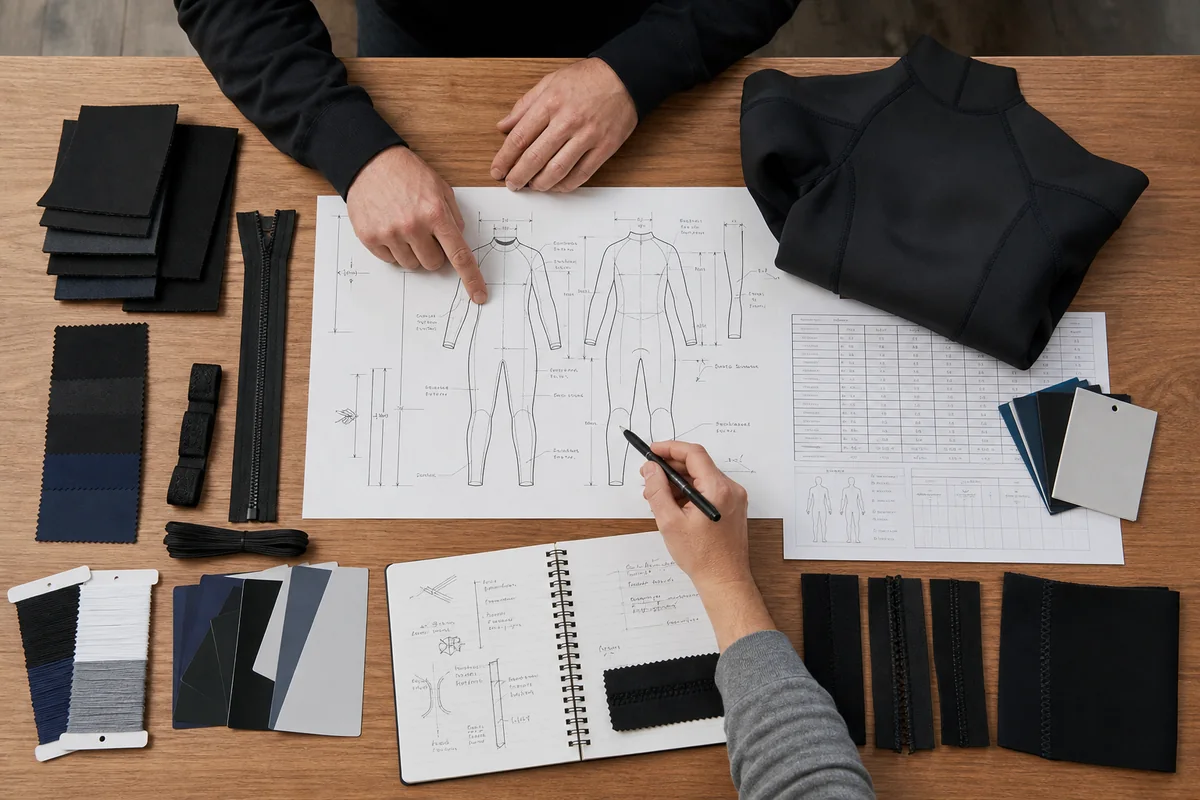
OEM is the most controlled route when your brand already knows what the product should be. A useful OEM package is more than a sketch. It connects intended use, fit, construction, materials, components, branding, packaging, quality requirements and commercial quantities.
What the buyer should provide
- product category and intended use;
- technical drawings or reference sample;
- measurement chart, points of measure and tolerances;
- size range and quantity by size;
- neoprene or foam requirement, lining, thickness and stretch direction;
- panel layout, seam construction, zipper and reinforcement details;
- logo artwork, colors, labels, hangtags and packaging files;
- target market, required tests and buyer-specific compliance requirements;
- sample stages, approval authority and target delivery date.
If the project is a freediving or spearfishing suit, the OEM specification should identify whether the interior is unlined open cell, coated or textile lined. Compare the engineering inputs in our open-cell vs lined wetsuit construction guide.
A manufacturer should not blindly reproduce conflicting instructions. It should identify feasibility problems and list proposed changes before sampling. Examples include a seam intersecting a high-stretch zone, an artwork method unsuitable for the selected laminate, a size chart that conflicts with the pattern, or a material lead time that misses the launch window.
When OEM is usually the better route
Choose OEM when product differentiation comes from your own fit, panel engineering, material map, construction or design language; when your team can approve technical decisions; and when consistent reproduction of a controlled specification matters more than selecting from an existing platform.
OEM is not automatically suitable only for large or established brands. A startup can use OEM if it has a complete specification, realistic development budget and someone responsible for technical approvals. Conversely, an established brand without available development resources may use ODM for a new category.
What does ODM wetsuit development involve?
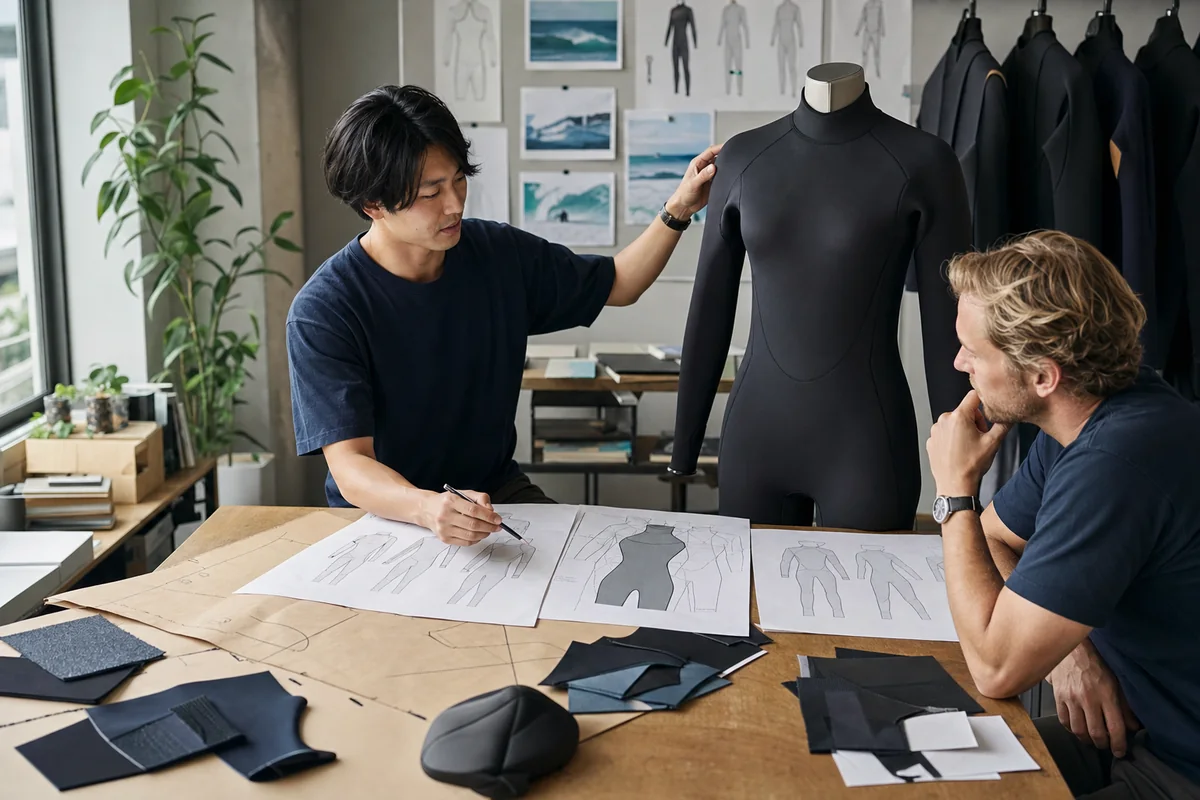
ODM begins earlier in the product-development process. The buyer may know the intended user, activity, price position, visual direction and performance target but may not yet have a production-ready pattern or tech pack. The manufacturer helps convert those inputs into a controlled design and sample.
Define the development work before paying for a sample
An ODM quotation should state which development outputs are included. Depending on the project, these may include:
- concept review and feasibility recommendations;
- material, thickness, lining and construction proposals;
- panel layout and pattern development;
- base-size measurements and size grading;
- logo, print and trim placement;
- prototype, fit sample and revised sample rounds;
- bill of materials and production specification;
- approved sample, change log and bulk-production release package.
The buyer still owns critical decisions. It must confirm target users, use conditions, price position, brand requirements, sample feedback and final acceptance. “The factory will design it” is not an adequate brief.
When ODM is usually the better route
ODM is appropriate when your brand has a clear market opportunity but needs technical development support; when entering a wetsuit category that your internal team has not engineered before; or when a collaborative process can produce a better specification than asking a factory to quote an incomplete design.
The main risk is ambiguity. If design responsibility, revision limits, pattern ownership and acceptance criteria are not defined, the buyer and manufacturer may assume that different work is included. Resolve that ambiguity before the first sample invoice.
What does private-label wetsuit manufacturing involve?
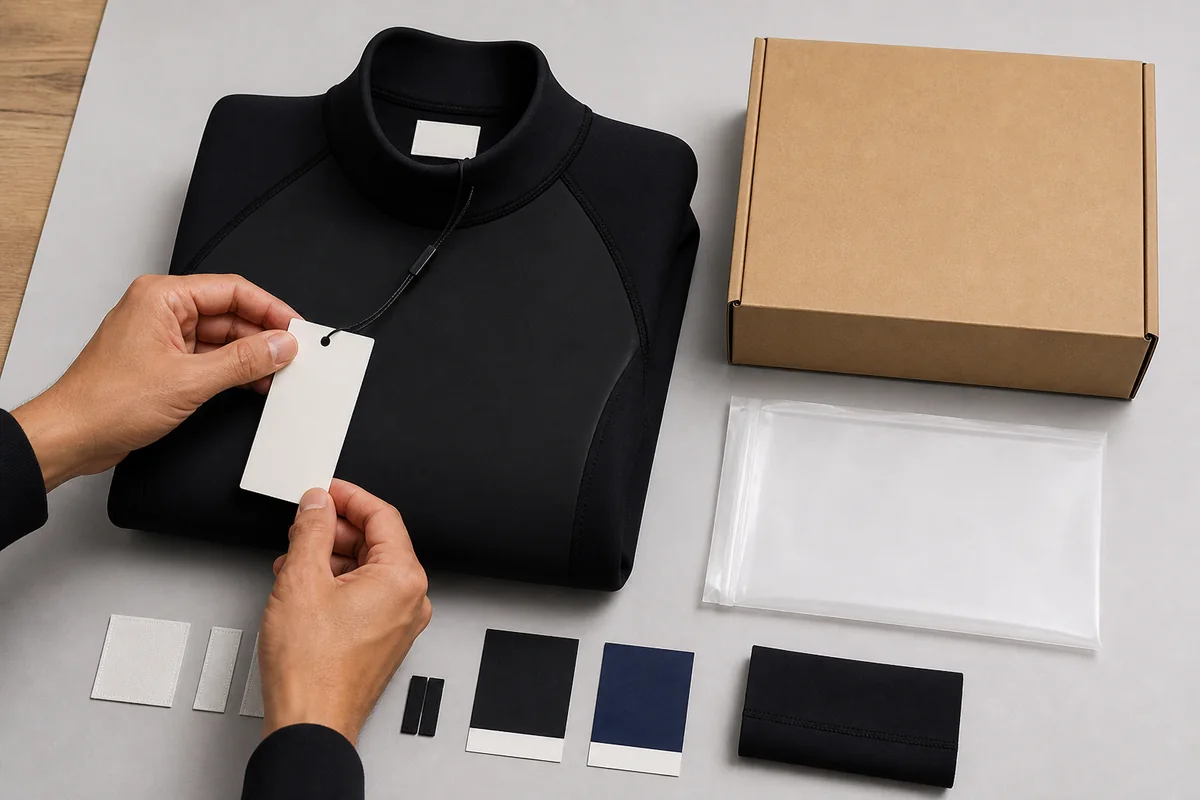
Private label is a focused route for selling a wetsuit under your own brand without developing every product element from zero. The project normally starts from a proven base solution and then defines the allowed changes.
Depending on the selected style, private-label options may cover:
- brand and logo placement;
- neck labels, size labels, care labels and hangtags;
- colors, prints and selected panel details;
- available materials and thicknesses;
- packaging, cartons and retail presentation;
- an agreed size assortment and order mix.
Private label is not automatically the same as ODM
Both routes may start from manufacturer knowledge, but the scope is different. Private label usually limits changes to an established product platform, which reduces development complexity. ODM may require new design, pattern or performance work. If a supplier calls both routes “OEM,” ignore the label and compare the defined work.
When private label is usually the better route
Private label can suit a retailer adding a branded range, a dive center launching rental or merchandise products, an emerging brand validating demand, or an established company filling a range gap without funding a completely new development.
Faster does not mean approval-free. The buyer should still inspect material, fit, construction, branding, label content and packaging before releasing production.
Founders choosing this route can use the 10-step private-label wetsuit brand launch guide to connect the manufacturing model with customer validation, range scope, startup cash, sample gates and launch readiness.
How should a brand choose between OEM, ODM and private label?
Use the questions below in sequence.
Whichever manufacturing route you choose, thickness must be converted into a panel, material, construction and approval specification. See our B2B guide to choosing neoprene thickness for wetsuit product lines.
1. Do you already have a production-ready tech pack?
If it defines measurements, tolerances, materials, construction, artwork, packaging and acceptance criteria, request an OEM review. If it is only a sketch or reference photo, the project still requires development and may fit ODM better.
2. Is a unique fit or construction central to your product?
If yes, choose a route that gives enough pattern, sample and testing control. OEM works when your team owns that specification; ODM works when you need the manufacturer to help develop it. A minimally modified private-label base may not create the differentiation you need.
If the closure system is part of that differentiation, define its entry opening, zipper or lock, barrier, drainage and pattern effects before sampling. Use this chest zip, back zip and zipless wetsuit comparison to frame those decisions.
3. Is speed to market more important than unique engineering?
If yes, evaluate private-label base styles first. Confirm that the available fit, materials and construction match the intended use; do not choose a base only because it is faster.
4. Who can make technical decisions during sampling?
OEM requires timely buyer approvals against a defined specification. ODM requires collaborative decisions about unresolved product details. Private label requires disciplined selection and branding approvals. Every route needs a named decision owner.
5. Which assets must be exclusive?
If your commercial advantage depends on a pattern, print, panel layout or technical feature, address ownership, exclusivity, territories, permitted reuse and confidentiality before development. Do not assume “OEM” or “ODM” answers the IP question.
How do cost, MOQ and lead time differ?
The manufacturing model affects cost and time indirectly because it changes the amount of development and uncertainty. The actual quotation still depends on product type, materials, thickness, seam construction, size assortment, artwork method, packaging, testing, quantity and delivery terms.
Material choice can change performance, sourcing evidence, sample timing and cost in every development route. Compare the complete foam, lining and lamination system in our wetsuit material selection guide.
Development and sample cost
OEM can require less manufacturer design work when the buyer provides complete files, but a complex proprietary design may require several fit and construction samples. ODM normally includes more development work and should state how many concepts, patterns and revisions are included. Private label can reduce development work when the selected base style needs only controlled changes.
Minimum order quantity
At INSEAKU, the standard MOQ starts from 50 pieces per style. The final MOQ depends on material availability, colors, size assortment, branding method and packaging. Ask whether the minimum applies per style, color or material and whether any component supplier has a separate minimum.
Sample lead time
Sample development can start from approximately 7 working days after specifications, materials and artwork are confirmed. Complex patterns, special materials, custom printing, multiple sizes or unresolved approvals may require more time. A useful schedule states what “day one” means and excludes buyer-response time explicitly.
Bulk-production lead time
Do not request a firm bulk date before the order quantity, material route, sample status and capacity window are known. Build the schedule backward from the required delivery date through shipping, final inspection, packing, production, material receipt and pre-production approval.
Compare current MOQ, sample-cost conditions and production lead time before selecting an OEM, ODM or private-label manufacturing route.
For international delivery, identify the Incoterms® rule and named place in the quotation. Incoterms allocate specified transport-related tasks, costs and risks, but they do not replace product specifications, payment terms, title transfer or IP clauses.
Who owns the design, patterns and project files?
Manufacturing labels do not determine ownership. Your contract should separate at least four categories:
- Buyer background IP: existing brand assets, drawings, measurement charts, designs, data and know-how supplied by the buyer.
- Manufacturer background IP: pre-existing patterns, methods, templates, tools, production know-how and base solutions supplied by the manufacturer.
- Project-created IP: new patterns, specifications, artwork adaptations, fixtures or other outputs created during development.
- Confidential project information: prices, launch dates, unreleased products, supplier information, samples and commercial plans.
The agreement should state who owns or may use each category, whether rights are exclusive, whether the manufacturer may retain production files, how long confidentiality lasts, what happens after termination and which files or physical tools must be returned or destroyed.
WIPO advises that an NDA should define the confidential information and the recipient’s permitted use, including when a supplier is performing development or manufacturing. WIPO also notes that supplier IP agreements are important because ownership can become unclear when a supplier contributes to product design or development.
INSEAKU can handle confidential designs, patterns and unreleased branding under an agreed NDA before sensitive project files are shared. Buyers should obtain qualified legal advice for the jurisdictions and assets involved.
How should sample approval and bulk-production release work?
A verbal “sample looks good” is not enough. The release record should connect the physical sample to the correct specification, measurements, material list, artwork and packaging.
- Project brief: define intended use, target user, market, product category, quantity and launch timing.
- Route and responsibility review: select OEM, ODM, private label or a hybrid scope and name each deliverable.
- NDA and file exchange: protect confidential information before sharing sensitive drawings, unreleased artwork or commercial data.
- Specification and quotation: confirm inclusions, exclusions, materials, sample stages, MOQ, payment and schedule assumptions.
- Sample development: create the agreed prototype or branded sample and record its version.
- Fit and construction review: measure the sample, test the intended functions and record nonconformities.
- Controlled revisions: document every requested change, owner, effect on price or timing and resulting version.
- Pre-production approval: freeze the bill of materials, measurements, pattern version, artwork, labels, packaging and approved sample.
- Bulk-production release: issue a dated written authorization identifying the approved reference.
- Production and final inspection: inspect against the frozen specification and agreed quality plan before shipment.
Whichever manufacturing route you select, apply one custom wetsuit sampling process to control prototypes, revisions, the pre-production reference and written bulk release.
After choosing a development route, review how tech packs, patterns, samples and written approvals move through the wetsuit manufacturing process.
Whichever manufacturing route you choose, define the inspection evidence and release gates in a written wetsuit quality control checklist before sample approval and bulk production.
The development route should also define how fit, mobility and leakage will be verified. Use this wetsuit fit and seam-leak testing protocol before signing the sealed-sample release.
If the approved product will serve a dive-center fleet, connect the release record to a rental wetsuit size, identification, care and cost-per-use plan before bulk production.
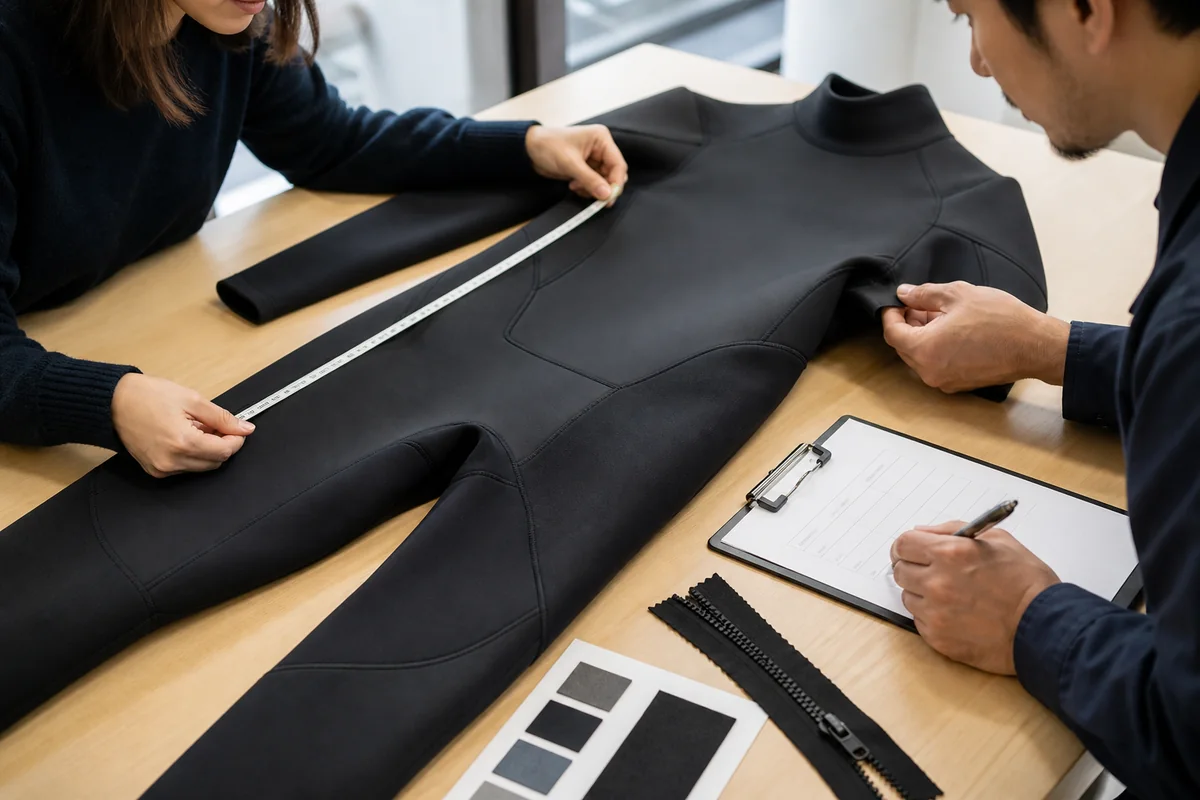
What should you include in an OEM, ODM or private-label RFQ?
Send the same structured brief to each candidate so that quotations are comparable.
If seam construction is part of the development scope, compare flatlock, GBS, taped and liquid-sealed wetsuit seams before assigning design responsibility.
Use our wetsuit tech pack template and RFQ checklist to control drawings, measurements, materials, artwork, quantities and open decisions in one revision.
- company, market and sales channel;
- product category and intended use;
- requested manufacturing route and a plain-language responsibility scope;
- what you will provide: tech pack, sketch, reference sample, measurement chart or branding files;
- what you need the manufacturer to develop;
- materials, thickness, construction, zipper and reinforcement requirements;
- size range and estimated quantity by size;
- logo, print, labels, hangtags and packaging;
- target market and required testing or documentation;
- sample types, included revision rounds and approval owners;
- required delivery date, destination and requested Incoterms rule;
- IP, NDA, exclusivity and file-delivery requirements;
- quotation validity, payment terms and explicit exclusions.
Do not send your most sensitive files to an unverified contact simply to obtain a rough price. Begin with a non-confidential brief, verify the company and factory relationship, agree confidentiality where needed and then release controlled information.
Frequently asked questions
What is the main difference between OEM and ODM wetsuits?
Under INSEAKU’s definitions, OEM begins with the buyer’s design and specifications, while ODM includes manufacturer support in developing the product from a concept or brief. Because suppliers may use the terms differently, define the inputs, outputs and responsibilities in writing.
Is private label the same as OEM?
Not in this framework. Private label begins with a proven base solution and focuses on agreed product options, branding, labels and packaging. OEM executes a buyer-controlled product specification. Another supplier may use “OEM” as a broad label for both, so compare scope rather than terminology.
Which model has the lowest MOQ?
No model guarantees the lowest MOQ. At INSEAKU, the standard MOQ starts from 50 pieces per style, while the final minimum depends on materials, colors, size assortment, branding method and packaging. A private-label base may simplify development but can still have component or color minimums.
How long does a wetsuit sample take?
INSEAKU sample development can start from approximately 7 working days after specifications, materials and artwork are confirmed. New patterns, complex construction, special materials, multiple revisions or delayed buyer feedback can extend the schedule.
Who owns an ODM wetsuit pattern?
The word ODM does not decide ownership. The development agreement should identify pre-existing manufacturer patterns, buyer-owned assets and newly created project files, then state ownership, exclusivity, permitted reuse, retention and delivery rights for each.
Can a startup use OEM wetsuit manufacturing?
Yes, if it has a sufficiently complete specification, realistic budget and someone qualified to approve technical decisions. A startup with only a product idea may obtain a more accurate scope through ODM development or test demand through a suitable private-label solution.
Can one project combine OEM, ODM and private-label elements?
Yes. For example, a brand may begin with an existing fit platform, request ODM changes to selected panels and supply OEM artwork and packaging files. Describe the project as a hybrid scope and list each deliverable, cost, revision allowance, owner and approval gate.
Turn the manufacturing model into a written project scope
The best route is the one that matches your current inputs and makes responsibility visible. Before requesting a final quotation, decide what your brand will supply, what the manufacturer must develop, which assets require exclusivity and who can approve the sample.
To discuss an OEM, ODM, private-label or hybrid wetsuit project, review our custom manufacturing capabilities and send your product brief for a manufacturing review. Include intended use, target market, design status, quantity, size range, materials and timing so the discussion starts with a defined scope.
References and further reading
- WIPO — Non-Disclosure Agreements to Protect a Venture’s Intellectual Property
- WIPO — IP Agreements with Suppliers: What Ventures Need to Know
- International Chamber of Commerce — Incoterms® and Commercial Contracts
Last reviewed: August 31, 2026. INSEAKU reviewed the service definitions, standard MOQ, indicative sample timing, pattern and design-development capability, confidentiality approach and approval workflow used in this article. Project-specific terms remain subject to the written quotation and agreement.