
Comparing wetsuit manufacturing cost starts with a question that a price list cannot answer: are the factories quoting the same product and the same responsibilities? A lower unit price may reflect a different foam grade, less seam reinforcement, a larger order, or charges that appear elsewhere. A higher price is not proof of better quality either. The useful comparison is a documented, like-for-like offer.
This guide shows brand buyers how to compare wetsuit quotes, separate development spending from bulk production, identify exclusions and prepare a clear follow-up request. The worked example is hypothetical. It is not an INSEAKU quotation, an industry price benchmark or a forecast of your project cost.

How do you compare wetsuit manufacturing cost fairly?
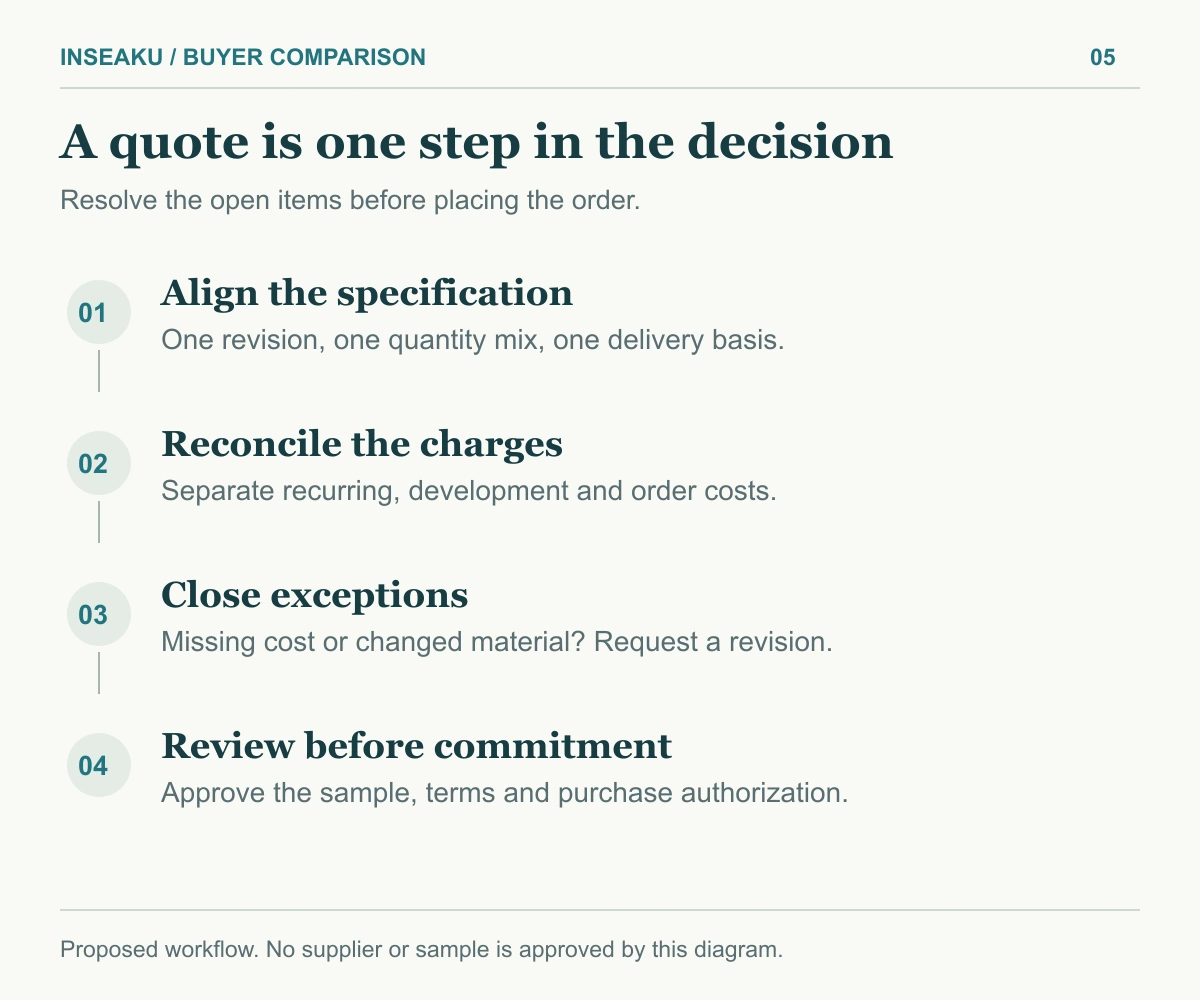
Send the same specification revision and quantity breakdown to each factory. Ask for a written list of inclusions, exclusions and deviations. Compare recurring production charges separately from one-time development costs, then add only the costs needed to reach your chosen comparison boundary. Keep delivery timing, payment exposure and unresolved technical issues visible beside the totals.
- Freeze the product specification and order mix.
- Request unit prices, separate charges and quote validity.
- Confirm the delivery term, named place and currency.
- Reconcile costs without counting any charge twice.
- Resolve exceptions before selecting a supplier.
Download the wetsuit quote comparison workbook. It includes a blank three-supplier comparison, a scope checklist and the editable worked example below.
1. Give every factory the same specification
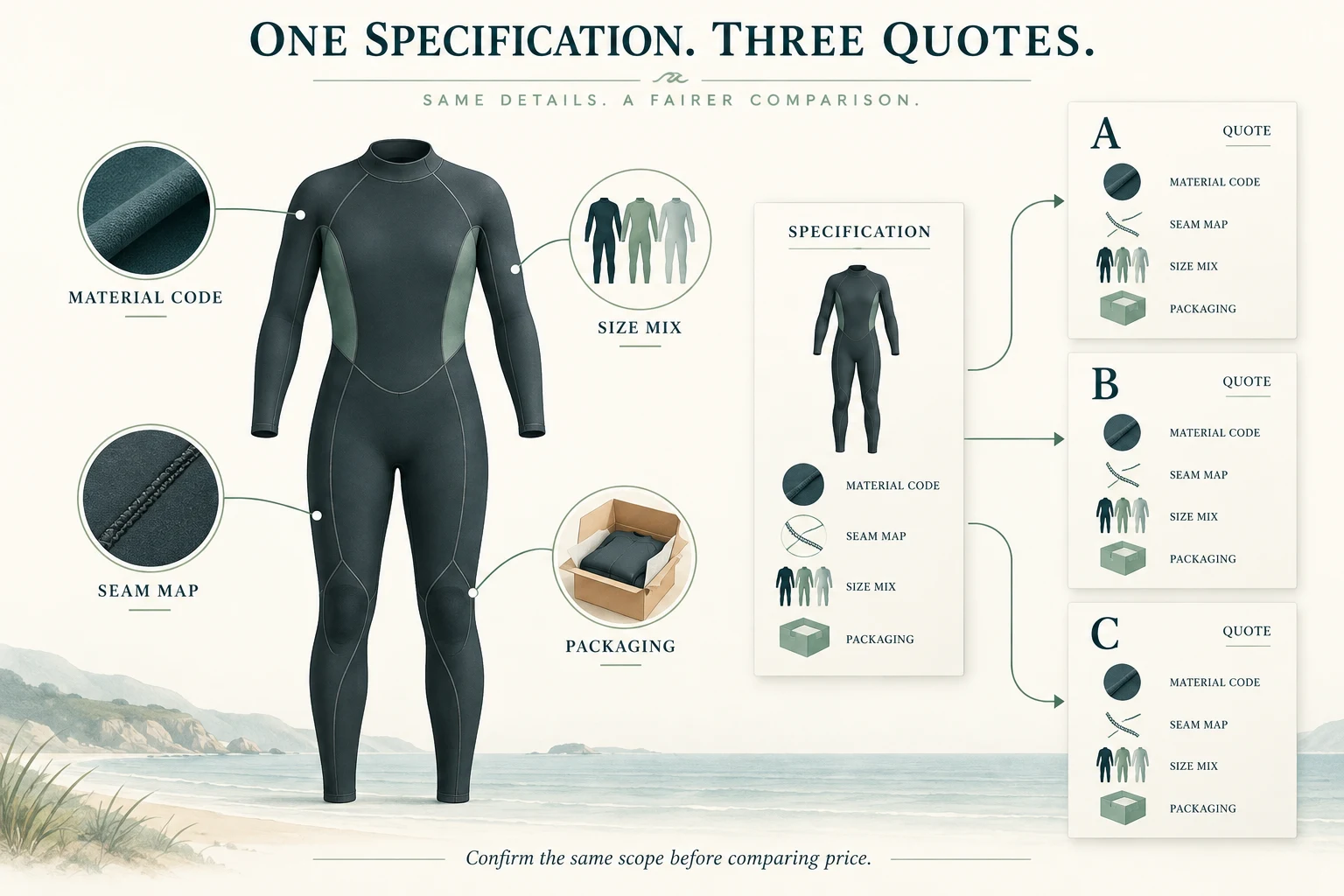
“Adult 3 mm wetsuit with our logo” leaves too much open. Two factories can answer that request honestly while proposing different garments. Use a style code, revision date and supporting files so the quoted product is identifiable. Our wetsuit tech pack and RFQ checklist helps assemble those inputs; this article focuses on comparing the offers that come back.
| Specification area | What should match | What to flag |
|---|---|---|
| Foam and surfaces | Material code, panel thickness, inside lining and outside finish | A generic material name or an undisclosed substitute |
| Construction | Pattern revision, entry system, seam map, taping and reinforcement | “Same as photo” without a construction schedule |
| Branding | Artwork revision, print method, colors, locations and labels | Setup or additional print locations priced later |
| Order mix | Units by style, thickness, color and size; price per suit or set | A unit price based on a different quantity tier |
| Inspection and packing | Acceptance criteria, agreed checks, labels, bags and cartons | Unpriced tests, retail packaging or extra inspection |
Require suppliers to mark each item as confirmed or as an explicit exception. A blank cell is an unanswered question, not agreement. If you accept an alternative material or construction, compare that as a separate version. Do not quietly overwrite the baseline and continue ranking the numbers as though nothing changed.
2. Trace price differences to specific product decisions
Ask what is different before asking why one factory is more expensive. The objective is not to obtain confidential factory accounting. It is to understand whether the proposed price buys the features and service scope your brand actually needs.
Materials and panel allocation
Specify foam identity, supplier grade where relevant, lining, outer textile and nominal thickness by panel. Ask suppliers to identify substitutions before quoting them as equivalents. A familiar material description does not establish identical stretch, surface treatment or supply conditions. Use the wetsuit material selection guide to define requirements instead of treating a marketing label as the full specification.
Seams, entry systems and branding
Compare the actual seam schedule: construction method, taped locations, edge finishing and reinforcement coverage. “Taped seams” may not describe the same coverage in two offers. The seam construction comparison provides background; the quote should identify which seams receive which treatment. Also check zipper specification, logo applications, artwork setup, label sets and any separate charge for another print location.
Quantity and assortment
Show the same quantities by variant to every supplier. A price for one color in a large run is not automatically available for several colors split into small runs. Ask whether minimums apply to the total order, a style, a material, a color or another purchasing unit. Avoid translating one supplier’s minimum into a universal factory rule. Our MOQ, sample cost and lead-time guide explains the questions to resolve.
3. Separate development, production and other charges
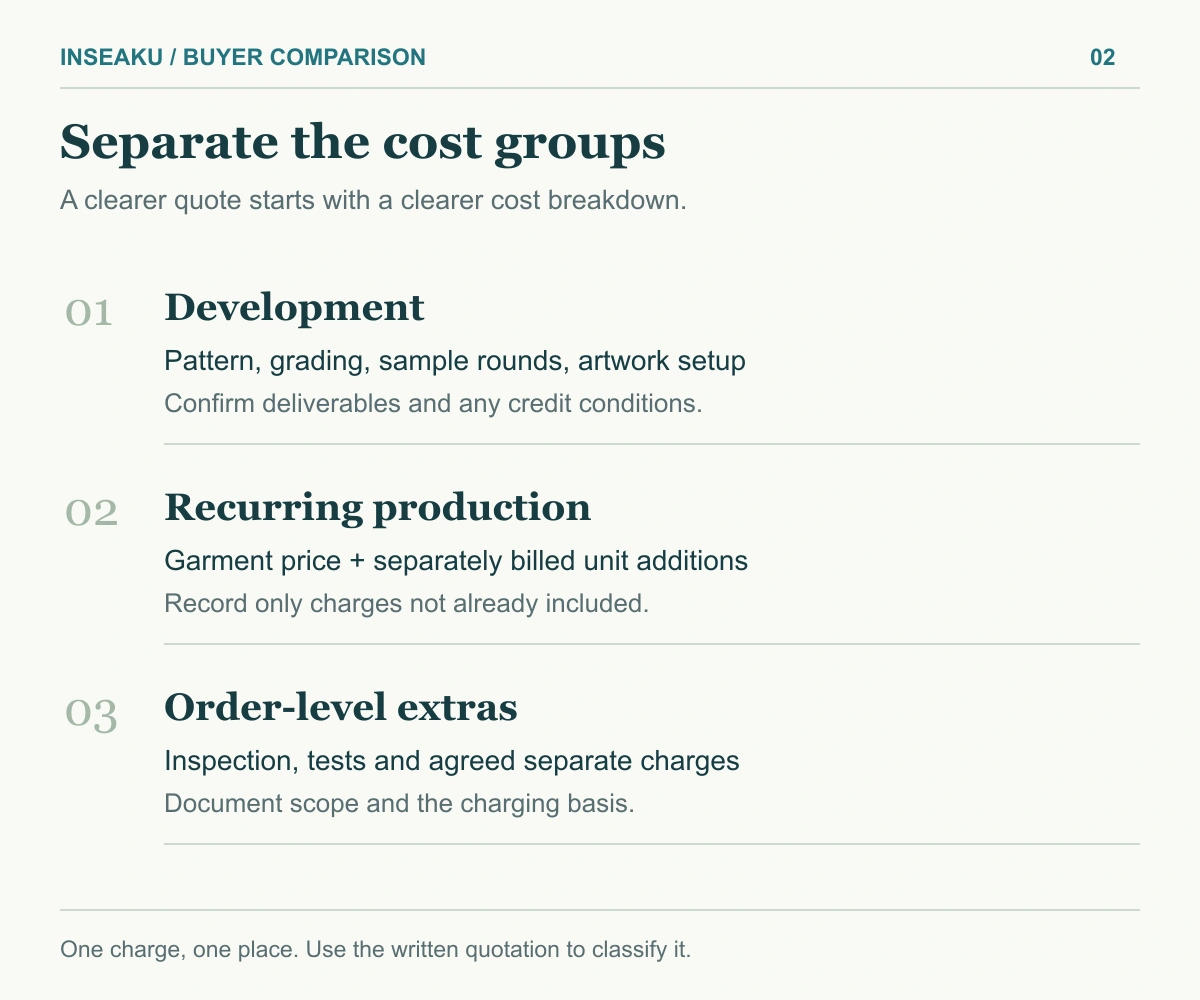
Keep the quoted unit price visible, but do not make it carry every decision. Organize costs into three groups:
- Development: pattern work, grading, sample rounds, artwork setup or other agreed one-time work.
- Recurring production: garment price and any per-unit additions not already included, such as agreed labels or individual packaging.
- Order-level extras: separately billed inspection, testing, handling or other charges within the comparison boundary.
Classify a charge by the actual offer, not by its name. A setup charge might recur when artwork changes; a sample fee might be credited only after an eligible bulk order. Record whether a credit is confirmed, conditional or unavailable, and when it is applied. Do not deduct a possible future credit as though it has already been earned.
Ask what the development fee delivers: how many sample rounds, which sizes, what revision work and what file access or usage rights are included. Record these terms rather than assuming that paying a fee gives unrestricted ownership of every development asset. For sample-stage decisions, refer to the custom wetsuit sampling process.
4. Set one delivery and currency basis
Write down the commercial boundary before adding totals. For example, you might first compare the specified goods and agreed preparation charges, then build a separate estimate to your warehouse. An export-port offer and a destination-delivered offer cover different responsibilities; the headline prices cannot be compared without reconciling the scope.
Where Incoterms are used, record the rule, precise named place or port and version. ICC explains that these rules allocate delivery-related obligations, risk and costs, but do not determine product specifications or payment terms. Agree those separately. See ICC’s Incoterms guidance.
Use one comparison currency and a documented conversion date if the offers use different currencies. Keep the original amount and the conversion assumption. Confirm quote expiry, payment stages and the event that starts the production clock. “Ready to ship” and “arrives at your warehouse” are different milestones.
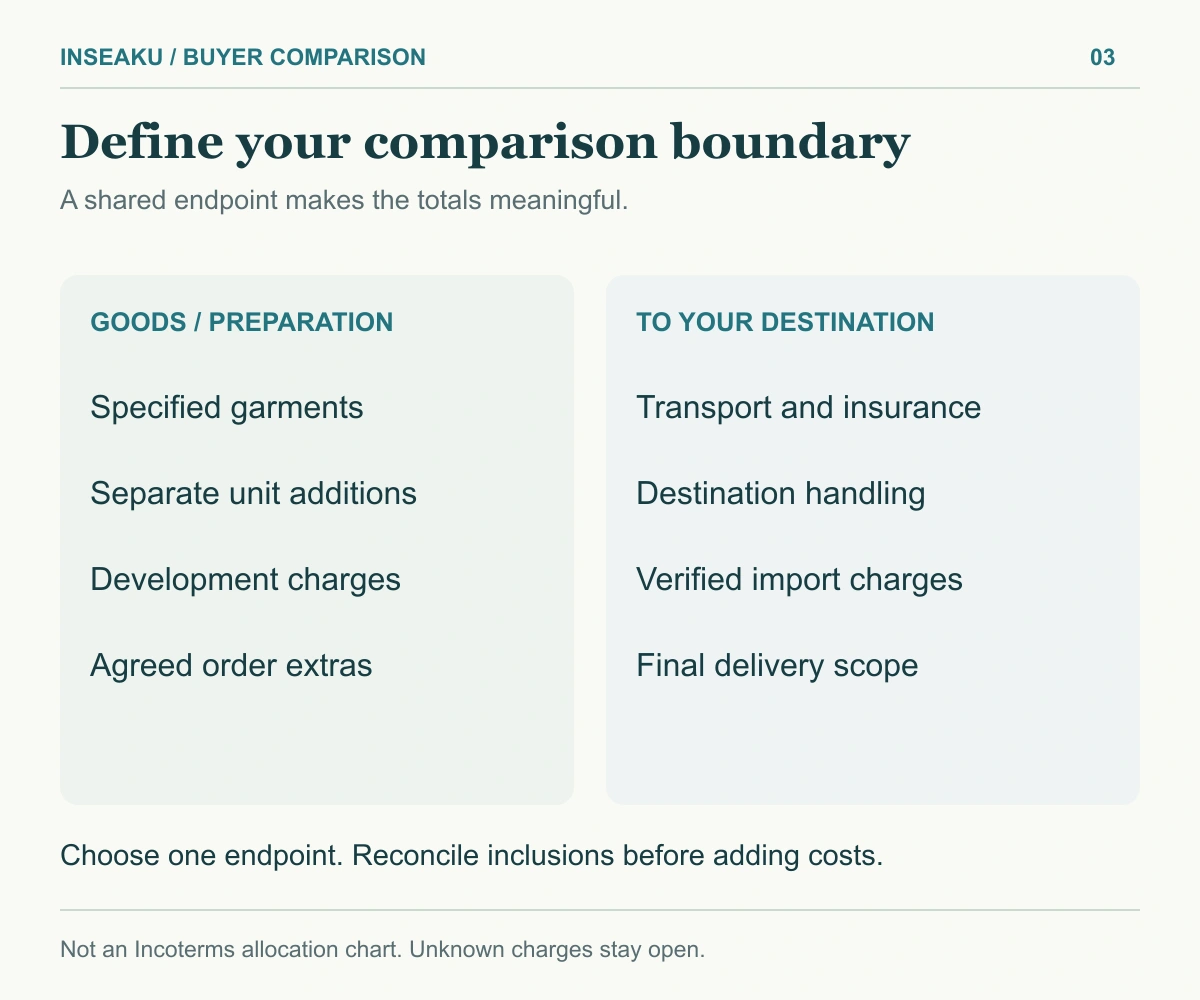
A full landed-cost exercise needs destination-specific inputs beyond this article’s simple example. Do not fill unknown freight or import charges with zero. Verify applicable classification, duties, taxes and handling with an appropriate logistics or customs professional. The downloadable sheet calculates only the cost categories you explicitly enter; it does not calculate customs duties or determine tax treatment.
5. Compare a first-order total, not just a unit price
Consider two fictional offers for the same approved specification and an assumed order of 300 suits. Both use USD and the same agreed comparison boundary. No supplier names or actual market prices are implied.
| Cost item | Quote A | Quote B |
|---|---|---|
| Quoted garment price per suit | $48.00 | $50.00 |
| Separate packaging per suit | $1.50 | $0.00, included |
| Recurring amount per suit | $49.50 | $50.00 |
| Production and packaging subtotal | $14,850 | $15,000 |
| Development, charged once | $600 | $300 |
| Separate agreed inspection charge | $150 | $0, included |
| First-order comparison total | $15,600 | $15,300 |
| First-order cost per ordered suit | $52.00 | $51.00 |
Calculation: first-order comparison total = quantity × (quoted garment price + separate recurring additions per suit) + development charges + other separate order charges. Divide that total by the ordered quantity for the first-order cost per ordered suit. This is not a cost per accepted or saleable suit.
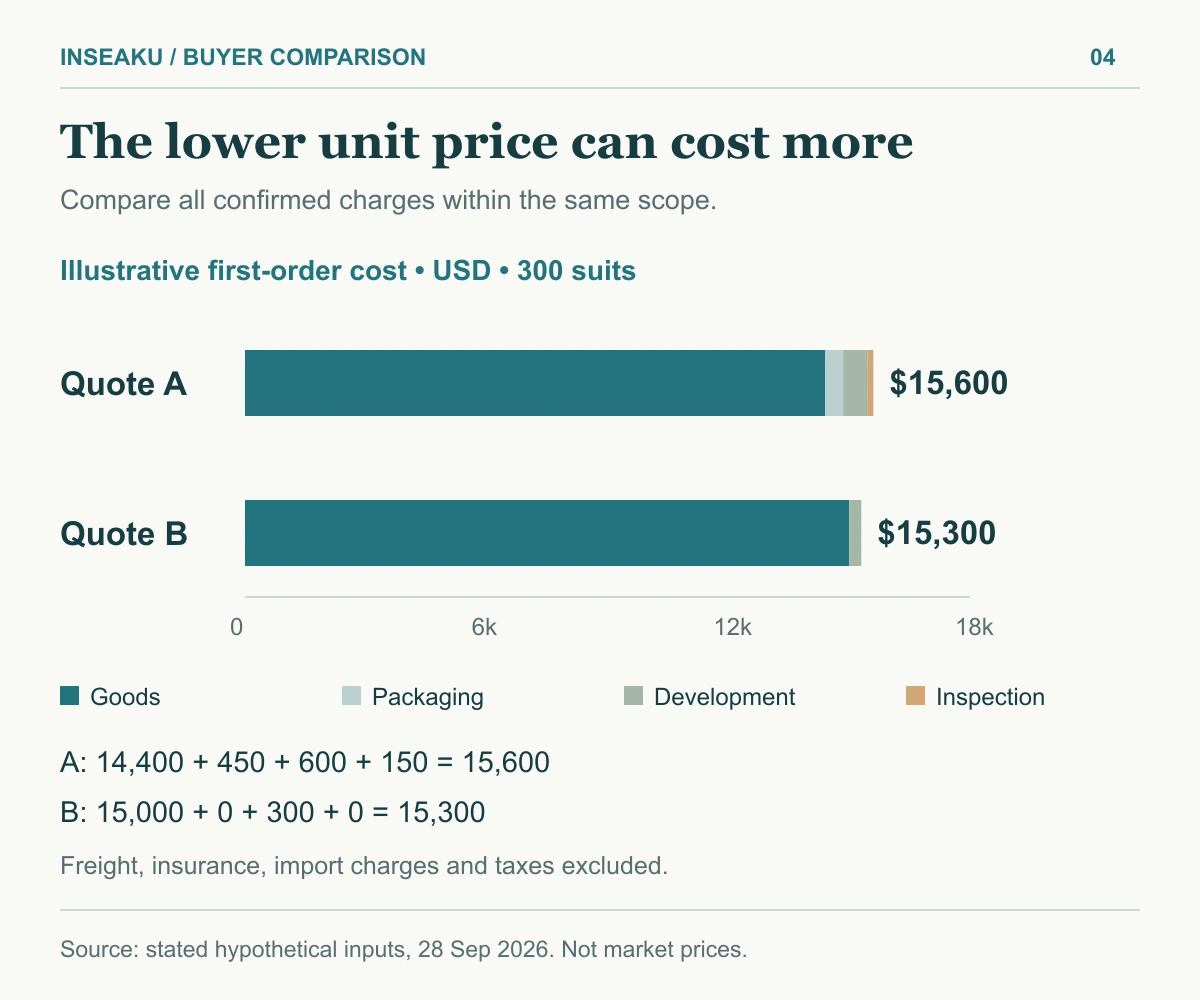
Quote A starts $2 lower per suit, but its first-order total is $300 higher under these assumptions. After separating one-time development, the recurring amount is $49.50 versus $50.00. Neither number establishes who should win a real order: the result depends on the confirmed specification, inclusions, quantity and acceptance requirements.
For a reorder, obtain a new quote. Do not simply remove every charge labeled “development” and reuse the old total. Artwork changes, revised materials, changed quantities or a new sample requirement can change the commercial scope. Do not spread a first-order fee across hoped-for future sales to make today’s commitment appear smaller.
6. Keep unresolved questions beside the price
A spreadsheet should expose missing information, not reward it with a low total. Enter zero only when a charge is confirmed as included, waived or not applicable. Leave unknown amounts blank and request clarification. Keep the supplier’s original quotation and revision so every input can be traced.
The workbook offers three supplier columns, one shared order quantity and comparison currency, and fields for each supplier’s quote reference, delivery basis, validity and payment terms. Yellow cells are inputs. Calculated totals stay blank when required numeric fields are missing or invalid. A separate scope-confirmation field remains a human decision; a calculated amount does not prove that the offers are equivalent.
Use the scope checklist to record exact requirements, each supplier’s response and unresolved exceptions. If one supplier changes the material or seam map, request a revised baseline offer or keep that version outside the like-for-like comparison. A substitute with a lower price may be worth discussing, but it answers a different purchasing question.
7. Review quality, timing and payment before selection
Price is only one part of the purchase decision. Establish the inspection plan, acceptance criteria, responsibility for corrections and the point at which shipment can be released. A quoted inspection charge is not proof of an agreed inspection scope. Use the wetsuit quality-control checklist to frame the evidence you need.
Compare dates on the same basis: sample approval, material confirmation, production completion, inspection, dispatch and estimated arrival. Ask which approvals or payments each stage depends on. A shorter quoted production interval can still miss your launch if it begins after an unresolved development stage.
Record payment amounts, triggers and documents separately from the comparison total. Two offers with the same total can create different cash commitments before inspection. Also ask how the supplier handles an approved change, a failed check and a shipment delay. Keep those responses attached to the decision; do not convert uncertain quality or delay assumptions into invented savings.
8. Send one focused clarification request
When a quote is incomplete, consolidate your questions so the supplier can return a controlled revision. The U.S. International Trade Administration’s pro forma invoice guidance highlights unit and extended prices, delivery terms, payment terms, estimated shipping date and validity. Add the wetsuit-specific specification references and exceptions your project needs.
Please revise your quotation against specification [style/revision] and the attached size/color quantities. Confirm the material codes, panel thickness, seam map, branding and packaging. Show the bulk unit price, all separate per-unit additions, development charges and order-level extras. State the currency, delivery rule and named place where applicable, quote expiry, payment stages and timing assumptions. Mark every exclusion or deviation explicitly, and identify any credit that depends on a later order.
For a new INSEAKU project, start with INSEAKU’s OEM, ODM and private-label manufacturing services and define the development route before asking for a comparable offer. Send your completed specification and comparison questions through the INSEAKU contact page. Share only documents you are authorized to disclose; you can summarize another supplier’s scope without forwarding its confidential quotation.
Frequently asked questions
How much does wetsuit manufacturing cost?
There is no reliable universal unit price for an unspecified wetsuit. Request a current quote tied to the material, construction, quantity, branding and delivery scope. The numbers in this guide demonstrate comparison arithmetic only; they are not a price range.
Can I compare two quotes with different order quantities?
You can review them, but they are not a like-for-like buying decision. Ask both factories to price your actual quantity and assortment. Do not assume a large-order unit rate applies to a smaller order.
Should sample and development fees be included?
Show them separately and include the relevant charges in the first-order project comparison. Also show recurring production cost without one-time charges. Record conditional credits separately until their conditions are satisfied.
Does an included inspection mean identical quality control?
No. Confirm the inspection scope, method, acceptance criteria, reporting and correction responsibilities. The word “included” describes charging, not the adequacy of the quality plan.
Is the lowest normalized quote the best supplier?
Not automatically. After aligning costs, review sample results, technical exceptions, timing and payment exposure. Select against the requirements of the project, with unresolved issues documented before commitment.
References and Further Reading
- International Chamber of Commerce (ICC): Incoterms® and Commercial Contracts. Official guidance on delivery obligations, allocation of costs and transfer of risk. Supports Section 4’s explanation of the delivery basis and the need to identify the chosen rule, named place and version.
- U.S. Department of Commerce, International Trade Administration: Pro Forma Invoice. Official guidance on quotation information, including unit and extended prices, delivery terms, payment terms, estimated shipping date and validity. Supports the clarification checklist in Section 8.
Scope of these references: These sources support the trade-term and quotation-document guidance, not the illustrative wetsuit prices in this article. The worked example and chart use stated hypothetical inputs prepared by INSEAKU Editorial Team; they are not official price data, supplier offers or evidence of endorsement.
Sources checked: 28 September 2026. Project-specific specifications, charges and commercial terms require written confirmation.