
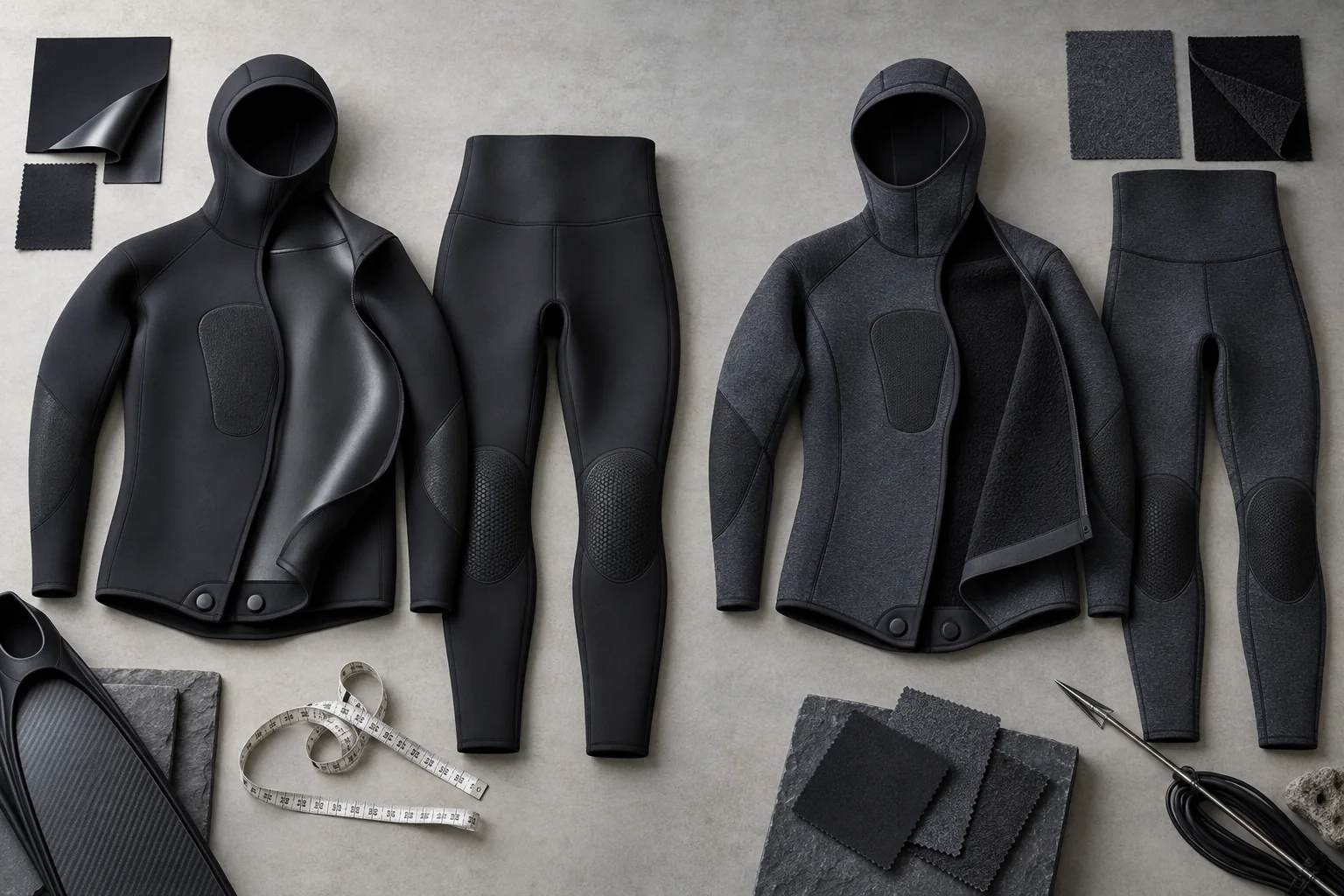
Short answer: In an open cell vs closed cell wetsuit comparison, the most useful purchasing distinction is usually the inside surface—not whether the neoprene foam itself contains open or closed cells. Wetsuit foam is generally closed-cell foam. In freediving and spearfishing trade language, an “open-cell wetsuit” normally has an unlined cut-foam interior, while a “closed-cell wetsuit” often means a nylon- or textile-lined interior. Open-cell interiors can provide close skin contact and help limit water movement when the pattern fits correctly, but they require more careful donning and handling. Lined interiors are usually easier to put on and more resistant to fingernail damage and repeated handling. Specify the interior, exterior, foam, thickness, pattern, seams, reinforcements and test plan explicitly instead of relying on either label alone.
INSEAKU manufactures custom freediving and spearfishing wetsuits in open-cell, lined and project-specific constructions. When evaluating an open cell wetsuit manufacturer, buyers should verify the complete layer construction and sample evidence rather than relying on the category name. Available project routes include two-piece hooded systems, one-piece suits, 1.5 mm, 2 mm, 3 mm, 5 mm and 7 mm options, customer-supplied or factory-developed patterns, camouflage artwork, chest loading pads, knee and elbow reinforcement, glued-and-blind-stitched seams, tape or liquid-seal options, and other seam constructions selected for the intended use.
This guide is written for brands, distributors, dive businesses and product teams. It does not assign one construction as universally warmer, more comfortable or more durable. Those outcomes also depend on foam formulation and density, thickness, pattern and fit, seam and edge design, water flushing, depth, activity, care and the actual test conditions.
What do open-cell and closed-cell mean in wetsuit sourcing?
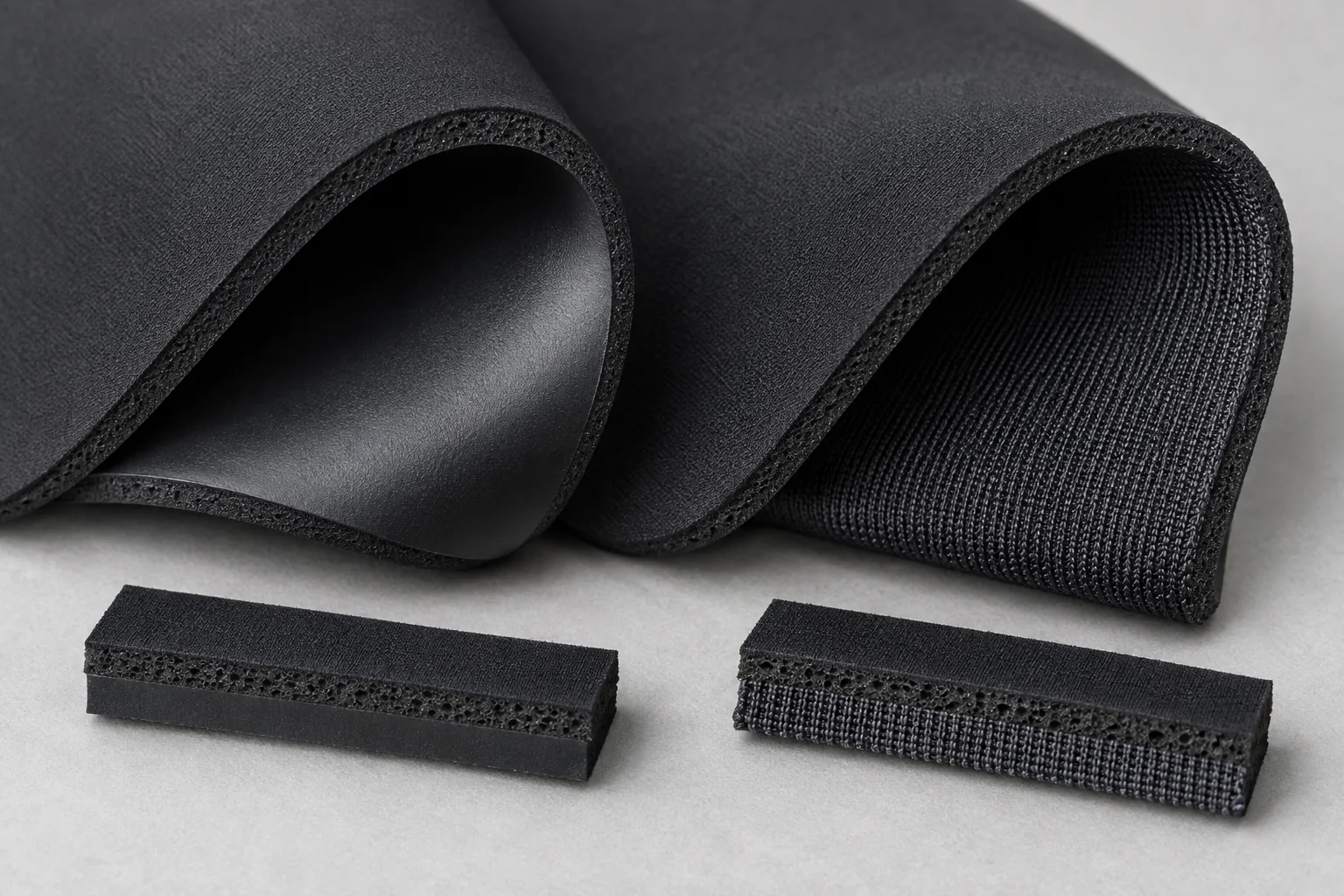
Wetsuits are commonly made with closed-cell neoprene foam. The gas cells within the foam provide insulation and buoyancy, and the foam compresses as ambient pressure increases. A technical study of commercial wetsuit neoprene describes it as closed-cell foam, while a Naval Postgraduate School study notes that the retail term “open-cell wetsuit” does not describe the actual internal foam-cell structure.
The sourcing shorthand instead describes the surface touching the wearer:
- Open-cell interior: the cut foam surface is left unlined, or receives a project-specific surface treatment rather than a knitted textile lining.
- Lined interior: nylon, polyester or another specified textile is laminated to the inner foam surface. Buyers may call this “closed cell,” “nylon lined,” “double lined” or simply “lined.”
- Single-lined open-cell construction: the exterior has a textile layer while the interior remains unlined.
- Double-lined construction: textile is laminated to both sides of the foam.
These terms are not complete specifications. “Open cell” does not identify the foam grade, thickness, outer surface, pattern, seam construction or reinforcement. “Double lined” does not prove a particular level of warmth, stretch or durability. A useful RFQ names every layer and the performance expected from the assembled garment.
Open-cell vs lined wetsuits: quick comparison
| Buyer question | Open-cell interior | Textile-lined interior | What to verify |
|---|---|---|---|
| Skin contact | Unlined foam contacts the skin and can reduce internal water movement when fit is correct | Textile contacts the skin; water control depends on fit, seals, pattern and construction | Fit sample, edge seals and movement test |
| Donning | Traditional raw surfaces commonly require a suitable manufacturer-approved water-based lubricant | Usually easier to don dry; actual ease depends on lining, cut and fit | Written donning instructions and user trial |
| Handling | More vulnerable to fingernail, jewelry and pulling damage | Textile adds surface protection for frequent handling | Handling test, care label and repair rules |
| Stretch and feel | Can feel close and flexible, but the result depends on foam, thickness and pattern | Lining can affect stretch and recovery; high-stretch textile options are project dependent | Material data, direction of stretch and fit trial |
| Exterior options | Often paired with a lined exterior; smooth-skin and other constructions are also possible | Often textile lined on both sides; solid or printed exterior options may be specified | Layer schedule and approved swatch |
| Typical project fit | Performance-focused freediving and spearfishing products where users accept careful donning | Training, entry-level, retail or high-handling products where easier use and surface resilience matter | Actual user profile and operating environment |
This table compares common tendencies, not guaranteed outcomes. For example, an incorrectly patterned open-cell suit may flush more than a well-fitted lined suit. A soft high-stretch lining can feel more flexible than a poorly selected unlined construction. The buyer should approve evidence from the actual material and sample, not from the category name.
When does an open-cell interior make sense?
An open-cell interior is often selected for freediving or spearfishing products designed around close fit, controlled water movement and users who understand careful donning. The unlined inner surface can conform closely to the wearer, but it should not be sold as a universal thermal guarantee. Warmth depends on the complete system: thickness, foam properties, panel geometry, seals, seam integrity, fit and the time, depth and activity of the dive.
Raw, coated and project-specific inner surfaces
Not all unlined interiors feel or behave the same. INSEAKU can discuss raw cut-foam interiors, coated surfaces and other easier-donning treatments according to the project. The buyer should specify the exact approved surface rather than requesting “open cell” only. Surface treatment may change feel, appearance, donning method, bonding process and handling requirements.
Handling is part of the product design
Unlined interiors are more exposed to fingernails, rings, watches, rough benches and concentrated pulling. Product instructions should tell users to remove sharp items, use the palms rather than fingertips, avoid overstretching openings and follow the approved donning method. Some commercial open-cell suits instruct users to wet or lubricate the interior before dressing to reduce tearing risk.
Do not choose a lubricant from internet habit alone. Confirm a suitable water-based product with the wetsuit material supplier or manufacturer and assess user safety, residue, hygiene and environmental requirements. Oil-based products or uncontrolled chemicals may affect materials, adhesives or skin and should not be assumed acceptable.
When does a lined interior make sense?
A textile-lined interior is often the practical route when the product will be donned repeatedly, handled by inexperienced users, stocked for rental or training, or expected to tolerate less controlled care. The lining shields the foam surface and generally makes the garment easier to put on without lubricant. This is one reason lined constructions are common in high-handling programs.
However, “lined” is not a performance grade. The textile type, knit, weight, stretch direction, lamination, foam and pattern all affect fit and mobility. A wetsuit material selection decision should therefore compare approved swatches and sample garments rather than treating all nylon-lined materials as interchangeable.
The foam label also needs its own evidence. Compare supplier grades, cost assumptions and test conditions with this CR vs SCR wetsuit material guide before approving an open-cell or lined construction.
Single-lined and double-lined are different decisions
A single-lined open-cell suit often uses a textile exterior for surface protection and printability while leaving the interior unlined. A double-lined suit uses textile on both sides, providing more surface protection but creating a different composite stretch and feel. Smooth-skin exteriors, coated surfaces and other hybrids introduce further tradeoffs. The bill of materials should identify every layer, side and orientation.
The interior-surface decision is separate from the foam-material route. If a brand is considering natural rubber, use the Yulex vs neoprene wetsuit comparison to verify the exact foam, finished laminate, performance evidence, supply records and permitted environmental wording.
Construction options beyond the binary label
The interior choice is only one branch in the product architecture. INSEAKU can manufacture one-piece suits and the two-piece systems frequently used for freediving and spearfishing. Two-piece projects may use an integrated-hood jacket with high-waist pants or other agreed overlap arrangements. One-piece products may be appropriate where easier use, a different activity profile or a specific brand concept takes priority.
Thickness and zoning
Available custom thickness routes can include 1.5 mm, 2 mm, 3 mm, 5 mm and 7 mm, subject to the selected material and product. A thickness number should be treated as a nominal material specification, not a universal temperature rating. The buyer should define the intended environment and validate the complete garment with relevant users or tests.
If a project uses thickness zoning, record the material for every panel on a map. Confirm how transitions affect pattern balance, seam bulk, flexibility and measurement. Do not let “5 mm suit” hide 3 mm inserts or different composite thicknesses unless those are deliberately specified.
Open-cell, lined and two-piece products still require a controlled thickness map rather than a single headline number. Use our custom wetsuit thickness and panel-zoning guide to define materials, panels, measurement and sample approval.
Seams and sealing
Open-cell products can use glued-and-blind-stitched construction with internal or external tape, liquid seal or other project-specific reinforcement. Flatlock, overlock and other seam methods are also available where the intended use supports them. The GBS vs flatlock wetsuit seams guide explains why stitch type, penetration, adhesive, tape, panel geometry and test method must be evaluated together.
A seam name alone does not prove waterproofness or durability. Specify the allowable penetration, seam location, stretch requirement, adhesive route, tape or seal coverage and any localized pressure, air or water test. Agree whether the seam is intended to limit water entry, reinforce an edge or simply assemble a non-thermal product.
Freediving and spearfishing requirements are not identical
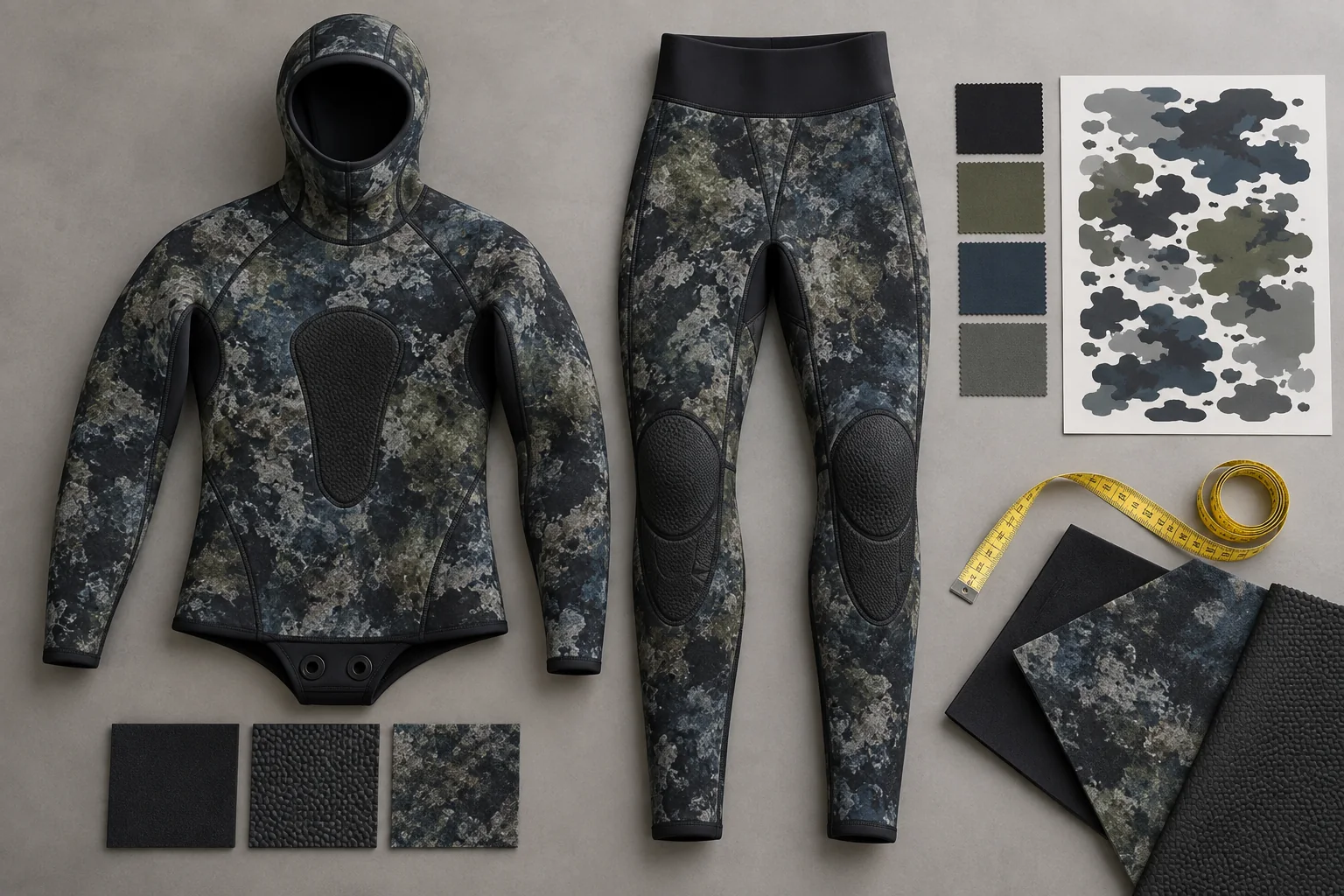
Freediving and spearfishing overlap, but a buyer should still describe the actual activity. A freediving wetsuit manufacturer needs the target fit, movement, depth profile and thickness strategy. A spearfishing wetsuit manufacturer also needs to know whether the product requires camouflage, a chest loading pad, knee or elbow protection and greater resistance to contact with equipment or the environment. Shore entry, boat use, reef exposure, repeated surface intervals and local regulations can change the requirement.
Camouflage is artwork plus manufacturing control
INSEAKU can produce different camouflage and printing routes according to customer requirements. A custom camouflage wetsuit manufacturer must control more than the visible concept: the customer may provide artwork and must confirm that it has the right to use the design. The specification should control file version, scale, color references, repeat, panel placement, seam continuity expectations, print method and acceptable variation. Approve a material strike-off or other agreed color reference before cutting bulk panels.
A screen image is not a reliable production color standard. Substrate color, surface texture, printing process, lamination and lighting can change appearance. If adjacent panels must align visually, define which seams are critical and how much displacement is acceptable; perfect pattern continuity across curved, stretched seams may not be realistic without a dedicated engineering method.
Brand teams developing camouflage or full-panel graphics can use the custom wetsuit artwork and printing guide to compare substrate compatibility, repeats, color approval and panel registration.
Loading pads and reinforcement must be located, not merely listed
A chest loading pad should be positioned from the approved pattern and verified on the intended users. Record its dimensions, material, thickness, edge construction and attachment method. Do the same for knees, elbows, seat and other reinforcement. Extra coverage is not automatically better: a stiff or misplaced patch can restrict movement or create stress at its edge.
For a complete two-piece sourcing brief, use our custom spearfishing wetsuit specification checklist to connect material surfaces, chest and knee reinforcement, camouflage and sample acceptance.
How should a buyer specify an open-cell or lined wetsuit?
Use a controlled tech pack and RFQ so competing suppliers quote the same garment. If you need a starting structure, download the Open-Cell and Lined Wetsuit Specification Worksheet, then adapt it to your product and testing requirements.
- Intended use: freediving, spearfishing, training, retail, rental or another activity; environment, depth profile, exposure duration and user experience.
- Product format: one-piece or two-piece; jacket, pants, hood, closure, overlap and entry design.
- Layer construction: outer textile or surface, foam grade and nominal thickness, inner textile, raw open-cell surface, coating or other treatment.
- Pattern and sizing: source pattern, grading rule, measurement points, size chart, fit intent, stretch orientation and tolerances.
- Seams and edges: stitch and glue method, tape or liquid seal, cuff and face seals, edge finish, reinforcement and acceptable appearance.
- Functional components: loading pad, knee or elbow patches, zipper, hook-and-loop, snaps, drawcords and any hardware.
- Artwork and branding: color references, camouflage or print files, logos, labels, placement, packaging and rights confirmation.
- Sampling and approvals: sample stages, measurements, fit users, mobility checks, leak-related tests, revision records and written release authority.
- Commercial scope: quantity by style, color and size, sample charges, tooling, testing, packaging, inspection, payment, Incoterm and requested timing.
- Care and warnings: donning method, approved lubricant if required, cleaning, drying, storage, repair and retirement criteria.
The wetsuit tech pack and RFQ checklist provides a broader sourcing template. Use the same controlled revision for the quotation, sample, pre-production approval and purchase order.
How should sampling, testing and approval work?
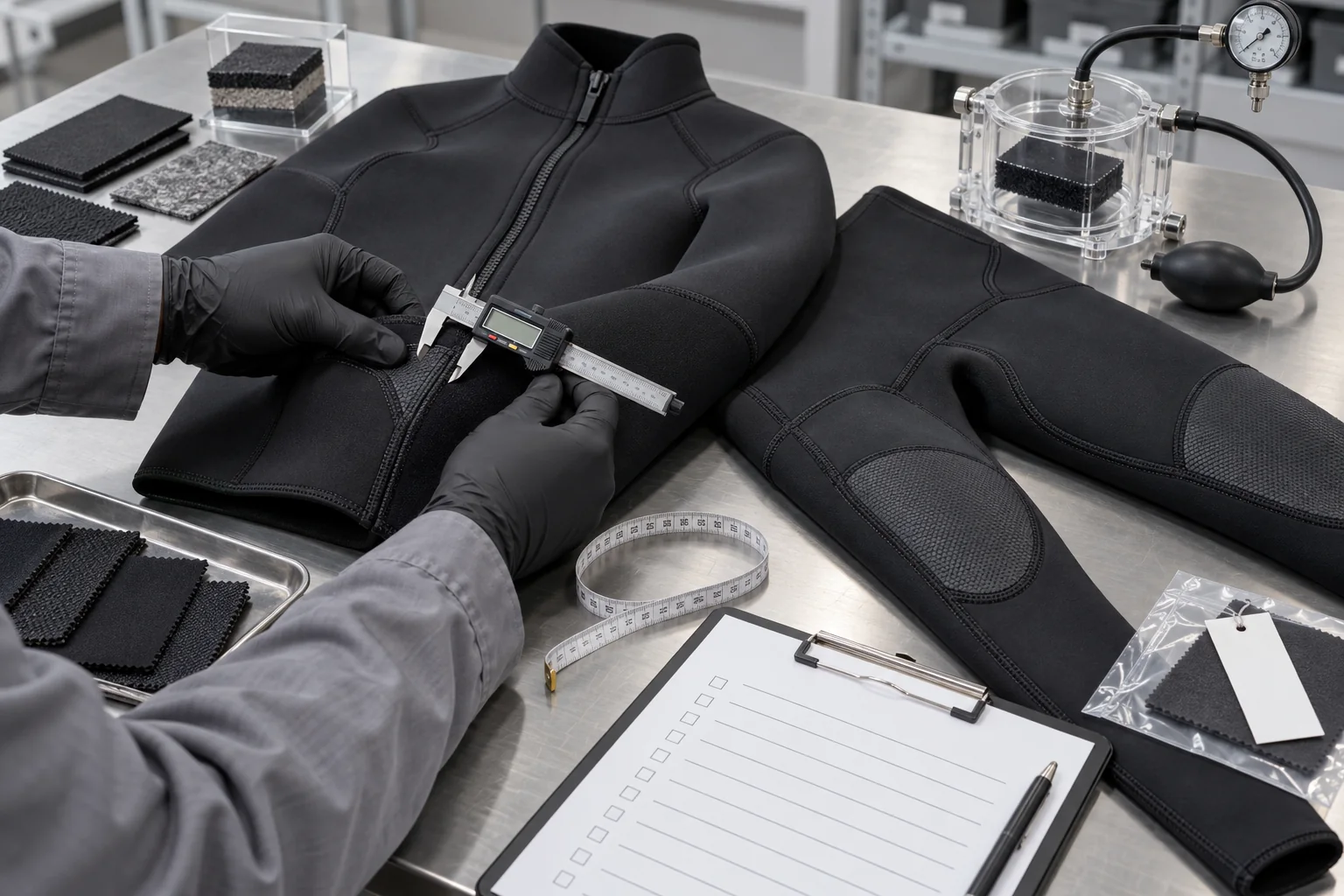
Sampling should convert subjective language into an approved product reference. INSEAKU checks sample size, appearance, seams, bonding and localized leak-related performance as applicable. Buyer fit trials, mobility evaluation and third-party laboratory testing can also be arranged when the project requires them.
Use staged approval gates
- Material approval: confirm the actual layer construction, thickness, color, stretch direction, surface and print or camouflage reference.
- Development sample: review proportion, pattern, mobility, closures, hood, loading pad, reinforcement and workmanship.
- Fit and use review: test with the intended user profile and activity; record size, conditions, movements, observations and requested changes.
- Controlled revisions: consolidate comments into one dated file and identify the effect on price, timing, measurements and construction.
- Pre-production sample: verify the frozen material, artwork, labels, packaging and workmanship before bulk release.
- Sealed-sample approval: authorize the exact physical sample and document versions in writing.
- Bulk production and final inspection: inspect against the sealed sample, confirmed specification and production order.
For a fuller manufacturing sequence, see how wetsuits are manufactured. For acceptance planning, use the wetsuit quality-control checklist and define any specialized laboratory work before ordering.
Do not confuse a visual sample with performance approval
A sample can look correct and still require measurement, movement, bonding or leakage review. Conversely, one test result does not prove that every future unit will match unless the production controls, inspection method and acceptance criteria are defined. The wetsuit fit-testing protocol explains how to record fit and mobility without turning one person’s opinion into an uncontrolled standard.
What are INSEAKU’s MOQ and sampling conditions?
INSEAKU’s normal starting MOQ is 50 pieces per style and color. Sizes may be mixed within that same-style, same-color quantity. Different colors cannot normally be combined to reach 50 pieces because each color is a separate production lot.
Sample development can start from approximately seven working days after materials and specifications are confirmed and payment is received. Special materials, camouflage or other printing, complex patterns, custom components and revision rounds may extend the schedule. This timing is not a guaranteed door-to-door delivery date.
Sample pricing is quoted case by case. The sample fee can be credited against a qualifying bulk order when the same style and color reaches 300 pieces, subject to the written quotation. Normal bulk production is approximately 30 working days after the sealed sample is approved and the required bulk-order deposit is received; actual timing depends on style, materials, quantity and capacity and must be confirmed in writing. International transportation is separate from production time.
Read the current wetsuit MOQ, sample cost and production lead-time guide before finalizing the buying calendar.
What should a freediving or spearfishing wetsuit RFQ include?
- Brand, market, intended activity and target user
- One-piece or two-piece format and hood requirement
- Open-cell, coated or textile-lined interior specification
- Exterior lining, smooth surface, color or camouflage artwork
- Foam route and nominal thickness by panel
- Customer pattern or requested pattern-development scope
- Size chart, grading, fit intent, stretch direction and tolerances
- Seam, adhesive, tape or liquid-seal construction
- Face, wrist, ankle, waist and overlap details
- Chest loading pad, knee, elbow, seat and other reinforcement
- Labels, logo, care instructions and packaging
- Sample stages, test methods, acceptance criteria and approval owner
- Quantity by style, color and size, destination and required timing
- NDA, artwork rights, file ownership and change-control terms
Before sending sensitive patterns or unreleased artwork, compare manufacturing responsibilities in the OEM vs ODM wetsuit guide. When shortlisting suppliers, use the evidence-based wetsuit manufacturer audit scorecard rather than relying on a showroom sample or category claim.
Buyer FAQs
Is open-cell neoprene actually open-cell foam?
Usually no. Wetsuit neoprene is generally closed-cell foam. In common freediving and spearfishing terminology, “open cell” describes an unlined cut-foam interior surface. Write the exact layer construction in the specification.
Is an open-cell wetsuit always warmer than a lined wetsuit?
No universal claim is supportable from the label alone. Skin contact and controlled water movement can be useful, but warmth also depends on fit, foam, thickness, seams, seals, depth, activity and conditions. Compare the actual approved products.
Does an open-cell wetsuit require lubricant?
Traditional raw open-cell interiors commonly require a suitable water-based lubricant for donning. Coated or other project-specific surfaces may differ. Follow the manufacturer-approved instructions and assess material compatibility, hygiene and user safety.
Which construction is more durable?
A textile lining generally protects the foam surface from fingernails and repeated handling. Total durability still depends on foam, lamination, pattern, seams, reinforcement, use and care. Define the expected handling environment and test the actual construction.
Can INSEAKU make both open-cell and lined wetsuits?
Yes. INSEAKU can manufacture open-cell, single-lined, double-lined and other project-specific constructions for freediving, spearfishing and related uses.
Can INSEAKU develop a two-piece hooded spearfishing suit?
Yes. INSEAKU can develop two-piece hooded systems and has experience serving customers in this category. One-piece routes are also available. Final construction is based on the approved specification and sample.
Can a customer supply its own pattern and camouflage artwork?
Yes. INSEAKU can work with customer-supplied patterns and artwork when the customer confirms the right to use them. File versions, placement, color references, ownership and permitted use should be controlled in writing.
What thicknesses can INSEAKU produce?
Custom options can include 1.5 mm, 2 mm, 3 mm, 5 mm and 7 mm, depending on the selected material and product. Specify thickness by panel and validate the full garment rather than treating thickness alone as a temperature guarantee.
What is the MOQ for a custom open-cell wetsuit?
The normal starting MOQ is 50 pieces per style and color, with mixed sizes permitted within that same-style, same-color quantity. Confirm project-specific materials, printing, components, packaging and timing in the quotation.
How long does sampling take?
Sample development can start from approximately seven working days after materials and specifications are confirmed and payment is received. Special materials, camouflage, complex patterns, components and revisions may require more time.
Choose the construction by evidence, not by label
An open-cell interior can be a strong choice for a close-fitting freediving or spearfishing product when the user accepts careful donning and handling. A lined interior can be the better operational choice when ease of use, training, retail handling or surface protection matters more. Many commercial products combine these decisions with a lined exterior, specialized surface, camouflage, reinforcement and a project-specific seam system.
Send INSEAKU your intended use, product format, thickness, layer construction, pattern status, size range, seams, reinforcement, artwork, quantity and testing needs. Discuss your freediving or spearfishing wetsuit specification and request a written manufacturing review.
References and further reading
- Royal Society of Chemistry research — closed-cell neoprene foam used in wetsuits
- Naval Postgraduate School — technical discussion of “open-cell” wetsuit terminology
- PADI — wetsuit materials, linings, fit and construction overview
- PADI — freediving wetsuit lining, donning and handling considerations
- Divers Alert Network — fit, flushing, thickness and wetsuit care
- SEAC — commercial open-cell spearfishing construction and handling example
- Salvimar — open-cell, camouflage, GBS and reinforcement product example
Last reviewed: September 10, 2026. INSEAKU reviewed the manufacturing capabilities, MOQ, indicative sampling conditions and approval workflow stated in this article. Project-specific construction, materials, performance, testing, pricing and timing remain subject to the approved specification, sample and written quotation.