
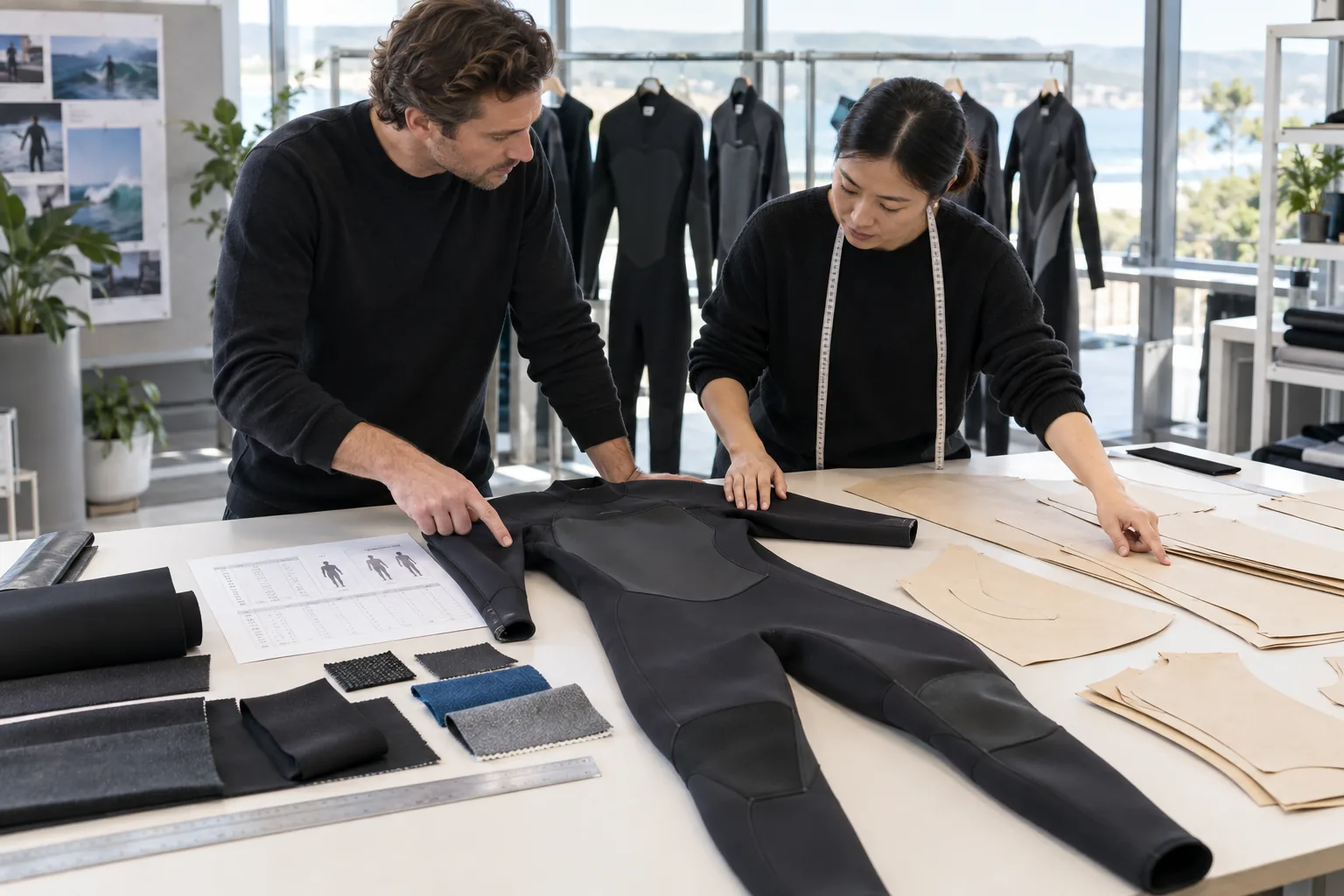
Short answer: A reliable wetsuit size grading guide starts with the target population and clearly defined body measurements, then connects those inputs to a base pattern, finished-garment measurements, size-to-size grade rules, representative samples and production tolerances. Do not treat XS, S, M, L or XL as universal dimensions. Approve the measurement method, material assumptions, pattern version and sample evidence together before releasing the full size range.
A size chart is easy to publish but difficult to engineer. Two brands can both sell a “men’s medium” while using different body ranges, garment measurements, stretch materials, seam constructions and fit intentions. For a water-sports product, the risk is not limited to appearance: an unsuitable size system can affect entry, mobility, seal contact, panel balance and consistency between samples and bulk production.
This guide is written for brand owners, product developers, importers and sourcing teams. It explains what a buyer should define, what a factory should return and what evidence should be approved. It does not provide a universal consumer size chart, medical guidance or a guarantee that one sizing system will fit every user.
Free working file: Use the wetsuit size chart and grading review checklist to record body inputs, garment measurement points, grade rules, sample results and release decisions.
A wetsuit size system needs four separate records
The first control is separation. A body chart, a garment chart, a pattern file and an inspection tolerance table answer different questions. Combining them into one spreadsheet without clear labels creates avoidable errors.
| Controlled record | What it describes | Typical decision |
|---|---|---|
| Body measurement table | The intended wearer or target population | Which body range each size is designed to serve |
| Finished-garment measurement chart | The dimensions of the wetsuit at defined points and under a defined method | What the sample and bulk garment should measure |
| Pattern and grade-rule record | Panel geometry, seam allowances, notches, component positions and size-to-size changes | How the base pattern becomes the full range |
| Sample and bulk acceptance plan | Tolerances, sample coverage, fit or mobility checks and inspection evidence | Whether a size is approved, revised or rejected |
ISO 8559-3 describes a methodology for body-measurement tables and intervals, but explicitly does not include garment dimensions. That distinction matters: the standard can inform how a brand structures body data, while the wetsuit’s finished measurements and pattern rules still require product-specific engineering and validation.
1. Define the target population and body measurements
Begin with who the product is for, where it will be sold and how it will be used. “Global sizing” should not mean one untested chart for every market. Body shape and proportions vary within and between target populations, so the development brief should identify the intended users instead of assuming that familiar letter labels are self-explanatory.
For each body dimension, state the anatomical landmarks, posture, tape orientation, clothing condition, unit and rounding rule. ISO 7250-1 provides definitions and landmarks for basic human body measurements, while ISO 8559-2 establishes clothing size designation around primary and secondary body-dimension indicators. These references support consistent terminology; they do not create a ready-made INSEAKU chart.
Common body inputs
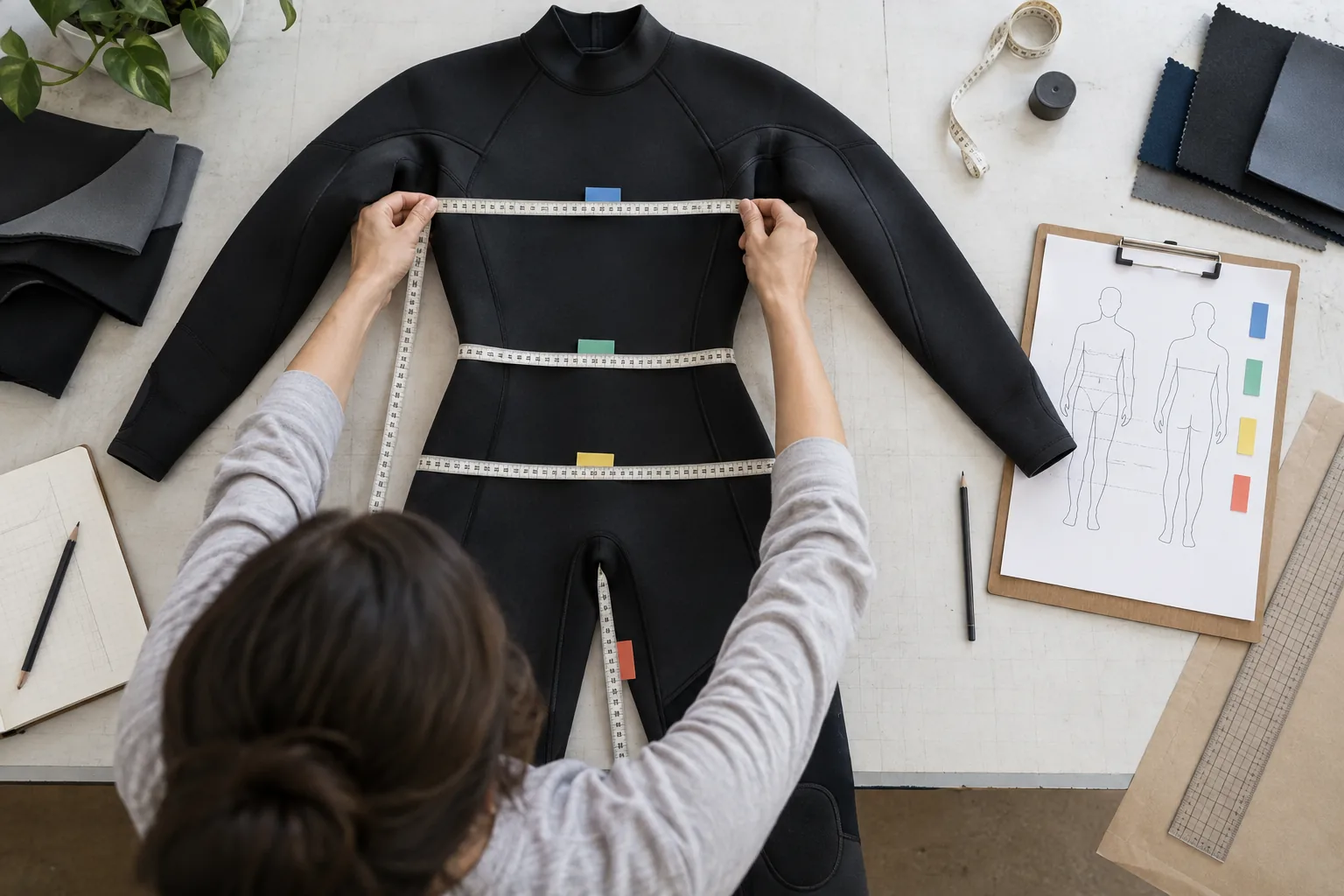
The required list depends on the product, but a wetsuit program commonly considers stature, chest or bust, waist, hip or seat, torso or girth, back length, arm length, upper arm, wrist, inseam, thigh, calf, ankle and neck. A hooded suit, shorty, two-piece suit, children’s product or specialist dive suit may require additional points.
Do not collect measurements without a decision rule. Identify which dimensions control the size designation, which are secondary checks and how a person between two sizes should be handled. Also record the source and date of the dataset. NIST’s apparel body-dimension work highlights the importance of definitions, measurement techniques, target population groups and anthropometric data in apparel sizing.
Men’s, women’s, youth and extended sizes are separate development questions
Changing a label is not the same as changing body architecture. A women’s range may require different proportions and panel balance; youth products require age-appropriate data and product review; an extended-size program may need more than a constant enlargement of every dimension.
A brand searching for a plus size wetsuit manufacturer should therefore ask for the proposed body ranges, base sizes, grade rules, representative samples and construction review—not only whether the supplier can add 2XL, 3XL or 4XL labels. The same principle applies to petite, tall, short-torso or market-specific ranges.
2. Create a finished-garment measurement chart
The body table describes the wearer; the garment chart describes the product. Each point of measure (POM) needs a unique ID, a written method, a target value, a unit and a tolerance. The document should say whether a measurement is taken flat or as a circumference, where the tape starts and ends, whether openings are relaxed, and how the suit is positioned.
A practical chart can include chest, waist, hip, body length, front and back rise, sleeve length, upper arm, wrist opening, inseam, thigh, knee, calf, ankle opening, neck opening, shoulder width and zipper length. The list must match the design; irrelevant points can be marked not applicable, while product-specific points should be added.
Do not confuse fit allowance with a universal percentage
A wetsuit normally relies on stretch and close body contact, but there is no single negative-ease percentage that is correct for every product. The relationship between body and garment dimensions depends on foam or rubber system, thickness, lamination, stretch direction, thermal lining, panel layout, seam construction, entry system, intended activity and the point being measured.
Write the assumption into the project record. If a material, thickness or seam changes, reassess affected dimensions and pattern geometry. The wetsuit thickness guide for brands explains why a thickness label alone does not define the complete product architecture.
3. Choose the base size and approve the fit intent
The base size is the pattern from which the range is developed. It should represent a useful central point for the target market and product category, not simply the size worn by the nearest employee or buyer. Record why it was chosen and which body and garment values it represents.
Next, convert subjective language into observable requirements. “Performance fit,” “rental fit,” “easy entry” and “warm fit” are useful positioning terms, but they do not replace measurable targets. Define intended mobility, entry and removal, seal contact, panel placement, compression points and acceptable wrinkles or gaps.
For the practical review sequence, use the wetsuit fit testing protocol. It separates measurement review, representative-user checks, movement, entry, seals and documented revision decisions. INSEAKU can use fixed fit models where agreed, but not every project or every sample automatically receives a live fit; the validation plan should state exactly what is included.
4. Build size-to-size grade rules
Wetsuit pattern grading is the controlled transformation of the approved base pattern into other sizes. It is not the automatic scaling of an image. Each measurement and pattern region can require a different change, and a circumference increment is not necessarily applied evenly to every panel edge.

Record more than one increment
A controlled rule table links each POM to the base target and the change toward smaller and larger sizes. It can also identify where increments change across the range. A brand may use one interval around the central sizes and a different interval at an extended end of the range, but that decision should follow body data and sample evidence rather than convenience.
Review length, circumference and balance together
Chest, waist and hip changes cannot be reviewed in isolation from torso length, rise, arm and leg length, openings and joint placement. A chart can appear numerically smooth while the assembled garment develops poor panel balance, misplaced knees or elbows, uncomfortable seal pressure or difficult entry.
Control the versions
The grade-rule record should identify the measurement-chart version, base pattern, graded pattern set, material and construction. After an approved change, update every linked document or issue a clear exception. Never release bulk production from a folder containing multiple unidentified pattern exports.
INSEAKU completes pattern making and size grading in house. To see where these activities sit within development and production, read how wetsuits are manufactured.
5. Recheck grading when material or construction changes
Size development is connected to materials. A thickness change, different lining, alternate foam, changed stretch orientation, added reinforcement, new zipper or different seam can change mobility, bulk, recovery, opening behavior or assembly geometry. A visual design that looks unchanged may still need a pattern or tolerance review.
| Change | Possible sizing effect | Evidence to review |
|---|---|---|
| Foam, rubber or lamination | Stretch, recovery, thickness and hand can alter fit response | Approved material reference, sample measurements and movement review |
| Panel thickness | Bulk and flexibility can change around joints, torso and openings | Panel map, pattern revision and representative sample |
| Seam construction | Seam allowance, elasticity and interior bulk may differ | Construction specification and sample seam review |
| Entry or zipper | Opening size, reach and torso geometry can change | Entry test, zipper reference and pattern/component positions |
| Neck, wrist or ankle seals | Contact pressure and opening dimensions can change | Relaxed opening POM, material and user feedback |
Use the wetsuit material selection guide and the GBS versus flatlock seam guide when specifying these dependencies.
6. Validate the base size and the size range
One approved base-size sample proves only what was inspected on that sample. It does not automatically prove the smallest, largest or proportionally different sizes. Define the sample plan before development so the quotation, schedule and approval gates are clear.
A risk-based sample sequence
- Development sample: review design, material, construction, initial measurements and workmanship.
- Fit sample: measure first, then review fit, mobility, entry, seals and panel placement using the agreed method.
- Size-set samples: select representative sizes, often including range boundaries or risk points, according to the approved plan.
- Pre-production sample: confirm production-intent materials, components, artwork, labels, packaging and controlled documents.
- Sealed sample and written release: identify the physical reference and every supporting version before bulk production.
At INSEAKU, sample development can start from approximately seven working days after materials and specifications are confirmed and payment is received. Complex patterns, multiple sizes, special materials, custom printing, ordered components or revision cycles can require more time. See the current wetsuit manufacturer MOQ, sample cost and lead-time guide for commercial conditions.
Document evidence size by size
For each reviewed sample, record the size, pattern version, material version, actual measurements, deviations, fit model or form, mobility findings, entry and removal, seam and panel balance, photographs, corrective action and decision. Consolidate comments into one dated file. “Looks good” is not enough to support repeatable production.
7. Turn approved sizing into bulk-production controls
Before cutting bulk material, freeze the approved measurement chart, tolerances, pattern versions, bill of materials, construction, artwork and sealed-sample reference. INSEAKU uses the buyer’s written approval of the sealed sample, confirmed specification and production order as the production basis.
Use the custom wetsuit sampling process to record which base-size, size-set or pre-production samples validate the grading decisions and which written approval authorizes bulk cutting.
Set project-specific tolerances
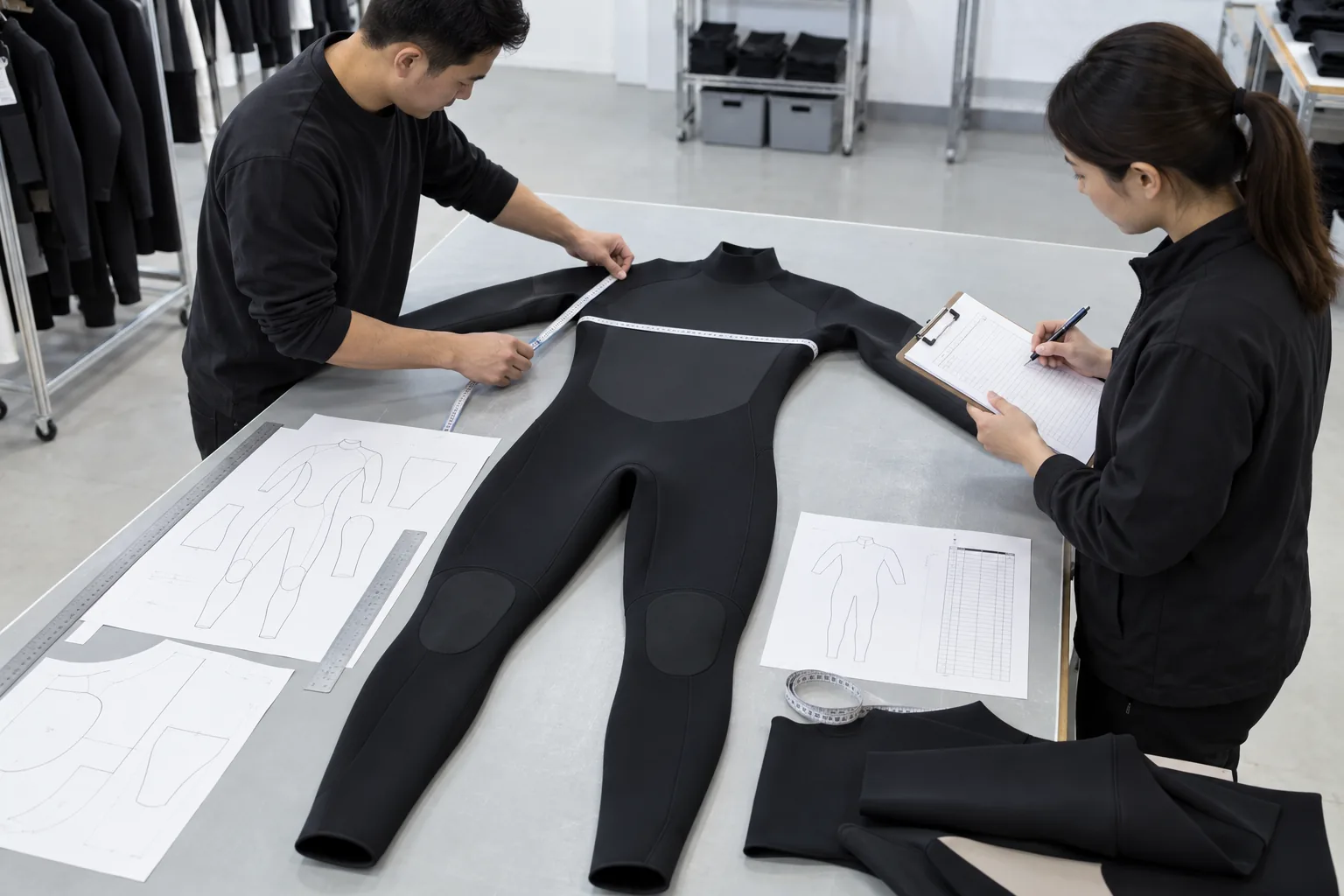
There is no responsible universal tolerance for every wetsuit POM, material and size. A tolerance should reflect the measurement method, material behavior, construction, function, manufacturing capability and buyer quality plan. It should state whether it is bilateral or one-sided and what happens when a result is outside the limit.
Inspect to the approved quality plan
Incoming material checks, in-process control and final sampling inspection should connect back to the approved product records. The wetsuit quality control checklist explains how specifications, checkpoints, evidence, corrective actions and shipment release work together. INSEAKU does not intentionally release identified defective goods to customers; final acceptance and sampling remain governed by the agreed quality plan.
Plan the size curve by style and color
Once the range is technically approved, convert it into an order size curve. INSEAKU’s normal starting MOQ is 50 pieces per style and color, and sizes can be mixed within those 50 pieces; different colors cannot be combined to reach the MOQ. The quotation controls the project. A technically valid size range is still different from a commercially sensible quantity split, so use sales data, channel needs and replenishment plans when allocating sizes.
What should you ask a wetsuit manufacturer?
Use these questions when comparing a wetsuit factory size guide or requesting development:
- Which body dimensions and target population support the proposed size range?
- Which values are body measurements and which are finished-garment measurements?
- How is each measurement taken, and which document controls the method?
- Which size is the base pattern, and why was it chosen?
- Who creates the pattern and performs size grading?
- Are grade rules constant across the range or changed at selected sizes?
- How do material, thickness, seam and entry choices affect the pattern?
- Which sizes will be sampled, measured and fit-reviewed?
- What are the tolerances and bulk measurement sampling plan?
- Which pattern, chart and sealed-sample versions authorize production?
- Who owns the body data, size chart, pattern and project-created files?
- What happens if a component or material changes after approval?
If you are still qualifying potential factories, use the 12-point wetsuit factory audit scorecard. When the size architecture is ready for quotation, put the approved inputs into the wetsuit tech pack and RFQ checklist.
Buyer FAQs
Is there a universal wetsuit size chart?
No. Size labels, target populations, materials, patterns and fit intentions differ. A chart should identify its intended user group, measurement method and product assumptions.
What is the difference between body measurements and garment measurements?
Body measurements describe the intended wearer. Garment measurements describe the finished wetsuit at defined points. Pattern rules connect the two through product-specific fit and construction assumptions.
Can a factory copy our existing size chart?
A factory can work from buyer-authorized inputs, but the buyer should confirm ownership and suitability. The chart should be checked for definitions, units, missing POMs, material assumptions and consistency before it is treated as a production specification.
Does every size need a physical fit sample?
Not automatically. The project should use a documented risk-based plan based on range width, target users, construction, materials and launch risk. One base sample alone does not validate the full range.
How are larger wetsuit sizes developed?
They should be based on target body data, explicit garment targets, controlled grade rules and representative validation. Simply increasing every dimension by one constant percentage can distort length, openings, joint placement and panel balance.
Can sizes be mixed within INSEAKU’s MOQ?
Under INSEAKU’s normal starting condition, 50 pieces are required per style and color, and sizes can be mixed within those 50 pieces. Different colors have separate MOQ requirements. The written quotation controls each order.
Who owns the size chart and graded patterns?
The answer depends on the project inputs and written agreement. Ownership, permitted use, exclusivity, background IP and project-created files should be defined before sensitive data or development work is exchanged.
Build a controlled size system with INSEAKU
Send INSEAKU your intended market, user group, product category, authorized size data, material and construction assumptions, desired range, expected quantities and launch timing. We can review the brief, identify missing controls and define a project-specific pattern, grading, sampling and production plan.
Request a size-chart and product-development review
References and further reading
- ISO 8559-2:2025 — Primary and secondary dimension indicators for clothing size designation
- ISO 8559-3:2018 — Methodology for body measurement tables and intervals
- ISO 7250-1:2017 — Body measurement definitions and landmarks
- NIST — Body Dimensions for Apparel
- ASTM D6240/D6240M-24 — Adult male body-measurement tables
Last reviewed: September 12, 2026. This article provides general product-development and procurement information. Standards named here do not replace the buyer’s market-specific, safety, legal or technical review. Project-specific requirements are governed by the approved documents, written quotation and agreement.