
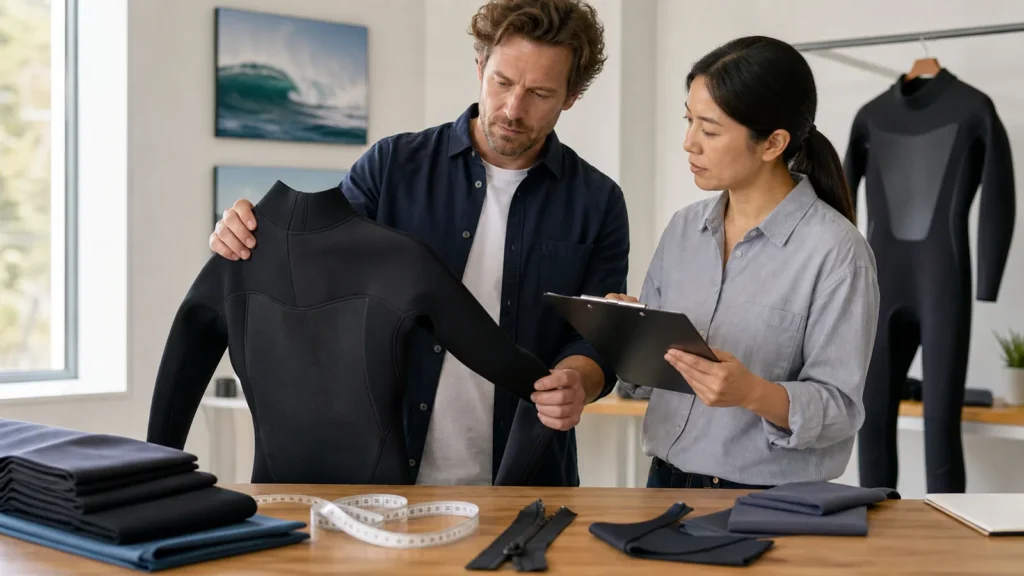
Short answer: If you are deciding how to find a wetsuit manufacturer, shortlist factories that match your product category, then verify their legal entity, material traceability, pattern and fit capability, sampling gates, production controls, quality records, cost assumptions, capacity, compliance documents and commercial terms. Score every supplier against the same written specification. Approve a bulk order only after a successful sample and controlled pilot—not on price, promises or one showroom sample.
Choosing a manufacturer is one of the highest-leverage decisions a water-sports brand makes. A strong partner can turn a technical concept into a repeatable product; a weak one can create inconsistent fit, leaking seams, material substitutions, missed selling seasons and disputes that appear only after the deposit is paid.
This guide gives brand owners, importers and product teams a practical wetsuit factory audit checklist. It is designed to help you compare an OEM wetsuit manufacturer, an ODM developer or a private-label supplier using evidence rather than sales language.
What should you look for in a wetsuit manufacturer?
A suitable manufacturer is not simply a factory that can sew neoprene. It must be able to translate your intended use, target user, fit standard, materials, seam construction, branding and packaging into a controlled specification—and then reproduce the approved sample at bulk scale.
For a fair comparison, send every candidate the same non-confidential request for quotation (RFQ). Ask for evidence in the same format and score what you can verify. A polished website or low quote may justify a conversation, but neither proves production control.
Use one evidence scale for every supplier
| Score | Evidence level | What it means |
|---|---|---|
| 0 | No evidence | The supplier cannot answer, refuses the request or provides contradictory information. |
| 3 | Verbal claim | The answer is plausible but unsupported by a current document, sample or live demonstration. |
| 5 | Generic evidence | A template, undated photo, general certificate or unrelated sample is provided. |
| 8 | Supplier-specific evidence | Current records, relevant samples and responsible staff support the claim. |
| 10 | Verified evidence | Dated or batch-specific records align with a live audit, approved sample or controlled pilot order. |
Score each of the 12 areas out of 10. The total is 120 points, but the number should support—not replace—professional judgment. A zero in legal identity, material control, quality control or compliance is a stop condition even if the overall score looks acceptable.
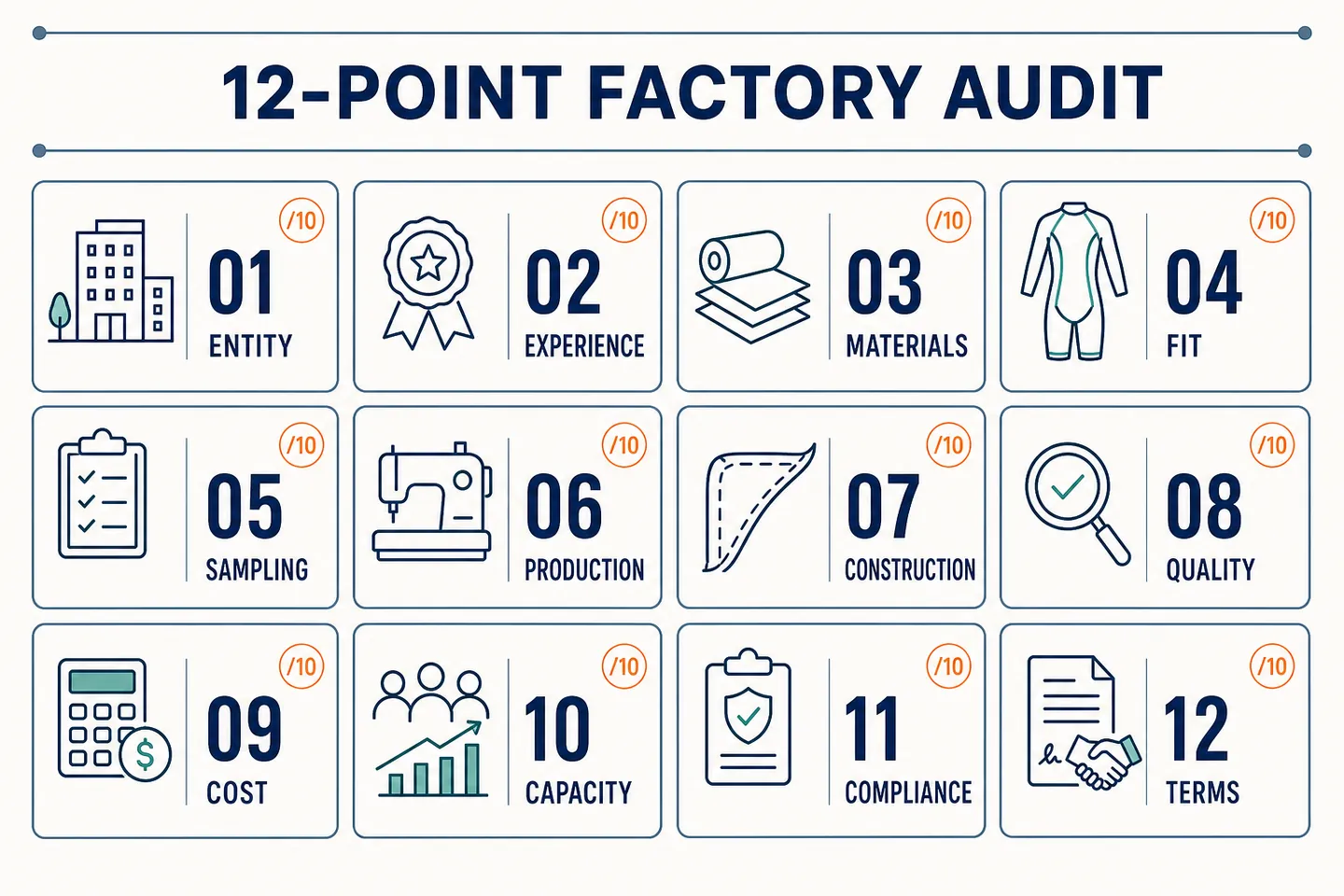
12-point wetsuit factory audit checklist
1. Verify the legal entity and factory relationship
Start by identifying the company that will sign the contract, receive payment, manufacture the goods and export the shipment. These may be the same legal entity—or they may be a factory, trading company and export agent working together. Either structure can be workable, but it must be disclosed.
Ask for: legal company name, registration number, registered and operating addresses, contract entity, bank-beneficiary name, export entity and an explanation of any related companies or subcontractors.
Verify: the names and addresses across the quotation, contract, bank account, business licence and shipping documents. Ask the supplier to explain any mismatch in writing before payment.
Red flag: the salesperson will not identify the production site, payment is requested to an unrelated personal account, or the contract party changes without a documented reason.
2. Confirm relevant product and market experience
A factory that makes simple neoprene accessories may not have the pattern, seam or fit experience required for a cold-water diving suit, triathlon wetsuit or open-cell freediving product. Ask about experience that matches your intended use—not just years in business.
Ask for: anonymized examples of comparable products, target-use experience, available construction methods, typical development problems and references that the factory is authorized to share.
Verify: whether the sample room, pattern team, equipment and quality checks shown actually match the product category being quoted.
Red flag: the same generic sample is presented for every category, or the supplier promises every construction method without explaining equipment, limits or trade-offs.
For freediving and spearfishing projects, ask each supplier to explain the complete interior, exterior and foam construction—not only a category label. Use this open-cell vs closed-cell wetsuit buyer guide to compare lining, donning, handling, seams and sample evidence.
3. Trace neoprene, lining, adhesive and components
Material names alone are not a specification. “Premium neoprene” does not identify foam type, density, thickness tolerance, stretch direction, laminate, colour, adhesive, zipper model or component supplier. Your tech pack should define measurable requirements and approved alternatives.
For a structured comparison of CR, SCR, limestone, Yamamoto and natural-rubber systems, use our wetsuit material selection guide before approving a material reference.
Ask for: material data sheets, supplier and grade, thickness options and tolerances, laminated-fabric specification, colour standard, zipper and fastener references, adhesive information, batch identification and a written substitution-approval process.
Verify: that purchase records, incoming inspection records and sample materials use the same grade. For EU-bound products, ask how the supplier manages applicable chemical information and supply-chain communication. ECHA explains that Candidate List substances in articles can trigger obligations for producers, importers and suppliers; your exact duties depend on the product and market.
Red flag: material can be changed “to something equivalent” without written buyer approval, or branded material claims cannot be supported by authorized documentation.
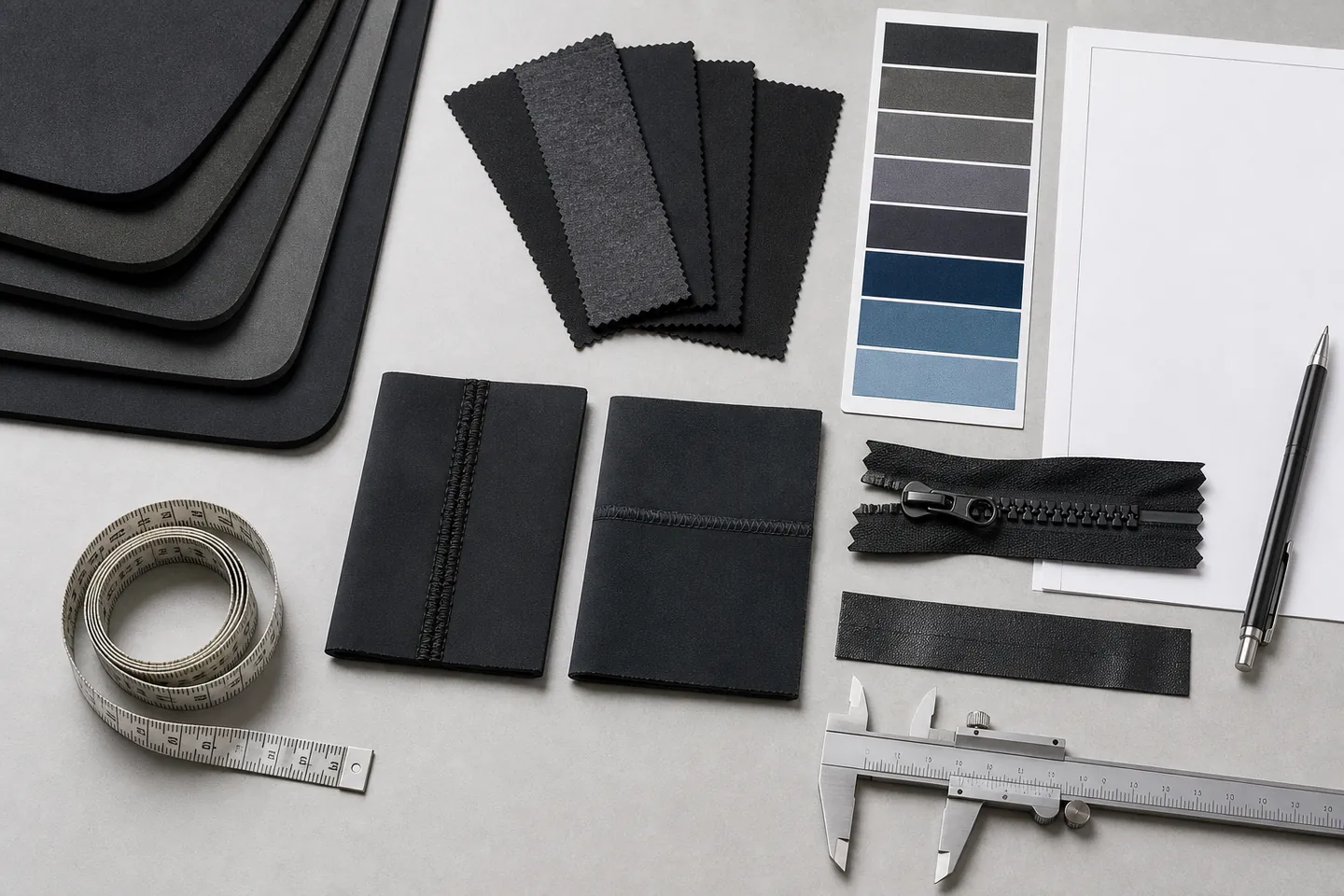
Material traceability should also identify nominal thickness, lining and the panel zones using each material. Use our wetsuit thickness specification guide for brands to compare 3 mm, 5 mm, 7 mm and multi-thickness constructions on the same evidence basis.
4. Audit pattern making, size grading and fit validation
Fit is a product system, not a single measurement chart. Panel geometry, stretch direction, seam placement, entry design and size grading interact. A supplier should be able to document how a base pattern becomes a full size range and how changes are approved.
For a structured method, use our wetsuit size grading guide to separate body measurements, finished-garment points, grade rules, sample evidence and production tolerances.
Ask for: pattern-development responsibility, file format and ownership, measurement points, grading rules, tolerances, fit-model profile, sample version history and change log.
Verify: one size-set or fit sample against the approved measurement method. Confirm who signs off changes and which pattern version becomes the production master.
Before treating a sample as proof of production readiness, use a documented wetsuit fit testing protocol to separate measurement, mobility, opening-flush and seam-leak risks.
Red flag: no version control, unclear pattern ownership, or production begins from a different pattern than the approved sample.
To see how pattern control, sample approval and production checks connect from development to final inspection, follow our wetsuit manufacturing process guide.
5. Define sampling stages and approval gates
“Sample approved” is too vague for a custom wetsuit. Define the purpose of each sample and what approval releases the next stage. Depending on the project, the sequence may include a prototype, fit sample, revised fit sample, size set, colour or logo sample, pre-production sample and sealed reference sample.
For a stage-by-stage approval method, use our custom wetsuit sampling process to identify sample versions, review evidence and the written gate required before bulk production.
Ask for: sample stages, fees, expected inputs, target timing, included revisions, courier responsibility, approval form and what happens when a change affects price or schedule.
Verify: that the final approved specification, bill of materials, artwork, colour standard, measurements and sample are frozen together before bulk production.
Red flag: the factory asks to begin bulk cutting before material, fit, artwork and size-range approvals are complete.
6. Walk through production flow and subcontracting
Map the actual production route from incoming material to packing. Typical stages may include material receiving, relaxation or conditioning, pattern preparation, cutting, printing, gluing, stitching, seam sealing, zipper installation, finishing, inspection and packing. The exact sequence depends on your construction.
Ask for: process map, in-house and subcontracted operations, critical equipment, maintenance records, work instructions, operator training and traceability between order, material batch and production lot.
Verify: the route by live video or in-person audit. Select one recent order and trace it from material receipt to final inspection rather than touring only the showroom.
Red flag: key operations are outsourced but the subcontractor, controls and responsibility are undisclosed.
7. Match seams, zippers, printing and reinforcement to use
Construction must follow the product’s performance target. Flatlock, glued-and-blind-stitched seams, internal taping, external sealing and reinforcement methods are not interchangeable. The correct choice depends on water temperature, flexibility, durability, price point and intended use.
Ask for: approved seam cross-sections, stitch and needle requirements, glue and curing process, tape specification, zipper make and model, reinforcement locations, print method, artwork tolerance and acceptance criteria.
For a focused supplier discussion, compare logo printing options for custom wetsuits and request evidence on the production-intent material.
Verify: construction on a cut sample or retained reference. Test the actual sample method rather than accepting a capability list copied from a brochure.
Red flag: the quoted seam method differs from the sample, or performance claims are made without defined test conditions.
For a construction-level comparison, review our guide to GBS vs flatlock wetsuit seams, including critical tape, full tape and liquid-sealed options.
Entry-system capability should be verified as a complete construction, not only a zipper label. Compare chest, back and zipless structures, barriers, drainage and sample checks in our chest zip vs back zip wetsuit specification guide.
8. Review quality control, testing and inspection records
Ask how the factory prevents defects, not only how it finds them at the end. A practical control plan should connect incoming materials, cutting, in-process construction, measurements, appearance, function, packing and corrective action.
Ask for: incoming, in-process and final inspection checklists; defect definitions; measurement tolerances; test methods; calibration status; nonconformance handling; corrective-action examples; retained samples; and final lot-inspection rules.
Verify: that records contain order or lot identity, date, result, inspector and disposition. If you use acceptance sampling, define the plan in the purchase specification. ISO 2859-1:2026 provides AQL-indexed sampling schemes for lot-by-lot inspection, but the buyer and supplier still need to agree defect classes, inspection level and acceptance criteria.
A supplier should also be able to identify who owns the final quality gate and whether that person can stop nonconforming goods. See how INSEAKU QC Supervisor Xuemei Zhang handles final inspection and shipment holds in a real brand-label case.
Red flag: “100% QC” is claimed but no criteria, records or corrective-action trail can be shown.
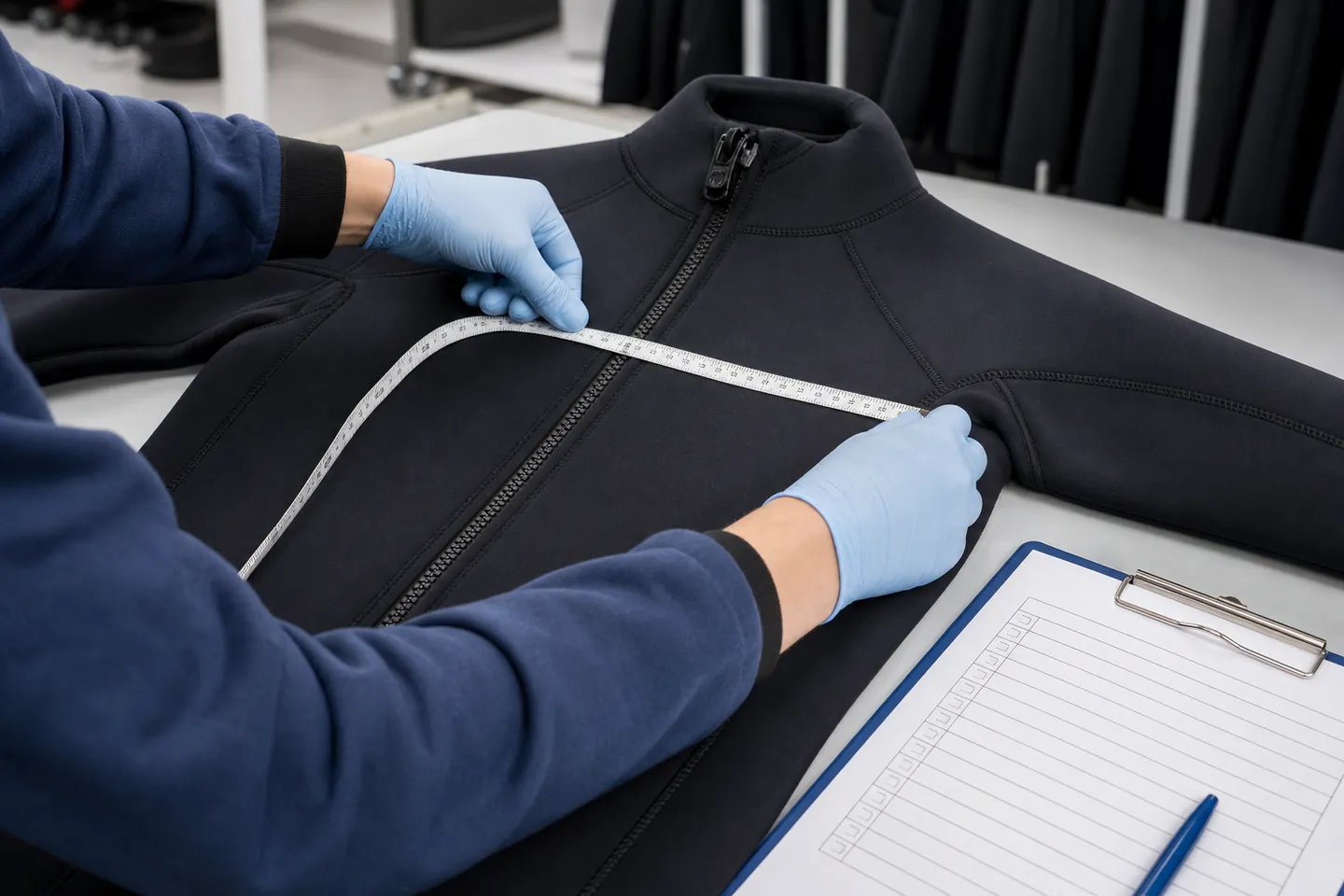
To turn supplier claims into a repeatable audit record, use our wetsuit quality control checklist for incoming materials, in-process checks, final inspection and shipment release.
9. Model MOQ, sample cost and total landed cost
A low unit price can hide commercial assumptions. MOQ may apply per style, colour, material, print, zipper or size breakdown. Separate product cost from development, tooling, labels, packaging, testing, inspection, freight, duty, banking and potential rework.
Once the audit shortlist is ready, use our wetsuit manufacturing cost comparison guide to align specifications, separate one-time charges and compare complete offers.
Ask for: MOQ basis, sample and development fees, tooling ownership, price-break quantities, included packaging, quote validity, payment terms, currency, Incoterm and a list of exclusions.
Verify: that all suppliers quote the same specification and delivery basis. Incoterms define the allocation of transport-related tasks, costs and risks; use the named place and selected rule precisely in the contract.
Red flag: a quote is materially lower but omits key materials, testing, packaging or delivery responsibilities.
For INSEAKU’s current starting quantities, sample-fee credit conditions and production timing, read our guide to wetsuit manufacturer MOQ, sample cost and production lead time.
For dive centers and other operators buying a shared-use fleet, compare rental wetsuits by total cost per completed use, including size utilization, asset tracking, care, repairs and replenishment—not garment price alone.
10. Validate capacity and lead-time assumptions
Capacity is not a single factory-wide number. Your order competes for specific pattern, cutting, printing, gluing, stitching, sealing and inspection resources. Ask for capacity relevant to your construction and selling season.
Ask for: production calendar, bottleneck process, line allocation, seasonal loading, material lead time, subcontractor dependency, changeover assumptions, progress-reporting cadence and recovery plan.
Verify: the schedule backward from required delivery through shipping, final inspection, packing, production, pre-production approval and material receipt. Include approval deadlines owned by your team.
Red flag: lead time is promised before the bill of materials, order quantity, approvals and capacity window are known.
11. Confirm compliance documents for the target market
There is no universal document pack for every wetsuit. Requirements vary by material, product claims, user group, destination, sales channel and buyer policy. The manufacturer should be able to supply accurate documentation and work with your chosen laboratory, but the brand or importer must define what applies.
Ask for: current certificate scope and status, material test reports, report applicant and sample identity, applicable declarations, chemical information, social-compliance records if required, packaging and labelling data, and document-retention policy.
For U.S. and EU programs, convert those documents into approved product, packaging, instruction and online-information fields before artwork release. The U.S. and EU wetsuit labeling procurement checklist separates each disclosure from the certificate and test-report file that supports it.
Verify: certificates with the issuer or accreditation source and test reports with the laboratory. Confirm that the tested material, colour and construction correspond to the product being purchased.
Red flag: expired reports, edited PDFs, a certificate belonging to another entity, or the claim that one generic “certificate” makes every future product compliant.
12. Agree IP, change control, shipping and after-sales terms
Good supplier relationships still need written rules. Define ownership and permitted use of patterns, artwork, molds, labels and confidential files. Establish how either party proposes, prices, tests and approves a change.
Ask for: NDA where appropriate, IP ownership, file-return or destruction terms, engineering-change process, golden-sample control, packing specification, shipment-release documents, defect notification period, investigation process, remedy options and continuous-improvement review.
Verify: that the final contract and purchase order reference the same controlled specification and approved changes.
Red flag: critical terms exist only in chat messages, or a substitution can be made without buyer approval.
How to interpret the 120-point score
| Total score | Working interpretation | Recommended next step |
|---|---|---|
| 96–120 | Strong documented candidate | Proceed to a controlled pilot if no stop condition remains. |
| 72–95 | Conditional candidate | Close named evidence gaps before pilot approval. |
| 48–71 | High risk or early-stage evidence | Limit activity to document review and sampling; do not place a bulk order. |
| Below 48 | Insufficient basis for approval | Do not proceed unless the supplier can resolve fundamental gaps. |
These thresholds are a procurement aid, not an industry certification. Adjust weighting for your product. A children’s rental wetsuit, premium cold-water suit and promotional warm-water product do not carry the same material, fit and risk priorities.
Five stop conditions that override the score
- The legal contract, payment and production entities cannot be reconciled.
- Material or component substitutions can occur without written approval.
- The factory will not establish a sealed sample and controlled specification before bulk production.
- Quality claims cannot be supported by criteria, records and corrective-action ownership.
- Required compliance information cannot be connected to the exact material, product and target market.
A safer supplier-verification sequence
- Capability screen: send a one-page, non-confidential brief and reject suppliers that cannot explain a relevant production route.
- Document review: verify legal identity, material sources, process map, quality plan, certificate scope and commercial assumptions.
- Live audit: use an in-person visit or live video to trace one order through real work areas and records.
- Sample program: test fit, materials, workmanship, branding and packaging through defined approval gates.
- Controlled pilot: place a limited production order with an agreed inspection plan and change controls.
- Bulk approval: release volume only after reviewing pilot results, corrective actions and the current capacity plan.
If supplier verification is part of a new launch, use this wetsuit brand procurement roadmap to connect factory approval with range planning, startup cost, sampling, production and launch gates.
What to include in your first RFQ
A useful RFQ lets each potential wetsuit supplier price the same requirement. Include:
To send every shortlisted supplier the same controlled specification, use our wetsuit tech pack template and RFQ checklist.
- Product category and intended use
- Target market and user profile
- Reference design, sketches or non-confidential tech pack
- Thickness, material, lining and stretch requirements
- Seam, zipper, reinforcement and entry construction
- Size range and estimated quantity by size
- Logo, print, labels and packaging
- Sample stages and required approval date
- Bulk delivery window and destination
- Testing, inspection and documentation requirements
- Requested quote basis, currency and Incoterm
- Questions about subcontracting, confidentiality and change control
Do not send confidential production files to every lead. Begin with enough information to test capability. Share controlled files after identity checks and an appropriate confidentiality agreement.
Questions buyers frequently ask
How do I find a wetsuit manufacturer?
Build a shortlist from specialist manufacturers, industry referrals, trade events and sourcing databases, then screen each candidate against the same product brief. Verify the legal entity, relevant product experience and real factory relationship before sharing sensitive files. Use the 12-point scorecard, a sample program and a controlled pilot before approving bulk production.
Should I choose an OEM, ODM or private-label supplier?
Choose OEM when your team controls the design and specification; ODM when you need development support from concept through production; and private label when you want to adapt an established product platform with your branding and packaging. The labels are less important than defining ownership, deliverables, approvals and change control in writing. See INSEAKU’s OEM and ODM wetsuit manufacturing services for an overview of these workflows.
Is the lowest MOQ the best choice?
No. MOQ is only one commercial variable. A low MOQ may be useful for market validation, but compare sample cost, material minimums, tooling, price breaks, testing, packaging, freight and expected defect or rework exposure. The best starting quantity is one that protects cash while still allowing the manufacturer to control materials and production consistently.
Do I need to visit the factory in person?
Not always. Begin with document checks, a live video walkthrough and supplier-specific records. For high-value, safety-sensitive, complex or repeat programs, an in-person or qualified third-party audit can reduce uncertainty. No audit format replaces sample approval and lot-specific inspection.
What documents should a wetsuit factory provide?
The appropriate pack may include business registration, quotation assumptions, material and component specifications, sample approval records, process and QC documents, test reports, certificate information, packing requirements and shipping documents. Ask only for documents relevant to your product and destination, and verify identity, scope, dates and issuing source.
What is the difference between a factory certificate and product evidence?
A management-system certificate describes an assessed system and scope; it does not prove that a specific material batch, construction or shipment meets your specification. Product evidence connects the tested or inspected sample to the exact material, order, date, method and acceptance criteria. Use both where relevant.
Turn the audit into a controlled development project
The purpose of a factory audit is not to find a supplier with perfect marketing. It is to expose assumptions early, establish an evidence trail and create a development process that both parties can repeat. The best custom wetsuit manufacturer for your brand is the one whose capabilities, controls and commercial model fit your exact product—not necessarily the largest factory or the lowest quote.
If you are preparing a custom wetsuit program, review INSEAKU’s company information, read our manufacturing FAQ, or send your product brief for a manufacturing review. Include your intended use, target market, construction, size range, quantity and timing so the discussion begins with a defined specification.
References and further reading
- ISO 2859-1:2026 — Sampling procedures for inspection by attributes
- ISO 9001 — Quality management systems requirements
- European Chemicals Agency — Candidate List substances in articles
- International Chamber of Commerce — Incoterms 2020 overview
Last reviewed: August 29, 2026. This article provides general procurement information and is not legal, regulatory or certification advice.