

Short answer: A reliable plan for EU wetsuit labeling requirements and U.S. sales starts with product classification, fiber composition, intended user and use, claims, destination country and sales channel. Then map five separate information layers: the physical product label, packaging or hangtag, instructions and safety information, the online product offer, and the supporting compliance or customs file. Do not treat a CE mark, Children’s Product Certificate, laboratory report or care label as interchangeable.
There is no single universal label that makes every wetsuit legal in both markets. U.S. textile, care, country-of-origin and children’s-product rules may apply in different combinations. In the EU, textile-fiber information, the General Product Safety Regulation (GPSR), language requirements and—only when the product is classified as personal protective equipment—the PPE Regulation may shape the label architecture. Exact applicability must be confirmed for the finished product and each sales country.
This procurement guide is operational information, not legal advice, certification or a declaration that a particular product complies. Regulations and official guidance can change. Appoint a qualified compliance professional, importer or authorized economic operator to review the current requirements before artwork release and shipment.
For sourcing and compliance teams: Download the editable workbook to assign owners, separate physical and online disclosures, control artwork versions, and record approvals before bulk production.
Download the U.S. and EU wetsuit labeling procurement checklist
Why one universal wetsuit label fails
A wetsuit looks like one garment, but its legal information may come from several decisions. The body can combine foam, knitted laminates, printed panels, coatings, thread, adhesive, zipper tape, hook-and-loop material and molded trims. A full suit, shorty, children’s style, thermal garment and suit sold with protective claims may not follow the same route. The United States and European Union also assign responsibilities differently among manufacturers, importers, private labelers and other economic operators.
The most common procurement mistake is to begin with a finished artwork file copied from a previous style. That file may use the wrong fiber wording, responsible-company identity, language, warning, origin statement or traceability code. It may also place information on a removable hangtag even though a rule calls for a durable or permanent disclosure. A visually correct label can therefore be legally incomplete.
1. Classify the product before artwork
Create a classification record before asking a designer to lay out the label. Identify every destination country, the legal manufacturer or brand owner, importer, intended age, activity, construction, claims and sales channel. If the same style will be sold in the United States and multiple EU Member States, create a row for each destination rather than one vague “US/EU” row. The United Kingdom is outside the EU framework and needs its own review.
| Input | Decision to record | Why it matters |
|---|---|---|
| Product | Full suit, shorty, top, hooded suit, children’s style or another configuration | Construction and intended use affect applicability and placement. |
| Composition | Foam, each textile laminate, coating, trim and their role | A composite wetsuit should not be reduced to an unsupported single-fiber statement. |
| User | Adult, child age range, rental user or specialist activity | Children’s rules and warnings can require separate controls. |
| Claims | Thermal, UV, protection, buoyancy, eco or performance claims | A claim can change classification and needs evidence. |
| Market | Specific U.S. channel or EU Member State | Language, importer and online-offer information can differ. |
| Operator | Manufacturer, importer, private labeler, EU responsible person | Names and contact details must match the legal supply chain. |
Record each conclusion as “applicable,” “not applicable” or “review required,” with a source, rationale, owner and approval date. “Not applicable” is a decision that needs evidence. A blank cell only hides an unanswered question.
2. Separate five information layers
Build the label plan as an information architecture. Some content belongs on the product, some may appear on packaging or an accompanying document, and some must be visible before an online purchase. Keeping these layers separate prevents a supplier from assuming that a carton sticker or PDF solves a product-label requirement.
- Physical product label or marking: information sewn, printed, transferred or otherwise attached to the wetsuit. Record permanence, visibility, comfort and exact placement.
- Packaging and hangtag: information a buyer or inspector can see without unfolding or opening the product, plus channel-specific commercial data.
- Instructions and safety information: care steps, warnings, fitting or use instructions and language versions supplied with the product.
- Online product offer: information displayed clearly before purchase on the product page or marketplace listing.
- Supporting file: classification memo, supplier declarations, test reports, technical documentation, customs records, certificates and artwork approvals.
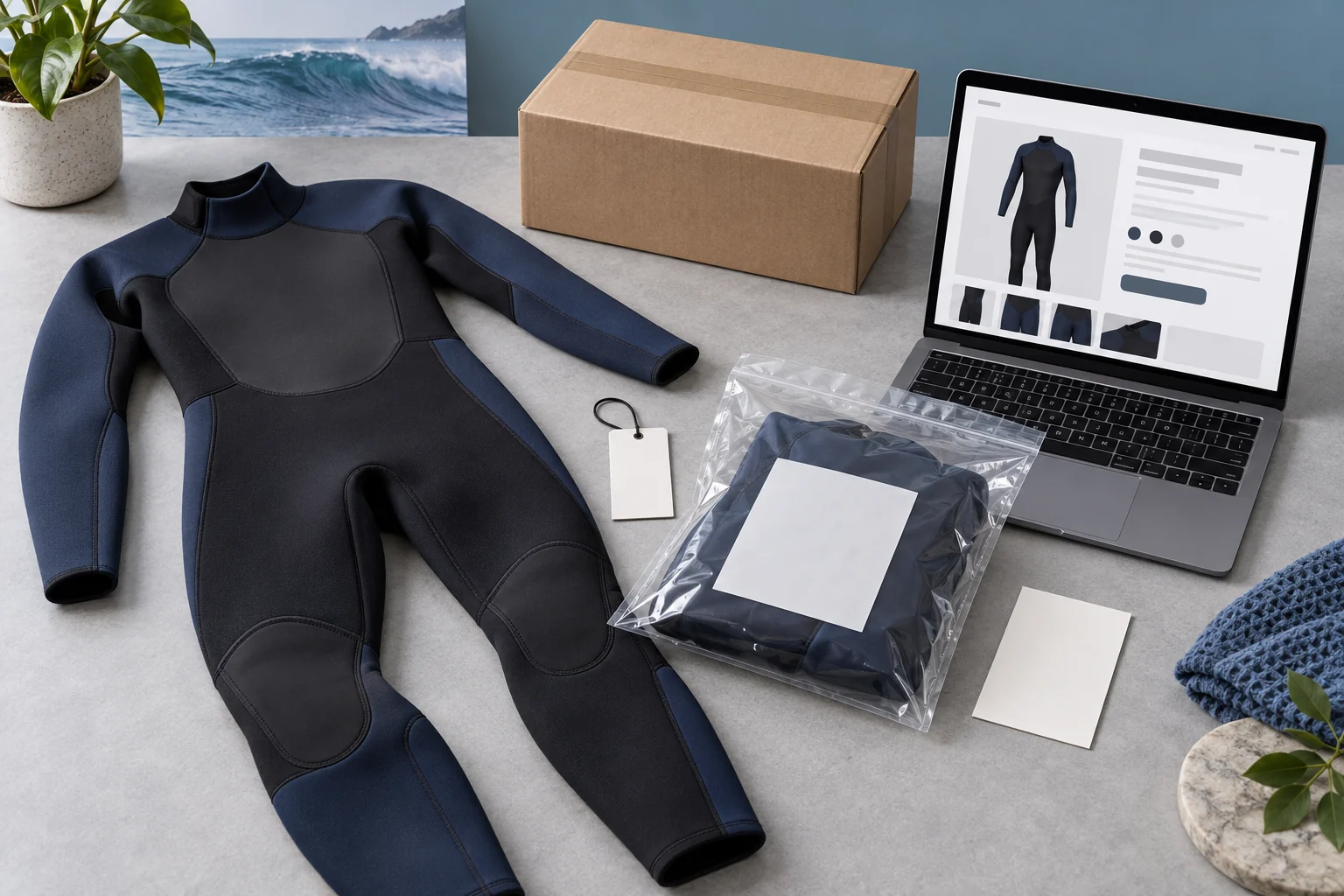
Add a field for the legal basis or buyer requirement behind every item. “Brand preference,” “retailer requirement” and “mandatory disclosure” are not the same. The distinction helps the team prioritize space and prevents a voluntary icon from displacing required text.
3. Map U.S. fiber, identity and origin information
US wetsuit labeling requirements depend on the finished construction and intended use. The U.S. Federal Trade Commission states that most textile and wool products must disclose fiber content, country of origin and the identity of the manufacturer or another responsible business. Under the Textile Fiber Products Identification Act and rules, the identity can generally be the business name or a registered identification number (RN). An RN is optional, and the FTC issues RNs only to U.S. businesses; a foreign factory should not invent or borrow one.
For a wetsuit, do not guess that the foam name is the fiber content. Determine whether and how the FTC textile rules apply to the particular composite construction, then document the generic fiber names and percentages supported by the bill of materials and supplier evidence. Marketing descriptions such as “premium stretch fabric” are not substitutes for required generic names. If different panels have different compositions, obtain qualified advice on the correct disclosure method.
Country of origin must also reflect the actual manufacturing route. “Designed in” language does not replace an origin statement. Coordinate FTC disclosure with customs-origin analysis and the importer before approving artwork, especially if cutting, sewing, lamination or finishing occurs in more than one country.
The FTC’s practical guidance says required disclosures should be in English. It also explains placement relationships among fiber content, identity and origin, including specific treatment of the origin statement. Preserve enough label space for the approved layout instead of compressing it after the sample is finished.
U.S. procurement questions
- Has a qualified reviewer decided whether the exact wetsuit construction is covered by the textile rules?
- Which components and percentages support the final fiber disclosure?
- Will the responsible business use its full name or a valid U.S. RN?
- What country-of-origin wording matches the actual production route?
- Can the label be found and read without damaging or disassembling the product?
4. Build the U.S. care label from evidence
The FTC Care Labeling Rule requires manufacturers and importers of covered textile wearing apparel to attach care instructions and have a reasonable basis for them. A care statement should describe regular care needed for ordinary use. It should not be copied from another wetsuit simply because the materials look similar.
Build the instruction from the approved foam, fabric, adhesive, print, zipper and construction. Consider washing method, water temperature, bleach restrictions, drying, ironing and professional care where applicable. Validate that the chosen process does not create unacceptable shrinkage, delamination, print damage, corrosion, odor retention or deformation. Record the supporting test or technical basis in the compliance file.
The care label should be visible or easily found when the consumer examines the product. If packaging hides it, the FTC rule may require care information on the outside of the package or a hangtag. This is why product and packaging rows must remain separate in the checklist. Care symbols may be used under the U.S. framework when the applicable requirements are satisfied, but a symbol library should not be adopted without confirming meaning and use.
5. Keep children’s tracking labels and CPCs distinct
If a wetsuit is designed or intended primarily for children age 12 or younger, additional U.S. Consumer Product Safety Commission requirements may apply. The CPSC describes tracking information that enables the manufacturer or private labeler, production location and date, and cohort information such as batch or run to be ascertained. To the extent practicable, visible, legible and permanent identifying marks are required on the product and its packaging.
A removable hangtag or adhesive sticker may not satisfy permanence for a textile product. The CPSC also explains that tracking information does not have to appear in one single box called a “tracking label”; codes may be used if the responsible company can decode them and is identifiable or contactable. Create a traceability format that survives normal use and connects the finished wetsuit to production records.
A Children’s Product Certificate (CPC) is different. It certifies compliance with applicable children’s product safety rules based on required testing. It is a document, not a sewn garment label, and the tracking-label requirement itself is not the rule being certified on a CPC. Beginning July 8, 2026, the CPSC states that importers of most regulated consumer products must electronically file certificate data through U.S. Customs and Border Protection’s Partner Government Agency Message Set; confirm current implementation for the shipment.
When the intended user is a child, connect age, design hazards, warnings and traceability to the sample-release process. The wetsuit fit testing protocol helps the team keep target-user and size-set decisions attached to the approved construction.
6. Assess EU wetsuit labeling requirements for textile fibers
EU Regulation (EU) No 1007/2011 controls textile-fiber names and related labeling and marking. Its scope includes products composed of at least 80% by weight of textile fibers and certain treated-as-textile products. A wetsuit is a composite of foam and laminated textiles, so the buyer should document whether the exact construction falls within scope and how each relevant component is treated. Do not assume that a common fiber statement from an ordinary garment can simply be reused.
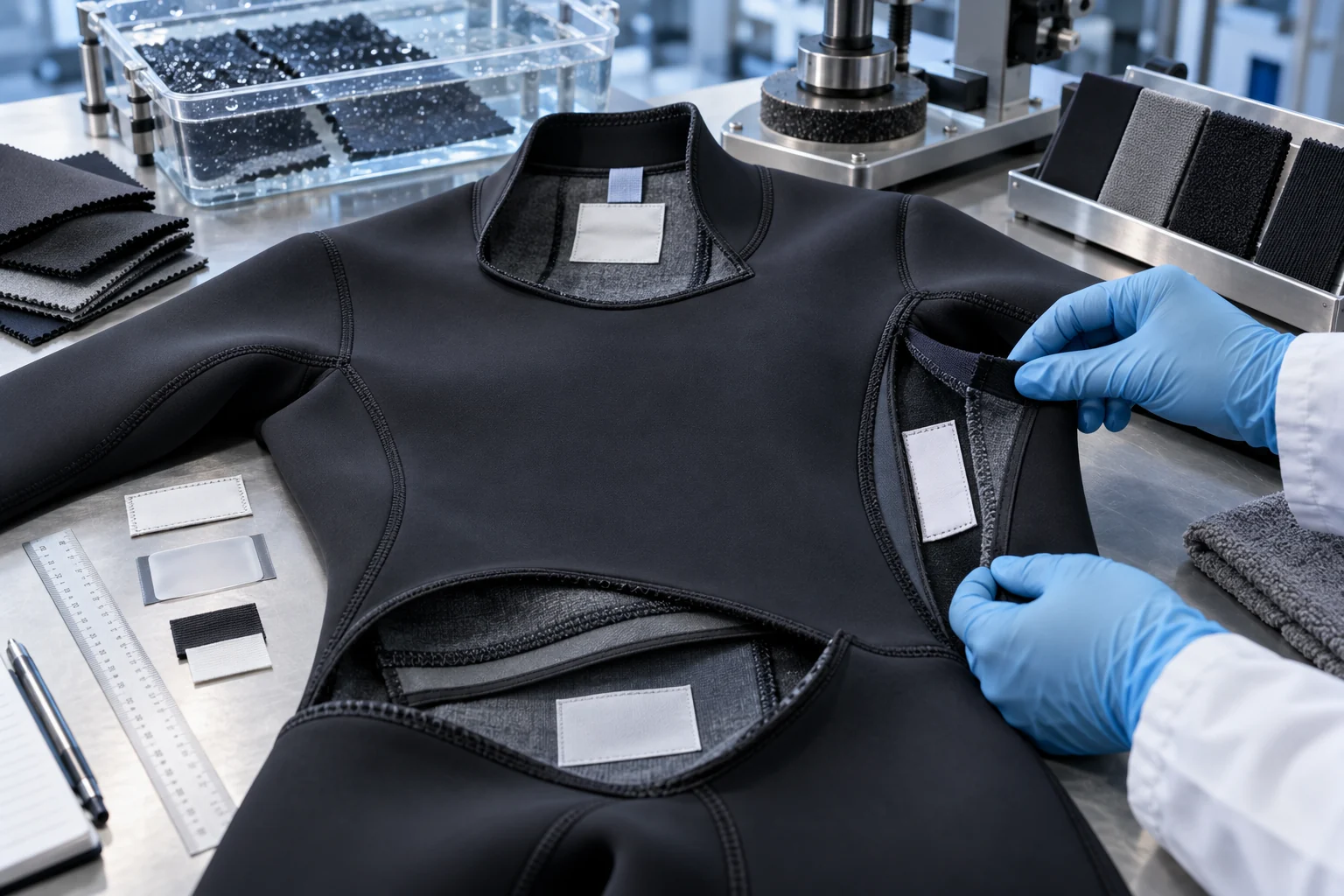
Where the Regulation applies, labels or markings must be durable, easily legible, visible, accessible and securely attached. Fiber-composition information must be available to the consumer before purchase, including electronic purchases. Member States may require the information in their official language or languages. A single English label may therefore be insufficient for a multi-country EU launch.
Manufacturer and importer responsibilities should be reflected in the review workflow. The procurement file should connect the approved composition claim to the bill of materials, supplier declarations and artwork revision. If material sourcing or laminate construction changes, reopen the composition decision before production.
7. Map EU GPSR product and online information
The EU General Product Safety Regulation has applied since 13 December 2024. For products within its scope, it adds a traceable product and economic-operator structure that procurement teams must plan before labels and listings are released. The manufacturer must ensure that the product bears a type, batch or serial number, or another element enabling identification. The manufacturer must also indicate its name, registered trade name or trademark, and postal and electronic address on the product or, where that is not possible, on packaging or an accompanying document.
Importers have their own identity and contact obligations. If the manufacturer is outside the EU, the Article 16 responsible economic operator must be identified, and required contact information may need to appear on the product, packaging, parcel or accompanying document according to the applicable provisions. The final architecture depends on the actual supply chain; it cannot be completed using the factory address alone.
Instructions and safety information must be clear and provided in a language that consumers can easily understand, as determined by the Member State, when that information is necessary for safe use. A buyer should therefore create controlled country packs rather than asking the supplier to improvise translations during packing.
Distance-sales information is a separate release gate. Article 19 requires an online offer to clearly and visibly display specified information, including manufacturer contact details; where the manufacturer is outside the EU, the responsible person’s details; product identification, including a picture and type or identifier; and warnings or safety information required for the product. A photograph of the sewn label is useful evidence, but it is not automatically a complete online disclosure.
8. Use CE marking only when the PPE route applies
Not every wetsuit requires CE marking. Regulation (EU) 2016/425 applies when a product is personal protective equipment—equipment designed and manufactured to be worn or held for protection against one or more risks to health or safety. The intended protective function, design, claims and foreseeable use require a qualified classification review.
If the PPE route applies, the team must determine the relevant category, conformity-assessment route, technical documentation, instructions, EU declaration of conformity and CE marking requirements. The PPE Regulation also includes product-identification and manufacturer/importer contact obligations. Do not place a CE mark on a product merely because it will be sold in Europe, and do not use an unrelated supplier certificate as permission to apply the mark.
If the route does not apply, record the rationale and control marketing language so that later product-page claims do not contradict the classification. Phrases implying protection, rescue, flotation or certified thermal performance can create legal and commercial risk when unsupported. Claims should be checked together across the label, packaging, catalog and online listing.
9. Control artwork, language and placement
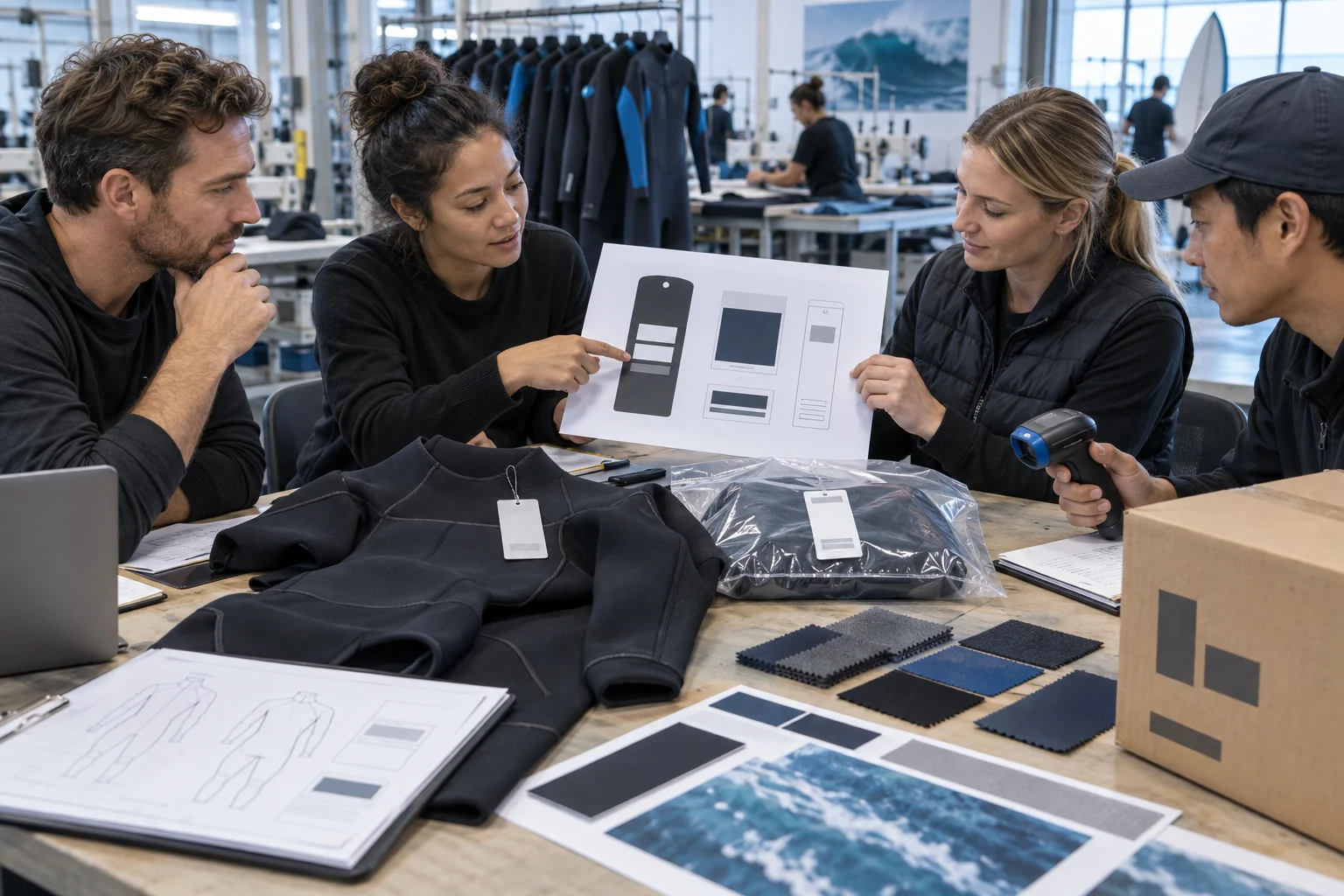
Turn the legal matrix into an artwork specification, not an email thread. Assign a unique file name and revision to each product label, transfer, hangtag, insert, bag sticker, carton mark and digital listing. The approval record should identify product style, colorway, size range, market, language and effective production lot.
Review artwork at actual size. A PDF enlarged on a monitor can hide text that becomes unreadable after printing, heat transfer or repeated stretching. Check contrast, font size, spacing, icon clarity, translation and the order of mandatory disclosures. Confirm that added importer or responsible-person information does not obscure manufacturer information.
Placement also needs a construction decision. A neck label may be easy to find but uncomfortable; a side-seam label may fold into a bonded seam or be difficult to read; a heat transfer may lose contrast after stretch, chlorine, salt, washing or abrasion. Test the approved method on the actual laminate and attachment process. Inspect after conditioning that represents expected care and use.
For multilingual ranges, do not force every country into one unreadable label. A modular system may combine a durable core product label with market-specific instructions, packaging and online content, provided the structure satisfies the confirmed rules. The qualified reviewer should approve which information may move to another layer.
10. Verify samples and release production
Label compliance needs the same gated control as fit and workmanship. At proto stage, confirm available label zones and the likely information volume. At size-set or pre-production stage, approve final wording, translations, materials, attachment and placement. Before bulk packing, compare production against a sealed sample and current artwork list.
The wetsuit quality control checklist can carry label verification into incoming, in-process and final inspection. Inspectors should check more than presence. They should verify:
- correct artwork revision for the style, color, size and destination;
- approved composition, care, origin, company and traceability information;
- correct language pack and market-specific warning or instruction;
- legibility, contrast, orientation, placement and attachment;
- matching product, bag, carton and online identifiers;
- no obsolete, duplicate or unauthorized marks;
- evidence that substitutions and artwork changes were approved.
Use first-piece approval at the labeling operation. A final random inspection may identify mixed labels, but it cannot efficiently repair an entire lot after incorrect heat transfers have been applied. Record the operator, time, machine or process, artwork revision and first approved pieces. Segregate labels by market and destroy obsolete stock under control.
Any change to composition, supplier, color chemistry, construction, country of manufacture, responsible operator, claim or destination can affect the label plan. Add these triggers to change control. A commercial reorder is not automatically a compliance repeat when the product or law has changed.
11. Send a decision-ready supplier brief
The supplier should receive decisions, not an open-ended request to “make the labels compliant.” Brand owners and importers retain important responsibilities and should coordinate qualified review. A useful release pack includes:
- style, revision, intended user, intended use and confirmed destination countries;
- controlled bill of materials and evidence supporting composition statements;
- market-by-market requirement matrix with legal or buyer basis;
- approved physical label, transfer, hangtag, insert, packaging and carton artwork;
- approved translations and contact details for responsible businesses;
- online product information and image requirements;
- placement drawings, attachment method and durability acceptance criteria;
- traceability-code format and the records needed to decode each lot;
- sample, first-piece, in-process and final inspection checkpoints;
- change-control triggers and named approval authority.
Connect this pack to the wetsuit tech pack, because label wording is only reliable when the composition and construction are controlled. For material decisions that affect both performance and disclosure, use the wetsuit material selection guide.
If you need a factory team to coordinate pattern development, materials, samples, controlled artwork and production records, review INSEAKU’s OEM, ODM and private-label services. Your importer, legal adviser or compliance professional should still confirm the exact market requirements and approve the final consumer information.
Frequently asked questions
What are the main U.S. wetsuit labeling requirements?
Depending on the product, relevant items may include fiber content, country of origin, the identity of the manufacturer or responsible business, and care instructions. Children’s products may also need permanent tracking information and certification for applicable CPSC rules. Product construction, intended age and exemptions must be reviewed before artwork is approved.
What are the main EU wetsuit labeling requirements?
Potential requirements include textile-fiber information where Regulation (EU) No 1007/2011 applies, product and economic-operator identification under the GPSR, necessary instructions or warnings, language versions and information for distance sales. PPE obligations and CE marking apply only when the product falls within the PPE Regulation.
Does every wetsuit sold in Europe need a CE mark?
No. CE marking is not a generic European quality symbol. For wetsuits, the team must determine whether the design, intended protective function and claims make the product PPE under Regulation (EU) 2016/425. Apply the mark only after the applicable conformity route has been completed.
Can a hangtag replace a sewn-in label?
Not automatically. Some information must be durable, securely attached or permanent, while other information may be placed on packaging, a hangtag or an accompanying document under specific conditions. Map each item to its rule and verify the permitted location.
Is a CPC the label for a children’s wetsuit?
No. A Children’s Product Certificate is a compliance document for applicable children’s product safety rules. It is distinct from product and packaging tracking information and from textile, care or origin labels.
Does an online listing need the same information as the product label?
Not necessarily the same layout, but online offers can have their own mandatory pre-purchase information. For EU sales, GPSR Article 19 specifically addresses distance-sale offers. Manage the product, packaging and online listing as linked but separate controlled records.
When should label artwork be frozen?
Freeze it only after product classification, destination countries, composition, supply-chain operators, claims, translations and placement have been approved. Then verify actual-size samples and a first production piece before bulk application.
Turn labeling into a release gate
A compliant-looking label is not enough. A defensible system links the exact product and market to confirmed requirements, evidence, approved consumer information and production records. That system reduces last-minute artwork changes, mixed-market packing and online-listing gaps.
Discuss your destination-market requirements with INSEAKU. Share the intended countries, user group, product claims, construction, sales channels and target launch date so the manufacturing brief can be structured for qualified review before sampling.
Official references used for this guide
- U.S. Federal Trade Commission: Apparel and Labeling
- U.S. Federal Trade Commission: Threading Your Way Through the Labeling Requirements
- U.S. Federal Trade Commission: Complying with the Care Labeling Rule
- U.S. Consumer Product Safety Commission: Tracking Label
- U.S. Consumer Product Safety Commission: Children’s Product Certificate
- EUR-Lex: Regulation (EU) No 1007/2011 on textile fibre names and labelling
- EUR-Lex: Regulation (EU) 2023/988 on general product safety
- EUR-Lex: Regulation (EU) 2016/425 on personal protective equipment