
Good wetsuit packaging starts with a packing trial on the actual garment. Agree how folds, closures and sensitive surfaces will be protected; measure the filled, closed cartons; and reconcile their contents on arrival. Choose the smallest practical package only if the unpacked garment meets the agreed condition. A neat retail bag or the correct carton count alone does not prove protection or completeness.
This guide is for brands, importers and procurement teams planning bulk shipments. It explains how to pack wetsuits for shipping without treating one folding method or carton size as suitable for every thickness, surface and product type. Actual packaging specifications, photos and acceptance criteria must be agreed for the project. The illustrations and worked quantity example below are editorial aids, not records of an INSEAKU shipment.

Download the fillable Packing and Receiving Checklist. The two-page template separates packing approval from arrival checks. Record evidence and open issues; checking a box alone does not authorize shipment or accept a damaged delivery.
1. Define the packaging job before choosing the box
Separate three decisions: the individual product pack, the transport carton and any pallet or consolidated load. A retail presentation bag can identify a garment without providing the protection required by the transport route. Equally, a strong outer carton does not resolve an abrasive tag rubbing against a sensitive surface inside it.
Specify the style and revision, material and inner/outer surfaces, size range, thickness profile, closures, printed areas and included accessories. Record whether the order counts individual garments or complete two-piece sets. A jacket and trousers sold as one set should not accidentally become two units on the packing list.
Add the destination receiving requirements: single-SKU or mixed cartons, carton numbering, label placement, pallet needs and access to the packing list. Link those decisions to the wetsuit tech pack and RFQ checklist. The receiver should not have to reconstruct the assortment from photographs of sealed boxes.
Ask the supplier to quote the packaging scope explicitly. Custom printing, bags, inserts or cartons may have separate purchasing conditions. Use the MOQ and commercial-terms guide as context, then confirm the current minimums, ownership of unused packaging and artwork-change arrangements in the quotation.
2. Approve fold locations and surface protection on a real sample
Make a packing trial part of the sample discussion. Show the actual garment before packing, the proposed fold or support arrangement, protection around closures and the condition after unpacking. A diagram can communicate the intended layout, but a trial reveals whether that layout works with the chosen neoprene, panel construction and print.
Do not force a thick panel into a sharp fold simply because another style fits the box that way. Identify areas where a zipper, slider, hook-and-loop closure, hangtag attachment or rigid accessory could press into the garment. Ask for a compatible separation or protection method and inspect it after the agreed trial.
Beuchat’s official care guidance advises storing a fully dry wetsuit with its shape protected and avoiding pressure from objects placed on top. That supports caution about prolonged compression; it is not a validated shipping recipe. A temporary transport configuration still needs its own review.
For unlined or coated products, review the surfaces that touch each other and the packaging. The open-cell versus lined construction guide helps identify those differences. Do not promise that every crease disappears after a fixed resting time, or prescribe heat, steam or ironing as a general remedy.

3. Control cleanliness, dryness and the individual pack
Confirm that garments are ready for packing under the agreed production and inspection process. Keep the packing surface clean and separate finished products from wet, dirty or unresolved items. Do not seal a damp garment into a bag and treat the outer carton as the solution.
List the bag or sleeve material, dimensions, closure, permitted contact surfaces and insert location. Where a protective sheet is proposed, check it with the actual garment and print rather than assuming that any paper or plastic is interchangeable. Keep loose accessories in a defined position so they cannot move unnoticed through the carton.
Do not automatically add vacuum compression, tight straps or chemical moisture-control products to reduce space or address uncertain storage conditions. Those are additional packaging decisions requiring suitability checks, instructions and buyer approval. A supplier should be able to explain the chosen method and any restrictions, not just show a smaller shipping volume.
Keep the individual identifier readable after packing. Confirm that the garment label, bag label and packing-list line refer to the same style, color and size. If a set has separate components, the matching rule should remain clear when the receiver opens the outer carton.
4. Specify the carton, then measure the closed package
Record carton material and strength specification, internal arrangement, maximum agreed quantity and gross weight, closure method and external markings. The selected carton and any pallet system must suit the handling route. A parcel sent through sorting equipment is not the same packaging problem as a palletized wholesale delivery.
UPS’s packaging guidance emphasizes a suitable rigid box, weight limits and secure closures. Treat carrier guidance as a transport input, not as proof that the wetsuit inside will retain its approved appearance. Confirm current requirements for the selected service with the carrier or forwarder.
Measure the outer length, width and height after the carton has been filled and closed normally. Weigh the complete package and state the units. Do not copy nominal empty-carton dimensions into the final shipping record when the packed carton differs. Record palletized dimensions separately where applicable, including the pallet and completed load.
Illustrative volume calculation: a closed carton measuring 60 × 40 × 40 cm occupies 0.096 m³: 60 × 40 × 40 ÷ 1,000,000. Four cartons of those exact outer dimensions total 0.384 m³ before any pallet or additional consolidation. These are hypothetical dimensions, not an INSEAKU carton size or evidence of how many wetsuits fit inside.

Cubic volume is not the same as billable weight. DHL Global Forwarding explains the distinction between physical and dimensional weight and the effect of transport-specific density ratios. Obtain the applicable calculation, rounding and charges for the booked service rather than applying one divisor to every route.
5. Reconcile every carton to its contents
Assign each carton a unique identifier within the shipment. Record the purchase order, product revision, SKU or style-color-size combination, unit of sale and quantity. Mixed cartons need separate variant lines; “assorted wetsuits” is not enough to establish which units should be inside.
Compare carton-level totals with the approved order and final packing list before sealing. Then use those same carton IDs at receiving. A correct number of outer boxes does not prove that the garment count or size mix is correct.
| Carton | Packing-list units | Counted on arrival | Variance: received minus listed |
|---|---|---|---|
| C01 | 24 | 24 | 0 |
| C02 | 24 | 22 | −2 |
| C03 | 24 | 24 | 0 |
| C04 | 18 | 18 | 0 |
| Total | 90 | 88 | −2 |
All four cartons arrived in this invented example, but the count is two units short in C02. The table identifies an exception; it does not establish where the discrepancy occurred or who is responsible. Recount, check the variant lines and preserve the relevant evidence before drawing a conclusion. These quantities are not recommended carton capacities.

6. Agree the packing trial and acceptance criteria
Define what will be reviewed before approving the package: surface marks, fold appearance, print contact, garment position, closure protection, carton condition and identification. Specify the observation conditions and timing for the actual project. Do not change the acceptable result after seeing the sample.
Where transport testing is needed, select the procedure with the buyer, packaging specialist or laboratory for the distribution route and packaged product. ISTA’s design and testing guidance links test selection to the distribution environment and calls for product and package damage criteria to be established before testing. A casual drop of an empty box does not validate a bulk wetsuit shipment.
Keep the garment, packing arrangement, materials, carton specification and test record tied to a revision. ISTA also highlights retesting when relevant product, packaging or process changes may affect performance. A changed insert, carton supplier or packing quantity should therefore trigger a review of the existing approval, not an assumption that the previous result still covers it.
Use the sample approval process to record the packaging decision alongside the approved product. This article does not claim that INSEAKU has completed a particular transport test or holds a packaging certification for the proposed shipment.
7. Inspect the delivery before mixing it into stock
Start with the shipment identity and outer-carton count. Record visible carton damage, wet areas, broken closures or changed markings before opening. Photograph the relevant carton ID and condition so the images can be linked to a specific package rather than a generic pile of boxes.
Open carefully without driving a blade toward the garment. Compare the contents with the carton-level packing list, then inspect the agreed product and packaging features. Keep clean garments separated from damaged or suspect items. Do not mix an unresolved carton into normal stock and lose its traceability.
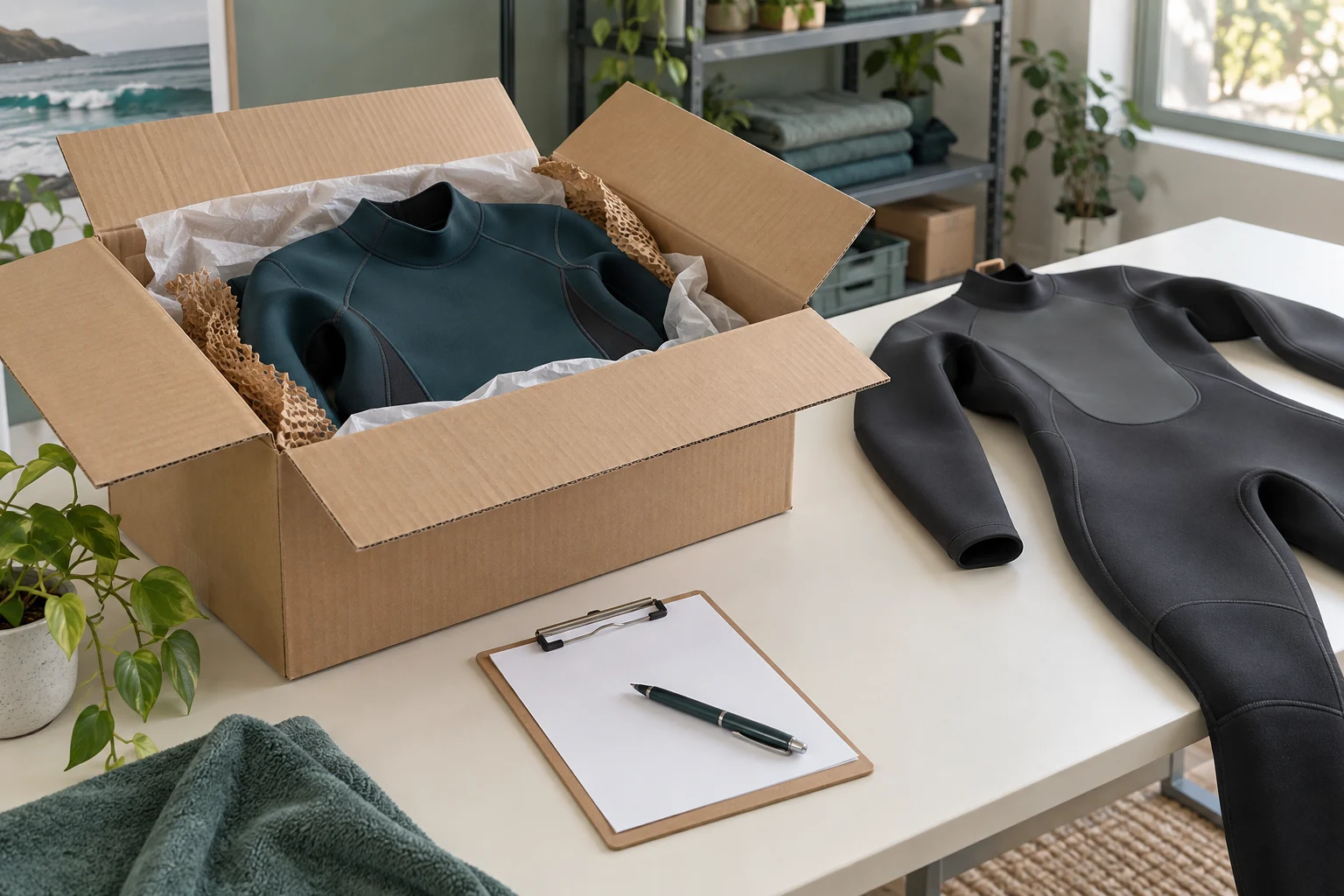
Record counts by variant, not only by carton. Note the inspection scope: checking selected garments must not be described as a complete inspection of every item. Use the agreed wetsuit quality-control checklist for product acceptance and keep quantity reconciliation separate from workmanship findings.
If something is wrong, retain the affected packaging and records, notify the relevant parties promptly and follow the shipment’s reporting procedure. Do not apply an invented universal claim deadline. Record the issue, evidence, owner and next action; a shortage, transit mark and product defect may need different investigations.
8. Release one controlled wetsuit packaging specification
Before dispatch, make sure the packing team and receiver have the same approved revision. Include the individual pack, garment arrangement, protection details, carton specification, quantity rules, marking artwork, packing list and any pallet requirements. Resolve open questions before they become improvisations at the packing table.
The downloadable checklist has one page for packing preparation and one for receiving. Its fields and checkboxes are a record aid, not an automated pass/fail system. Use one copy per defined inspection scope and attach carton-level or SKU-level detail when the available lines are insufficient. Leave unknown facts unresolved rather than entering a convenient zero.

To review packaging alongside a custom product order, explore INSEAKU’s custom wetsuit production and project services and send your packaging and receiving requirements. Include the intended route, assortment, sensitive surfaces and receiver’s requirements. Confirm actual packaging photographs, carton measurements and any trial or test scope as project deliverables.
Frequently Asked Questions
Should wetsuits always be rolled rather than folded?
No single method is established here for every style. Review the proposed arrangement on the actual garment, including closures, coatings, prints and thickness changes, and approve the unpacked condition.
How many wetsuits fit in one carton?
That requires a packing trial with the actual product and approved protection. Thickness, size, included pieces and carton limits matter. The worked quantities above are arithmetic examples, not capacities.
Can vacuum packing reduce freight cost?
A smaller measured package does not prove acceptable garment condition or lower total cost. Do not adopt vacuum compression without product-specific review and written approval; obtain the applicable carrier calculation separately.
Does a correct carton count mean the delivery is complete?
No. Reconcile the contents and variants as well. In the hypothetical example, four cartons arrive but two garments are missing from the listed quantity.
Will shipping creases disappear by themselves?
Do not promise that every mark will recover or assign a universal recovery time. Document the condition, follow the supplier’s instructions and assess it against the agreed acceptance criteria.
References and Further Reading
Official sources checked on 29 September 2026. They support care, transport measurement and packaging-test principles, not the illustrative carton dimensions, packing quantities or an INSEAKU certification claim.
- Beuchat — How to Maintain Your Neoprene Wetsuit? Dry storage and protection from pressure; not a bulk-shipment packing specification.
- UPS — How to Pack a Box or Pallet for Shipping. Carrier-oriented packaging preparation; confirm the service-specific requirements.
- DHL Global Forwarding — Calculating Chargeable Weight by Air, Ocean, Road and Rail. Physical versus dimensional weight and transport-specific calculation factors.
- ISTA — Getting Started with Design and Testing. Distribution-related test selection, defined acceptance criteria, documentation and retesting.