
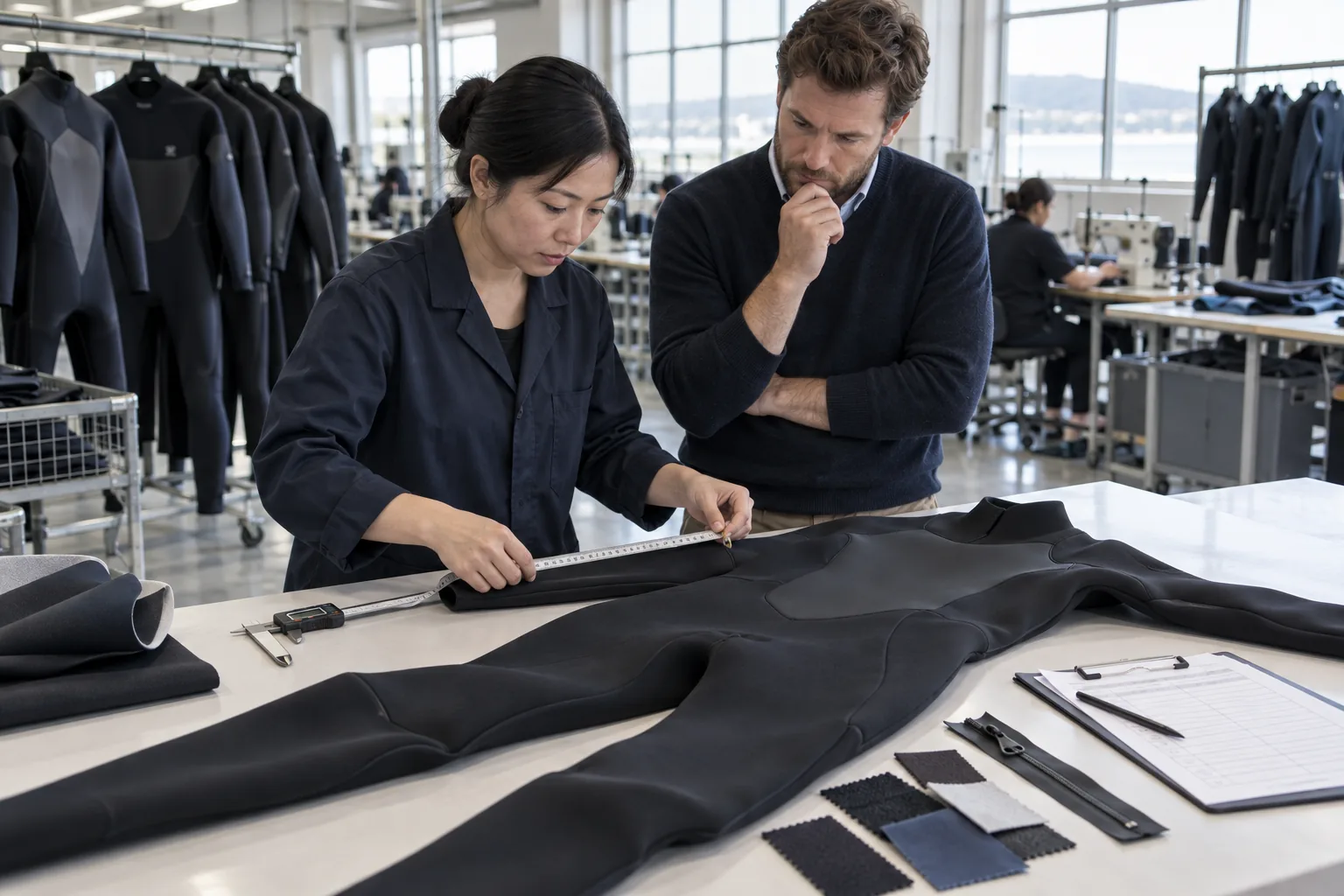
Short answer: A practical wetsuit quality control checklist controls the approved specification from incoming material inspection through first-piece approval, in-process checks, final measurement, packaging verification and shipment release. At INSEAKU, every incoming material batch is inspected and traceable. Finished-goods inspection may be 100% or sampling-based according to the customer’s written quality plan. When an AQL plan is specified, the lot, sample size, defect classes and acceptance/rejection numbers must be agreed before inspection.
Wetsuit quality cannot be judged by appearance alone. Foam type and thickness, lamination, stretch direction, pattern version, seam construction, zipper installation, measurements, labels and packaging can all affect fit, durability and commercial acceptance. The most useful quality plan therefore defines what will be checked, when it will be checked, how results will be recorded and who can release the order.
This guide is written for water-sports brands, importers, retailers and product teams preparing an OEM, ODM or private-label order. If the development responsibilities are not yet defined, compare OEM vs ODM wetsuits and private-label manufacturing first. This guide then explains INSEAKU’s normal control route and provides downloadable templates that buyers can adapt to their own product, market and risk requirements.
Download the wetsuit quality control checklist
Use the editable workbook to plan and record inspection results, or use the PDF as a printable field checklist. The files do not reproduce proprietary ISO sampling tables; enter the sample size and acceptance/rejection numbers from the sampling plan approved for your order.
Download the editable Excel checklist | Download the printable PDF checklist
What should a wetsuit quality plan control?
A quality plan converts the approved product requirements into checkpoints and records. It should connect each inspection result to the correct purchase order, supplier, material batch, production order, style, color and size range. It should also identify the responsible person and the document or sample used as the acceptance reference.
| Control stage | Main reference | Typical decision | Typical record |
|---|---|---|---|
| Incoming quality control (IQC) | Material specification, color standard and component approval | Accept, conditionally accept or quarantine the material batch | Incoming inspection report and batch identity |
| Pre-production | Approved specification, pattern version and sealed sample | Release materials, artwork, patterns and first piece | Pre-production checklist and first-piece approval |
| In-process quality control (IPQC) | Work instructions, approved construction and measurement points | Continue, adjust, rework or stop the process | Process inspection and corrective-action records |
| Final inspection | Approved sample, measurement chart, defect criteria and packaging specification | Pass, hold, rework or reject the inspected lot | Final inspection report, defect summary and photos |
| Shipment release | Completed quality plan and closed nonconformities | Relevant QC, production and project/commercial stakeholders approve release | Dated release authorization linked to the order and batch |
The approved sealed sample is important, but it is not the only control document. A sample cannot communicate hidden material properties, all graded measurements, inspection frequency, defect classification or packaging quantities. The written specification and customer quality plan remain part of the production basis.
How does incoming material inspection work?
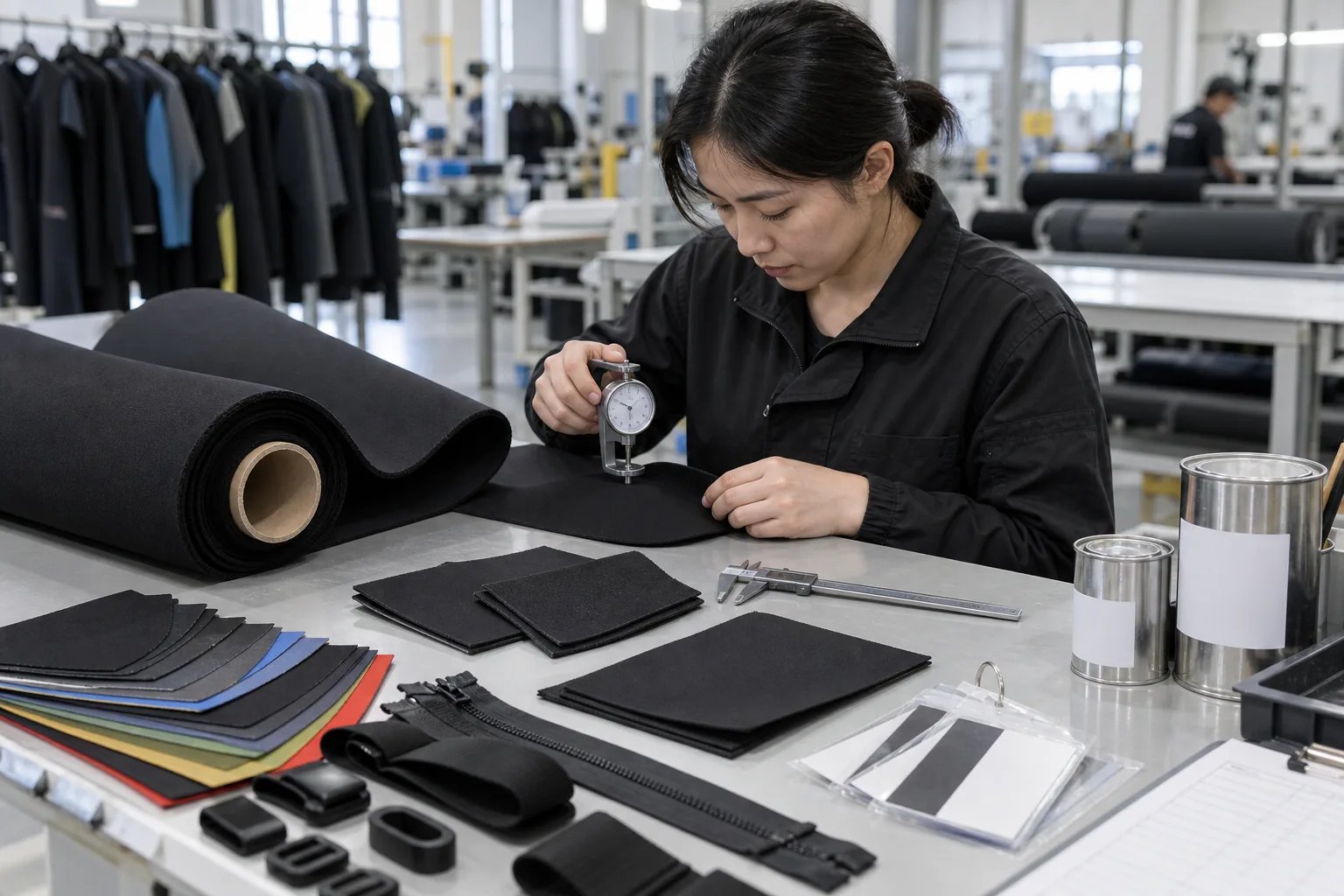
INSEAKU performs incoming inspection on every batch of materials. The batch is identified so that materials can be traced through the purchase order, supplier, material batch and production order. This traceability allows a problem to be contained without treating unrelated material as affected.
For named Yamamoto grades and other limestone-based candidates, follow the Yamamoto and limestone neoprene traceability guide so the received lot remains connected to the manufacturer, grade, swatch, sealed sample and approved marketing claim.
For natural-rubber or branded-material orders, traceability should also connect the exact candidate, converter, transaction evidence, approved swatch and claim route to the received lot. See the Yulex vs neoprene supply and claim checklist for the additional evidence fields.
Depending on the material or component, incoming checks can cover:
- neoprene or foam type, thickness and visible condition;
- fabric lamination, bonding condition, wrinkles, bubbles or separation;
- color and shade against the approved reference;
- surface contamination, dents, creases, holes or other defects;
- zipper model, length, slider operation and component identity;
- hook-and-loop, thread, tape, liquid-seal material and other trims;
- printed or woven labels, hangtags, polybags and packaging materials;
- quantity, lot identity and supporting supplier documents.
Available inspection tools include thickness gauges, calipers, measuring tapes, scales, approved color cards or controlled lighting, tensile equipment and leak or water-test equipment. The selected tool and method should match the characteristic being controlled. A visual check alone is not a substitute for measurement when a numerical requirement has been approved. Buyers defining foam, lining, stretch and component requirements can use our wetsuit material selection guide before setting the inspection criteria.
When CR and SCR are both proposed, the CR and SCR material-control guide shows which supplier-grade, test-condition and approved-sample records should follow the batch into production.
What happens when incoming material fails?
A questionable batch should be identified and isolated before it is issued to production. The team records the nonconformity, assesses the affected quantity and decides whether to reject, replace, sort, test further or accept under a documented customer-approved deviation. Uncontrolled substitution is not an acceptable response.
What is checked before cutting and bulk production?
Pre-production checks protect the link between the approved development work and the production floor. Before cutting, the team verifies the current pattern version, material face and stretch direction, color, size, panel identification and required panel quantity. Artwork, labels, zippers and other components must correspond to the correct order and version.
Open-cell and textile-lined interiors require the inspector to verify the approved layer construction, surface, thickness and handling condition. Use the open-cell vs closed-cell wetsuit comparison to define the product evidence before cutting.
INSEAKU also uses first-piece approval. The first completed or representative production piece is checked against the sealed sample, specification, measurement chart and workmanship requirements before the process continues at volume. If the first piece does not pass, the cause is corrected and the revised piece is checked again.
For the production route behind these checkpoints, see our guide to the wetsuit manufacturing process. Buyers who need to specify inputs and acceptance criteria can also use the wetsuit tech pack and RFQ checklist.
Which in-process quality checks are used?
In-process quality control finds problems while correction is still practical. INSEAKU’s checkpoints can cover material lamination, printing, cutting, gluing and curing, seam assembly, seam taping or liquid sealing, zipper installation, finished measurements and appearance. Inspection may be continuous, 100% at a defined station or sampling-based according to the customer quality plan and process risk.
Lamination and printing
Checks can confirm the correct material combination, bonding condition, face direction, color, artwork version, placement, scale and visible print quality. Color approval should use an agreed reference and viewing method because monitors, lighting and substrate can change perceived color.
For method-specific risks and approval evidence, use the screen print, heat transfer and sublimation comparison before defining the bulk printing checks.
Cutting and panel control
Cut parts are checked for the correct pattern version, size, grain or stretch direction, notches, paired components and visible damage. Panel identity and bundling help prevent mixed sizes, colors or versions from moving downstream.
Gluing, curing and seam assembly
Process checks can include adhesive coverage, open time, alignment, curing conditions, stitch type, stitch consistency, skipped stitches, seam allowance, reinforcement and stress-point construction. The required seam route depends on the approved design and product use. Our guide to GBS vs flatlock wetsuit seams explains why the seam name alone is not a complete quality specification.
Taping, liquid sealing and zippers
Where specified, tape or liquid-seal checks include placement, continuity, bonding and surface condition. Zipper checks include model, orientation, stop position, operation, reinforcement and interaction with the surrounding pattern. A zipper that operates on an empty garment can still create a fit or leakage problem if installed in the wrong position.
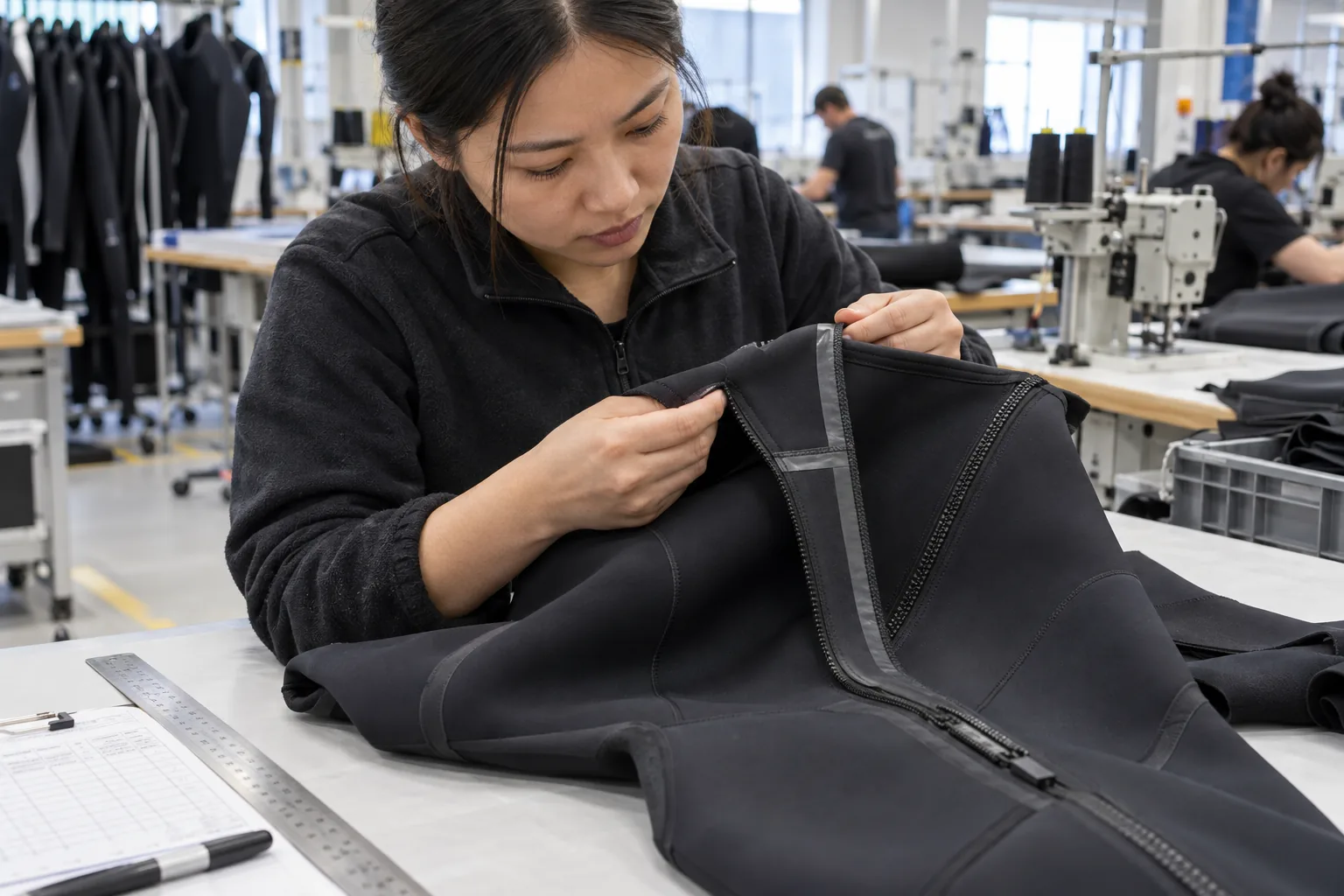
Closure inspection should also match the selected entry architecture. See the chest zip, back zip and zipless wetsuit guide for component identity, alignment, operation, barrier, drainage and localized test checkpoints.
What is included in final wetsuit inspection?
Final inspection verifies finished garments and their packing against the approved requirements. Depending on the customer quality plan, selected characteristics may be checked on every unit while others are evaluated on a defined sample. The inspection route should state the lot, sampling basis, defect classes and decision rule before the inspection starts.
A final inspection can include:
- style, color, size and order identity;
- overall appearance, cleanliness and workmanship;
- critical measurements against the approved chart and tolerances;
- seams, reinforcements, tape or liquid sealing and edge finishing;
- zipper, closure, puller, hook-and-loop and component operation;
- logo, artwork, labels, care information and barcode accuracy;
- quantity by size and color;
- polybag, accessories, carton assortment, carton marks and carton condition;
- product-specific function, leak or water checks when required by the intended use and quality plan.
Packaging is part of product conformity
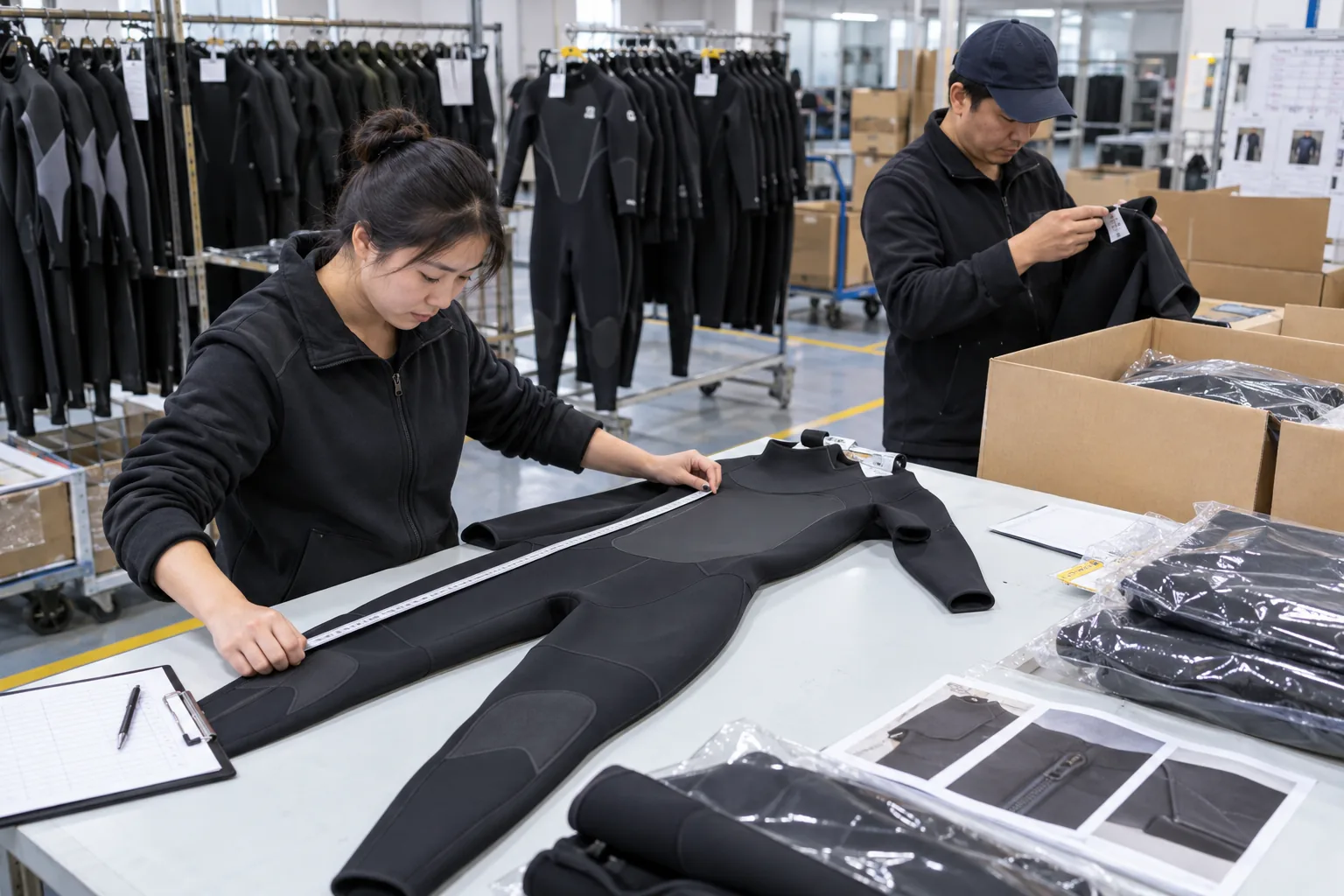
A correctly made wetsuit can still fail the order if it is mislabeled, packed in the wrong size assortment or shipped under the wrong carton mark. Packaging QC therefore checks the model, color, size, labels, barcodes, quantity, polybag, carton markings and carton condition against the approved packing specification.
The inspection specification should distinguish product labels, packaging data, instructions and information that must appear in an online offer. The destination-market wetsuit labeling checklist provides separate approval and verification rows for those U.S. and EU information layers.
For rental fleets, extend the quality plan with the dive-center wetsuit size, asset-identification, maintenance and cost-per-use framework.
How does wetsuit batch inspection with AQL work?
Wetsuit batch inspection AQL is a sampling decision process, not a promise that every unit has been inspected and not a permitted percentage of defective garments in the shipment. ISO 2859-1 provides AQL-indexed sampling procedures for lot-by-lot inspection by attributes. The actual plan requires the lot size, inspection level, sampling scheme, sample size and acceptance/rejection numbers.
For INSEAKU orders using the normal default plan, the starting values are:
- Critical defects: zero acceptance;
- Major defects: AQL 2.5;
- Minor defects: AQL 4.0.
These are default commercial criteria, not universal rules. The customer’s written quality plan can require different AQLs, inspection levels, 100% checks or product-specific tests. The approved plan governs the order.
For the order-level decision details, use the wetsuit batch-inspection AQL plan covering lot definition, current standard edition, random carton and unit selection, Critical/Major/Minor counting, Ac/Re, measurement sub-samples and failed-inspection response.
AQL does not replace process control
A final random inspection observes a sample from a completed lot. It cannot repair weak material control, an obsolete pattern, poor adhesive curing or mixed production records. Incoming inspection, first-piece approval and in-process controls reduce the probability that a large finished lot reaches final inspection with a systematic problem.
For children’s wetsuits, the quality plan should also trace the market classification, child-focused design risks, component evidence, warnings and approved size-set scope. The children’s wetsuit safety and compliance checklist provides a companion control record for those pre-production decisions.
How are critical, major and minor defects classified?
INSEAKU can classify defects as critical, major or minor. The customer quality plan should define product-specific examples because the same observation can carry different risk for a recreational surf suit, a children’s product or specialized diving equipment.
| Class | Working definition | Possible wetsuit examples | Normal response |
|---|---|---|---|
| Critical | A condition that can create an unacceptable safety, legal or product-identity risk | Sharp exposed component, prohibited material, materially incorrect safety information or another customer-defined critical risk | Zero acceptance; hold the lot and investigate |
| Major | A defect likely to affect intended use, fit, durability, saleability or an important agreed requirement | Wrong size label, measurement outside an approved tolerance, open or weak seam, nonfunctioning zipper, serious print error, missing reinforcement or significant leakage where watertight performance is required | Count against the approved major-defect limit; correct and reinspect as required |
| Minor | A workmanship or appearance issue that does not materially impair intended use but falls below the approved standard | Small cosmetic mark, minor thread trimming issue, slight noncritical print variation or other customer-defined minor observation | Count against the approved minor-defect limit and monitor the process |
The examples above are planning guidance. Final classification belongs in the approved defect catalogue or inspection instruction. Ambiguous defects should be documented with photos and escalated rather than silently reclassified.
How are measurements, tolerances and performance tests controlled?
Measurements need a defined method and tolerance
INSEAKU products have allowed measurement tolerances, but there is no single tolerance that applies to every wetsuit and measurement point. The approved measurement chart should identify the size, point of measure, method, target and project-specific plus/minus tolerance. The garment should be conditioned and positioned consistently so that different inspectors can reproduce the result.
For the upstream sizing work that defines those targets, see the wetsuit size grading guide, including body inputs, finished-garment measurements, pattern grading and size-set validation.
Measurement records should preserve the actual observed value, not only a pass/fail mark. This helps distinguish a random outlier from a grading or pattern trend across several sizes.
If material thickness is a controlled characteristic, state the nominal value, measurement tool, contact condition, locations, sampling and acceptance basis. The wetsuit thickness measurement and QC guide provides a practical specification workflow.
Leak and water tests depend on intended use
Leak, water-entry or other performance checks are selected according to the product’s intended use and the customer’s quality plan. A flatlock surf suit, a glued-and-blind-stitched wetsuit and specialized diving equipment do not have identical performance expectations. The specification should therefore define the test setup, sample quantity, conditioning, duration and acceptance criterion.
For development-stage measurements, mobility checks, localized pressure or bubble inspection and sample re-approval, follow the separate wetsuit fit testing protocol.
Factory checks should also be distinguished from testing by a competent third-party laboratory. Where a market, buyer or product claim requires independent laboratory evidence, agree the standard, sample selection, laboratory and report ownership before production.
What happens when a defect or failed inspection is found?
INSEAKU does not ship known defective goods to the customer. Nonconforming material or product is identified, isolated and held to prevent unintended use or shipment. The response can include containment, sorting, rework, replacement, root-cause analysis and corrective action. Reworked goods are reinspected against the same approved requirement before they can return to acceptable stock.
- Identify: record the order, style, color, size, batch and observed problem.
- Contain: isolate the affected material or finished units and define the potentially affected quantity.
- Assess: classify the defect and determine whether other sizes, batches or operations may share the cause.
- Correct: rework, replace, sort or obtain a documented customer-approved deviation where appropriate.
- Verify: reinspect the corrected product and record the result.
- Release or reject: only conforming product receives final authorization; failed product remains on hold or is rejected.
Which records can support shipment release?
INSEAKU can provide inspection photos, measurement charts, defect summaries, rework records, final inspection reports and order or batch references according to the agreed quality plan. Records should be dated and identify the inspected quantity, sample quantity, inspector, result and any outstanding action.
Buyers may also arrange their own inspection or appoint third-party organizations such as SGS or Intertek. The inspection window, access, sampling plan, report recipient and decision authority should be agreed before the required shipment date.
Who makes the final release decision?
Final shipment release follows confirmation by all relevant parties. In normal operations this includes the responsible quality, production and project or commercial stakeholders. Any failed checkpoint, open corrective action, unresolved deviation or missing approval keeps the order on hold until it is formally closed.
For a named example of that responsibility, meet Xuemei Zhang, INSEAKU’s wetsuit quality inspector and QC Supervisor, and read how a one-letter brand error triggered a shipment hold, rework and reinspection.
What should a buyer include in the quality plan or RFQ?
Before quotation or sample approval, define the following:
- product category, intended use, target market and user group;
- approved material, thickness, lamination, color and component references;
- pattern and artwork versions;
- measurement points, methods and tolerances by size;
- seam, zipper, reinforcement and finishing requirements;
- function, leak, water or laboratory tests and their acceptance criteria;
- defect catalogue with critical, major and minor examples;
- which characteristics require 100% inspection;
- lot definition, inspection level, AQL, sample size and Ac/Re numbers for sampled inspection;
- label, barcode, folding, polybag, assortment and carton requirements;
- required reports, photographs, retained samples and traceability records;
- buyer or third-party inspection requirements;
- deviation authority, reinspection rule and final release responsibility.
If you are still selecting a supplier, start with our evidence-based guide on how to find a wetsuit manufacturer. For commercial planning, confirm the current wetsuit MOQ, sample cost and production lead time before scheduling inspection and shipment.
Buyer FAQs
What is a wetsuit quality control checklist?
It is a controlled list of material, process, measurement, workmanship, labeling, packaging and release requirements. A useful checklist identifies the reference, inspection stage, method, sample quantity, result, defect classification, corrective action and approval status.
Does INSEAKU inspect every incoming material batch?
Yes. Every incoming material batch is inspected and identified for traceability. The exact characteristics and method depend on the material, component and approved quality plan.
Are all finished wetsuits inspected one by one?
It depends on the customer’s quality plan. Selected high-risk or functional characteristics may receive 100% inspection, while other characteristics may use an agreed sampling plan. The inspection basis should be written before final inspection.
What AQL does INSEAKU normally use?
The normal starting plan is zero acceptance for critical defects, AQL 2.5 for major defects and AQL 4.0 for minor defects. A customer’s written quality plan may specify different values, inspection levels or 100% checks and will take precedence.
Does AQL 2.5 mean 2.5% defective goods are allowed?
No. AQL is an index used with an acceptance-sampling plan. The pass or fail decision depends on the defined lot, inspection level, sample size and acceptance/rejection numbers. It should not be presented as a promise that a fixed percentage of defective units may be shipped.
How are wetsuit measurement tolerances set?
Tolerances are project-specific. The approved measurement chart should state each point of measure, target, method and allowed plus/minus tolerance by size. INSEAKU does not apply one undisclosed universal tolerance to every style.
Can a buyer arrange SGS, Intertek or another third-party inspection?
Yes. Buyer and third-party inspections can be accommodated when their scope, timing, access, sampling plan, report distribution and decision authority are agreed in advance.
What happens if an inspection fails?
The affected goods are held and isolated. INSEAKU records the issue, contains the affected quantity, performs the agreed correction or disposition, reinspects the product and releases only conforming goods after all required approvals are complete.
Turn the checklist into an order-specific control plan
Download the editable Excel wetsuit QC checklist or the printable PDF version. Replace the example fields with your approved specification, tolerances, defect catalogue and sampling decision before production.
To request an OEM, ODM or private-label review, send INSEAKU your product brief. Include intended use, market, materials, construction, size range, order quantity, required tests, packaging and desired inspection plan so the quotation and quality route begin from a defined scope.
References and further reading
- ISO 2859-1:2026 — Sampling procedures for inspection by attributes
- ISO 28590:2017 — Introduction to the ISO 2859 series of standards for sampling for inspection by attributes
- ISO/IEC 17025:2017 — General requirements for the competence of testing and calibration laboratories
Last reviewed: September 8, 2026. INSEAKU confirmed the incoming-inspection frequency, traceability, available inspection methods, process checkpoints, default defect/AQL framework, nonconforming-product control, reporting capability, third-party-inspection support, packaging checks and release workflow described in this article. Order-specific requirements remain subject to the approved customer quality plan, specification and written agreement.