
A new wetsuit smell can prompt questions about the foam, lamination, printing, packaging or storage history. The smell alone cannot identify the cause or establish whether the product is safe. For a buyer receiving new stock, the useful first step is to document the condition before washing, treating or changing the goods.
This guide covers newly delivered, unused wetsuits. It helps brand buyers, receiving teams and customer-service staff turn a vague complaint into a traceable supplier investigation. It does not cover routine odor after swimming, rental use or damp storage by the wearer.
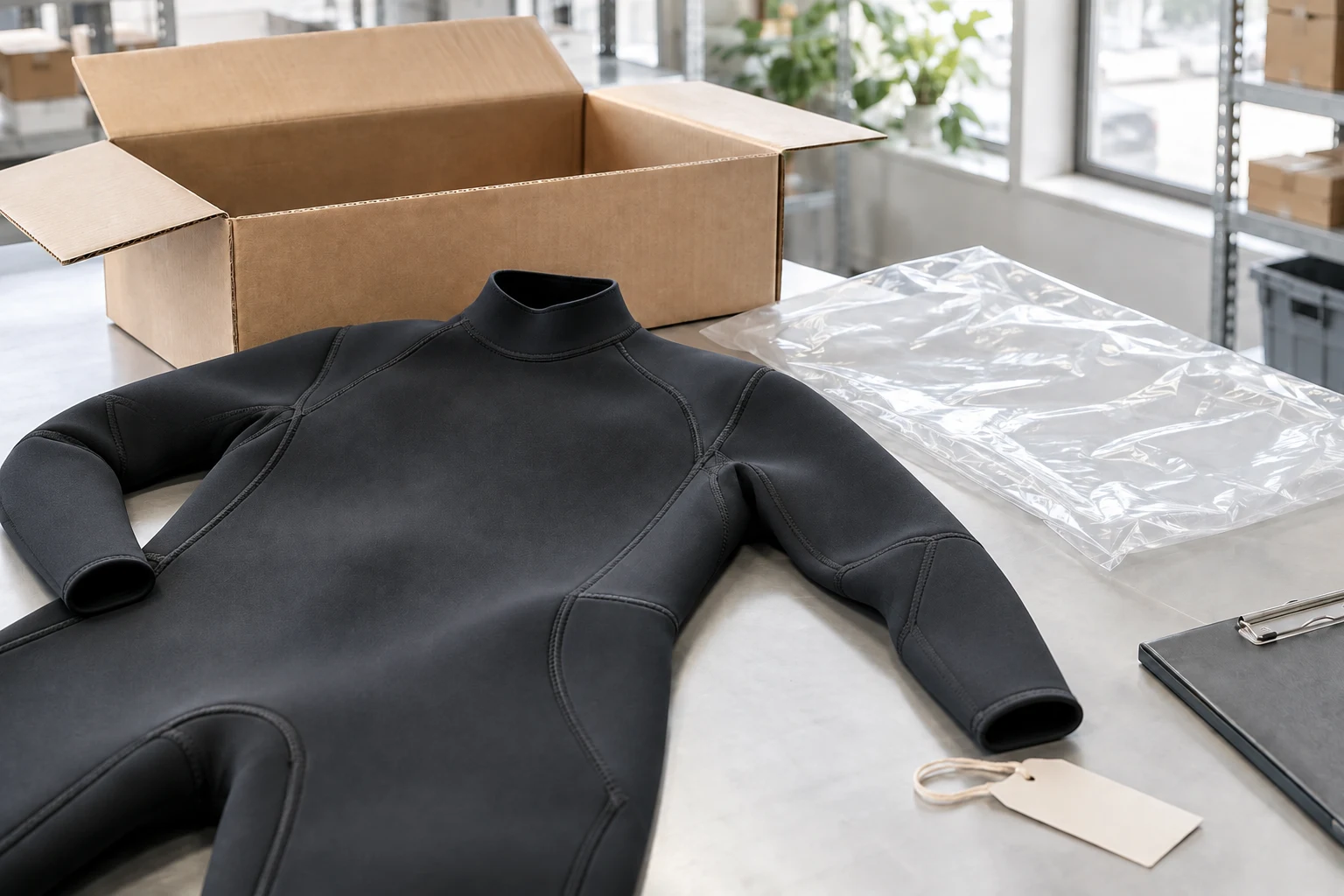
1. Record the new wetsuit smell before changing anything
“The shipment smells bad” is a starting report, not a diagnosis. Record who noticed it, when it was first noticed and what was being opened or handled. Identify the order, product, production lot, carton and individual item wherever those identifiers exist.
Describe observations in ordinary language: an unfamiliar odor noticed when a bag was opened, a difference from the reference sample, or an odor associated with a particular carton. Do not convert “chemical-like” into the name of a chemical. A photograph can document packaging and identification, but it cannot measure smell.
ATSDR explains that people differ in odor sensitivity and that health effects depend on the substance and exposure conditions. Its environmental-odor guidance does not certify consumer products. The practical distinction is to record the observation separately from any health or compliance conclusion. [1]
If handling causes irritation or other symptoms, stop the check, move away from the exposure and follow the workplace response procedure; seek medical advice as appropriate. Do not ask staff to repeatedly inhale from a bag or put their face inside a carton to confirm a complaint.
| Record | Include | Why it matters |
|---|---|---|
| Identity | PO, style, color, size, lot, carton and item ID | Connects the report to the goods being discussed |
| Timeline | Arrival, first opening and observation time; known storage history | Separates arrival condition from later handling |
| Packaging | Bag and carton type, damage, moisture and other visible conditions | Preserves a possible packaging or transport lead |
| Scope | Quantity received, quantity reviewed and items flagged; selection method | Prevents an isolated report becoming a claim about the entire shipment |
| Handling | Any airing, washing, repacking or other treatment already performed | Explains changes before the supplier receives a sample |

Keep the record factual even when the commercial urgency is high. “Seven identified items need follow-up” is more useful than “all material is defective” when most of the delivery has not been reviewed.
2. Compare the received item with an identified reference
Confirm which sample was approved, its revision, material specification and storage history. A months-old sample displayed in an office is not an equivalent comparison to a newly opened item that has spent time in sealed transport packaging. That difference belongs in the record.
Where comparison is appropriate under the workplace procedure, use an agreed setting and record relevant conditions. Keep the received item, reference and their packaging identifiable. Ask the supplier or laboratory how comparison samples should be handled when an investigation is likely. Avoid prescribing your own heated, enclosed or prolonged sniffing procedure.

| Condition | Reference sample | Received item |
|---|---|---|
| Identity | Approval date, sample ID and revision | Lot, carton, item ID and specification revision |
| History | Age, storage, use and previous cleaning | Arrival, opening, storage and any treatment |
| Comparison setting | Recorded place, time and handling | Same agreed setting, or state the difference |
| Observation | Plain-language note with observer and time | Plain-language note; no invented concentration or safety score |
Where the histories differ, the comparison may still reveal a question to investigate, but it cannot by itself prove a material substitution. Connect the samples to the approved bill of materials and actual lot records. The wetsuit material selection guide explains those specification fields.
Preserve the original condition of investigation samples where safe and consistent with laboratory instructions. Obtain advice on containers, quantities, labels, storage and dispatch before collecting samples for analysis. Photograph the original arrangement first; changing a bag or mixing components can remove a useful traceability link.
3. Map where the reports occur, with a clear denominator
Separate the number of garments received from the number reviewed. Then record which reviewed items were flagged and why. Keep different lots, colors, carton groups or packaging versions distinguishable. Choose the review scope through the quality plan, not through the sample count in an online example.
The following numbers are a hypothetical training example, not INSEAKU shipment or test data. Imagine a record covering 12 reviewed garments from each of four cartons. “Flagged” means an item met a documented follow-up trigger in that exercise. It is not a chemical test failure or a health-risk classification.

| Carton | Reviewed garments | Flagged for follow-up | No flag recorded |
|---|---|---|---|
| A | 12 | 2 | 10 |
| B | 12 | 7 | 5 |
| C | 12 | 1 | 11 |
| D | 12 | 0 | 12 |
| Total reviewed | 48 | 10 | 38 |
Carton B has more flags in this record, so it offers a place to start comparing packing dates, material lots and handling history. The pattern does not prove that its carton, adhesive or transport conditions caused the observation. Items without a flag are not thereby chemically cleared.
The arithmetic is simply 2 + 7 + 1 + 0 = 10 flagged items among 48 reviewed. Do not apply that count as the defect rate for unreviewed stock or turn it into an automatic acceptance decision. Use the batch inspection and AQL planning guide when defining an actual sampling and decision system.
4. Ask the supplier to trace the complete material and packing system
A wetsuit is more than its foam designation. The investigation may need records for the laminate, adhesive, printed elements, trims and packaging, alongside manufacturing and packing history. These are investigation branches, not a list of components already proven responsible.
Ask the supplier to compare the delivered lot against the approved specification and identify any recorded changes. A useful answer names the relevant component, supplier reference, lot or process record. “Same as before” is difficult to verify without those links.

| Area | Request | Compare with |
|---|---|---|
| Foam and textile laminate | Specified grade, suppliers, lot references and any substitutions | Approved material list and retained samples |
| Lamination and seams | Adhesive references, relevant process/curing records and changes | Approved construction and production records |
| Printing and trims | Ink/transfer and component references; processing and change records | Approved print sample, artwork and component specification |
| Packaging | Bag/carton references, packaging lot and packing dates | Approved packaging and the actual received packaging |
| Storage and transport | Known storage, handling or transport deviations and available logs | Agreed handling requirements; distinguish records from recollection |
Do not infer a foam formulation from an odor description. Similarly, “water-based adhesive” or “CR neoprene” is not a finished-product clearance document. Our CR versus SCR neoprene comparison explains why the exact grade and assembled material system matter.
Keep packaging in scope without assuming it is the cause. SGS lists odor analysis within its packaging testing services, alongside other specialist investigations. That supports asking a laboratory whether separate packaging examination is relevant; it does not establish that a particular wetsuit bag is responsible. [2]
For an INSEAKU project, connect the request to the PO and recorded material and production lots. The existing wetsuit quality-control workflow provides the incoming-material, process and final-inspection context. A specific conclusion still needs the actual case records.
5. Define the testing question before ordering a test
“Please test the smell” can refer to several different tasks. Tell the laboratory whether the question concerns a reported sensory difference, the substances associated with a component, a market-specific chemical requirement or an odor-control marketing claim.
Intertek describes chemical testing for textile and apparel requirements and brand restricted-substance programs. Those are scoped investigations: the relevant materials, substances, destination market and requirements must be established for the case. A generic report title is not enough. [3]
| Question | Discuss with the laboratory | Do not assume |
|---|---|---|
| Is the reported difference reproducible? | An appropriate controlled comparison and documented handling | An informal smell description is a concentration reading |
| What may be associated with the observation? | Relevant sample selection and analytical investigation of goods or components | One detected substance explains every observation |
| Does the product meet the applicable chemical requirements? | The product scope, market, target substances, methods and limits | A limited test covers every material, chemical or lot |
| Does a textile reduce specified odors? | A deodorization-performance method for that particular claim | That result resolves a new-product odor complaint |
The last distinction is easy to miss. Intertek’s deodorization page describes measuring a textile’s ability to reduce specified odor chemicals. That is a different question from identifying the cause of an unexpected smell in newly delivered goods. An odor-control performance result should not be substituted for the receiving investigation. [4]
Before sending anything, confirm sample IDs, quantities, whether garments and packaging should be separated, the requested methods, reporting units and the decision the results need to support. Follow the laboratory’s handling and shipping instructions. Ask how a changed or washed sample would affect interpretation.
When the report arrives, check the tested sample, date, method, results and stated limitations against your case. Avoid translating a result for one component into “the entire shipment is safe” or applying an unrelated report to a new material revision.
6. Record the disposition and verify the follow-up
Assign an owner to the case and document any inventory hold under your quality procedure. Keep the affected and unreviewed scope visible. Separate the investigation finding from the commercial decision about release, return, replacement or agreed corrective action.
Record what was observed, what evidence was reviewed, what remains unresolved and who authorized the disposition. If a cause is supported, connect the correction to that cause and define how it will be checked. If the cause remains uncertain, say so instead of closing the case with a guessed explanation.

Do not wash, deodorize or air every item before deciding which samples are needed. Treatment changes the as-received condition. If treatment is later agreed, use product-compatible instructions and record what was done, to which items, and when.
O’Neill’s care guidance is an example of manufacturer-specific instructions: it warns against excessive heat and direct sunlight and advises retaining the original packaging until satisfied with the product. It also discusses cleaning odors associated with use. Those care instructions are not a universal remedy for a new-shipment complaint or a fixed waiting period. [5]
For the next receipt, check the agreed corrective action and compare against the documented acceptance criteria. A lower reported odor after handling is an observation to record; it does not by itself establish the original cause or chemical conformity.
Use the editable new-wetsuit receiving record (ZIP) to keep the case, quantities, reference history, supplier response and disposition together. Download and extract the ZIP, then open the HTML record locally. It starts blank, works offline and exports a JSON file for later reopening. Photo and report filenames are references; their files are not embedded.
For a new development project, discuss material references, sample approval, packaging and investigation responsibilities through INSEAKU’s OEM and ODM wetsuit development services. Defining those records before production makes later receiving questions easier to resolve.
New wetsuit smell: buyer FAQs
Is a strong neoprene smell normal in a new wetsuit?
A description alone cannot establish what is expected for a particular model or lot. Check the manufacturer’s information, the approved reference and the received condition. An unexpected difference deserves a documented review rather than an automatic “normal” or “unsafe” label.
How long should a new wetsuit take to stop smelling?
This guide sets no universal number of days. Record the opening and handling timeline and obtain model-specific instructions. A fixed waiting period cannot replace an investigation or the evidence needed for release.
Should a buyer wash new stock to remove the smell?
Document the original condition first and agree whether untreated investigation samples are needed. Washing can change the evidence. Any later treatment should follow the product instructions and the agreed disposition, not an improvised chemical recipe.
Does a low odor prove chemical safety?
No. An odor observation is not a chemical-compliance test. The relevant question needs appropriate evidence for the actual product and intended market. Sensitivity also varies between people. [1]
Does changing from SCR to CR guarantee no smell?
No such guarantee follows from a foam acronym. Confirm the complete material specification, processing, printed components and packaging, then evaluate the actual product against the agreed requirements.
References and further reading
Sources checked on 5 October 2026. Public-health guidance is used for general evidence limits, not product certification. Laboratory and care sources describe their own scope. The carton counts are hypothetical; no actual INSEAKU complaint, measurement or test result is represented.
- ATSDR — Environmental Odors. General odor sensitivity and exposure considerations; not a consumer-product test or clearance.
- SGS — Paper, Nonwovens and Packaging Testing. Packaging investigation can include odor analysis; relevance and methods must be agreed for the case.
- Intertek — Textile & Apparel Chemical Testing. Chemical testing can address defined market or brand requirements; this is not a test result for INSEAKU goods.
- Intertek Hong Kong — Deodorization Test. Deodorization performance assesses reduction of specified odor chemicals, distinct from investigating a new-product complaint.
- O’Neill Australia — Wetsuit Care. A manufacturer example of product care and retaining packaging. Its instructions and warranty are not INSEAKU policy.