
Good surf wetsuit specifications give each product in a brand’s range a clear job. Define the intended surfer and conditions first, then specify the material, panel thickness, lining coverage, seams, entry system and approval evidence. An entry, core and performance structure can make the range easier to explain, but those labels should describe deliberate product choices—not three different levels of acceptable workmanship.
This guide shows how to build a specification matrix for private label surf wetsuits. The three tiers below are an illustrative planning framework, not an industry grading standard or an INSEAKU stock-product offer. Material availability, construction feasibility, minimum quantities and costs need confirmation for the actual project.
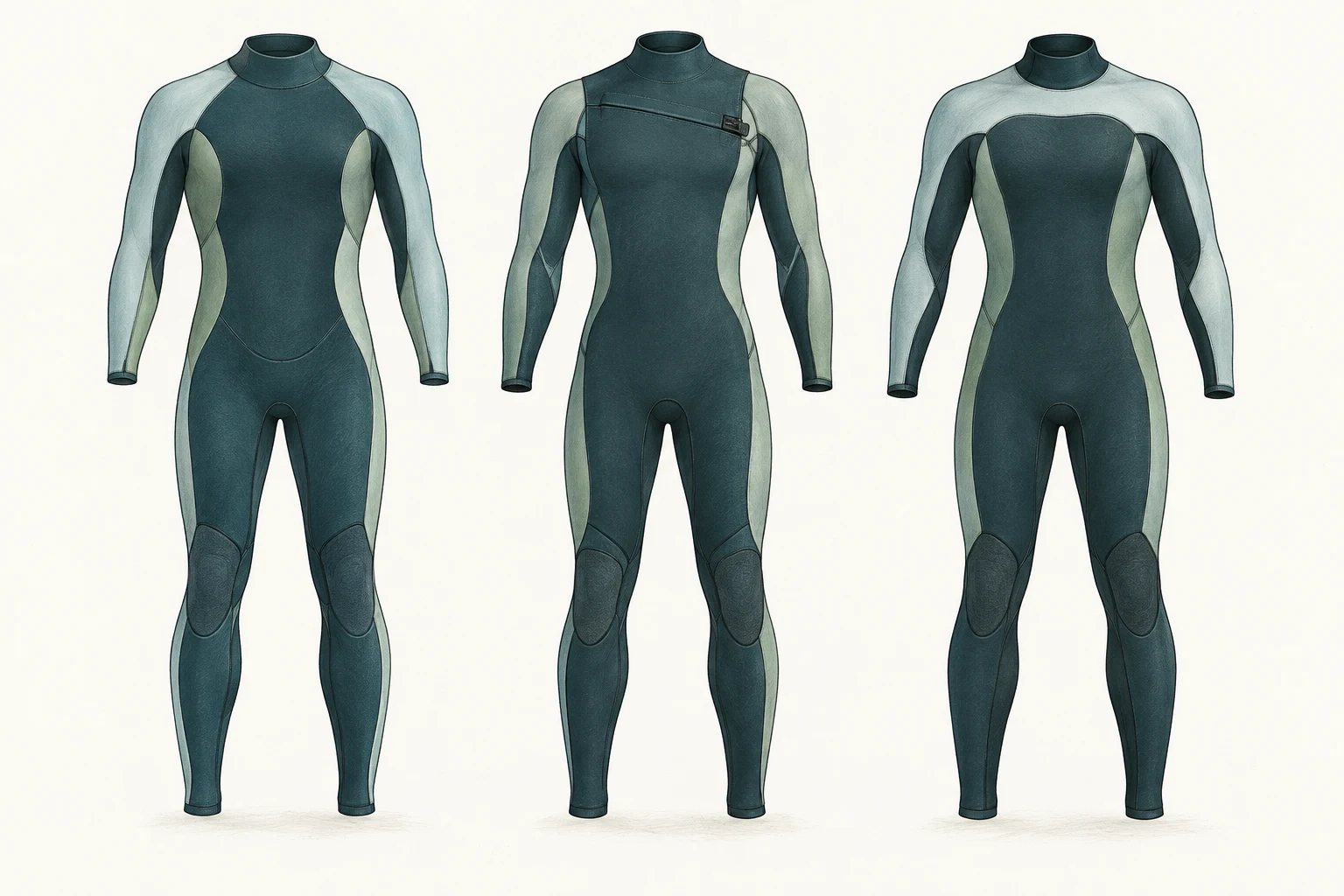
1. Define the range before selecting its features
Start with a one-page range brief. Record the destination market, intended conditions, session type, target fit population and selling channel. Include the customer problem that each model should solve. A first-time buyer who wants straightforward changing may need a different product from a frequent surfer who prioritizes freedom of movement.
Separate environmental suitability from commercial tier. A thicker suit is not automatically a higher-tier suit. Likewise, a premium model for one climate is not a substitute for a suitably specified model for another. Use the wetsuit thickness planning guide to document panel requirements, rather than using a tier name as a temperature recommendation.
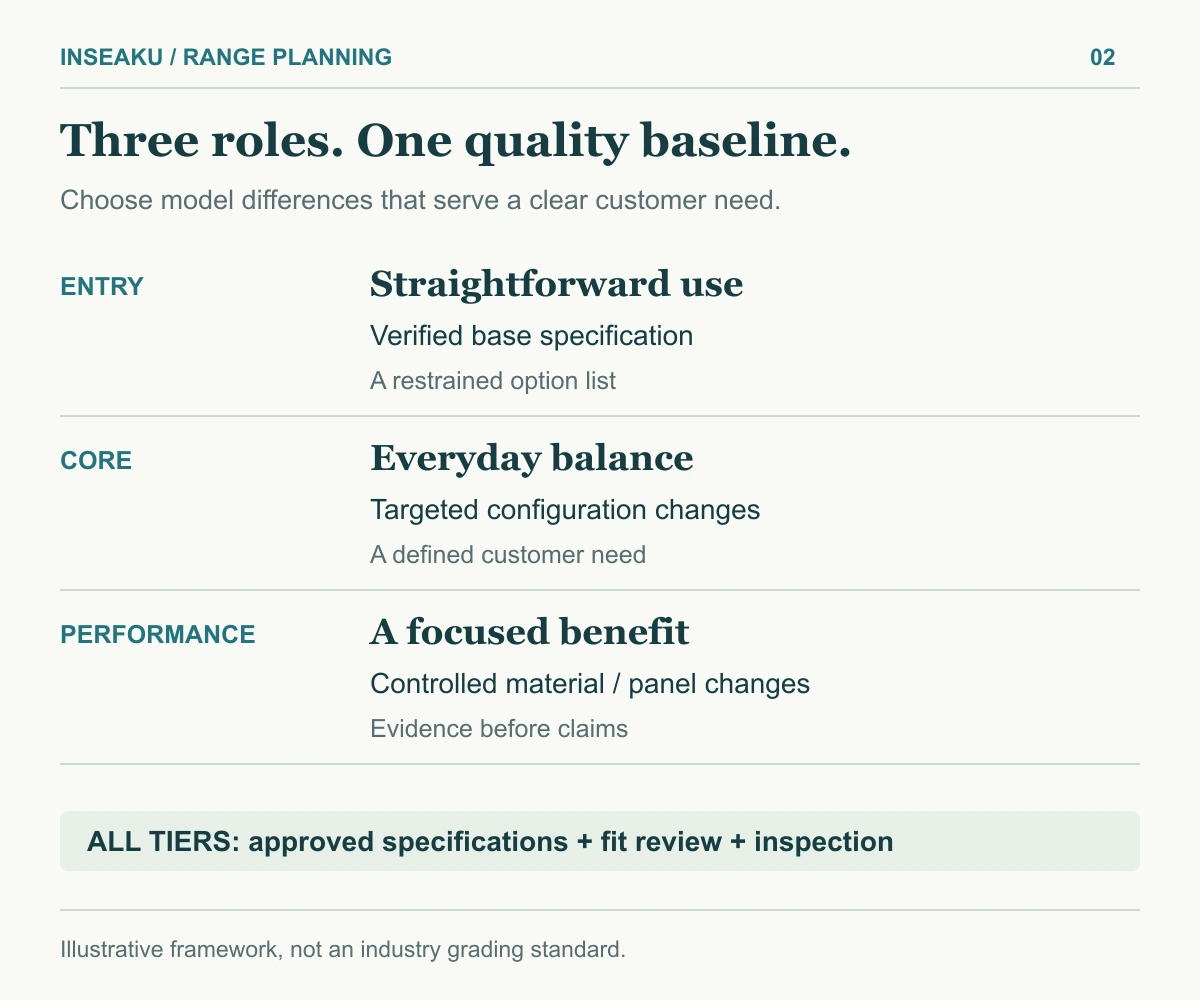
For a meaningful comparison, write the shared requirements first. These might include the fit population, intended conditions, fullsuit format, brand identity and required inspection process. Then list the few differences that justify separate models. If the customer benefit of a difference is unclear, it may be an unnecessary variation.
- Entry: prioritize an accessible, well-defined product with a restrained option list.
- Core: offer a balanced everyday configuration for the brand’s main customer.
- Performance: focus on a specific, demonstrable benefit that matters to the intended surfer.
These are positions within your own range. They do not certify beginner, intermediate or professional suitability. A buyer may prefer the entry model’s changing system even if they are an experienced surfer.
2. Build a three-tier surf wetsuit specifications matrix
The example below assumes three adult surfing fullsuits being developed around a shared use brief. It does not prescribe a foam brand, exact thickness, selling price or water-temperature band. Decide those items with the supplier and validate the resulting samples.
| Specification area | Entry | Core | Performance |
|---|---|---|---|
| Product promise | Straightforward use with limited options | Balanced everyday use | One clearly prioritized benefit |
| Material system | Verified base laminate for the use brief | Targeted material changes where useful | Selected laminate and panel map supported by evaluation |
| Lining | Document the base lining and its coverage | Consider targeted torso lining | Choose coverage around the specific performance objective |
| Seams | Construction suitable for intended conditions | Evaluate targeted seam reinforcement or sealing | Approve a detailed seam/tape map and its trade-offs |
| Entry system | Select for the customer’s changing needs | Select for fit, access and intended use | Validate the chosen system with the target user |
| Options | Keep unnecessary variants out | Prioritize options supported by the range brief | Retain only variants with a clear role |
| Release requirements | Approved specification and inspection criteria | Same control discipline | Same discipline plus evidence for added claims |
The final supplier-facing matrix should replace every general phrase with a controlled detail: a material reference, drawing revision, panel ID, coverage map or test requirement. “Premium neoprene” and “fully sealed” are not sufficiently precise purchasing descriptions by themselves.
3. Specify the whole material and lining system
For each tier, record the foam reference, outer textile, inner textile, nominal panel thickness and agreed measurement method. Identify the complete laminate, not only the foam name. The wetsuit material selection guide can support that detailed material discussion.
O’Neill’s official wetsuit guide describes jersey as fabric laminated to the inner and outer faces of the foam. It also explains that internal lining can be applied selectively. These distinctions help buyers ask for a complete material-and-coverage specification instead of relying on a single material adjective.
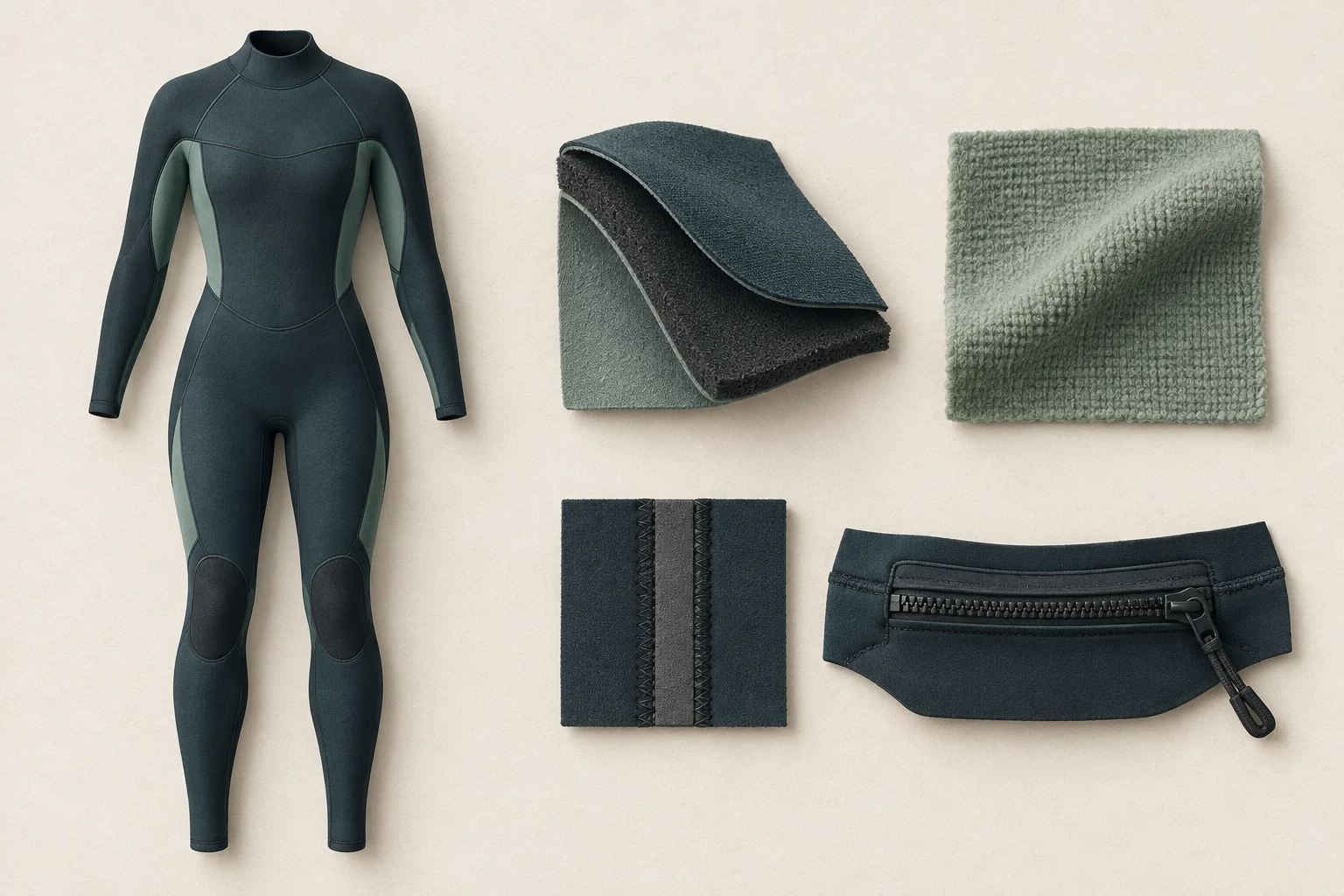
An entry model can start with a documented base laminate. A core model might evaluate a different shoulder material or a defined torso lining. A performance model should state which outcome the change is intended to improve and how the sample will be compared. These are development options, not guaranteed gains.
Map lining by named panels. “Thermal lining inside” leaves too much open: chest only, chest and back, upper legs or almost the entire suit could all fit that description. Record coverage boundaries, material code and color. Retain a labeled swatch and an approved sample reference so later substitutions are visible.
If the proposed upgrade is faster drying, agree a repeatable comparison procedure before making a claim. Define the samples, wetting and draining procedure, drying conditions, measurement intervals and endpoint. Do not publish a percentage improvement based on how a swatch feels in a showroom. A material result also should not be presented as a whole-garment result without supporting evaluation.
4. Set the seam baseline for the intended conditions
Do not assign flatlock to every entry suit and extensive taping to every performance suit by default. Decide the baseline construction for the use brief first. A lower price target does not remove the need for the construction to suit the intended environment.
O’Neill’s seam overview distinguishes stitching through the material from glued-and-blindstitched construction and describes internal tape applied to selected seams or across a suit. Those are different specifications. Its descriptions are manufacturer guidance, not comparative test results for your proposed products.
For each model, provide a seam map with the construction at each join, the tape or sealing reference, the coverage and the reinforcement points. If the proposed core model adds tape only in certain areas, identify those areas explicitly. If the performance model uses wider coverage, evaluate that configuration in the finished garment rather than assuming more coverage improves every outcome.
Use the detailed GBS versus flatlock seam guide for construction terminology. Keep this range matrix focused on what changes between models and why. Inspection must confirm the agreed seam map, not merely check whether a sales description says “sealed.”
5. Choose entry systems through fit and use
A back zip, chest zip or zip-free opening is a design choice, not a universal quality score. Do not force all three systems into a collection simply to make the tiers look different.
Rip Curl’s official wetsuit guide presents back-zip entry as convenient for changing and notes that zip-free suits can be harder for less experienced wearers to put on and remove. Use those considerations to define a wearer trial, not to assume the same outcome across all patterns and bodies.
Ask representative wearers to try the actual samples. Record changing difficulty, neck comfort, reaching and paddling movements, closure operation and any problems observed in the agreed use trial. Keep size, material revision and entry design attached to each record. If a design changes after testing, decide which checks must be repeated.
The chest-zip versus back-zip comparison helps structure the initial choice. The fit-testing protocol supports sample review. Neither replaces evaluation of the particular combination you intend to sell.
6. Give every upgrade a specification and an evidence requirement
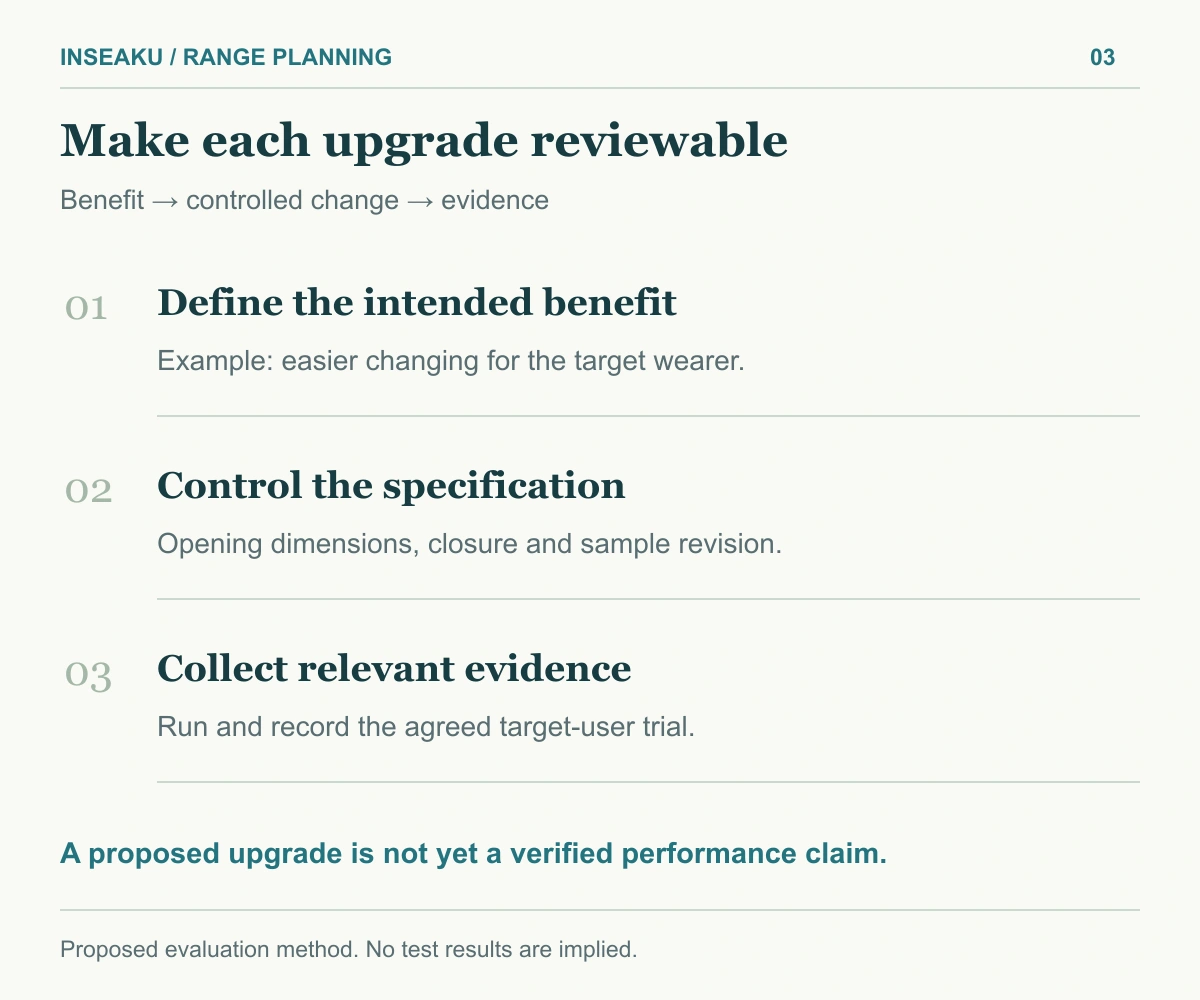
A useful upgrade record has three parts: the intended customer benefit, the controlled change and the evidence required before approval. This keeps design, buying and marketing teams aligned.
| Proposed benefit | Controlled change | Evidence to request |
|---|---|---|
| Less restriction during paddling | Named laminate and revised shoulder panel map | Documented wearer comparison using the agreed movement protocol |
| Different drying behavior | Specific lining reference and coverage | Controlled comparative drying record with stated conditions |
| Improved resistance at an identified wear area | Named reinforcement material and location | Agreed abrasion or use evaluation and inspection of the finished construction |
| Easier changing | Opening dimensions and closure configuration | Target-user changing trial with size and sample revision recorded |
Keep acceptance limits and test procedures in the technical pack. They must be agreed for the product rather than copied from an unrelated model. If there is no evidence for a comparative claim, use a factual construction description instead: for example, identify the lining coverage rather than claiming a quantified warmth advantage.
Shared quality requirements stay outside the upgrade ladder. Correct artwork, agreed measurements, sound assembly, traceable revisions and the specified inspection process belong in every tier. An entry model should have fewer selected features when appropriate—not permission for avoidable defects.
7. Count sellable variants before expanding the range
More models, colors and thicknesses create more combinations to develop and manage. Count them before adding an option. The following arithmetic is hypothetical and describes product variants, not order quantities, minimum quantities, forecast demand or sales performance.
Suppose each tier has one style and six sizes. Entry has one thickness and one color, core has two thicknesses and two colors, and performance has one thickness and one color. Assuming every listed combination is offered, the calculation is:
- Entry: 1 style × 1 thickness × 1 color × 6 sizes = 6 SKUs.
- Core: 1 × 2 × 2 × 6 = 24 SKUs.
- Performance: 1 × 1 × 1 × 6 = 6 SKUs.
- Total: 6 + 24 + 6 = 36 SKUs.
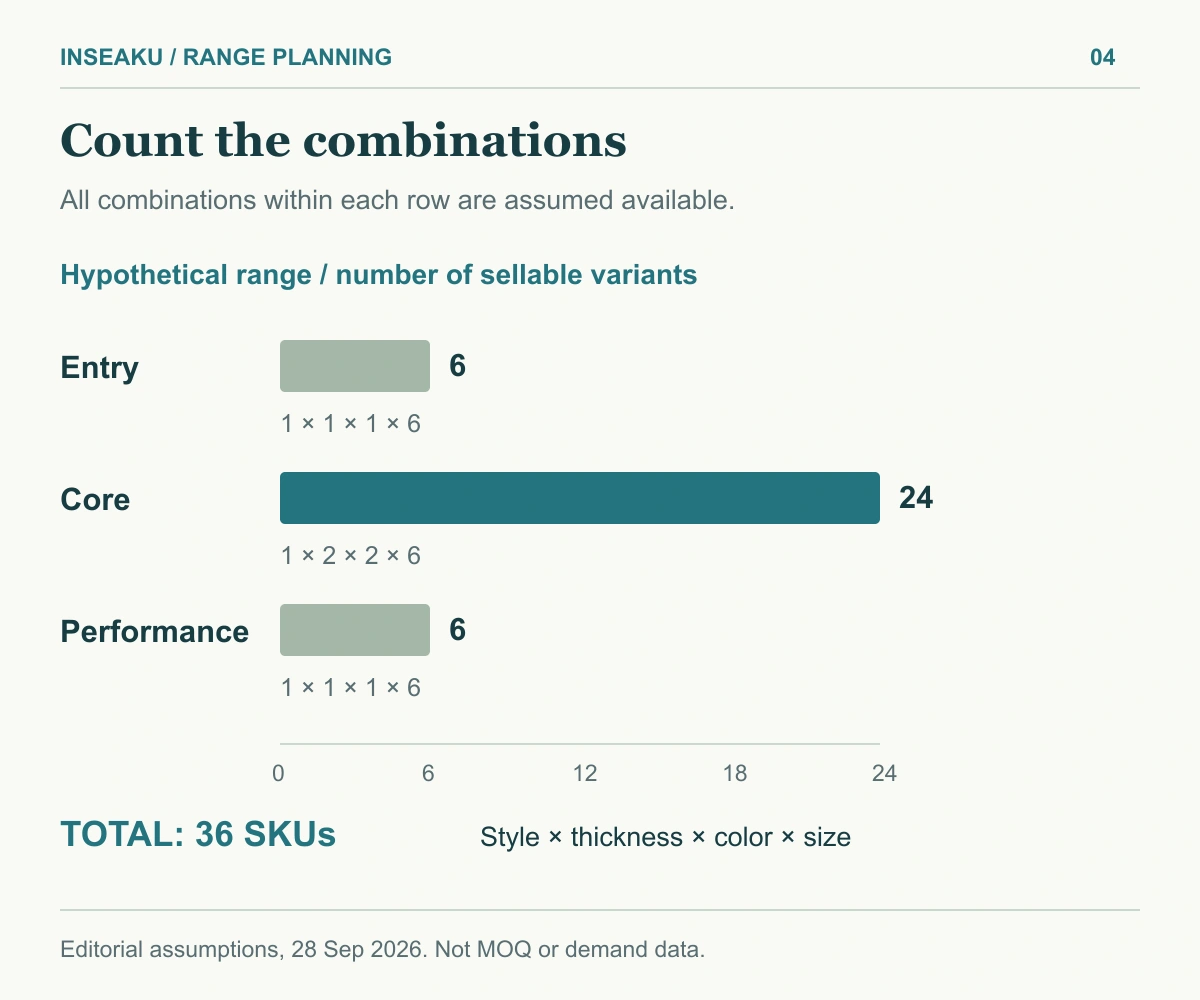
The core tier has the most variants here because of the chosen options, not because the label “core” requires a broader range. If only some colors are offered at a given thickness, split the configuration into separate non-overlapping rows. Do not use a full multiplication for combinations you will not sell.
Download the surf wetsuit range planner to record specifications and count variants. It includes a blank range matrix and an editable SKU-count worksheet with this example clearly separated from your own inputs. Quantities, commercial terms and production allocation need a separate purchasing decision.
8. Approve the range as a controlled development project
Issue one range matrix plus a technical pack for each model. Assign revision IDs, identify the shared items and highlight model-specific changes. A shared brand size chart does not mean every laminate and entry configuration can use an unchanged pattern without review.
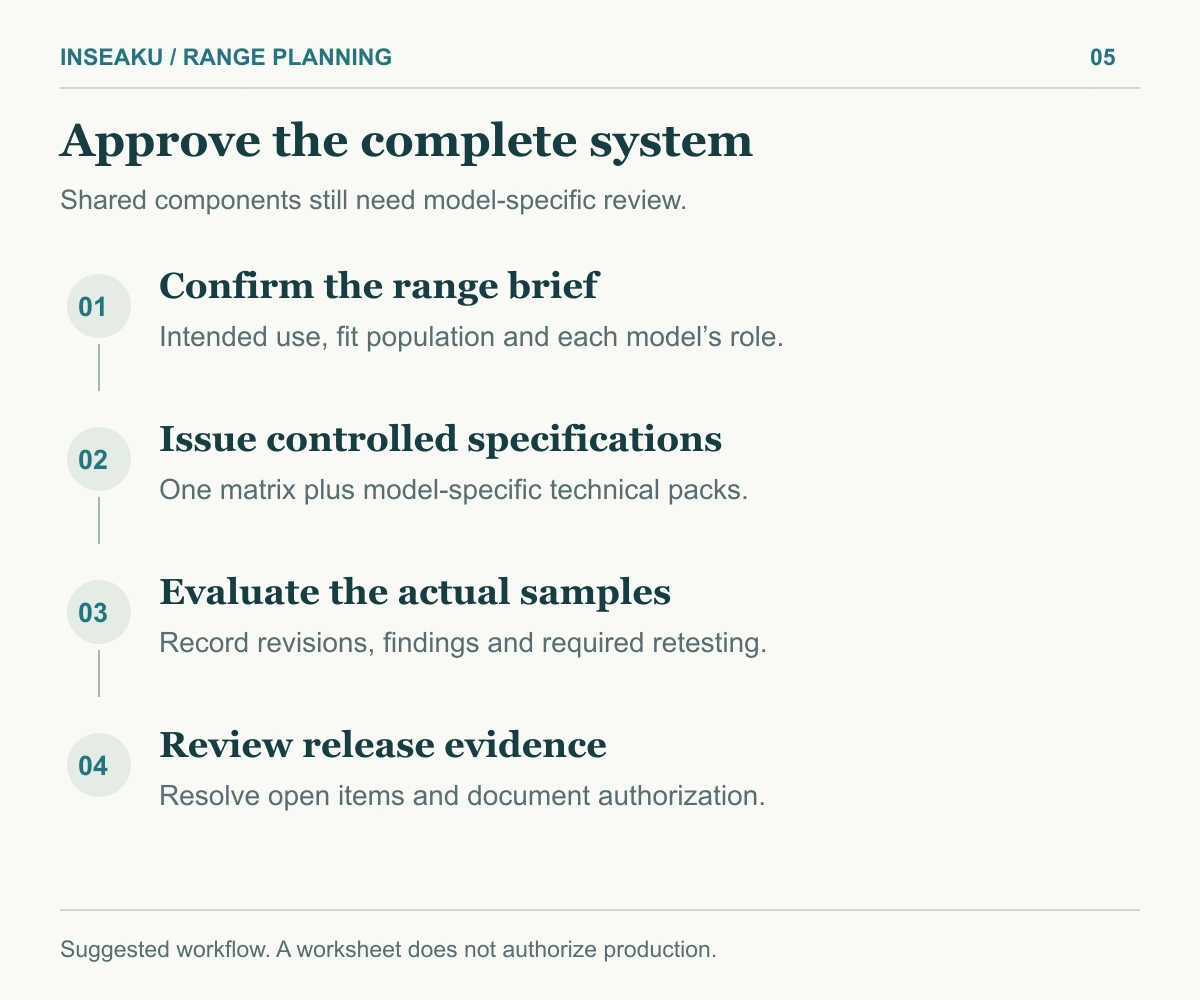
Agree which sample rounds are needed and what each round must demonstrate. Record discrepancies, corrections and any required retesting. The custom wetsuit sampling process explains how to keep development changes connected to the approved production reference.
Plan care information alongside the garment. Patagonia’s official wetsuit care sheet advises fresh-water rinsing and avoiding machine washing and direct-sun drying for its wetsuits. Use it as a care-planning reference, while confirming instructions appropriate to your own materials, trims and construction. Do not copy another brand’s warranty or packaging policy.
For a private-label project, send INSEAKU the use brief, three-tier matrix, target quantities, drawings and open questions. Discuss the proposed combinations through INSEAKU’s surf wetsuit development and manufacturing services. Request confirmation of feasibility, available materials, sampling requirements and commercial terms before treating the range as production-ready.
Contact INSEAKU with your range brief and identify which specifications are fixed and which remain open for supplier proposals.
Frequently Asked Questions
What should surf wetsuit specifications include?
Include intended use, fit population, material references, panel thickness, lining coverage, seam and reinforcement maps, entry details, measurements, artwork, care information and sample acceptance requirements. Keep revisions and approval records attached to the same specification.
Should an entry-level surf wetsuit always use flatlock seams?
No. Start with the intended conditions and construction requirements. A price-position label alone is not a reason to choose a particular seam. Document the selected construction and confirm it through the agreed sample evaluation.
Does a performance model need a chest zip?
No. Choose the entry system for the intended user, fit and product objective. Evaluate the finished configuration rather than assuming a closure type establishes product quality or suitability.
Can three tiers share the same thickness?
Yes, a range can use a common nominal thickness while differentiating other specifications. That does not establish equal warmth, fit or performance. Record the complete construction and validate any claims separately.
How many styles should a private-label surf wetsuit range launch with?
There is no universal number. Start with clearly defined customer needs and count the resulting variants. Add a style when its role, development requirements and purchasing plan are justified. The 36-SKU example is arithmetic, not a recommended launch size.
References and Further Reading
These official manufacturer resources support the technical background cited above. They are not independent certifications, do not endorse INSEAKU, and do not establish performance results for the illustrative range. Accessed 28 September 2026.
- O’Neill — Wetsuit Guide. Background on foam, laminated jerseys, lining placement and seam construction. Product-specific names and promotional claims have not been adopted as INSEAKU specifications.
- Rip Curl — Men’s Wetsuit Guide. Entry-system considerations used to frame the wearer-trial discussion. Its temperature guidance and brand performance claims are not reproduced here.
- Patagonia — Wetsuit Care (PDF). Manufacturer care guidance, copyright 2008, used only as background for care planning. Confirm current instructions for the actual product being developed.