
Custom spearfishing wetsuits need a specification that connects fit, materials and sample approval. A camouflage reference and a nominal thickness are not enough to define a repeatable product. Before requesting a bulk quote, decide the two-piece configuration, inner and outer surfaces, panel thicknesses, chest loading pad, knee reinforcement, artwork and acceptance criteria.
This guide is for brands developing an adult private-label or OEM spearfishing range. Here, “custom” means a controlled brand specification and size range, not necessarily an individually made-to-measure suit. Use the eight checks below to turn your product idea into a supplier brief, then record the decisions in the downloadable specification workbook.
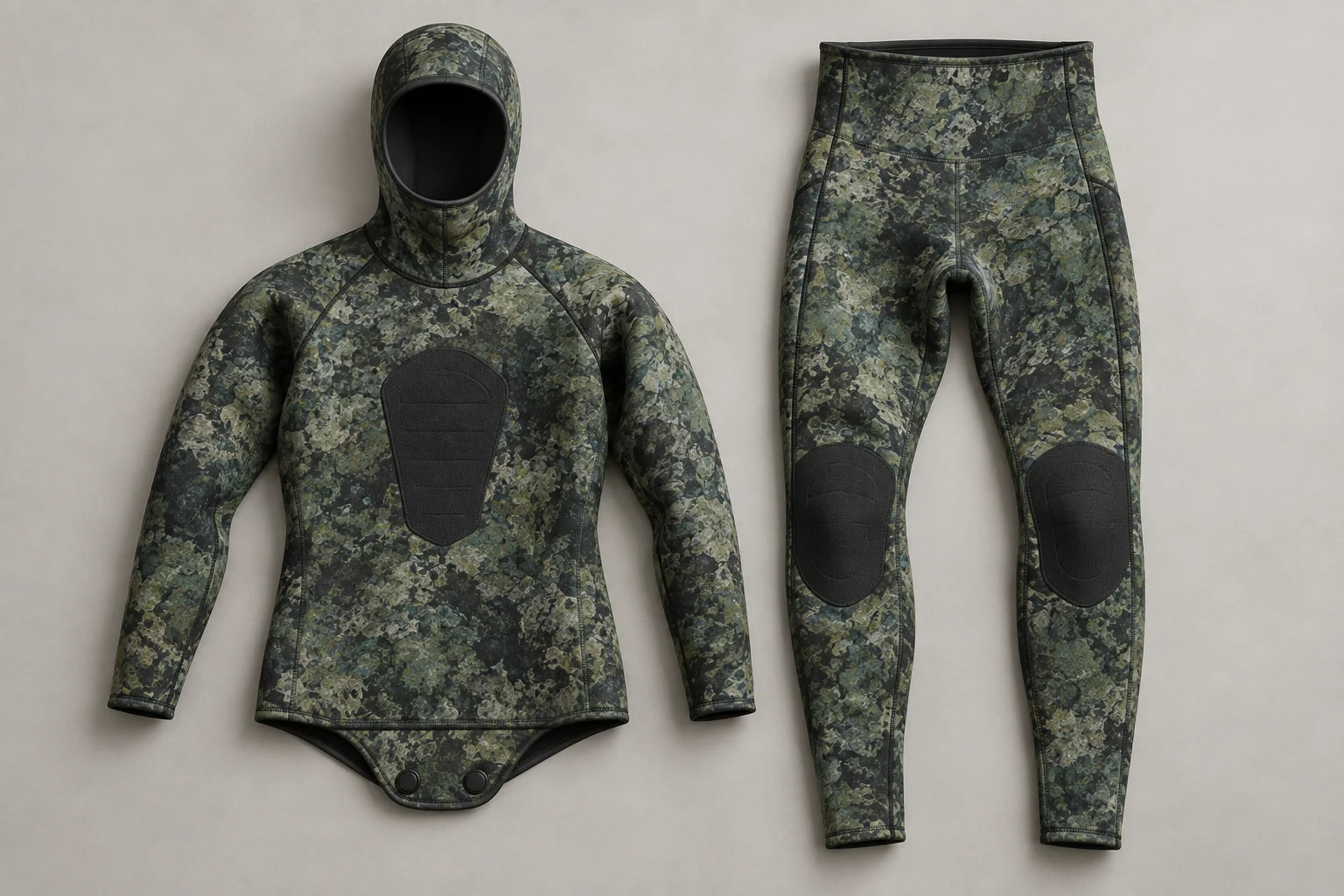
Custom spearfishing wetsuits: the procurement checklist
Before approving production, your team should be able to identify one current specification, one approved sample reference and the evidence supporting each critical decision. Start with these eight areas.
- Define the intended customer, conditions and product range.
- Choose the hooded jacket and trouser configuration.
- Identify the foam and both material surfaces.
- Map nominal thickness to individual panels.
- Specify the chest pad, knees, seams and edge finishes.
- Approve camouflage and branding on the actual substrate.
- Control measurements, grading and sample acceptance.
- Freeze the released files and compare like-for-like quotations.
Download the editable spearfishing wetsuit specification workbook. It includes project specifications, panel-level materials, garment measurements, sample-review records and a range-planning calculator. Blank fields mean decisions are still required, not that a feature has been approved.
1. Define the use brief before choosing features
Describe who will wear the suit and how it will be used. Record the target market, customer experience, intended water conditions, typical session pattern, entry environment and care expectations. Distinguish a specialist personal-use product from a suit expected to withstand frequent shared use. These priorities affect the acceptable balance between close fit, dressing convenience, surface durability and maintenance.
Do not use a thickness label as a universal water-temperature recommendation. Fit, flushing, material properties, exposure and individual differences matter. Any temperature or performance claim needs evidence relevant to the finished construction and intended conditions. A procurement document is not a substitute for diving instruction or a personal exposure assessment.
For a first collection, identify what must be unique and what can stay consistent. A shared fit block with controlled material and artwork options can make comparisons easier. If different thicknesses change fit or dressing behavior, they still need review; a common style name does not prove that one sample validates every version.
2. Specify the two-piece pattern and overlap
A hooded jacket can be paired with high-waisted trousers or a long-john lower section with shoulder straps. These are distinct pattern decisions. For example, Cressi’s Posidonia specification describes high-waisted trousers, while Beuchat’s Espadon specification describes a separate jacket and long john. These examples demonstrate available constructions, not an endorsement or evidence of INSEAKU supply relationships.
High-waist trousers: define the top-edge height, waist construction and overlap with the jacket. Check whether that overlap remains in place during arm reach and bending. A photograph of a flat suit cannot show whether the waist rolls, gaps or creates uncomfortable bunching when worn.
Long john: specify the upper-body coverage, strap geometry and interaction with the jacket. Review the complete layered fit rather than approving the lower piece in isolation. Extra coverage changes the assembly worn over the torso, so avoid treating it as interchangeable with high-waist trousers without another fit review.
For either option, record hood shape, face-opening finish, jacket length, beavertail geometry, fastener type and adjustment. Review closure reach and local pressure across the size range. If you sell tops and bottoms separately, define compatible size combinations and identify each component clearly on labels and packing records.
3. Name the foam, inside surface and outside surface separately
Terms such as “open cell,” “smooth skin” and “super stretch” are too broad to serve as a complete bill of materials. Specify the foam supplier or approved material code, the inside construction, the outside construction and any coating as separate fields. Require a physical swatch and an agreed substitution process.
| Decision | What to identify | What the sample must clarify |
|---|---|---|
| Unlined / open-cell interior | Exposed inner foam surface and exact material reference | Dressing method, handling sensitivity and skin-contact feel |
| Coated interior | Coating name or code, coverage and approved finish | Whether dressing and repeated use affect the coating |
| Textile-lined interior | Fabric code, stretch direction and lamination | Fit and dressing with the specified lining, not a substitute |
| Exterior | Textile, smooth surface or other finish, plus print substrate | Appearance, handling, wear and artwork compatibility |
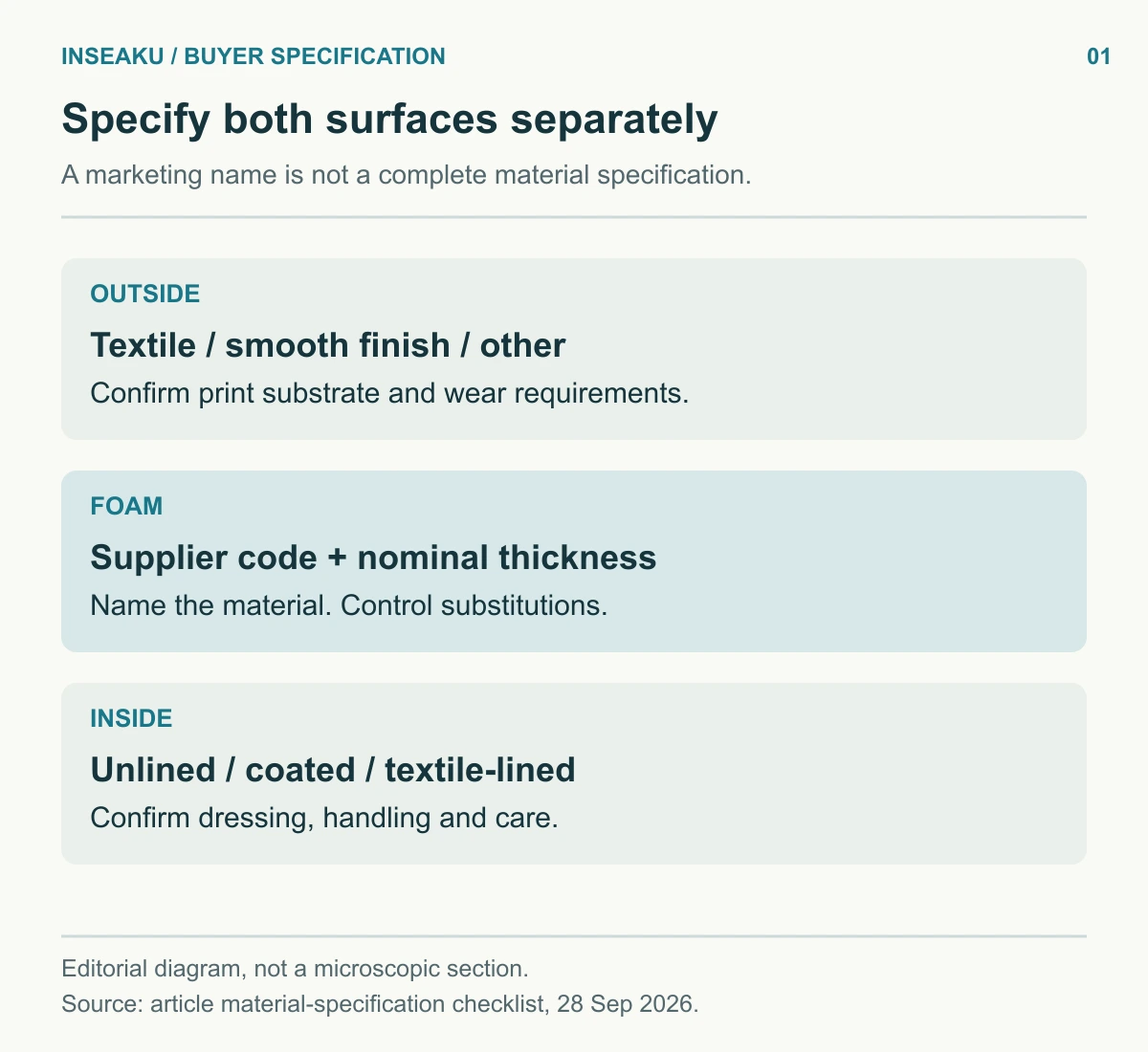
In wetsuit buying terminology, an open-cell interior commonly means an unlined inner surface in contact with the skin. JBL’s wetsuit FAQ explains that this surface requires more careful handling and a suitable dressing procedure. Ask your supplier for instructions appropriate to the exact material; do not assume that every interior can be pulled on dry or that every lubricant is compatible.
Likewise, a smooth exterior and an open-cell interior describe different sides of the product. One term does not determine the other. The open-cell versus lined wetsuit buyer’s guide provides a fuller comparison. In the final specification, use material codes and swatches rather than relying on a marketing name to settle the choice.
4. Build a panel-level thickness map
A request for a “5 mm suit” leaves important questions unanswered. Does the same nominal foam thickness apply to the hood, torso, sleeves and trousers? Is a measurement for foam alone or the laminated composite? Are loading pads and other overlays excluded? Resolve those questions before comparing quotes.
List each panel or panel group, material code, nominal thickness, allowed tolerance and measurement method. Agree the instrument, contact pressure or test procedure, conditioning and measurement locations. Soft material can give different readings under different measuring conditions; the acceptance method needs to travel with the number.
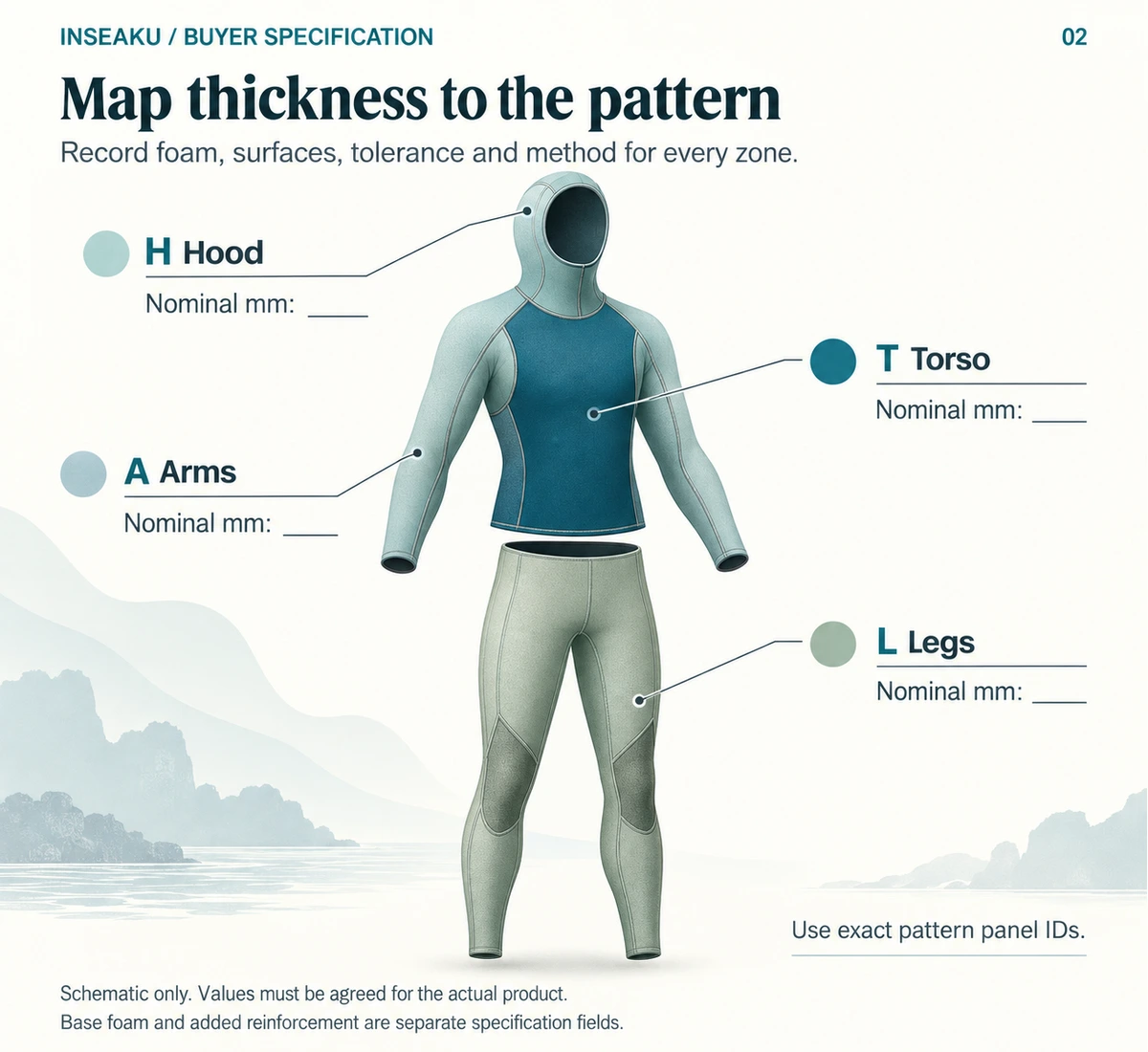
Consider zone changes only when they support a defined product requirement. A different sleeve material may change mobility, assembly and fit. A thicker jacket paired with thinner trousers is also a separate configuration that needs approval. Neither a panel map nor the sum of overlapping layers is a verified thermal-performance rating.
Use the wetsuit thickness specification guide to structure the discussion. Keep reinforcement thickness separate from the base foam field, and record the exact boundary of every material transition. The approved sample should be traceable to the same panel map and material revision.
5. Place the chest pad and knee reinforcement by function
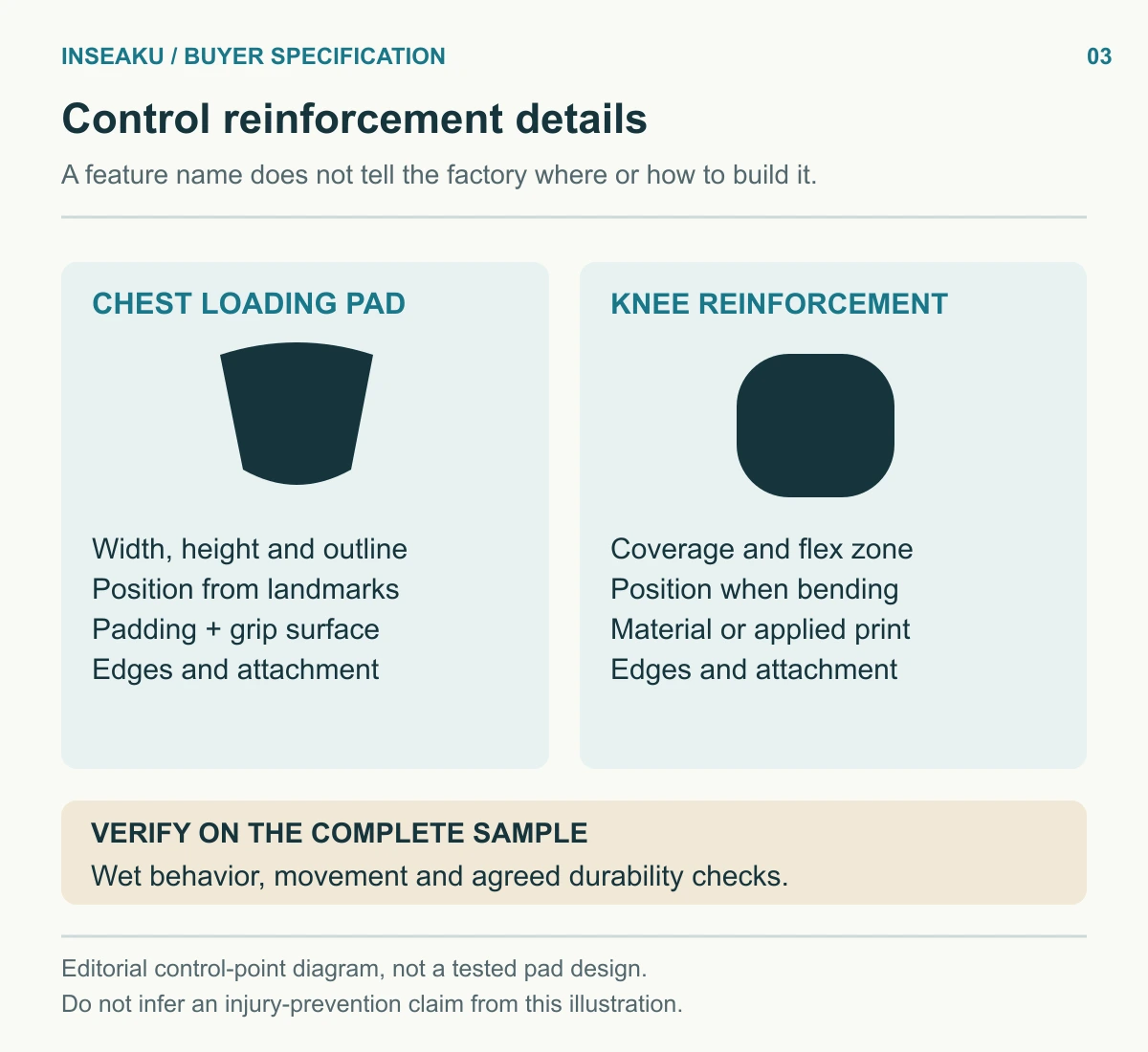
A chest loading pad is a functional component, not just a branding area. Define its width, height, outline, material layers, attachment and position from named garment landmarks. Then confirm placement on representative wearers. A centered pad on a flat drawing may sit differently once the jacket stretches over a body.
Record padding and outer grip material separately where applicable. Ask how the edges are finished and how the component behaves when wet and flexed. Do not make an impact-protection or injury-prevention claim from appearance alone. Product evaluations should use an agreed safe procedure; a photo of someone using the product is not a validation report.
Knee reinforcement needs its own placement and flex review. Define coverage, abrasion-resistant material or print, bonding or stitching and edge treatment. Check alignment during bending and whether the reinforcement restricts the surrounding panels. If the design includes shin or elbow coverage, specify those areas independently rather than copying the knee treatment everywhere.
Review seams and seals at the same time. Identify seam construction by location, reinforcement at intersections and the finish of face, wrist, waist and ankle openings. Do not accept “sealed seams” as the entire instruction. The supplier should be able to explain what is assembled at each location and how your inspection will recognize an unacceptable result.
6. Approve camouflage on material, then control the range
For custom spearfishing wetsuits, camouflage approval should cover more than the color on a monitor. Provide an authorized artwork file, revision, repeat dimensions, orientation, color reference, print substrate and placement rules. State whether matching across seams is required or whether a controlled random repeat is acceptable. These are different manufacturing expectations.
Approve a physical print strike-off on the proposed fabric, then review it on the assembled sample. Check color under agreed lighting, appearance when wet and stretched, logo readability and changes around curved panels. Agree relevant durability checks with the supplier. A visually attractive pattern is not evidence that it improves hunting success, reduces visibility to every species or offers protection from marine animals.
Keep the brand logo separate from the camouflage file. Specify logo size and position, and proofread small text against the original approved artwork. Use the wetsuit logo printing methods guide to discuss process compatibility. Avoid copying another brand’s distinctive pattern; obtain permission for any third-party artwork you intend to use.
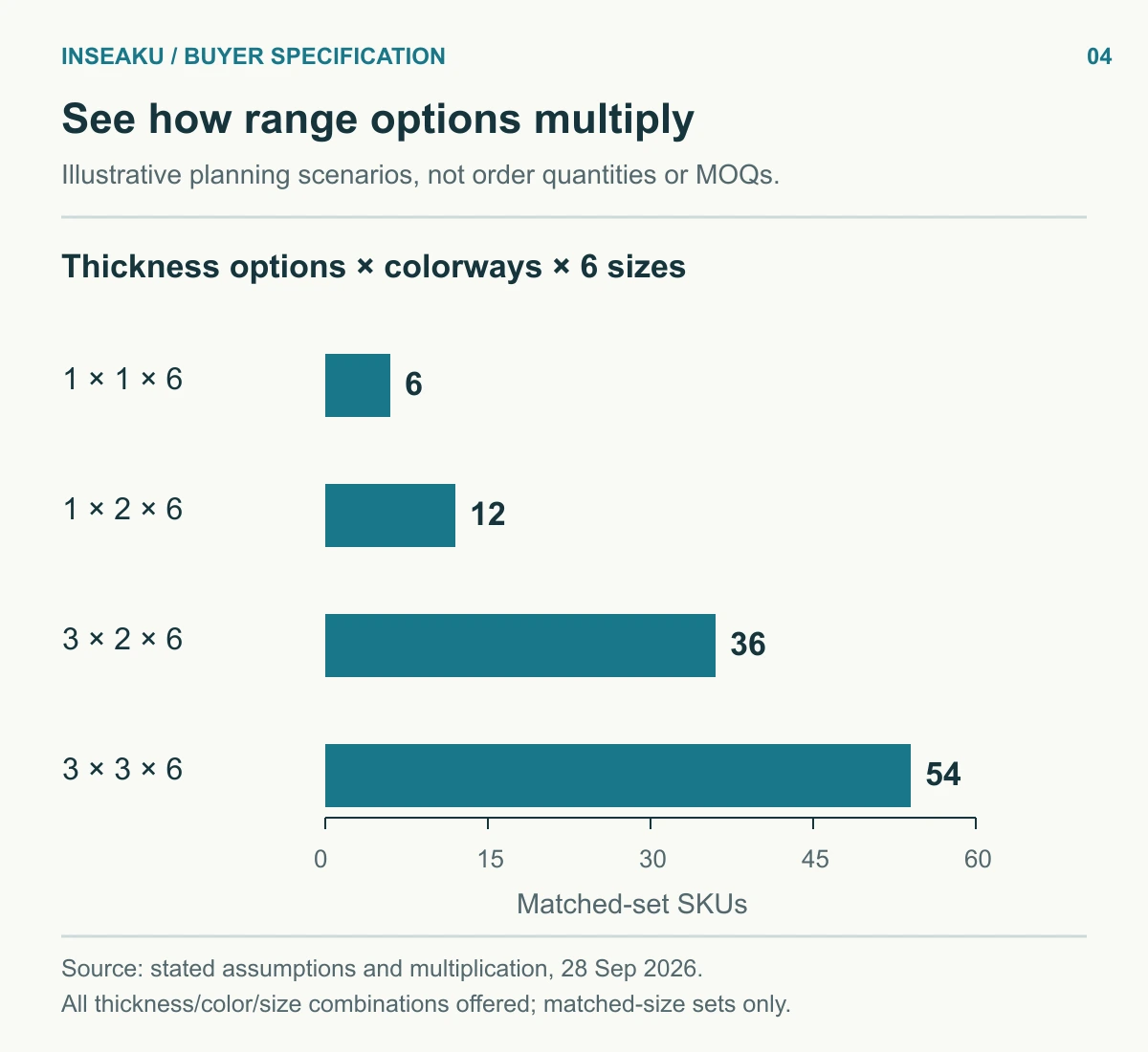
Range-planning example: how options multiply
The chart below is a planning calculation, not market research or INSEAKU production data. Assume six sizes and that every offered thickness and camouflage combination is available as a matched-size jacket-and-trouser set. Matched-set SKUs equal thickness options × colorways × sizes.
| Thickness options | Colorways | Sizes | Matched-set SKUs |
|---|---|---|---|
| 1 | 1 | 6 | 6 |
| 1 | 2 | 6 | 12 |
| 3 | 2 | 6 | 36 |
| 3 | 3 | 6 | 54 |
The result shows why a seemingly small design choice can increase planning work. It does not mean every SKU needs a separate production run or the same order quantity. Confirm minimums by material, print, style and color with the supplier. If tops and bottoms are stocked separately, count their item codes separately; the chart does not model mix-and-match set combinations.
7. Make sample acceptance measurable
Define what each sample is supposed to prove. A prototype in substitute material may help resolve geometry, but it cannot approve the final interior, print, stretch or handling. A pre-production sample should represent the released materials, construction, artwork and labels. Name the sample stage, style, size, material references and document revision on the review record.
Measure the garment before judging the fit
Keep body measurements and finished-garment measurements separate. In the garment table, give each point a code, diagram reference, unit, measurement method, target and tolerance. Useful points include flat chest and waist widths, torso length, sleeve and inseam lengths, waist height, face opening and pad positions. Specify how the garment is laid out and whether it is relaxed; do not mix flat widths with circumferences.
Record actual results and deviations. A measurement within tolerance does not automatically prove good fit, while a comfortable base-size sample does not approve the full size range. Review representative sizes and changes in material or thickness. Use the wetsuit fit-testing protocol to organize repeatable movement and seam checks.
Record observations, actions and release evidence
Evaluate dressing, hood and face contact, arm reach, torso bend, waist overlap, knee-pad alignment, closure operation and local pressure. Wet-use evaluation should be planned by qualified personnel for the intended activity and conditions. Document observations without turning informal feedback into certified performance claims.
For each issue, identify the sample, location, photograph or report, required correction, owner and recheck result. If a print defect is found, confirm whether it is isolated or shared by the artwork or material lot. Rework must be checked against the corrected source, not just against another sample carrying the same error.
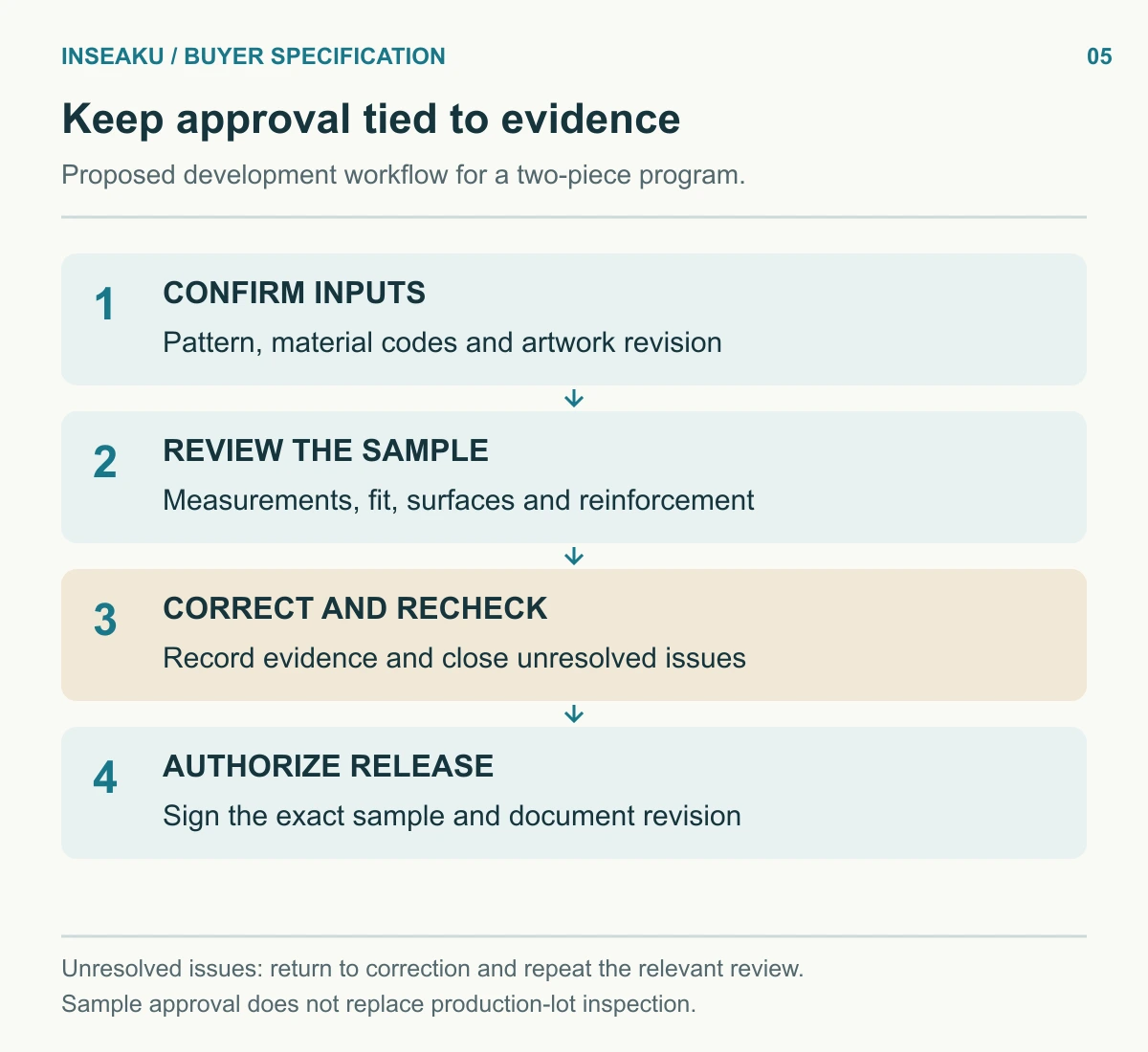
The custom wetsuit sampling process explains the broader approval stages. For this product, the sign-off should identify both pieces, the exact surface combination, panel map, reinforcement and camouflage revision. Sample approval and final shipment release are separate decisions: a signed development sample does not remove the need to inspect the production lot.
8. Send a controlled RFQ for custom spearfishing wetsuits
Send suppliers the same brief, drawings, panel table, measurement specification, artwork register and sample criteria. Add quantities by style, color and size; whether sets or separate components are being ordered; destination; packaging; target dates; and responsibility for any requested testing. Ask for written assumptions and exclusions.
Compare material codes, print method, reinforcement construction, sample stages, packaging and commercial terms before comparing the headline price. Request confirmation of material availability and how substitutions are approved. A quote based on a different lining or an omitted sample stage is not directly comparable.
For an INSEAKU project, use the completed workbook to discuss custom wetsuit development and manufacturing services. Confirm the exact spearfishing construction, materials, sample scope, minimum quantities and timing in the project quotation. This guide does not promise that every illustrated option is available for every order.
Ready for a specification review? Send INSEAKU your spearfishing wetsuit brief with the two-piece configuration, surface preferences, panel thickness plan, camouflage file, size range and quantity breakdown. Mark undecided fields clearly so the technical discussion starts with the right questions.
Frequently asked questions
Are custom spearfishing wetsuits always made to individual measurements?
No. A brand program usually defines a repeatable style and graded size range. Made-to-measure production is a separate service and should be confirmed explicitly, including measurement responsibility and fit-adjustment terms.
Should a brand choose high-waist trousers or a long john?
Choose through the product brief and layered fit review. Record coverage, overlap, dressing and movement requirements for each configuration. Neither label alone establishes the better fit for every wearer.
Is an open-cell interior mandatory?
No. The interior should match the intended customer and use. Specify unlined, coated or textile-lined construction explicitly, then approve the actual material and care instructions. Do not assume a coating and a textile lining are interchangeable.
Can a single sample approve all thicknesses and sizes?
Not by default. Changes in material, thickness, grading and component placement can affect the product. Agree a representative validation plan and document which versions each sample approval covers.
What should be included in a spearfishing wetsuit specification sheet?
Include project identity, jacket and trouser configuration, material codes, inside and outside finishes, panel thicknesses, seams, chest and knee reinforcement, garment measurements, artwork revisions, sample criteria, quantities and authorized approval records.
Sources and scope
- Cressi: Posidonia product specification — one example of a two-piece, high-waist construction with chest and knee reinforcement.
- Beuchat: Espadon product specification — one example of a jacket-and-long-john configuration.
- JBL: wetsuit material and dressing FAQ — manufacturer guidance on its open-cell interiors.
Sources checked 28 September 2026. The checklist, diagrams and workbook are editorial procurement tools, not a test standard or certification. SKU figures are explicitly stated planning calculations. Material choices, tolerances, testing and product claims must be agreed for the specific project.