
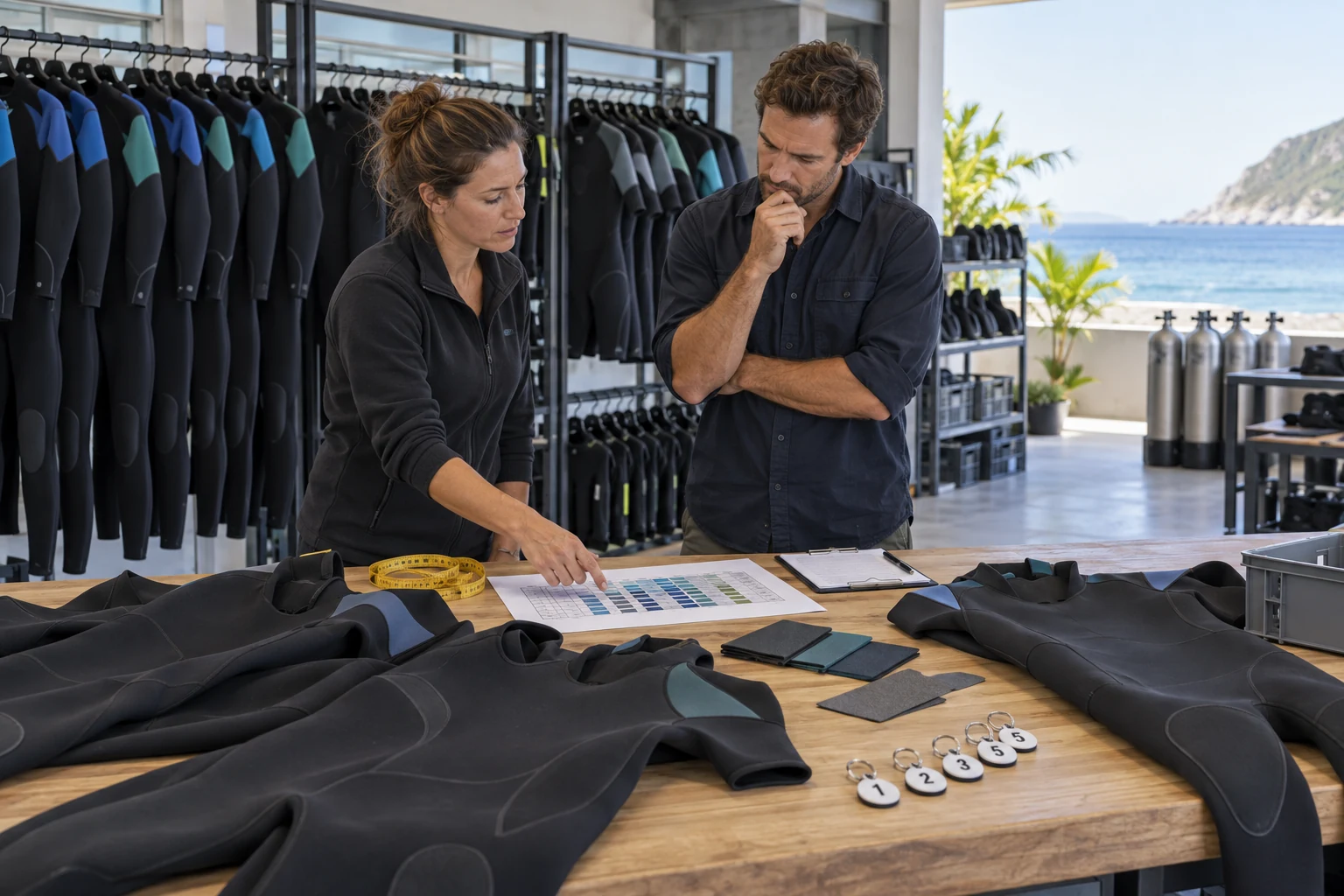
Short answer: When sourcing wetsuits for dive centers wholesale, compare the total cost per completed rental use—not the garment price alone. Define the intended activities and water conditions, product styles, thicknesses, size curve, construction, reinforcement, identification system, care workflow, inspection rules, repair plan and replenishment terms. Then divide the complete lifecycle cost by the number of rentable uses the fleet actually delivers. INSEAKU’s normal starting MOQ is 50 pieces per style and color; sizes may be mixed within that same-color lot. A lower unit price can still produce a higher cost per use if the wrong sizes remain idle, high-wear areas fail early or the fleet cannot be tracked and returned to service efficiently.
INSEAKU can custom manufacture full suits, shorties, children’s, men’s, women’s and unisex rental wetsuits for dive centers, dive schools, resorts and other water-sports operators. Available project options include 2 mm, 3 mm, 5 mm and 7 mm constructions; CR, SCR and limestone-based foam routes; flatlock, glued-and-blind-stitched and internally taped seams; reinforced high-wear zones; YKK zipper options; contrasting panels; and operational marking such as large size labels, colors, numbers, barcodes or QR codes.
No one construction has a universal service life. Actual cost per use depends on fit, user behavior, activity, frequency, material and component selection, cleaning chemistry, rinsing, drying, storage, handling, damage, repair decisions, loss and retirement criteria. This guide therefore provides a calculation framework rather than a promised number of rentals.
Download the Rental Wetsuit Cost-per-Use Calculator
The editable workbook separates initial fleet cost, recurring cleaning and inspection cost, repair cost, realized utilization, early retirement and loss. It also includes a size-mix planner and conservative, base and strong-operations scenarios.
Download the editable Excel calculator
Yellow cells are inputs and green cells contain formulas. Replace every illustrative value with your quotation and operating records. The calculator is currency-neutral, but all inputs in one scenario must use the same currency.
What does rental wetsuit cost per use include?
A useful lifecycle view includes more than purchase price. General life-cycle-cost guidance treats acquisition, operation, maintenance, repair and disposal as connected costs rather than isolated invoices. A rental-wetsuit model applies the same logic to a fleet and uses completed rental uses as the denominator.
Estimated cost per completed use = total estimated lifecycle cost ÷ projected completed rental uses.
| Cost or operating factor | What to include | Evidence source | Common mistake |
|---|---|---|---|
| Garment acquisition | Quoted unit price × quantity | Approved specification and written quotation | Comparing prices for different materials or construction |
| Landed and startup cost | Freight, duty, clearance, labels, numbering, optional spares and setup | Supplier, forwarder and internal setup records | Treating unit price as the complete fleet cost |
| Recurring operation | Return handling, cleaning, drying, inspection, recordkeeping and storage | Time study, utilities and consumable records | Assuming each use has no handling cost |
| Repair and replacement | Repair labor, materials, spare components, lost items and early retirement | Asset-level maintenance and retirement log | Counting only garments that survive to the planned age |
| Utilization | Actual completed rentals after size imbalance, seasonality and downtime | Booking and issue/return records by size | Using theoretical capacity as the denominator |
| End of life | Disposal cost minus supportable recovery value | Actual retirement route | Assuming a resale value that may not exist |
Cost per use is a comparison tool, not a complete measure of safety, fit, guest experience or revenue. Compare alternatives that meet the same product and quality requirements. An unsuitable low-cost garment should not become the benchmark simply because its spreadsheet value is small.
1. Start with fleet demand and operating conditions
A rental specification should begin with demand, not a catalog model. Describe where the suits will be used, the activities, water and air conditions, exposure duration, season, expected turnover, user experience level and any local operational requirement. Let the buyer define the thermal and safety requirements for the actual site; a thickness label alone is not a universal water-temperature recommendation.
Map the customer groups the fleet must serve. A dive school may need repeated entry and removal across training sessions. A resort may need broad sizing and fast visual identification. A children’s program may prioritize a dedicated size and body-shape range. A multi-activity operator may need separate full-suit and shorty lots because one pattern cannot optimize every use.
When the fleet includes children, define intended age, destination market, fit risks, component controls, warnings and traceability before approving the size range. Use the kids wetsuit specification and safety checklist to organize those decisions and the required evidence.
Use operational records to answer five questions
- Which product styles and thicknesses are issued by season or activity?
- Which sizes are frequently unavailable, exchanged or left idle?
- Which areas fail, abrade or require repair most often?
- How long does each return-to-ready cycle take?
- Which items are lost because the asset ID, guest assignment or storage location is unclear?
If the operator has no history, start with a provisional size curve and define an early review date. Do not call the first purchase mix “final.” Track every issue, exchange, repair and retirement by style, color and size so the next order is based on evidence.
2. Select styles, thicknesses and materials
INSEAKU can manufacture full suits, shorties, children’s, men’s, women’s and unisex products as custom projects. Thickness options can include 2 mm, 3 mm, 5 mm and 7 mm, subject to the selected product, material construction and written specification. CR, SCR and limestone-based foam routes can be discussed according to performance, budget and sourcing requirements.
Rental fleets often prioritize easy donning and resistance to repeated handling, while specialist freediving projects may prioritize close skin contact. Compare those tradeoffs in the open-cell vs closed-cell wetsuit guide before selecting the interior construction.
A material name does not fully define the rental result. Specify foam, thickness, lining, stretch direction, lamination, panel allocation, surface finish, color, tolerance and test requirements. Review the wetsuit material selection guide before fixing the construction, because a change in foam or lining can affect stretch, fit, pattern behavior, drying and cost.
| Decision | Rental-fleet question | Document in the specification |
|---|---|---|
| Style | Is a full suit, shorty or separate category needed for each activity? | Product category, entry, coverage and intended use |
| Body profile | Will unisex alone cover demand, or are dedicated men’s, women’s or children’s blocks required? | Pattern block, size chart and intended user range |
| Thickness | Which conditions must the buyer’s exposure plan address? | Nominal thickness, panel map and tolerance |
| Material | What balance of stretch, robustness, comfort, drying, sourcing and price is required? | Foam route, lining, lamination and approved reference |
Fleet thickness should be selected from water and air conditions, session duration, user range, activity, suit format, seams, entry and accessories—not from temperature alone. Use the wetsuit thickness planning guide for brands and operators to document the decision.
3. Design high-wear zones for repairable durability
Rental garments can receive repeated kneeling, sitting, carrying, entry, removal and storage. INSEAKU can reinforce knees, seat, elbows and shoulders where the project requires it. Reinforcement should be placed against observed wear and movement—not added everywhere by default.
For each reinforcement, define material, thickness, shape, edge construction, position and size grading. A panel that is too stiff, large or poorly positioned can restrict movement, concentrate stress at its edge or reduce fit. A repairable construction also needs accessible components and a clear retirement rule; durability does not mean keeping a compromised garment in service.
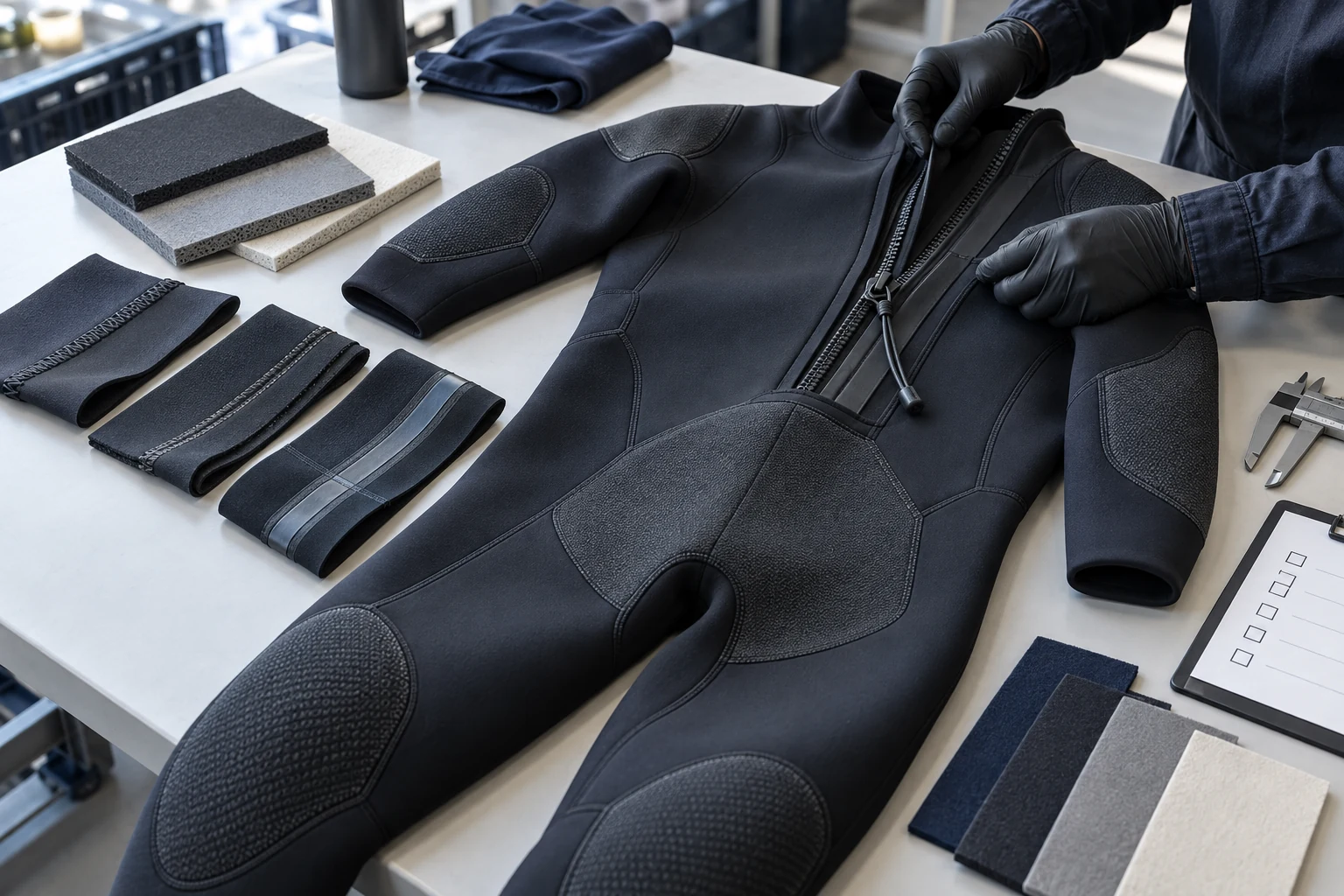
Record the failure mode instead of writing “worn out.” Distinguish abrasion, cut, puncture, seam opening, tape lift, adhesive failure, zipper damage, permanent stretch, odor, contamination, lost identification and fit rejection. This allows the next specification to address the correct cause.
4. Match seams and zippers to the use case
INSEAKU can produce flatlock, glued-and-blind-stitched (GBS) and internally taped seam constructions. The correct route depends on the product’s exposure, water-entry requirements, flexibility, robustness, budget and verification plan. Our guide to GBS vs flatlock wetsuit seams explains why the seam name alone is not a complete performance specification.
For rental operation, also review seam placement near high-motion and high-contact zones. Define stitch formation, adhesive route, tape type and coverage, liquid-seal details if used, reinforcements and visual workmanship criteria. If leakage is a project risk, connect the construction to a documented fit and localized seam-leak testing protocol.
YKK zipper options, extended pull cords and local reinforcements can be specified. State the exact zipper reference, size, length, slider, stops, flap, pull arrangement and replacement expectations. Care instructions should follow the selected component manufacturer’s guidance. YKK’s water-protective zipper support advises removing sand or mud, rinsing with clean water and avoiding forced operation when a zipper is jammed.
Rental buyers should compare easy donning, user handling, zipper serviceability and water-entry controls before selecting an entry. Use the chest zip, back zip and zipless wetsuit specification guide to document that choice.
5. Build the size and identification system
INSEAKU’s normal starting MOQ is 50 pieces per style and color. Sizes from XS to XXXL may be mixed within that lot, but different colors cannot be combined to reach the 50-piece MOQ. The actual size range and quantities should be confirmed for the selected pattern and project.
Build the size curve from completed-rental records, exchanges, stockouts, idle inventory and the target customer mix. Keep a safety quantity for high-demand sizes, but separate a real peak-demand pattern from one unusual event. The workbook in this article contains a size-mix planner for one style and color.
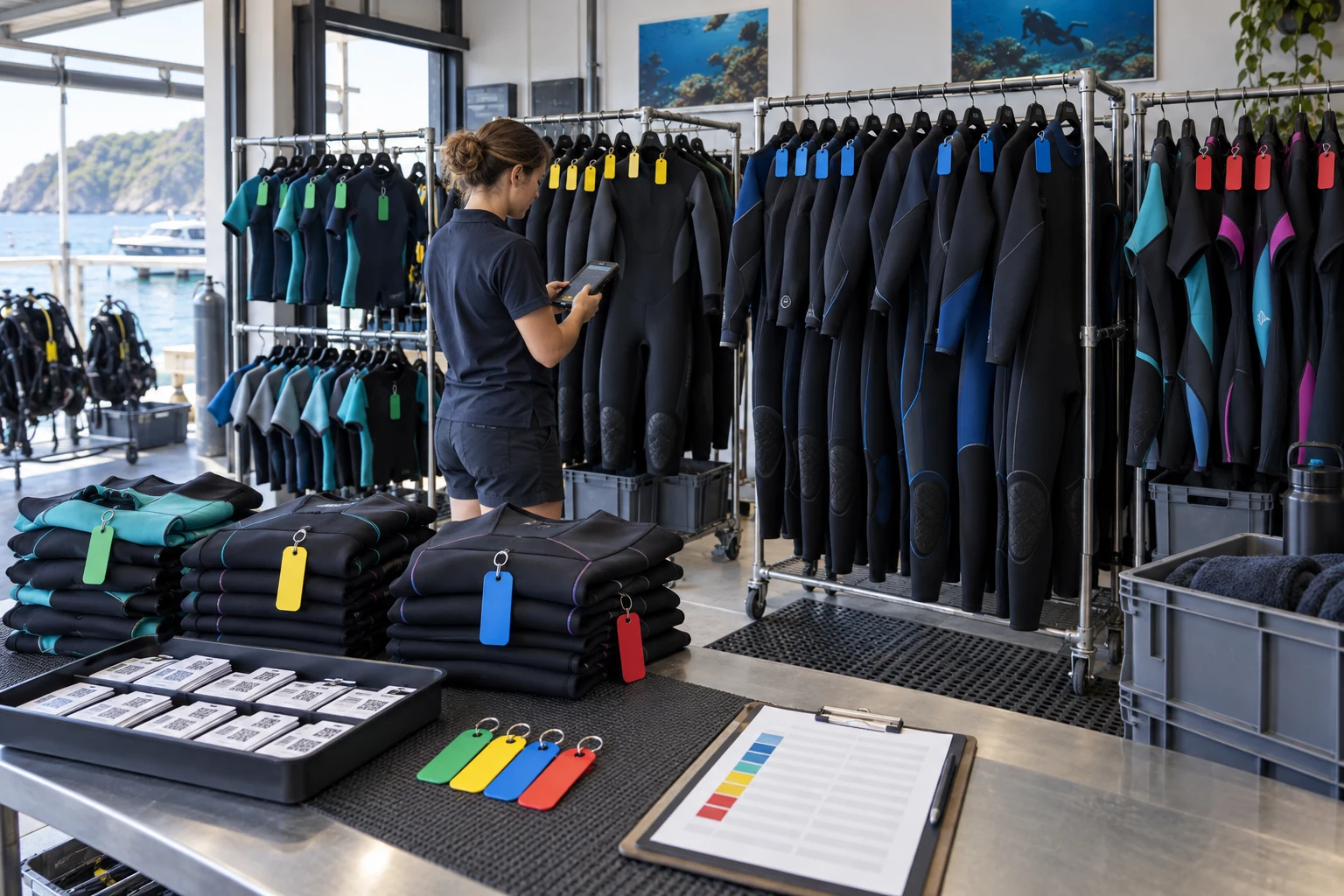
Make selection and return visible
Operational identification can include:
- large, high-contrast size labels;
- contrasting sleeves, shoulders or side panels for category or size coding;
- printed or applied asset numbers;
- barcodes or QR codes linked to the operator’s inventory system;
- operator logo, contact details or “Rental” marking;
- storage zones that match the garment identification scheme.
Do not let color perform too many jobs. If blue means both “medium” and “training fleet,” staff can misissue stock. Define one hierarchy—such as style, thickness, size and asset number—and document where each identifier appears. Test label readability, print adhesion and scanner performance on the actual material and under the intended workflow.
When rental products are also offered for retail sale, separate operational asset tags from consumer-facing market disclosures. Use the wetsuit product-label and online-information checklist to map U.S. and EU fields without treating a rental barcode as a compliance label.
6. Plan return, cleaning, drying and storage
Garment design and operating procedure affect each other. Divers Alert Network (DAN) recommends documented infection-control procedures for rental operations and notes the importance of cleaning, following product directions, rinsing as required, drying completely, ventilation and separation of returned equipment from clean equipment. The operator must select processes compatible with the wetsuit, other equipment, local regulations and the chosen cleaning or disinfecting product.
A practical flow can be:
- Return and scan: identify the suit, user assignment and condition.
- Quarantine or returned zone: keep used items separate from ready stock.
- Inspect before cleaning: flag cuts, open seams, zipper problems or contamination that requires a special route.
- Clean or disinfect: follow the operator’s current SOP, local requirements and compatible product directions.
- Rinse as required: remove residues and salt according to the defined method.
- Dry completely: provide airflow and sufficient time; turn the suit as required by the approved care method.
- Inspect and record: check size label, asset ID, seams, panels, zipper, print and general condition.
- Repair, retire or release: only ready garments return to the clean storage zone.
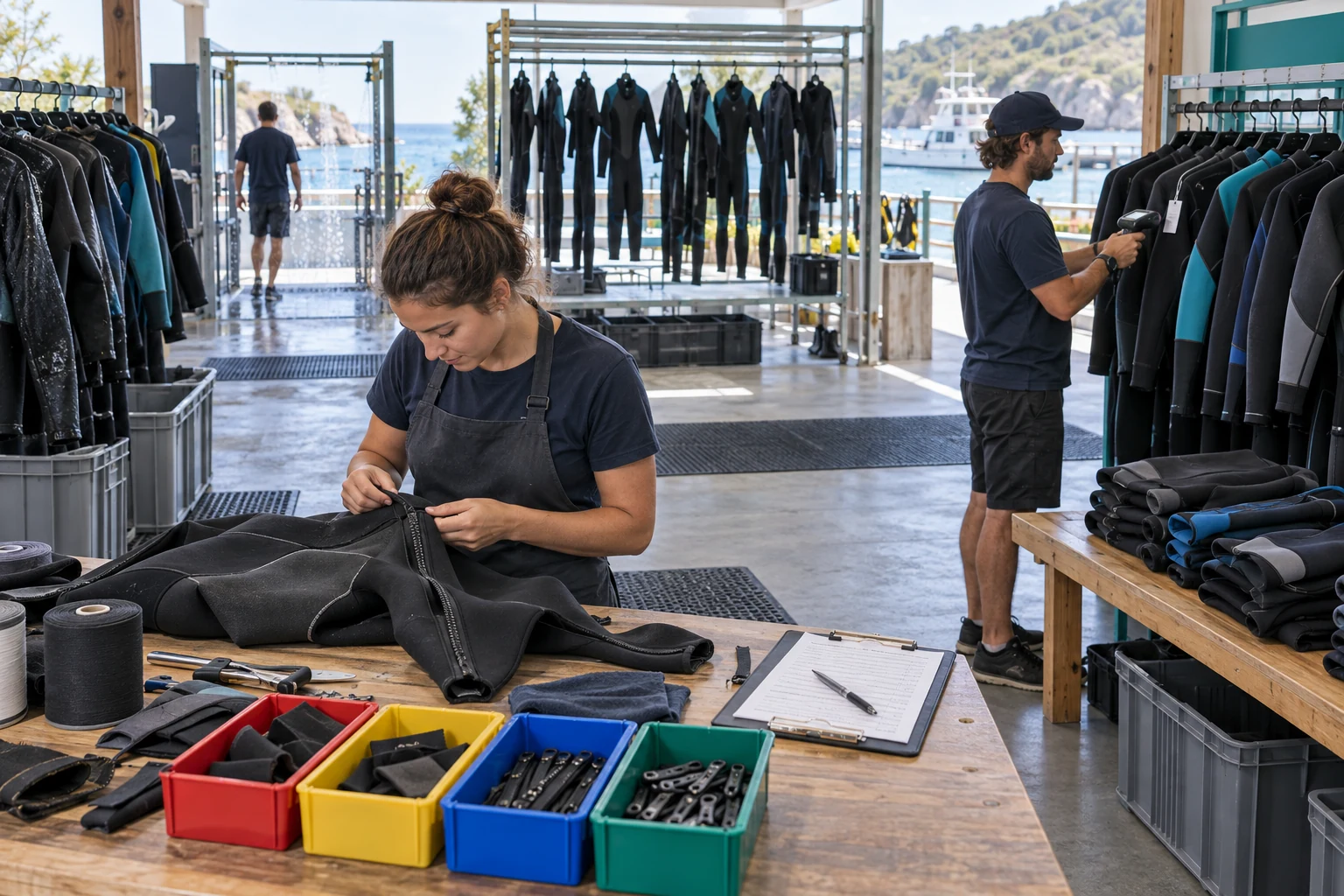
DAN’s general wetsuit gear-care guidance advises rinsing, turning the suit inside out, hanging it to dry and storing it in the shade because neoprene is susceptible to UV damage. Translate general guidance into a site-specific written procedure with responsibilities, contact times where applicable, drying criteria, storage conditions and records. Do not copy a chemical concentration into the SOP without confirming the product label, material compatibility and current local rules.
7. Control repairs, spare parts and reorders
A rental fleet needs three visible states: ready, repair/hold and retired. Staff should not return a garment to service because a defect “looks small.” The operator’s acceptance rules should state which issues can be repaired, who is authorized to perform or approve the repair, what evidence is recorded and when the suit must be retired.
INSEAKU can provide repair fabric, spare zipper parts or other agreed components as separately charged items. The quotation should identify the item, compatibility, quantity, packaging and whether installation requires special skill or equipment. Spare components are not useful if staff cannot match them to the correct garment version.
For replenishment, track shortages and retirements by style, color and size. Repeat-order MOQ can be discussed with INSEAKU, but a lower quantity is not automatic; confirm the arrangement, material availability, color continuity, component availability, price and lead time in writing. Preserve the approved tech pack, pattern/version reference, artwork, color standard and sealed-sample record so a reorder does not quietly become a different product.
8. Convert quality control into fleet acceptance rules
INSEAKU can inspect dimensions, appearance, seams, zippers, printing and labels, and can conduct sample leakage checks according to the customer’s quality plan. The order should state sample selection, inspection stage, method, acceptance criteria, responsible parties, reporting and final release authority.
Use the wetsuit quality control checklist to connect incoming materials, in-process checks, final inspection and nonconformity control. A rental-specific plan can add:
- readability and position of size and asset identifiers;
- scan verification for barcodes or QR codes;
- reinforcement shape, position and edge workmanship;
- zipper operation and extended-pull security;
- color-panel location and shade reference;
- repair-kit or spare-part identity and count;
- individual or bulk packaging requirements;
- project-defined leakage or localized seam checks where required.
Bulk production should be based on the customer’s written approval of the sealed or pre-production sample, confirmed specification and production order. The wetsuit manufacturing process article explains how those approved references connect to materials, pattern making, cutting, seam assembly and final inspection.
9. Calculate and stress-test cost per use
Start with one scenario per style and color. Enter the actual quantity, unit price, landed costs, labeling, optional spares, expected cleaning and inspection cost, repair budget, disposal/recovery values, planned uses, utilization and early-retirement factor. The formula should use completed rental uses—not garments purchased or calendar days.
Run at least three scenarios
- Conservative: lower utilization and higher early retirement or loss.
- Base: the most supportable assumptions from current records.
- Strong operations: improved utilization and asset control, without changing the garment-life assumption merely to make the result attractive.
Then change one assumption at a time. If cost per use is highly sensitive to utilization, the main improvement may be size allocation or booking control. If repair and early retirement dominate, examine failure records, fit, reinforcement, use instructions and the return-to-ready process. If freight and setup dominate a small lot, compare consolidation and replenishment planning while preserving stock availability.
Measure the fleet after launch
Define one completed use consistently. Decide how to record exchanges, multi-day rentals, cancellations and training sessions. At regular intervals, compare forecast with actual:
- completed uses by asset and size;
- idle days and stockouts by size;
- repair type, cost and downtime;
- loss and retirement reason;
- cleaning and inspection time;
- guest fit exchanges or complaints;
- revenue only where the operator’s accounting definition supports it.
Update the model with actual data. A transparent imperfect forecast is more useful than a precise-looking figure built from unsupported lifetime claims.
What should a rental-wetsuit RFQ include?
Use a controlled wetsuit tech pack and RFQ checklist so every supplier prices the same requirement. Include:
- operator type, activity, use environment and target users;
- full suit, shorty, children’s, men’s, women’s or unisex route;
- thickness and panel map;
- foam, lining, lamination, stretch and color requirements;
- flatlock, GBS, tape and reinforcement details;
- zipper reference, length, pull and surrounding reinforcement;
- size chart and quantity by size for each style/color lot;
- large size labels, contrasting panels, numbers, barcode/QR and branding;
- individual or bulk packaging;
- optional repair fabric and spare components;
- sample stages, approval records and quality plan;
- order quantity, target timing, destination and Incoterms rule;
- reorder data and request to discuss repeat-order MOQ.
The standard starting quantity is 50 pieces per style and color, with sizes mixable within the same-color lot. Project cost, sample charge and schedule depend on the confirmed specification. Review the current wetsuit manufacturer MOQ, sample cost and lead-time guide before budgeting. If you are still selecting a supplier, begin with the 12-point wetsuit factory audit scorecard. Buyers deciding how much development support they need can also compare OEM, ODM and private-label wetsuit routes.
Buyer FAQs
What is INSEAKU’s MOQ for rental wetsuits?
The normal starting MOQ is 50 pieces per style and color. Sizes may be mixed within that same style/color lot.
Can different colors be combined to reach 50 pieces?
No. Each color has its own MOQ. A buyer may mix sizes within one style and color, but cannot combine different colors to reach the normal 50-piece starting quantity.
Which rental wetsuit styles can INSEAKU make?
INSEAKU can custom manufacture full suits, shorties, children’s, men’s, women’s and unisex products, subject to the confirmed specification and quotation.
Can a rental fleet use color coding, asset numbers and QR codes?
Yes. Options can include contrasting garment panels, large size labels, numbers, barcodes or QR codes. The buyer should define the coding hierarchy, data format, position and verification method.
Can INSEAKU add a dive center’s logo and contact details?
Yes. Logo, contact information, asset number and rental marking can be produced using an agreed method after artwork and placement approval.
Are repair materials and spare parts included?
They can be supplied as separately charged items when agreed. Compatibility, quantity, installation requirements and packaging should be written into the quotation.
Can repeat orders use a lower MOQ?
Repeat-order MOQ can be discussed, but it is not automatically lower. Confirm material and component availability, color continuity, quantity, price and lead time in writing.
How long should a rental wetsuit last?
There is no universal guaranteed number of uses in this article. Life depends on the product, fit, activity, frequency, care, cleaning, drying, storage, damage, repair and retirement criteria. Use asset-level records to replace estimates with actual results.
How should a dive center clean rental wetsuits?
Use a documented process that follows current local rules, the directions for the selected cleaning or disinfecting product and compatibility guidance for the wetsuit and other equipment. Separate returned and clean stock, rinse as required, dry completely and record release back to service.
How is cost per use calculated?
Add acquisition, landed/startup, recurring operating, repair and disposal costs; subtract supportable recovery value; then divide by projected completed rental uses. Test utilization and early-retirement assumptions with the downloadable workbook.
How to Source Wetsuits for Dive Centers Wholesale
When sourcing wetsuits for dive centers wholesale, send INSEAKU your intended activities, user groups, styles, thicknesses, materials, seam and zipper requirements, size range, quantity by size, identification system, reinforcement zones, packaging, quality plan, optional spares, target timing and destination. Include any existing rental records so the discussion begins with demand and failure evidence instead of a generic price request.
Request a rental-wetsuit manufacturing review
References and further reading
- Divers Alert Network — Rental Equipment
- Divers Alert Network — Infection Control for Dive Operations
- Divers Alert Network — Gear Care Guidelines
- YKK — PROSEAL Water-Protective Zipper Handling and Care
- U.S. Department of Energy — Life-Cycle Costs for Acquisition
Last reviewed: September 9, 2026. INSEAKU reviewed the manufacturing capabilities, normal MOQ, size-mixing rule, marking options, optional spare-part policy, repeat-order discussion and quality-control scope used in this article. Project-specific construction, prices, sample charges, hygiene procedures, testing, acceptance criteria, delivery and commercial terms remain subject to the confirmed specification, quotation and agreement.