
Short answer: A useful wetsuit fit testing protocol does more than ask whether a sample “feels right.” It freezes the intended user and product requirements, records garment measurements, checks movement and pressure zones when live fit confirmation is required, separates opening flush from true seam leakage, documents the test method and converts every failure into a controlled revision. Bulk production should begin only after the pre-production sample, confirmed specification, production order and required commercial approvals are in place.
A sample can look clean on a table and still fail in use. A sleeve may restrict shoulder rotation, the crotch may pull downward, a knee panel may sit in the wrong position or water may enter through a neck opening that has been incorrectly blamed on a seam. These failures have different causes and require different corrective actions. The purpose of the protocol is to produce evidence before quantity makes correction expensive.
This guide is for water-sports brands, product developers, importers and quality teams approving an OEM, ODM or private-label wetsuit. It explains INSEAKU’s practical development controls without presenting one universal test pressure, tolerance or wear-test frequency. Those values must be defined for the product’s intended use and the customer’s written quality plan.
Download the wetsuit fit, leak and sample-approval checklist
The editable workbook links product inputs, garment measurements, mobility observations, leak locations, corrective actions, sample versions and final approvals. The printable PDF can be used during a sample-review meeting. Both are templates: replace the example fields with the approved size chart, points of measure, tolerances, methods and decision authorities for your project.
Download the editable Excel protocol | Download the printable PDF protocol
What causes wetsuit fit and seam-leak failures?
A symptom is not yet a root cause. The same wet area can result from an open seam, water flowing through a loose neck, a zipper interface or moisture absorbed by the material surface. Likewise, restricted shoulder movement can come from the body measurements, pattern balance, panel geometry, seam placement, foam thickness or stretch direction. Record the symptom first, then test the competing explanations.
| Observed symptom | Possible causes to investigate | Evidence to collect | Do not assume |
|---|---|---|---|
| Water inside the torso | Neck or zipper entry, seam discontinuity, interface leak or product-use conditions | Entry location, timing, localized pressure/bubble result, opening fit and seam inspection | That every wet area proves a seam leak |
| Underarm or shoulder restriction | Chest/sleeve dimensions, armhole shape, panel geometry, material stretch or seam placement | Body and garment measurements, movement observations, marked pressure zone and pattern version | That increasing one circumference will solve the complete fit problem |
| Knee pad sits too high or low | Body proportion, inseam, rise, grading, panel position or garment stretch under movement | Landmark measurements, size, movement photos and graded-pattern reference | That the base-size correction automatically fixes every size |
| Leak appears after stretching | Adhesive coverage, joint alignment, stitch penetration, tape adhesion, liquid-seal cracking or material damage | Before/after test condition, exact seam location, close photographs and construction sample | That an unchanged visual appearance proves an unchanged seal |
| Sample fits but size set drifts | Grading rule, material lot, stretch direction, cutting, assembly tension or measuring method | Actual measurements by size, material identity, pattern version and repeated measuring method | That one approved base size validates the complete size range |
Material thickness and panel zoning can change compression, mobility, seam bulk, entry operation and the finished measurements. Review the 3 mm, 5 mm and 7 mm wetsuit thickness specification guide before approving the fit protocol.
1. Freeze intended use and approval inputs
Fit cannot be approved without knowing who will wear the wetsuit and what the garment must do. Before sample review, the buyer should provide the intended activity, target user, body measurements or body-size standard, size chart, material and thickness, seam route, zipper or entry construction and any market-specific requirement. The same visual silhouette can behave differently when the foam thickness, lining, stretch direction or seam method changes.
When the intended wearer is a child, add the age range, market classification, opening and component risks, warnings, traceability and evidence plan to the fit inputs. Use the kids wetsuit specification checklist before treating a fit sample as ready for compliance or bulk approval.
Fit comments should identify the actual construction being tested because an unlined open-cell interior and a textile-lined interior can feel and behave differently. Start with the terminology and specification controls in our open-cell vs lined wetsuit buyer guide.
The controlled review pack should identify:
- product category and intended use;
- target gender, age group, body profile and size range;
- body-measurement source and garment size chart;
- approved material, thickness, lamination and stretch direction;
- pattern and grading version;
- seam, zipper, seal and reinforcement construction;
- sample stage and sample ID;
- points of measure, method and project-specific tolerances;
- required fit, mobility, leak or third-party tests;
- who records, reviews and approves the result.
If these inputs are incomplete, use the wetsuit tech pack and RFQ checklist before starting the review. Material choices should also be defined through the wetsuit material selection guide, because thickness, lining and stretch can alter both measurements and movement.
2. Measure the sample before judging fit
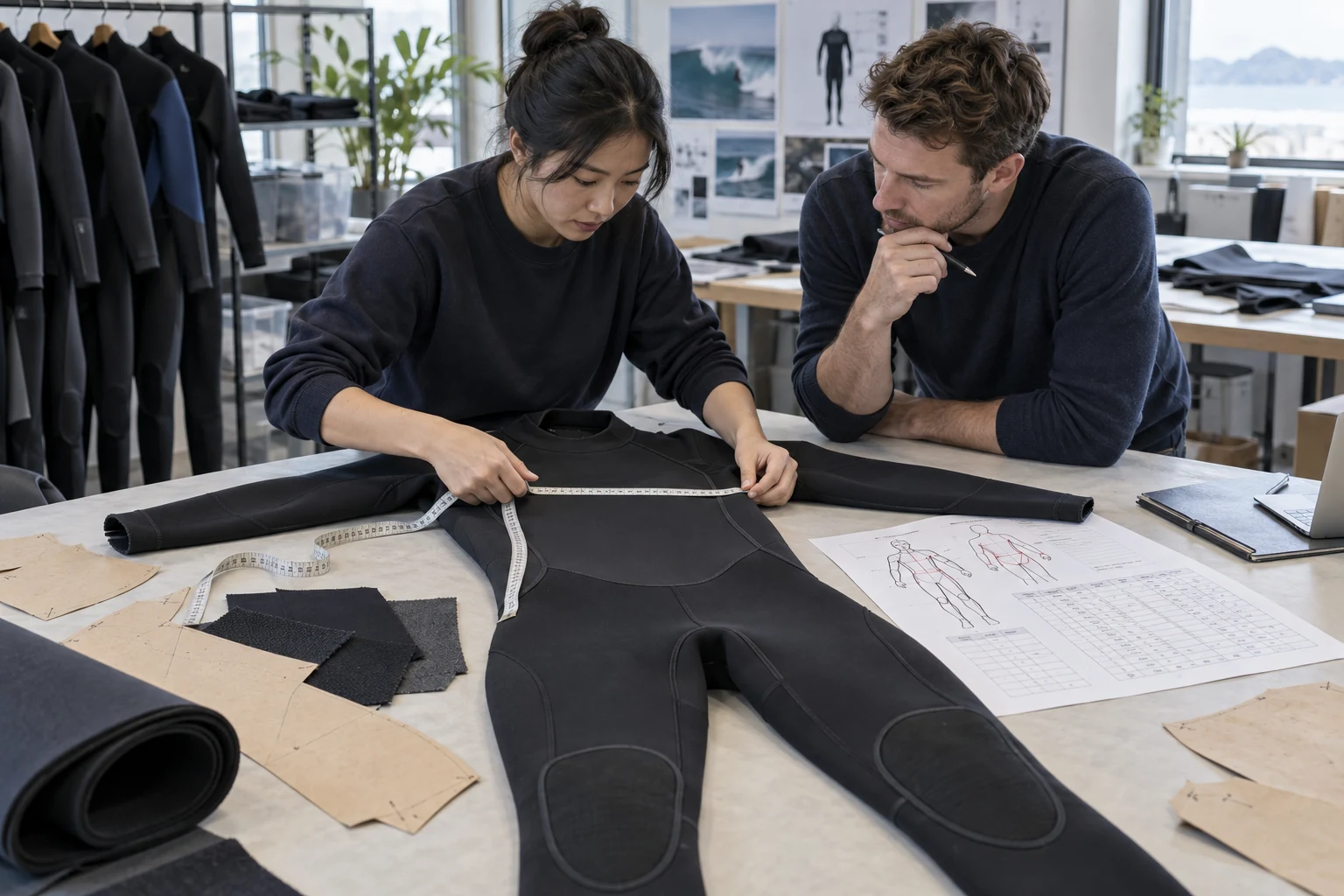
INSEAKU records major garment measurements during sample review. The record should state the garment condition, size, sample ID, measurement point, method, target, tolerance and actual value. A pass/fail box without the observed measurement is weaker evidence because it cannot reveal direction or pattern trends.
Typical points can include chest, waist, hip, torso length, shoulder width, sleeve length, bicep, wrist, rise, inseam, thigh, knee and ankle. The correct set depends on the style and intended use. Measurements should be taken with the garment positioned consistently and without uncontrolled stretching. If two inspectors interpret a point differently, the tech pack should add a diagram or written measuring instruction.
Look for patterns, not isolated numbers
A single dimension inside tolerance does not prove good fit. Review related dimensions together. Shoulder width, chest, armhole, sleeve angle and bicep all influence upper-body movement. Torso length, rise and inseam influence crotch tension and knee position. Size-set results should also be reviewed for smooth grading rather than judged as unrelated garments.
Before interpreting these fit results, define the complete size system with our wetsuit size grading guide, which separates body measurements, garment targets, grade rules and sample evidence by size.
3. Use a fixed fit model when live review is required
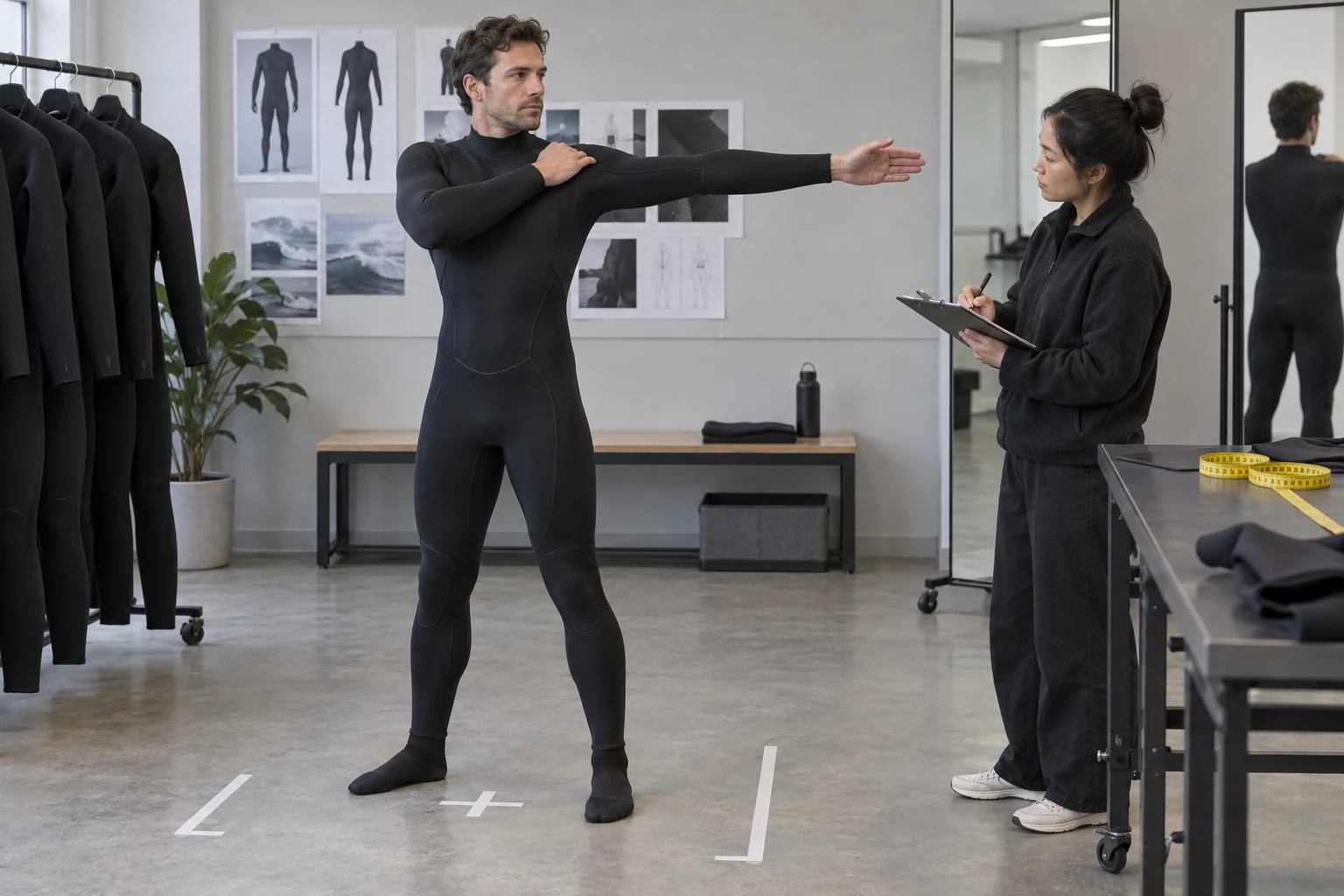
INSEAKU does not normally require live wear testing for every sample. When a project needs live fit confirmation, a fixed fit model can provide a more repeatable comparison between sample versions. The model’s relevant body measurements, the sample size, underwear or base layer, fitting conditions and observations should be recorded. A different person with different proportions should not silently replace the reference model during a revision cycle.
A movement review can include shoulder rotation, arm reach, elbow flexion, squat, knee flexion, forward bend, torso rotation, zipper operation, entry and removal. The reviewer can mark pressure, restriction, excess volume, panel displacement, neck compression, back gaps, crotch pull, knee-panel misalignment and localized wrinkles. Male, female, children’s and other body profiles can be addressed according to the project requirement.
For activity-specific sample tasks, compare the movement and entry requirements of triathlon and surfing wetsuits before finalizing the fit-review method.
Translate comments into measurable actions
“Too tight” is not a complete correction instruction. Record the location, movement, model measurements, garment measurements, severity and proposed change. For example, note whether the restriction appears only during arm elevation, whether it is bilateral and whether the seam is being pulled into a different position. This helps the pattern team decide whether to change length, circumference, angle, panel shape, material or construction.
4. Separate seam leakage from water entry
Water inside a wetsuit is an observation, not a diagnosis. A technical record should distinguish at least five conditions:
- Seam leakage: water or air passes through a joint or construction discontinuity.
- Opening flush: water enters through the neck, wrist or ankle because of shape, movement, compression or fit.
- Zipper or interface ingress: water enters through or around the zipper, end stop, flap or adjoining seam.
- Material wetting or absorption: the surface or laminate holds moisture without proving a through-leak at a seam.
- Test-setup artefact: the fixture, closure, handling or test pressure creates a result that does not represent the agreed use condition.
The symptom location, time to appear, body position, movement, test method and exact construction area should be recorded. This distinction prevents a pattern change from being used to solve an adhesive problem, or a seam rework from being used to solve a loose opening.
5. Define the localized wetsuit seam-leak test
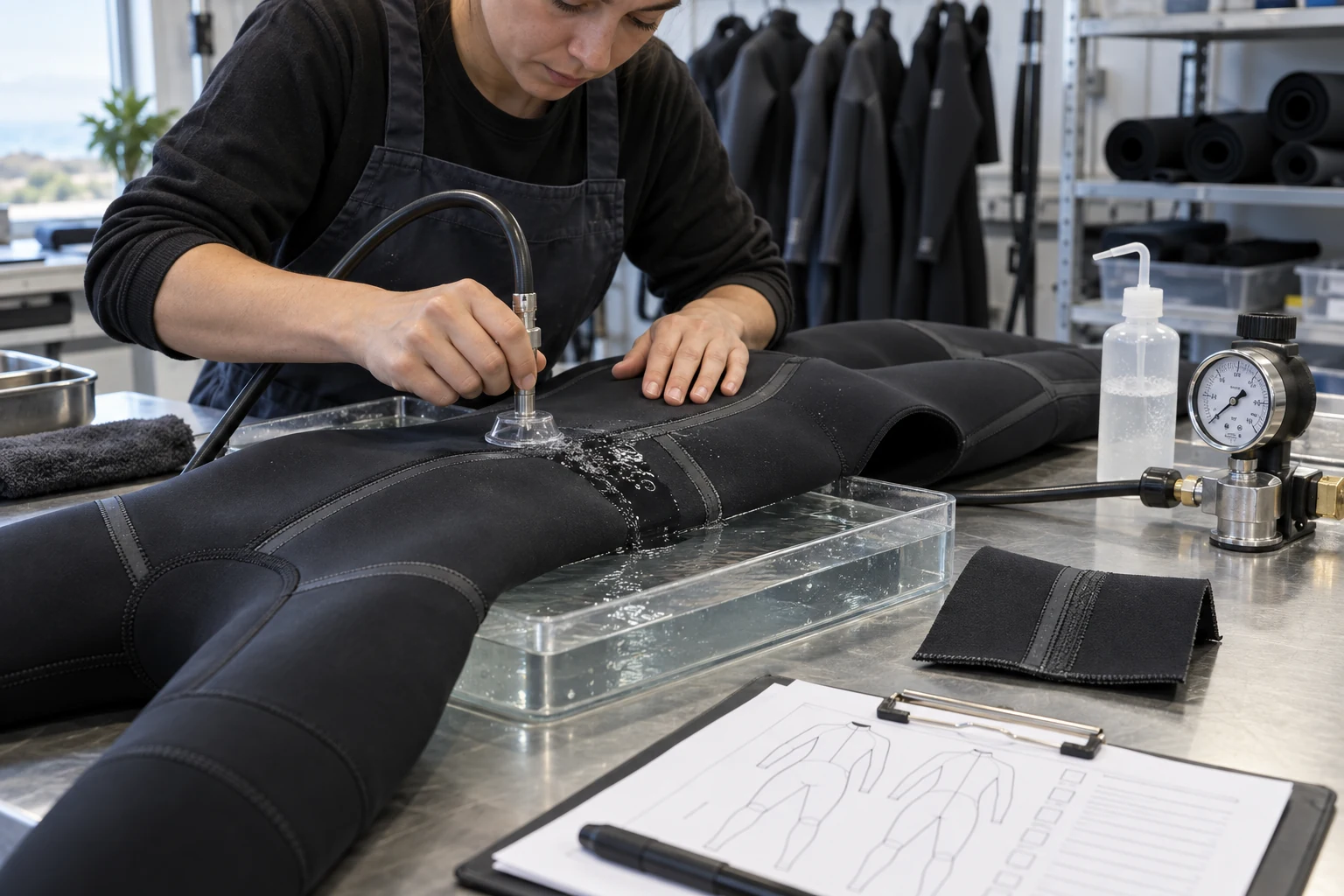
INSEAKU can use localized seam water-pressure or air-pressure checks, bubble inspection, visual and manual inspection, third-party laboratory testing and other project-agreed methods. The written plan must identify which method applies. It should also state the sample condition, area being tested, fixture, pressure or water condition, duration, observation, acceptance rule and person recording the result.
A localized air-and-bubble method can help identify a discontinuity at a seam or interface, but an unspecified pressure can make results difficult to compare. Excessive pressure can also create a failure that does not represent the intended condition. The project should therefore define or approve the method before the result becomes a release criterion.
Material water resistance is not the same as a garment leak test
Laboratory methods can evaluate specific material properties. For example, ISO 1420 addresses resistance of rubber- or plastics-coated fabrics to water penetration under hydrostatic pressure, while ISO 17581 addresses water absorption resistance. These questions are related but not interchangeable. A material test coupon does not reproduce every seam, opening, zipper interface, pattern tension or movement of a finished wetsuit.
6. Diagnose seam and zipper-interface failures
Inspection should follow the approved construction. Depending on whether the product uses flatlock, glued-and-blind-stitched seams, internal tape, liquid sealing or another route, the investigation can cover:
- missing, uneven or discontinuous adhesive;
- incorrect alignment or incomplete joint compression;
- insufficient curing or contamination at the bonded surface;
- skipped stitches, broken thread, inconsistent stitch formation or unintended needle penetration;
- tape lift, offset, wrinkles, bubbles or incomplete bonding;
- liquid-seal gaps, thin areas, cracking or poor adhesion;
- material damage or excessive trimming near the seam;
- zipper end, flap, reinforcement and seam-interface discontinuity;
- pattern tension that opens or distorts the joint during movement.
Our comparison of GBS vs flatlock wetsuit seams explains why a seam name is not a complete performance claim. The approved construction, workmanship criteria, use condition and verification method must be considered together.
When the defect is concentrated around the entry, compare the approved closure architecture before changing the pattern or component. Our chest zip vs back zip wetsuit specification guide maps the barriers, openings, reinforcements and sample checks that should be traced.
7. Connect stretch recovery and durability tests to the actual risk
A wetsuit stretch recovery test may be useful when the concern is dimensional drift, bagging or loss of compression after extension. INSEAKU can conduct a material stretch-and-recovery check when required, but the protocol must define the specimen or garment area, direction, extension, hold time, number of cycles, recovery period and acceptance criterion. Without those conditions, two “stretch tests” may not be comparable.
Professional wetsuit durability testing is generally assigned to a qualified third party. Depending on the agreed risk, a buyer may request tensile or elongation, tear, coating/lamination adhesion, abrasion, repeated extension, zipper cycling or other laboratory work. ISO 37 covers tensile stress-strain properties of vulcanized or thermoplastic rubber; ISO 1421 and ISO 4674-1 address tensile/elongation and tear resistance of rubber- or plastics-coated fabrics. These references show why the test method and specimen matter; they do not create one universal wetsuit acceptance value.
Before commissioning a laboratory, specify the material construction, conditioning, test direction, sample selection, edition of the method, required report and acceptance criteria. Also decide whether the test is for material qualification, sample validation, claim substantiation or batch verification. The same report should not be reused beyond its actual sample and scope.
8. Control corrections and sample versions
When a sample fails, INSEAKU can record the issue, analyze the cause, revise the pattern, material, seam process or other requirement, make a new sample and seek approval again. The correction loop should preserve the link between the symptom, evidence, root cause, action and new result.
- Identify: record product, size, sample ID, test condition and exact failure location.
- Contain: stop the affected sample or pre-production version from being treated as approved.
- Analyze: compare body and garment measurements, pattern, material, stretch direction, seam route, process and test setup.
- Correct: issue a dated change to the responsible file or work instruction.
- Resample: produce the defined replacement sample or corrected section.
- Retest: repeat the relevant measurement, movement or leak check under the same agreed method.
- Approve: record the result and obtain written acceptance of the correct version.

Use the custom wetsuit design and revision guide to carry this evidence back into the pattern, panel map, measurements, material specification and next controlled sample version.
9. Approve the pre-production sample and bulk release
Sample stages can include a prototype, fit sample, size-set sample, pre-production sample and sealed or approved sample. Not every project needs every label, but the purpose of each submitted sample must be clear. A visual approval should not silently approve an unreviewed size set, material change or seam revision.
INSEAKU produces a pre-production sample before bulk production in addition to the earlier development samples. Bulk production begins only after the customer has approved the required sealed or pre-production reference in writing, the specification is confirmed, the production order is in place and the agreed advance payment has been received. The wetsuit manufacturing process then uses those approved references as its production basis.
For the wider sequence around these fit checks, see INSEAKU’s custom wetsuit sampling process, including sample identity, consolidated revisions, sealed-sample approval and controlled bulk release.
Repeated-use operators should connect fit and leak decisions to the rental wetsuit fleet cost-per-use model, because exchanges, downtime and early retirement change realized utilization.
What must the written release identify?
- style, color, size and purchase or production order;
- approved sample ID and date;
- specification, pattern, measurement-chart and artwork versions;
- approved material and component references;
- closed fit, mobility, leak and corrective-action items;
- conditions or deviations accepted by the authorized buyer;
- scope of the approval: base size, size set, colorway or complete order;
- name, authority and date of the person releasing production.
The sample schedule and commercial triggers should also be aligned with the current wetsuit MOQ, sample cost and production lead-time guide. Testing and buyer-response time should not be hidden inside an unsupported production promise.
What should buyers put in a wetsuit fit testing protocol?
| Protocol block | Minimum controlled information | Decision output |
|---|---|---|
| Product and user | Use, market, body profile, body measurements, size range and risk | Valid test scope |
| Sample identity | Stage, sample ID, material, pattern, grading and construction versions | Traceable reference |
| Garment measurement | Point, method, target, tolerance, actual value and inspector | Pass, fail or trend review |
| Fit and movement | Whether live review is required, fit-model record, movement, pressure zone and observation | Accept or issue a defined correction |
| Leak diagnosis | Observed entry location, construction area, method, condition, duration and result | Seam, opening, zipper, material or test-setup cause |
| Material/durability | Property, specimen, direction, conditioning, method, laboratory and criterion | Qualified, rejected or further review |
| Corrective action | Root cause, responsible file/process, revision, resample and retest evidence | Closed or still open |
| Production release | Approved sample/spec versions, open conditions and authorized written approval | Release or hold |
The final plan should connect to the buyer’s wetsuit quality control checklist. Sample approval prevents known development problems from entering production; incoming, in-process and final inspection verify that bulk output continues to follow the approved reference.
At finished-lot stage, apply the separate batch inspection, Ac/Re and shipment-release guide so sample approval, bulk measurements, defect counts, packing evidence and reinspection remain linked to one authorized decision.
Buyer FAQs
What is a wetsuit fit testing protocol?
It is a controlled method for defining the target user, measuring the garment, checking required movement and pressure zones, recording water-entry or leak observations, assigning corrective actions and approving the correct sample version before bulk production.
Does INSEAKU live-fit every wetsuit sample?
No. INSEAKU does not normally put every sample through live wear testing. Dimensional, pattern, construction and document checks are the normal basis. When a project requires live fit confirmation, a fixed fit model can be used and the conditions and observations should be recorded.
How can a buyer tell whether a wetsuit seam is leaking?
First record where and when water appears. Then inspect the openings, zipper interfaces and material condition and use the agreed localized seam method, such as controlled water or air pressure with bubble observation. A wet interior alone does not prove which path the water used.
Can INSEAKU perform a localized seam-leak test?
Yes. Available approaches include localized water- or air-pressure checks, bubble inspection and visual or manual inspection. The project must define the area, setup, pressure or water condition, duration and acceptance criterion. Third-party laboratory testing can also be arranged where required.
What should be checked during wetsuit mobility review?
The movement set should match intended use. It can include shoulder rotation, arm reach, elbow and knee flexion, squat, bend, torso rotation, entry, removal and zipper operation. Record the exact pressure, restriction, gap, panel displacement or wrinkle rather than only writing “good” or “bad.”
Is there one standard wetsuit measurement tolerance?
No. Tolerances depend on the product, size, point of measure, material, intended use and customer quality plan. Each approved measurement chart should state the target, method and allowed plus/minus tolerance.
What is a wetsuit stretch recovery test?
It evaluates how a defined material specimen or garment area behaves after a specified extension and recovery period. The direction, extension, hold time, cycles, recovery time and acceptance value must be recorded; otherwise the results are not reliably comparable.
Who performs professional wetsuit durability testing?
INSEAKU can carry out agreed factory checks, while professional material and durability tests are generally assigned to a qualified third-party laboratory. The buyer and manufacturer should agree the method, sample, laboratory, report and acceptance criterion before testing.
What happens when a sample fails?
The sample is kept from approval, the issue and affected version are recorded, the cause is investigated, the relevant pattern, material, seam process or specification is revised, and a replacement sample or section is retested. Only the correct approved version may become the bulk-production reference.
Does an approved base-size sample approve all sizes?
Not automatically. If the order or risk requires a size set, graded measurements and relevant fit points should be reviewed across the selected sizes. The approval record must state whether it covers one size, a size set, a colorway or the complete order.
Request a sample review before bulk production
Download the editable wetsuit fit and leak protocol or the printable PDF checklist. Complete the product, user, size, material, construction, measurement, test and approval fields before sending the sample for review.
To discuss an OEM, ODM or private-label project, request a sample review from INSEAKU. Include the intended use, target user, body and garment size charts, sample stage, material, seam and zipper construction, known fit or leak observations and required third-party tests. If you are still comparing suppliers, begin with our guide on how to find a wetsuit manufacturer.
References and further reading
- ISO 37:2024 – Rubber, vulcanized or thermoplastic – Determination of tensile stress-strain properties
- ISO 1420:2016 – Rubber- or plastics-coated fabrics – Resistance to penetration by water
- ISO 1421:2016 – Rubber- or plastics-coated fabrics – Tensile strength and elongation at break
- ISO 4674-1:2016 – Rubber- or plastics-coated fabrics – Tear resistance
- ISO 17581:2025 – Rubber- or plastics-coated fabrics – Water absorption resistance
Last reviewed: September 9, 2026. INSEAKU confirmed the product-input requirements, garment-measurement review, availability of a fixed fit model when required, mobility observations, localized water/air-pressure and bubble checks, seam-failure review, optional stretch-recovery checks, third-party durability testing, corrective-action loop, sample stages, pre-production sample and written bulk-release conditions described in this article. Project-specific methods, tolerances, sample quantities and acceptance criteria remain subject to the approved specification, customer quality plan and written agreement.