
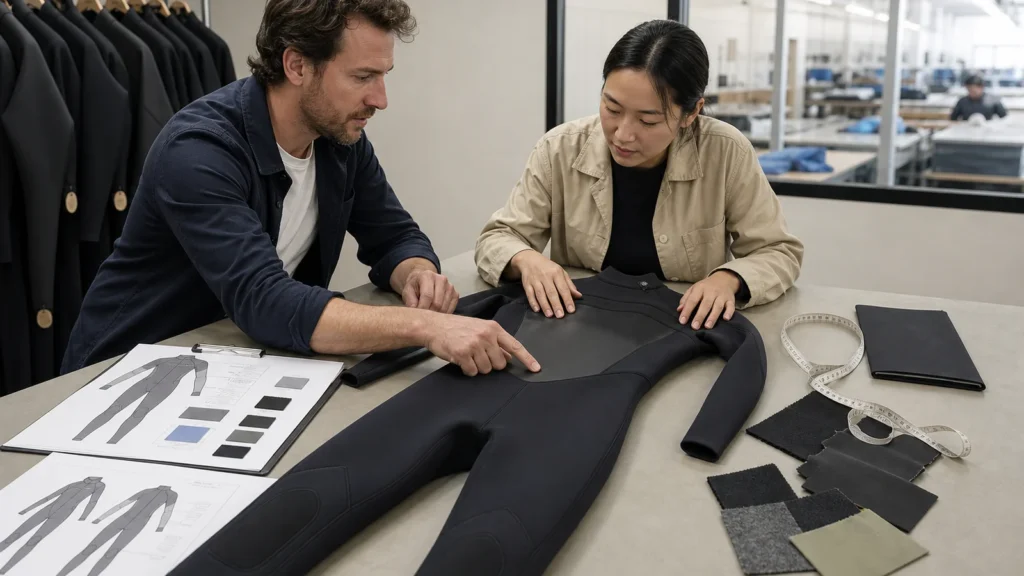
Short answer: The wetsuit manufacturing process turns an approved product specification into repeatable finished garments. At INSEAKU, the normal route is project and tech-pack review, material confirmation, pattern making and size grading, sample development, written sealed-sample approval, material preparation and lamination, printing, cutting, gluing, stitching or seam sealing, in-process quality control, final inspection and packaging. The exact operations depend on the intended use, material, entry system, seam construction and branding specified for the project.
This guide answers “how are wetsuits made?” from a B2B buyer’s perspective. It shows what the buyer supplies, what the manufacturer develops, what should be checked and which approval prevents the next stage from moving forward with an unresolved assumption.
Wetsuit manufacturing process at a glance
A factory should not treat this as one uninterrupted production line. The workflow contains decision gates. A design is not ready for a bulk cutting plan simply because a sample exists; the buyer first needs to approve the sealed sample and the parties must confirm the specification and production order in writing.
| Stage | Main output | Control or approval |
|---|---|---|
| 1. Project definition | Intended use, design input, quantity and target requirements | Written scope and open-issue list |
| 2. Engineering review | Feasibility notes, construction route and bill of materials | Conflicts and substitutions resolved |
| 3. Material confirmation | Foam, lining, lamination, trims and approved colors | Material references and specifications confirmed |
| 4. Pattern and grading | Base pattern, panel geometry and size set | Measurement chart and grading logic reviewed |
| 5. Sampling | Development sample, revisions and final sealed sample | Buyer gives written sealed-sample approval |
| 6–8. Bulk preparation | Controlled materials, approved artwork and cut-panel kits | Incoming, print and cutting checks |
| 9–11. Assembly | Joined panels, specified seams, zipper and reinforcements | First-article and in-process checks |
| 12–13. Inspection | Measured and inspected finished wetsuits | Final sampling and project-specific performance checks |
| 14. Packing and release | Correctly labelled, counted and packed order | Release against production order and shipping instructions |
The same sequence can be shorter for a proven private-label solution or longer for an original design. It should still preserve the three documents that control bulk production: the buyer’s written approval of the sealed sample, the confirmed specification and the production order.
How OEM and ODM wetsuit projects enter the process
The factory operations can look similar after approval, but the development responsibility before approval is different. In an OEM project, the buyer normally supplies a complete design or tech pack and the manufacturer converts it into a manufacturable, controlled product. In an ODM project, the buyer may begin with an idea, reference product or basic requirements, and INSEAKU supports design development, pattern making, sampling and preparation for production.
| Route | Typical buyer input | INSEAKU development role | Common approval risk |
|---|---|---|---|
| OEM | Tech pack, measurement chart, artwork, materials and construction requirements | Feasibility review, manufacturing interpretation, patterns when required, samples and bulk production | Ambiguous drawings, conflicting dimensions or unspecified tolerances |
| ODM | Product idea, use case, target user, references and commercial requirements | Design and engineering support, material route, in-house patterns and grading, samples and production | Unclear performance priorities or uncontrolled changes during development |
| Private label | Selected proven solution, brand assets, colors, labels and packaging | Configuration, branding, sample confirmation and production | Assuming every component or dimension can be changed without new development |
For a fuller commercial comparison, read OEM vs ODM wetsuits and where private label fits. The name of the route does not replace a written list of deliverables, responsibilities and intellectual-property terms.
1. Project definition and wetsuit tech-pack review
A production-ready brief begins with the intended use. A surf wetsuit, diving suit, triathlon suit, rental product and children’s product can require different priorities for flexibility, warmth, durability, buoyancy, entry, visibility and repeated use. The manufacturer needs enough context to understand why a requirement exists, not only what number appears in a table.
Brands can structure the required drawings, materials, measurements, artwork and quotation fields with our wetsuit tech pack template and RFQ checklist.
Buyer input
Supply the target user, activity, water conditions, product type, thickness map, size range, entry system, seam construction, materials, colorways, artwork, labels, packaging, target quantity, destination and required timing. For OEM work, include version-controlled drawings, a bill of materials and a measurement chart if available.
Manufacturer work
A capable wetsuit tech pack manufacturer checks whether drawings, dimensions, materials and construction notes describe the same product. INSEAKU records open questions, highlights manufacturing conflicts and identifies decisions that affect pattern geometry, tooling, sample cost, minimum quantities or timing.
Control point
Use one dated specification version. Verbal messages and isolated screenshots should be converted into written revisions. If a requirement changes, the affected drawing, measurement, material, sample status, price and schedule should be reviewed together.
2–3. Engineering feasibility, materials and lamination
2. Translate the concept into a construction route
Engineering review connects performance requirements to the panel layout and assembly method. The review considers where stretch is needed, where abrasion or stress is likely, how the wearer enters the suit, how seams intersect and whether a proposed logo or component can survive the intended operation.
The output is a working construction specification: panel map, thickness map, seam type, zipper and seal details, reinforcements, artwork placements, acceptable tolerances and an initial bill of materials. This is also the point to identify any process or component supplied by an external specialist. INSEAKU states that more than 90% of its production processes are performed at its own facility, but buyers should confirm the exact route for their product instead of treating that figure as a guarantee that every operation on every order is internal.
3. Confirm foam, lining, lamination and components
Wetsuit material is a system rather than one generic sheet. The specification may include foam type, thickness, density, surface finish, inner and outer fabrics, stretch direction, color and laminated construction. Zippers, hook-and-loop fasteners, cords, seals, knee panels, transfers, printed elements and labels also need defined references.
Use our wetsuit material selection guide to define the foam, thickness, lining, lamination, test evidence and approved reference that should be locked before cutting.
For freediving and spearfishing products, an “open-cell” request must be translated into a precise layer schedule. See the open-cell and textile-lined wetsuit guide for interior surfaces, outer linings, seams, reinforcement and approval controls.
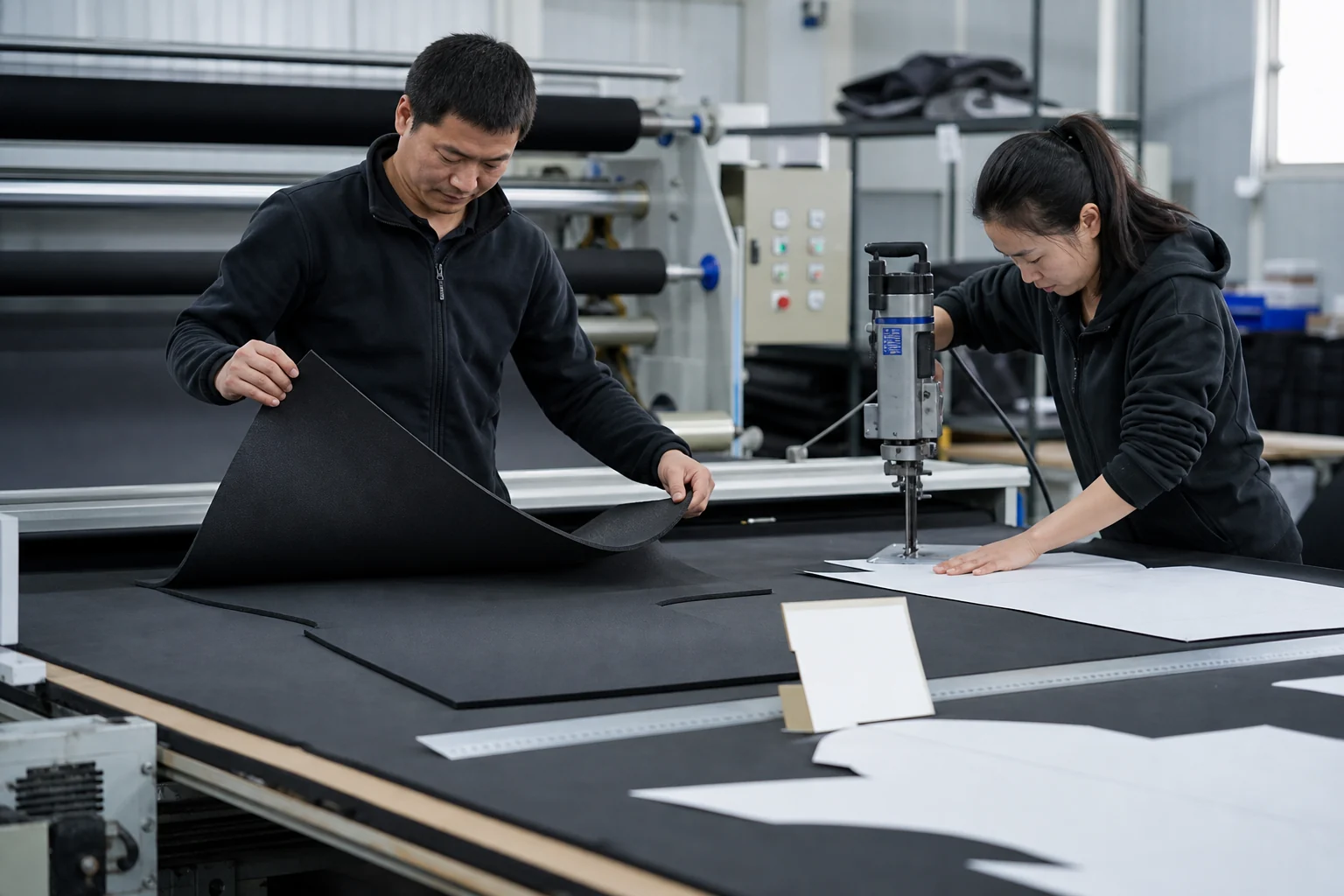
INSEAKU has an in-house material lamination process. Lamination bonds the selected face fabric or lining to the foam according to the approved material route. The factory should control material identity, appearance, thickness and relevant lot information before cutting. A substituted fabric that looks similar can still change stretch, hand feel, bonding behavior and fit, so any substitution needs written acceptance.
If the specification names Yamamoto or another limestone-based material, complete a Yamamoto and limestone material-identity review before lamination so the manufacturer, grade, surface, fabrics and claim evidence are not reduced to one marketing label.
Material approval questions
- Is the material identified by supplier, reference, thickness, lining and color?
- Which side and direction of the material belong to each panel?
- Are appearance and performance tolerances written down?
- Does the order require a specific compliance document or test report?
- Who may approve a proposed material or component substitution?
For single- and multi-thickness products, the approved material record should connect every panel to its nominal thickness, foam, lamination and lining. See the wetsuit thickness and panel-map specification guide.
4–5. Pattern making, size grading and sample development
4. Build the base pattern and grade the size range
Pattern making converts body measurements, ease, material stretch and construction allowances into manufacturable panels. INSEAKU completes pattern making and size grading in-house. That work includes panel geometry, seam allowances, alignment points, component positions and size-to-size grading.
See our wetsuit size grading guide for the body-measurement inputs, base-size decisions, grade-rule controls and sample checks that should be approved before the full size range enters production.
A wetsuit pattern making service should not be evaluated only by whether the flat panels can be cut. The real question is whether the assembled garment meets the agreed measurements and fit intent in the selected material. A change in foam thickness, stretch or seam method may require pattern adjustments even when the visual design is unchanged.
5. Run the custom wetsuit sampling process
The first development sample is a learning tool, not automatic permission for bulk production. It allows the parties to review fit, dimensions, mobility, seam layout, entry, components, artwork placement, workmanship and appearance. Comments should be consolidated into one dated feedback file with photographs, measurements and clear action items.
INSEAKU’s sample development can start from approximately seven working days after materials and specifications are confirmed and payment is received. Complex patterns, special materials, custom printing, multiple sizes or revision cycles can require more time. For the full commercial conditions, see the guide to wetsuit manufacturer MOQ, sample cost and production lead time.
The sealed sample is a production control
After revisions are accepted, the approved sample becomes the sealed sample. INSEAKU starts bulk production only when the buyer has approved that sealed sample in writing, the specification is confirmed and the production order is in place. The sealed sample does not replace the specification; together they define the visual and measurable production target.
Before this manufacturing route begins, follow the custom wetsuit sampling process and approval gates that connect each sample version to the sealed reference and controlled bulk release.
For the detailed pre-bulk verification sequence, see the wetsuit fit testing, mobility and seam-leak protocol.
If the buyer approves with conditions, those conditions must be closed or incorporated into controlled production documents before bulk work proceeds. Phrases such as “approved except for the zipper” are risky unless the final zipper reference and its effect on pattern, construction and cost are separately confirmed.
Before this manufacturing handoff, follow the guide on how to design a custom wetsuit to convert the user brief, panel map, materials, measurements and sample revisions into one controlled production package.
6–8. Incoming material control, artwork and cutting
6. Receive and identify bulk materials
Before production, incoming materials and components are checked against the confirmed references. Depending on the item and project, this can include identity, quantity, color, dimensions, thickness, appearance and documentation. Material lots should remain identifiable so a later issue can be traced to the affected batch rather than treated as a factory-wide mystery.
7. Prepare printing, logos and labels
INSEAKU can implement multiple printing and branding methods. The suitable method depends on artwork, color, panel material, stretch, placement, durability expectation and order quantity. The approved production file should define size, position, orientation, color reference and method. A monitor image is not a reliable color standard by itself; use an agreed physical or documented reference where color accuracy is important.
Artwork approval should happen before the affected panels are produced. Check spelling, legal marks, care content, country-of-origin requirements, barcode data and orientation. A technically good print with incorrect text is still a nonconforming component.
8. Cut and kit the panels
INSEAKU uses multiple cutting methods selected according to material, pattern, quantity and required precision. The cutting plan controls pattern version, size, material direction, panel count and identification. Cut-panel measurements can be checked before assembly so an error is found before it is multiplied across finished garments.
Panels are then grouped into complete garment kits. Kitting reduces size mixing and helps operators verify that each garment has the correct left and right panels, reinforcements, printed parts and components before joining begins.
9–11. Gluing, stitching, seam sealing and component installation
9. Prepare edges and assemble panels
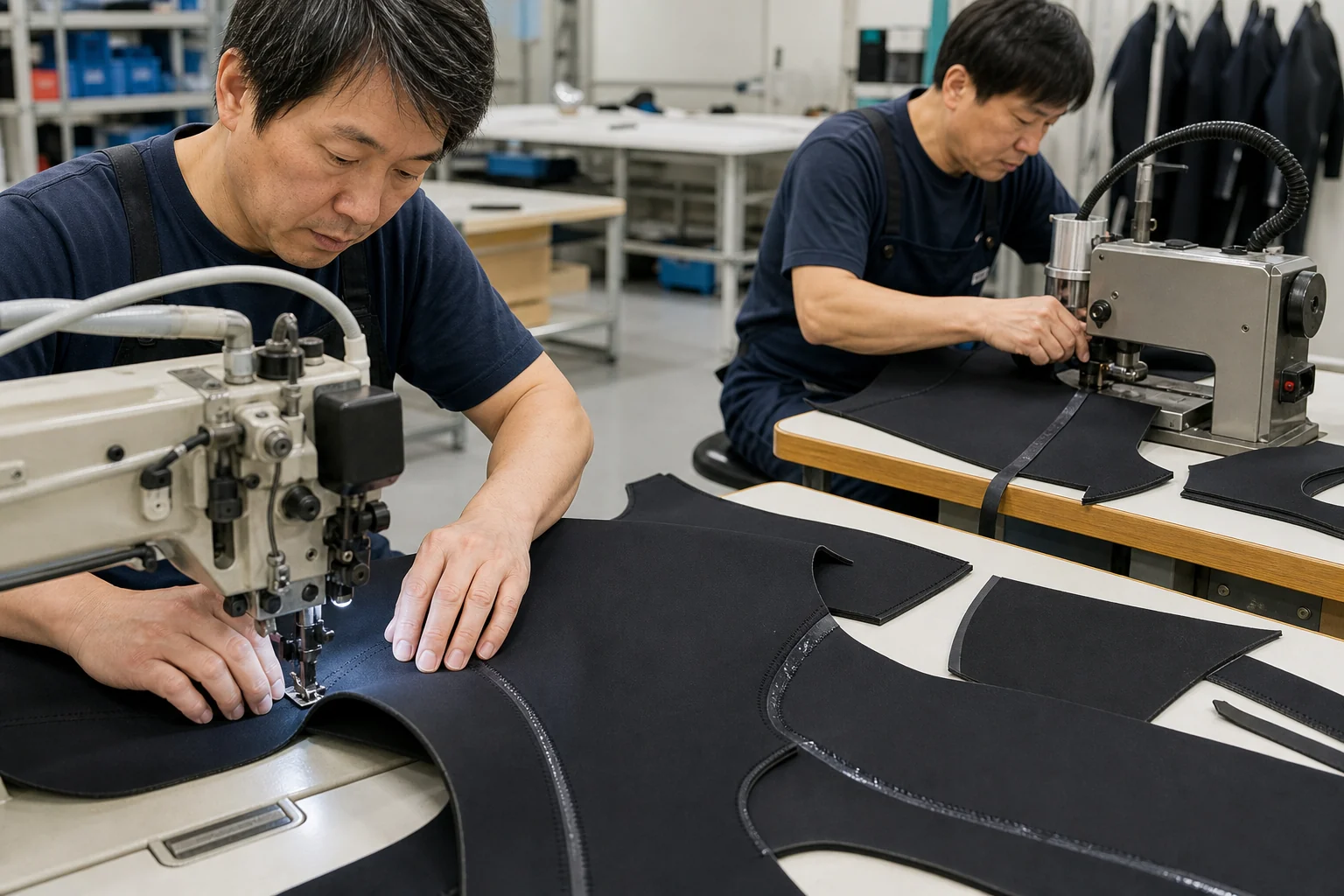
Panel edges are aligned, prepared and joined according to the construction specification. Gluing or other assembly preparation helps stabilize matching edges before or as part of the selected seam process. Operators must follow the panel sequence and alignment marks so a small positioning error does not distort the finished garment.
10. Build the specified seam construction
INSEAKU can produce flatlock, glued-and-blind-stitched (GBS), internal taping, external liquid-seal and standard stitched constructions, as well as project-specific combinations. These are capabilities, not a statement that every method belongs on every wetsuit. The intended use, material, price target, water-resistance requirement and approved specification determine the correct construction.
For the buyer-facing decision framework behind this production step, compare GBS vs flatlock wetsuit seams, critical and full tape, and liquid sealing.
| Construction option | Production focus | Buyer confirmation |
|---|---|---|
| Flatlock | Panel alignment, stitch consistency and comfort at the seam | Intended product use and approved stitch appearance |
| GBS | Glue preparation, blind-stitch depth and seam continuity | Approved seam construction and workmanship standard |
| Internal tape | Tape position, adhesion, coverage and clean intersections | Tape type and exact coverage map |
| External liquid seal | Application width, continuity, cure and appearance | Color, finish and acceptance criteria |
| Standard stitching | Stitch type, thread, tension, reinforcement and consistency | Location and performance expectation |
11. Install zippers, seals and reinforcements
Zippers, pulls, closures, neck or wrist seals, knee panels, reinforcement patches and other details are installed at their specified stage. Placement and alignment matter because these components can affect comfort, entry and load distribution. Reinforcement should follow the approved location and size rather than being added informally as a repair after assembly.
For entry-system engineering, compare zipper orientation, overlap panels, anti-flush barriers, drain holes, neck seals and sample tests in the chest zip, back zip and zipless wetsuit specification guide.
12–13. In-process quality control and final inspection
Quality control is not one inspection at the end. INSEAKU’s actual process includes incoming-material inspection, cut-panel and dimensional checks, first-article inspection, in-process checks, seam, zipper and logo checks, finished-garment measurement, appearance inspection, relevant leak or seal testing, final sampling inspection and packaging checks. The exact test method and acceptance requirement should be defined for the product.
12. First-article and in-process checks
A first article allows the production team to compare the initial assembled output with the approved sample and documents before the same issue appears across the full order. Inspectors and production staff can review measurements, panel matching, seam execution, component placement, logo position and visible workmanship.
In-process inspection should occur where a defect can still be corrected without dismantling a finished garment. Examples include checking cut dimensions before assembly, stitch depth before a seam is covered, tape position during application and zipper alignment before the surrounding construction is completed.
13. Finished-garment and final sampling inspection
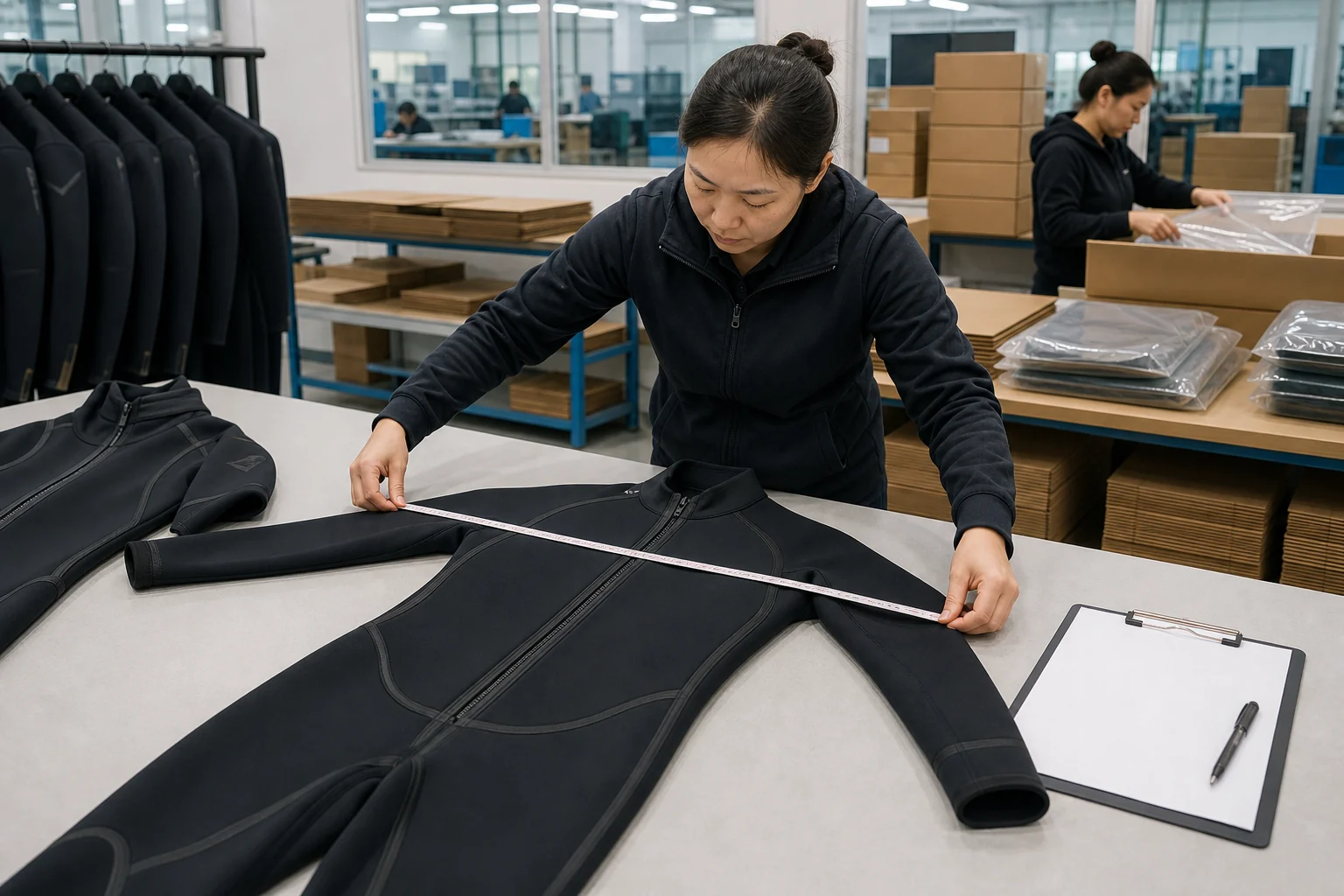
Finished wetsuits are checked for measurements, appearance, seams, zippers, logos and overall conformity to the approved references. Leak or seal testing is performed where required by the product and agreed method. A result is meaningful only when the test setup, location, duration and acceptance rule are defined; “water tested” without a written method is not a complete quality requirement.
Final sampling inspection provides a lot-level decision using the agreed sampling plan and acceptance criteria. ISO 2859-1:2026 describes acceptance-sampling schemes indexed by acceptance quality limit (AQL), but the buyer and manufacturer must still agree which inspection level, AQLs, defect classes and special tests apply to the order. Referencing “AQL” alone does not define a complete inspection plan.
Use the detailed wetsuit batch inspection and AQL QC plan to define the lot, random-selection method, defect catalogue, sample size, Ac/Re numbers, measurement sub-sample, reinspection and release authority before the final visit.
For a stage-by-stage inspection plan and downloadable records, use the wetsuit quality control checklist from IQC to final AQL inspection.
Define defects before inspection
The inspection agreement should distinguish critical, major and minor defects and give product-specific examples. It should also state who may accept a deviation, how repairs are verified and whether reinspection is required. A generic checklist is useful for structure, but it cannot replace the confirmed specification and approved sample.
For products intended for repeated rental, connect these production controls to the rental wetsuit fleet specification, care, asset-tracking and cost-per-use plan.
14. Packaging, count verification and release
Packaging protects the approved product and preserves its identity through storage and transport. The team checks the garment, size and color against the label and packing instruction, confirms required accessories or inserts, verifies barcode or carton marks where applicable and records quantities.
Custom packaging can have a separate supplier minimum. INSEAKU’s current custom-packaging MOQ is 1,000 units, so buyers should confirm ownership and storage of any packaging balance when the wetsuit order is smaller. Packaging approval should cover both graphics and physical suitability; attractive packaging that compresses, marks or incorrectly labels the product is not acceptable.
Production release should match the confirmed order, inspection status and shipping instructions. International transport time is not part of manufacturing lead time. The quotation should identify the delivery basis, named place, documents and responsibility split for the selected freight route.
Buyer approval gates and document traceability
The most reliable way to control a custom manufacturing project is to define what cannot proceed without written approval. The following gates keep design decisions separate from production assumptions.
| Gate | Evidence | What it authorizes |
|---|---|---|
| Scope confirmation | Dated brief or tech pack plus resolved open issues | Detailed development and quotation |
| Material and artwork approval | Approved references, colors, files and placement details | Use of those inputs for sample or production preparation |
| Sample revision approval | Consolidated comments and revised specification version | Next sample iteration |
| Sealed-sample approval | Written approval tied to a specific sample and specification | One required condition for bulk production |
| Bulk production release | Approved sealed sample, confirmed specification and production order | Bulk manufacturing |
| Shipment release | Inspection status, quantities, packing details and shipping instruction | Handover for transport |
Keep the revision number on the tech pack, measurement chart, bill of materials, artwork and approval record. If the buyer changes one item, the parties should assess every connected document. This version control supports a process approach in which inputs, activities, outputs and monitoring are defined rather than left to memory.
What should a buyer send for an accurate manufacturing review?
A useful RFQ gives the factory enough information to identify the correct development and production route. Include:
- buyer company and responsible project contact;
- product category, intended activity, target user and use conditions;
- OEM, ODM or private-label starting point;
- design files, tech pack, measurements or reference sample status;
- material, thickness, lining, stretch and color requirements;
- seam construction, entry system, components and reinforcements;
- artwork, logo, label and packaging requirements;
- size range and quantity by style, color and size;
- testing, compliance, inspection and documentation requirements;
- destination, required delivery window and preferred commercial terms.
If you are still shortlisting suppliers, use the 12-point wetsuit manufacturer factory-audit scorecard. If the project scope is ready, review INSEAKU’s manufacturing services or send your product brief for a manufacturing review.
Buyer FAQs about how wetsuits are made
Does every wetsuit follow exactly the same manufacturing process?
No. The main control sequence is similar, but the actual material preparation, printing, cutting, assembly, seam sealing and testing depend on the product specification. A flatlock surf suit, a GBS diving suit and a performance triathlon suit should not be assumed to use identical operations.
Can INSEAKU work from a complete tech pack?
Yes. INSEAKU accepts OEM projects in which the buyer supplies a complete design or tech pack. The factory still reviews feasibility, dimensions, materials, construction and unresolved conflicts before sampling or production.
Can INSEAKU develop a wetsuit from an idea or reference?
Yes. For ODM work, the buyer can begin with an idea, reference product or basic requirements. INSEAKU can support design development, make patterns, grade sizes, develop samples and prepare the approved solution for production.
Are patterns and size grading made in-house?
Yes. INSEAKU completes pattern making and size grading in-house. Ownership, permitted use and delivery of project files should still be stated in the written agreement because production responsibility does not by itself define intellectual-property ownership.
Does INSEAKU laminate wetsuit materials?
Yes. INSEAKU has a material-lamination process. The exact foam, face fabric, lining, adhesive route, color and performance requirements must be confirmed for the project.
Which seam constructions can INSEAKU manufacture?
Capabilities include flatlock, glued-and-blind-stitched seams, internal taping, external liquid sealing and standard stitched constructions. The selected construction must match the intended product and written specification; these methods are not all used on every wetsuit.
What authorizes bulk production?
INSEAKU bases bulk production on the buyer’s written approval of the sealed sample, the confirmed specification and the production order. Price payment and timing conditions also follow the written quotation and order agreement.
Is every process completed inside the INSEAKU factory?
INSEAKU states that more than 90% of its production processes are completed at its own facility. The exact manufacturing route can vary by product, material, component or specialist process, so any partner-supplied operation should be disclosed and controlled in the project documents.
How should a buyer define final inspection?
Specify the inspection level, sampling plan, critical, major and minor defect definitions, AQLs where used, measurements, appearance criteria, project-specific tests, packaging checks, reporting format and release authority. “Final inspection required” is not detailed enough on its own.
Turn the process into a controlled production plan
A good wetsuit is not created by one machine or one final inspection. It comes from controlled handoffs: a clear product definition, confirmed materials, in-house pattern engineering, evaluated samples, a written sealed-sample approval, accurate bulk preparation, specified seam construction, checks at the point of production and documented final release.
To discuss an OEM, ODM or private-label project, send INSEAKU your product brief for a manufacturing review. Include your intended use, development status, material and construction requirements, size range, quantities, branding and timing so the production route can be reviewed against a defined scope.
References and further reading
- ISO 2859-1:2026 — Sampling procedures for inspection by attributes
- ISO — ISO 9001 explained: process approach and quality management principles
Last reviewed: September 2, 2026. INSEAKU reviewed the OEM and ODM entry routes, in-house pattern and size-grading capability, material lamination, cutting, printing, seam-construction capabilities, quality-control stages, in-house production statement and bulk-release requirements used in this article. Project-specific requirements remain subject to the written quotation, confirmed specification, approved sealed sample and production order. All article images are AI-generated illustrations, not photographs of the INSEAKU factory.