

In this guide
- Find the contact point before changing the fit
- Why a comfortable-looking collar can still rub
- What research tells us about moisture and friction
- 5 checks to help prevent wetsuit neck chafing
- If your neck is already sore, stop the rubbing
- For brands: turn “it rubs” into a collar design brief
- Questions about wetsuit neck chafing
The short answer
Wetsuit neck chafing happens when the collar or closure repeatedly rubs the skin. Start by checking how the whole suit sits, then inspect the collar edge, seam junctions and closure overlap. A suitable anti-chafe product may help, but it cannot correct a badly positioned or uncomfortable neckline. Stop if rubbing becomes painful; investigate the cause before the next session.
If the same suit now feels different, use the wetsuit fit-change checks to separate positioning, current body measurements and repeatable garment changes.
A wetsuit can feel fine standing on the beach and start rubbing once you turn your head to breathe or look forward while paddling. The useful question is not simply “Is this suit too tight?” It is “What is moving against my neck, and why?”
This guide starts with checks a wearer can make, then shows brands and product developers how to turn that feedback into a better collar specification. It focuses on adult wetsuits; it does not diagnose skin conditions.
Find the contact point before changing the fit
Look at where the discomfort starts and inspect the matching part of the suit. A rear closure edge, a side seam junction and a folded front collar call for different checks. The map below identifies construction areas to examine; it is not a map of medical diagnoses.
A twisted strap or bunched underlayer can introduce another contact point. See what to wear under a wetsuit for activity-specific choices and a complete-outfit fit check.
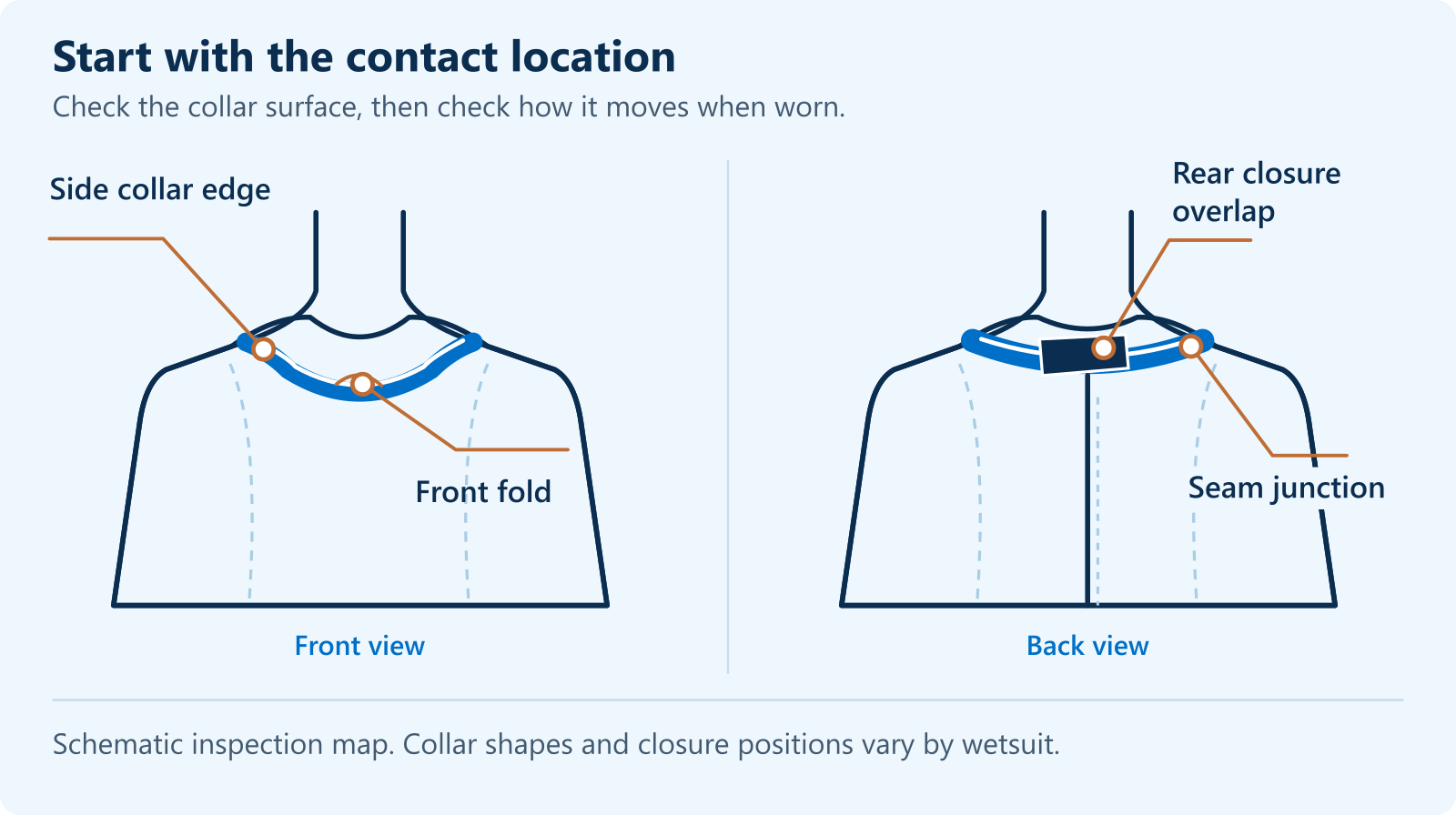
| What you notice | What to inspect | A useful first action |
|---|---|---|
| A small spot at the back | Closure overlap, exposed hook surface, zipper guard or folded edge | Check alignment and coverage with the suit off. Refasten according to its instructions. |
| Rubbing when turning your head | Side collar edge, nearby seams and movement of the neckline | Reseat the suit, then observe gentle, normal head movement without forcing it. |
| Pulling at the front of the neck | Leg, hip and shoulder position as well as collar adjustment | Correct the whole-suit position before tightening or loosening the collar. |
| The same edge repeatedly catches | Rolled material, grit, a rough junction or damaged finish | Rinse and inspect. Ask the supplier to assess a persistent construction problem. |
| A persistent, widespread or unexplained rash | Possible causes beyond local rubbing | Seek medical advice rather than assuming that a collar adjustment will resolve it. |
These are inspection prompts, not one-to-one diagnoses. Persistent or severe skin symptoms need appropriate assessment. [7]
If the same collar also admits repeated cold surges, our wetsuit flushing guide explains what to inspect and record before tightening the neckline further.
Why a comfortable-looking collar can still rub
Movement changes the contact
Swimming and paddling move the head, shoulders and suit relative to one another. ZONE3 explains that head rotation while breathing can contribute to rubbing at the back of the neck. Its guidance also notes that lifting the head can press the rear neckline against the skin. That is a reason to review the collar during normal activity, not a reason to force an unfamiliar swimming posture. [2] For brands comparing use cases, the triathlon versus surfing wetsuit development guide explains which movement tasks belong in each sample review.
Both sliding and concentrated pressure matter
“Looser” is not automatically the answer: a neckline that moves excessively may create another rubbing problem. Equally, fastening a collar harder to stop movement can introduce uncomfortable pressure. Orca advises a close fit around the neck and chest while preserving comfortable breathing. Evaluate the whole suit, not a universal one-finger or two-finger gap. [3] For a product range, record the wearer and garment measurements using a controlled wetsuit size-grading system before changing the neckline across every size.

A dry hand check can find an obvious rough edge, but it cannot establish comfort during a wet session. Material feel, movement and the actual wearer still need to be considered together.
What research tells us about moisture and friction
Gerhardt and colleagues studied forearm friction in 22 adults. Reported mean coefficients were 0.42 at the dry baseline and 0.91 with completely wet fabric. [1]

Useful takeaway: moisture can change skin–textile friction. Limit: this was not a neoprene-collar experiment, and the numbers do not describe wetsuit injury probability or prove a prevention method.
See the two values used in the chart
| Condition | Dynamic friction coefficient |
|---|---|
| Natural skin / dry fabric | 0.42 |
| Completely wet fabric | 0.91 |
The coefficient is dimensionless. The chart begins at zero. Conditions and original source are identified above.
5 checks to help prevent wetsuit neck chafing
Make these checks when the skin is comfortable and intact. If it is already painful or blistered, skip the trial and read the skin-care note below.
Seat the whole suit first
Work the suit into position from the legs and hips through the torso and shoulders, following the maker’s dressing instructions. Do not try to solve downward tension by pulling on a fragile collar edge. Orca’s fit guidance notes that a tight crotch can pull down through the shoulders; that is why a neckline complaint deserves a whole-suit check. [3]
Inspect the surface that touches the neck
With the suit off, look and feel gently along the inner collar, closure and seam ends. Remove loose grit with a fresh-water rinse. Check for folds, damaged tape, exposed fastening surfaces or a junction that feels different from its surroundings. Photograph a suspect point before asking the supplier to assess it. For construction comparisons, see the GBS, flatlock and taped seam guide; the finished edge and junction still need inspection on the actual garment.
Check the closure overlap
If the design has an adjustable neck tab, align it as intended and keep the hook surface away from the skin. Confirm that the flap or guard lies flat. Extra tension is not a repair for exposed hardware or an edge that keeps folding. Brands reviewing this assembly can use the chest-zip, back-zip and zipless specification guide to document the guard, overlap and fastening arrangement.
Observe normal movement
Turn your head gently, look forward and raise your arms in the way your activity requires. Notice whether the collar slides, rolls or presses at one point. Stop at discomfort. A comfortable dry check is only an initial screen; it does not guarantee comfort in water or over a longer session.
Check lubricant compatibility separately
If using an anti-chafe product, follow both its skin-use directions and the suit maker’s current care instructions. Blueseventy’s dedicated care page recommends water-based products or products specifically designed for triathlon wetsuits, and excludes petroleum products and several oils or gels. That is guidance for its products, not a universal test result for all wetsuits. [4]

Do not cut or sand the collar as a first fix. Ask the manufacturer to review fit and construction before changing the garment. A change that feels better on land may also change the opening, closure or serviceability.
If your neck is already sore, stop the rubbing
The American Academy of Dermatology advises stopping an activity when pain, discomfort or redness develops. If a blister forms, do not resume the activity that caused it until it has healed. NHS guidance also advises avoiding the equipment responsible while a blister heals, rather than repeatedly irritating the area. [5] [6]
Seek medical advice for worsening pain, swelling, warmth, discharge, or persistent or recurring symptoms. Not every rash after wearing a wetsuit is friction-related. A different skin problem needs assessment rather than a new balm or tighter collar. [6] [7]
For the suit itself, rinse away sand and residue and follow its care label. O’Neill recommends rinsing the inside and outside with cool fresh water and drying in the shade. Keep this routine separate from treating the skin. [8]
For brands: turn “it rubs” into a collar design brief
A complaint becomes much more useful when it identifies where, during which movement, and on which garment version it happens. “Use softer neoprene” alone leaves the edge geometry, closure and whole-suit fit unresolved.
Collect the wearer’s selected size, relevant body measurements, activity, collar photographs and approximate time when discomfort began. Record how the suit was put on and whether a lubricant was used. Ask permission before retaining personal photographs, and keep feedback separate from any medical interpretation.

| Design variable | What to compare | What to record |
|---|---|---|
| Collar height and shape | Contact during head rotation and activity-specific posture | Contact location, movement and photograph of each sample |
| Skin-facing surface and edge | Actual lining, edge finish, folds and transitions | Material and construction reference; dry and wet observations |
| Seam and junction placement | Whether a junction sits at the reported contact point | Junction location and difference between sample versions |
| Closure coverage | Guard alignment and exposed edges within the intended adjustment range | Fastened position, coverage and any recurring fold |
| Whole-suit fit and grading | Torso and shoulder balance across the intended sizes and wearers | Size, measurements and representative movement observations |
Keep comparisons interpretable: when practical, change one feature at a time and identify both versions. For example, compare two collar finishes on an otherwise matched sample rather than changing the collar, torso length and foam simultaneously. This is an editorial development method, not a standardized test or an INSEAKU trial result.
Plan a suitable wet-use evaluation with healthy, consenting wearers and stop at discomfort. A small sample review cannot substantiate an “anti-chafe for everyone” claim. Record what was actually evaluated and any limitations before deciding what to change.
Use the wetsuit fit-testing protocol to record the broader sample review, corrective actions and approval decision. Keep the collar observations linked to the same sample version so that a local change can be checked against whole-suit fit.
Keep a consistent collar-review record
A one-page checklist covers the garment version, contact point, movement, observations and next action.
Questions about wetsuit neck chafing
Does a rubbing neckline mean the wetsuit is too small?
Not necessarily. Whole-suit positioning, collar movement, local pressure, a rough junction or closure alignment may be involved. Check the contact point and how the suit sits before changing size. A larger size is not automatically the best solution.
Should I keep wearing a new suit until the collar breaks in?
Do not keep using it through pain or broken skin. Newness does not show that a recurring rubbing problem will disappear. Check the maker’s fitting advice and request a review if the same point continues to cause discomfort. [5]
Can I use petroleum jelly around the neck?
General skin advice does not establish compatibility with a wetsuit. Check the current instructions for the exact garment; Blueseventy, for example, excludes petroleum products in its care guidance. Do not assume a household oil or gel is an approved substitute. [4]
Will a chest zip or zipless suit stop neck chafing?
The entry-system name alone cannot establish neck comfort. Collar height, contact surfaces, closure details, whole-suit fit and the wearer’s movement still need checking. Compare the actual garments rather than treating one zipper label as a guarantee.
Is every wetsuit rash caused by friction?
No. Contact dermatitis and other conditions can also cause skin symptoms. Persistent, recurrent or severe irritation should be assessed by a healthcare professional, especially when the pattern is not limited to a rubbing point. [7]
Sources and how they are used
Sources checked on 2 October 2026. Brand instructions apply to their own products. The inspection map, comparison tables and development checklist are editorial tools; the numerical chart uses published research data.
- Gerhardt et al. — Influence of epidermal hydration on the friction of human skin against textiles. Journal of the Royal Society Interface, 2008, §4.1. DOI: 10.1098/rsif.2008.0034.
- ZONE3 — I’ve developed marks on my neck from your wetsuit. Manufacturer guidance on head movement and neckline contact; not comparative laboratory evidence.
- Orca — How should your wetsuit fit you? 1 July 2024. Whole-suit fit, neck and chest comfort, and unrestricted breathing.
- Blueseventy — Caring for your Wetsuit. Product-specific lubricant and care guidance. Confirm the current instructions for your own suit.
- American Academy of Dermatology — How to prevent and treat blisters. General guidance on stopping friction and recognizing problems; not a wetsuit compatibility guide.
- NHS — Blisters. General care and reasons to seek medical advice.
- NHS — Contact dermatitis. Used to distinguish persistent skin symptoms from an assumed friction problem.
- O’Neill — Wetsuit wash and care instructions. 14 November 2022. Fresh-water rinsing and shade drying; follow the garment’s own care label.