

Short answer: To choose neoprene thickness for a wetsuit product line, do not select 3 mm, 5 mm or 7 mm from water temperature alone. Define the activity, water and air conditions, exposure time, user profile, movement level, depth or repeated-dive pattern, suit style, material, lining, seams, entry system and accessories. Then map nominal thickness by panel, agree how thickness will be measured, approve a physical sample and release bulk production against the approved specification. INSEAKU can develop single- or multi-thickness constructions, including common 3/2, 4/3, 5/4, 5/4/3, 6/5 and 7/5 configurations.
A consumer may ask, “Should I buy a 3 mm or 5 mm wetsuit?” A brand has a harder question: “What complete construction should we specify, validate and reproduce for this user and use case?” The answer affects pattern geometry, mobility, seam construction, entry design, seals, accessories, sample iterations, quality control and claims.
This B2B neoprene wetsuit thickness guide helps product managers, importers, retailers, dive operators and private-label buyers turn a temperature or thickness idea into a controlled manufacturing brief. It covers conventional and alternative rubber materials; the same specification logic applies whether a project uses CR/SCR foam, limestone-based neoprene, Yamamoto material, natural rubber or another buyer-approved material.
What should a wetsuit thickness specification include?
A useful thickness specification does more than place “3 mm” in a product title. It connects six layers of information:
- Use conditions: activity, market, water and air conditions, expected exposure, movement level, depth or repeated dives, and user experience.
- Product architecture: full suit, shorty, spring suit, two-piece suit, hooded suit, top, vest, jacket or accessory.
- Panel schedule: nominal thickness, material code, lining, stretch direction and panel location.
- Construction system: seams, entry, barriers, seals, reinforcements, zipper and compatible accessories.
- Acceptance method: supplier specification, agreed tolerance basis, measurement tool, locations, sampling plan and evidence.
- Approval record: sample ID, specification revision, test results, buyer comments, sealed-sample approval and bulk-production release.
The following table is a planning framework, not a universal consumer temperature chart.
| Planning level | Question to answer | Evidence before bulk release |
|---|---|---|
| Use case | Who will use the suit, for which activity, where and for how long? | Approved product brief and market requirements |
| Thickness architecture | Single thickness or zoned thickness, and which panel receives each value? | Numbered panel map and bill of materials |
| Material system | Which foam, lamination, thermal lining and stretch orientation are required? | Approved swatch, supplier reference and sample |
| Construction | Which seam, entry, seal and accessory package works with that thickness? | Construction cross-sections and physical sample |
| Measurement | Where, when and how will thickness be checked? | Incoming-material and finished-product inspection records |
| Validation | What fit, mobility, leak, thermal or other tests are required? | Buyer-approved results and sealed sample |
What do 3/2 mm, 4/3 mm and 5/4 mm mean?
Wetsuit thickness is often expressed with two or three numbers. O’Neill explains that in a two-number construction such as 4/3 mm, the first number generally identifies the thicker core regions and the second identifies areas where greater flexibility is required. The exact panel distribution can vary by model, so the notation is not a substitute for a panel map.
- 3/2 mm: commonly communicates a thicker torso zone and thinner movement zones.
- 4/3 mm: commonly communicates a 4 mm core with selected 3 mm flexibility panels.
- 5/4 mm: commonly communicates a 5 mm core with selected 4 mm panels.
- 5/4/3 mm: communicates three nominal thickness zones, but every zone must still be identified on the panel map.
- 6/5 mm or 7/5 mm: communicates a thicker core strategy with thinner selected panels; the exact distribution remains project-specific.
For manufacturing, write each construction as a controlled schedule: panel ID, panel name, nominal thickness, material, lining side, grain or stretch direction, seam method and applicable tolerance basis. “5/4/3” without this schedule leaves too much room for interpretation.
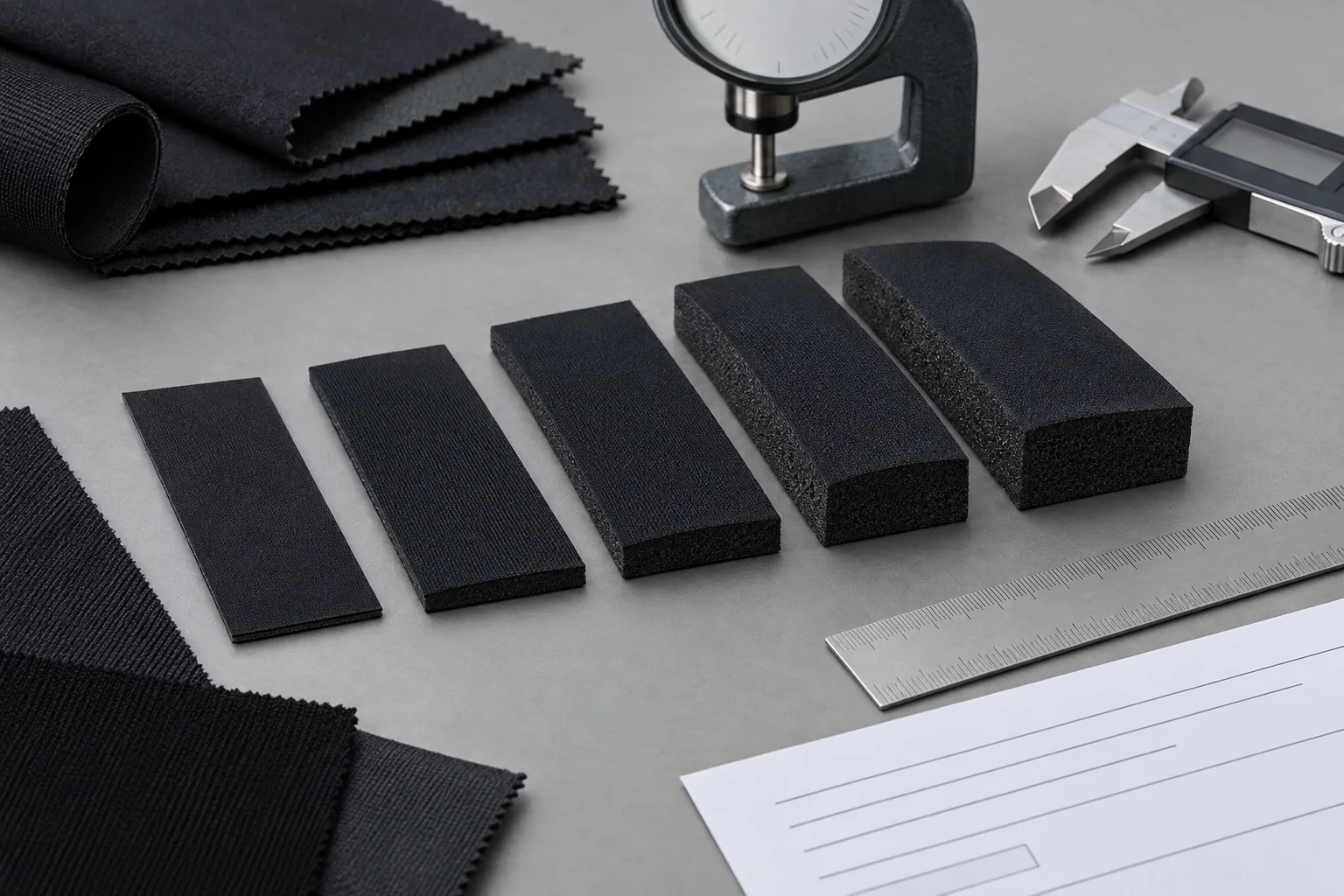
How should brands evaluate 3 mm, 5 mm and 7 mm wetsuits?
The numbers below are product-development categories, not promises of a specific temperature range. A 3mm wetsuit manufacturer, 5mm wetsuit manufacturer or 7mm wetsuit manufacturer still needs the full use brief before recommending a construction.
| Nominal category | Typical planning objective | Questions that become more important |
|---|---|---|
| 3 mm class | Prioritize movement and a lighter build for a comparatively warmer, shorter or more active use brief. | Will a 3/2 zone improve shoulder movement? Which seam and entry system provide the required water-entry control? Is a lining needed? |
| 5 mm class | Increase insulation for a colder or longer exposure brief while controlling bulk and movement. | Should the suit use 5/4 or 5/4/3 zones? Are wrists, ankles, neck, hood and zipper barriers coordinated? Does the pattern account for material behavior? |
| 7 mm class | Build a cold-water or extended-exposure system in which fit, mobility, entry, seals and accessories are especially consequential. | Is 7/5 zoning appropriate? Is the suit one- or two-piece? Which hood, glove and boot interfaces are required? What thermal, compression or activity-specific validation is needed? |
3 mm versus 5 mm is not a one-variable decision
A search for 3mm vs 5mm wetsuit often expects one temperature cutoff. For a product team, the useful comparison is broader. A thicker nominal foam can add insulation, but it may also change stretch, bending resistance, bulk at overlapping seams, zipper loading, seal behavior and the pattern required to achieve the intended fit. A 3 mm design with a different lining, seam or entry system is not directly equivalent to a 5 mm design with another construction.
7 mm requires system-level specification
At greater thickness, small interface decisions can have larger consequences. Neck height, wrist and ankle seals, hood integration, zipper length, internal barriers, knee construction and panel transitions should be reviewed together. If the product is intended for depth, repeated dives or a specialized professional activity, define the relevant material-compression, thermal or performance validation rather than relying on the label “7 mm.”
How should water temperature enter a B2B wetsuit brief?
Water temperature is an important input, but it is not the only input and it should not become an unconditional marketing promise. Published brand charts illustrate why. Patagonia’s current Yulex Regulator range uses its own product-specific combinations and temperature bands. SCUBAPRO publishes thermal-performance information for its products while warning that exposure, depth, repeated dives, fit, body characteristics and accessories affect warmth. These references are useful examples, not universal conversion tables for another product.
For a development inquiry, provide a range and context:
- Expected minimum, typical and maximum water temperature
- Air temperature, wind and surface interval conditions where relevant
- Expected session or dive duration
- Activity level: high movement, intermittent work, low movement or static exposure
- User group, experience and any fit constraints
- Depth, compression exposure and repeated-dive pattern where relevant
- One-piece or two-piece construction and hood integration
- Planned gloves, boots, hood, vest or other accessories
- Required test, certification, labeling or claim language for the destination market
INSEAKU can use these inputs to prepare a written project recommendation. Final suitability and claims should be confirmed through the agreed sample and testing program.
How do you specify a multi-thickness wetsuit panel map?
A multi-thickness construction places insulation and mobility where the product needs them. The design may use a thicker torso and selected upper-leg panels, thinner shoulders and arms, or a more detailed three-zone layout. There is no single correct map for every 3/2, 5/4/3 or 7/5 suit.
Use a front and back technical drawing with numbered panels. For each panel record:
- Panel ID and descriptive name
- Nominal foam thickness
- Approved material supplier and material code
- Outer and inner lamination or skin finish
- Thermal lining, if any
- Stretch or grain direction
- Seam relationship and overlap direction
- Reinforcement, print or logo interaction
- Measurement location and tolerance basis
- Pattern and specification revision
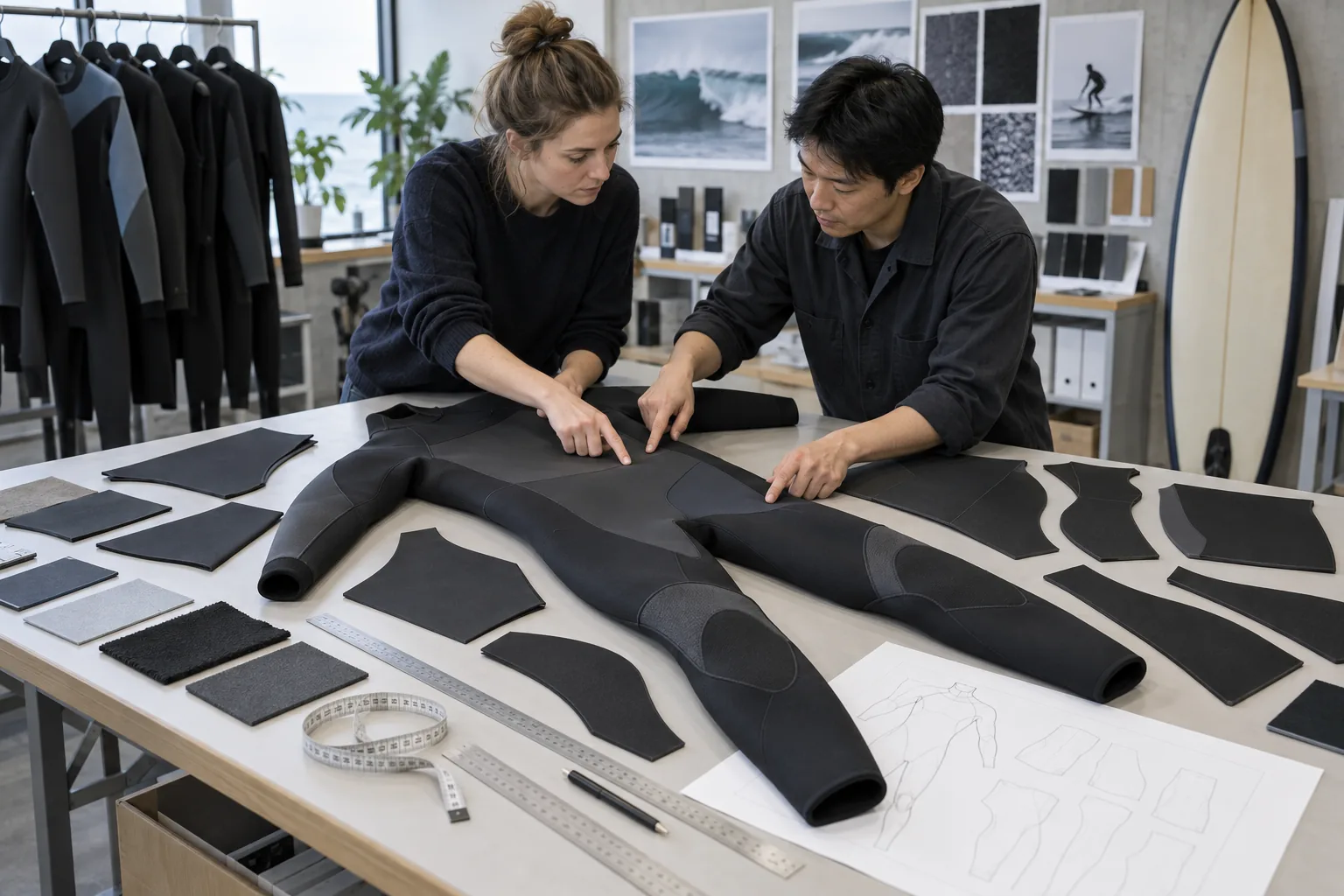
INSEAKU can create patterns and size grading in-house. A buyer may also supply its own pattern and grading rules. In either route, the approved panel schedule should be tied to one pattern version so a material or thickness change cannot enter production without review.
For hooded jackets and matching trousers, the spearfishing wetsuit procurement checklist shows how to connect a panel-thickness map with waist overlap, reinforcement and sample-review requirements.
How do material and lining change a thickness decision?
Nominal millimeters do not describe the complete material. Foam formulation, density, cell structure, stretch, compression behavior, surface finish and lamination all affect the finished product. INSEAKU can source or process different thicknesses in CR/SCR, limestone-based neoprene, Yamamoto materials, natural-rubber or neoprene-free alternatives, and buyer-specified materials, subject to written confirmation and supply availability.
Foam and lamination must share one reference
Specify whether the nominal thickness refers to the foam core, the laminated sheet under the supplier’s stated method, or another agreed measurement basis. Do not compare two quotations solely because both say “3 mm.” Ask for the material code, construction, measurement method and supplier specification.
Thermal lining is part of the system
Thermal linings can be applied to selected panels or larger internal areas. The brief should state the lining name or approved reference, coverage, orientation, bonding requirement and panel relationship. A lining may affect stretch, drying, feel, pattern response, seam bulk, cost and lead time, so it must be approved with the actual foam and construction.
Material changes require controlled re-evaluation
If the approved material becomes unavailable, a replacement with the same nominal thickness is not automatically equivalent. Compare stretch, density, compression, lamination, color, hand feel and test requirements. Update the bill of materials, make the necessary samples and obtain written approval before bulk use. Our wetsuit material selection guide explains how to qualify material claims and alternatives.
How does thickness affect pattern, seams, entry and accessories?
Pattern and grading
A thicker or less flexible material can change the relationship between flat pattern dimensions and worn fit. It may require revised ease, seam allowance, panel geometry or size grading. Do not assume that the pattern for a 3 mm suit can simply be cut in 5 mm or 7 mm material. Use the wetsuit fit-testing protocol to review measurement, mobility and interface issues by sample version.
For the broader sizing workflow, use the wetsuit size grading guide to connect material assumptions to base-size patterns, size-to-size grade rules, fit samples and production measurement controls.
Seam construction
Thickness must be specified together with the seam method. Flatlock, glued-and-blind-stitched, taped, liquid-sealed and other constructions have different material, bulk and performance implications. Panel transitions between thicknesses need controlled skiving, alignment, glue, stitch, tape or reinforcement requirements as applicable. Compare seam options in our GBS versus flatlock wetsuit seam guide.
Entry system and seals
Entry opening, zipper selection, overlap panels, anti-flush barriers, neck design, wrist and ankle seals, hood interface and drain details influence the complete product. A thicker build may need a different opening or zipper configuration to remain usable. Use the chest zip, back zip and zipless specification guide to document these interfaces.
Hoods, gloves, boots and layered systems
Accessories should not be added as an afterthought. Specify their nominal thickness, material, lining, seal overlap, fastening method and compatibility with the suit. For two-piece or layered products, identify the resulting overlap zones and how they will be described to users.
How should wetsuit material thickness be measured and controlled?
INSEAKU checks thickness during incoming-material inspection and through finished-product sampling inspection. Calipers, thickness gauges and material-supplier test reports may be used according to the agreed material and quality plan.
For soft flexible rubber, the measurement method matters. ASTM D3767 notes that instrument pressure can significantly affect the observed thickness of soft flexible materials. Therefore, a useful specification identifies the method or supplier basis, the contact or pressure condition where applicable, measurement locations, sample conditioning, rounding rule, sampling frequency and acceptance criteria. A single unqualified caliper reading is not a complete quality standard.
Incoming-material inspection
- Match supplier, material code, lot or batch identification and purchase reference.
- Confirm nominal thickness and the applicable supplier specification or agreed quality plan.
- Measure at agreed locations and avoid edges, creases or visibly compressed areas unless the method says otherwise.
- Record tool, method, result, operator, date and disposition.
- Review lamination, surface, color and other agreed material characteristics.
- Segregate nonconforming or unapproved material.
In-process control
- Verify each cut panel against the correct material and thickness reference.
- Control mixing of similar-looking materials at cutting, printing, gluing and assembly.
- Check thickness transitions, skiving, seam allowance and reinforcement placement.
- Maintain traceability to the pattern, bill of materials and approved sample.
Finished-product sampling inspection
- Confirm that the correct thickness zone appears in each required panel.
- Sample finished products according to the agreed customer quality plan.
- Check dimensions, workmanship, seam and entry interfaces, labeling and packaging.
- Compare the finished garment with the sealed sample and confirmed specification.
- Record nonconformity, corrective action, reinspection and final release.

The acceptable result is project-specific. INSEAKU does not publish one universal thickness tolerance for every material and product. The applicable basis should come from the confirmed material supplier specification, material type and written customer quality plan. The wetsuit quality-control checklist shows how these checks fit into a wider inspection plan.
How should a brand validate a 3 mm, 5 mm or 7 mm sample?
Thickness should be validated in the actual product, not only as a loose swatch. INSEAKU can provide material swatches and make panel, seam or garment samples; development and material costs are quoted according to the project.
- Confirm the brief: intended use, users, conditions, duration, activity, suit format and required claims.
- Approve material references: foam, thickness, lamination, lining, color and supplier or equivalent rules.
- Freeze the panel map: numbered zones, thickness schedule, pattern version and construction notes.
- Make the development sample: use representative materials, seams, entry, seals and accessories.
- Review dimensions and workmanship: measure the garment and document deviations.
- Review fit and movement: use the agreed fitting protocol and test relevant movements.
- Review functional interfaces: entry operation, seal contact, hood/glove/boot overlap, seam and panel transitions.
- Run agreed tests: local leak or pressure checks, material testing, third-party thermal or compression testing, and market-specific tests as required.
- Control revisions: issue one consolidated, dated comment file and identify the next sample version.
- Approve the sealed sample: written approval must identify the sample, specification, material and pattern revisions used for bulk production.
Professional thermal, compression, temperature-related or specialized validation can be assigned to a qualified third-party laboratory or performed under a buyer-defined test program. The method, sample conditioning, pass/fail criteria and report ownership should be agreed before testing.
What are INSEAKU’s MOQ, sample and lead-time conditions?
| Commercial item | INSEAKU starting position | Project variables |
|---|---|---|
| MOQ | Normally 50 pieces per style and color; sizes may be mixed within that style/color. | Special materials may have supplier stock, procurement MOQ or lead-time effects. |
| Thickness MOQ | No separate garment MOQ solely because a standard project uses a different thickness. | Material supplier requirements and availability must be confirmed. |
| Swatches and samples | Material swatches and development samples can be supplied; costs are charged according to the project. | Material, construction, sizes, tests and revisions. |
| Sample timing | Can start from approximately 7 working days after materials and specifications are confirmed and payment is received. | Special materials, components, multiple sizes, tests and revision cycles may extend timing. |
| Bulk production | Normally approximately 30 working days after written sealed-sample approval and receipt of the required bulk-order deposit. | Style, material, quantity and production schedule; final timing is confirmed in writing. |
| International transport | Not included in production lead time. | Route, mode, carrier, destination and customs. |
Read the current commercial assumptions in our wetsuit manufacturer MOQ, sample cost and lead-time guide. A written quotation and agreement control each project.
What should buyers include in a wetsuit thickness RFQ?
Send every candidate manufacturer the same controlled brief so the quotations are comparable. Include:
- Brand, project name, style ID and destination market
- Product category and suit configuration
- Intended activity, user profile and experience level
- Water and air conditions, exposure duration and activity intensity
- Depth or repeated-dive requirements where relevant
- Proposed 3 mm, 5 mm, 7 mm or multi-thickness panel schedule
- Material, density or supplier preference, lamination and thermal lining
- Seam construction, entry system, seals, hood and accessories
- Pattern source, size range, grading rules and measurement chart
- Thickness measurement basis, inspection stage and sampling plan
- Fit, mobility, leak, thermal, compression or third-party test requirements
- Quantity by style, color and size
- Sample stages, approval owners and required dates
- Packaging, labeling, compliance and shipping destination
Use the detailed fields in our wetsuit tech pack and RFQ checklist, then attach the thickness worksheet below.
Download the Wetsuit Thickness, Panel Specification and QC Worksheet (Excel)
Buyer FAQs
Which neoprene thickness is best for a wetsuit?
There is no universally best thickness. Define the use conditions, activity, user, exposure, complete material and construction system, then validate the product. Thickness is one variable in that system.
Is a 5 mm wetsuit always warmer than a 3 mm wetsuit?
Not as an unconditional product claim. Greater nominal foam thickness can increase insulation, but fit, foam properties, compression, lining, seams, entry, seals, flushing, accessories, activity and exposure also affect the result. Compare complete tested products, not the number alone.
Does 4/3 mm mean every torso panel is 4 mm?
Not necessarily. The first number generally denotes thicker core regions and the second thinner flexibility regions, but the exact distribution varies by design. The technical specification must identify every panel.
Can INSEAKU make custom multi-thickness wetsuits?
Yes. INSEAKU can develop single- or multi-thickness panel schedules, including common 3/2, 4/3, 5/4, 5/4/3, 6/5 and 7/5 concepts, or a project-specific construction subject to material and sample approval.
Can one pattern be used for 3 mm, 5 mm and 7 mm versions?
Do not assume so. Material thickness and stretch can change fit, movement, seam bulk, entry operation and grading. Each material/thickness version should be reviewed and sampled; pattern changes may be required.
How does INSEAKU inspect thickness?
Thickness is checked during incoming-material inspection and finished-product sampling inspection. Depending on the confirmed plan, INSEAKU may use calipers, thickness gauges and supplier test reports. The material specification and written quality plan define the applicable method and acceptance basis.
What thickness tolerance does INSEAKU use?
INSEAKU does not publish one universal tolerance for all wetsuit materials. The confirmed supplier specification, material type and customer quality plan establish the applicable tolerance and method for each project.
Can INSEAKU provide thickness swatches?
Yes. Material swatches and development samples can be provided, with the material and handling cost quoted for the project. Availability and supplier minimums must be confirmed.
Is the 50-piece MOQ applied to each thickness?
The normal garment MOQ is 50 pieces per style and color, with sizes mixed within that style/color. There is no separate MOQ solely for thickness, but a special material can carry its own supplier MOQ, stock or lead-time constraint.
Can a temperature chart be printed on packaging?
A brand may use carefully qualified guidance after validating its product and legal requirements. Do not copy another brand’s chart or turn a planning reference into an absolute warmth or safety guarantee. State the product, conditions and limitations supporting the claim.
Turn millimeters into a production-ready specification
INSEAKU can review your intended use, market, water and air conditions, duration, activity level, user, depth or repeated-dive pattern, suit format, material, lining, seams, entry and accessories. Send a panel sketch, size range, quantities and target timing. We will identify the information needed to prepare a project-specific thickness recommendation, quotation and sampling plan.
Request a Wetsuit Thickness Recommendation
References and further reading
- O’Neill — What do wetsuit thickness numbers mean?
- Patagonia — Wetsuit Thickness Guide for Surfing
- SCUBAPRO — Wetsuit Manual and Thermal Performance Classes
- ASTM D3767-03(2020) — Standard Practice for Rubber: Measurement of Dimensions
Last reviewed: September 11, 2026. INSEAKU reviewed the manufacturing capabilities, materials, thickness options, inspection stages, measurement methods, MOQ, sample process and production assumptions stated in this article. Project-specific requirements remain subject to the written quotation, approved specification, agreed quality plan and sealed sample.