
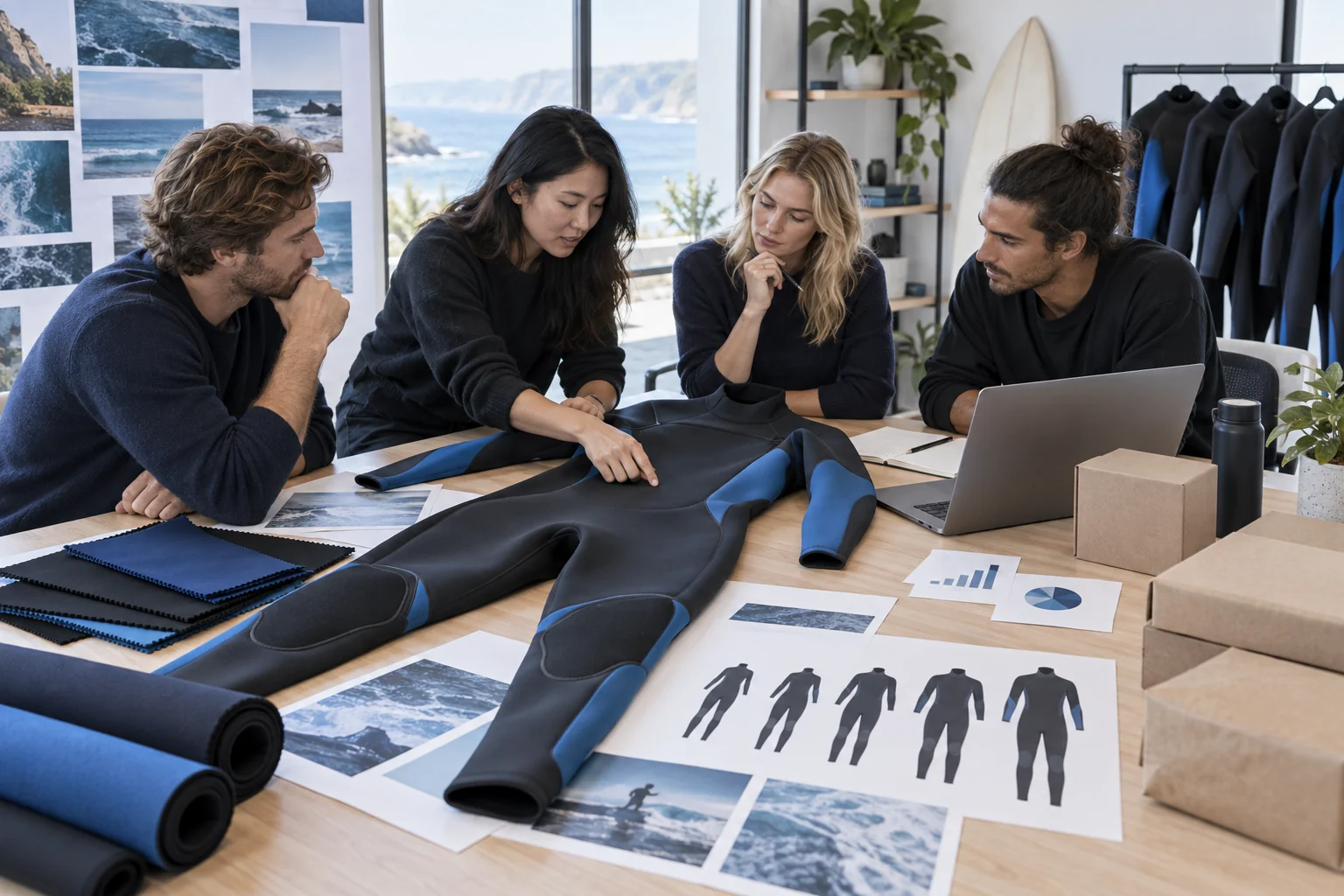
Starting a private-label wetsuit brand means choosing a specific customer, validating the product and price, translating that promise into a controlled specification, and proving the factory can reproduce an approved sample before you commit to inventory. The strongest first collection is usually narrower than a founder initially imagines. It has a clear use case, a manageable size and color matrix, a realistic cash plan, and written approval gates from sample development through shipment.
This ten-step procurement guide explains how to start a wetsuit brand without treating sourcing as a sequence of disconnected quotations. It is written for founders, ecommerce teams, watersports operators, distributors, and established brands adding a wetsuit category. It does not promise a universal budget, margin, minimum order, or launch time. Those figures depend on design complexity, materials, sizes, packaging, testing, factory capacity, shipping lane, destination rules, and your own sales model.
Download the working tool: use the Private-Label Wetsuit Brand Launch Planner to map the first range, startup budget, contribution per unit, supplier and sample gates, and launch dependencies in one workbook.
Before step 1: know what “private label” means
Private label is often used loosely. In the simplest version, a supplier already has a proven base style and you customize selected elements—branding, colors, trims, packaging, and sometimes materials. OEM normally starts from your specification and product requirements. ODM gives the supplier a larger role in design and development. In practice, projects can sit between these models, so the label matters less than the written division of responsibility.
Ask what is truly fixed and what can change. Is the pattern existing or newly developed? Who owns the pattern, grading, artwork, molds, and test data? Can the same base style be sold to other buyers? Which components may be substituted, and who must approve a substitution? Our OEM vs ODM wetsuit guide provides a practical comparison. Record the agreed model in the request for quotation, sample approval, purchase order, and manufacturing agreement rather than relying on a sales conversation.
Step 1: define one customer, one use case, and one market
“People who enjoy the water” is not a usable customer definition. A useful brief identifies the activity, water-temperature range, expected session length, skill level, fit needs, buying context, destination market, and the reason this customer would change from an existing option. A beginner surf-school suit optimized for rental turnover has different priorities from a premium open-water swimming suit or a spearfishing suit designed around mobility and thermal protection.
Write a one-sentence product thesis: “For [specific user] in [specific conditions], this suit improves [important outcome] through
, at a target retail price of [range].” Then list the evidence you have and the assumptions you still need to test. Evidence may include interviews, service records, rental-fleet failures, retailer feedback, search behavior, returns data, or preorders. A founder’s preference is an input, not validation.
Choose the first sales territory early. It affects seasonal timing, taxes and duties, language, labeling, product-safety work, logistics, returns, and the claims you can responsibly make. If you plan to sell in several markets, define the first launch market and treat later markets as separate readiness gates. This protects the project from late-stage packaging and compliance rework.
Step 2: validate the problem and acceptable price band before buying inventory
Validation should test the whole offer, not just whether someone likes a sketch. Show the intended customer a realistic concept: activity, construction, key features, color direction, expected delivery window, return conditions, and a credible price band. Ask what they currently use, what fails, what they have tried, and what would prevent purchase. Specific behavior is more useful than polite enthusiasm.
Use several low-cost signals before a production order: structured interviews, a landing page with a waitlist, retailer conversations, sample try-ons, small paid traffic tests, or a refundable deposit where legally and operationally appropriate. Do not present a concept as a finished or certified product. The goal is to learn which problem, message, and price band deserve further investment.
Separate willingness to try from willingness to pay. If a target price only works when you ignore freight, returns, payment fees, or discounts, it is not yet a viable price. If customers consistently prioritize a feature that the base private-label style cannot support, reconsider the sourcing model before paying for packaging or inventory.
Step 3: clear the name, domain, and ownership before committing artwork
A name is not cleared because the matching domain or social handle is available. Search the relevant trademark registers for identical and confusingly similar marks in related goods and services. The USPTO advises searching for confusing similarity and related goods, while WIPO notes that an absence from its Global Brand Database does not prove availability in every national register. For a meaningful launch, use qualified trademark counsel in the markets that matter.
Before you approve woven labels, heat transfers, cartons, or photography, document:
- the legal entity that will own the mark and product assets;
- domain and priority social handles controlled by that entity;
- search records, legal advice, filing status, and markets covered;
- ownership and permitted use of logos, artwork, patterns, grading, photography, and packaging;
- confidentiality terms and the supplier’s restrictions on sharing your files or samples.
Do not print a large quantity of branded material while the name is still uncertain. A rebrand at sample stage is inconvenient; a rebrand after labels, cartons, product photography, and inventory have been produced is expensive.
Step 4: choose private label, OEM, or ODM based on the evidence
Choose the development path that matches the product difference you need, your technical capability, budget, timetable, and ownership requirements. A proven private-label base can reduce development work when the fit and construction already suit the customer. OEM is more appropriate when your advantage depends on a controlled specification. ODM may help when you need design support, but responsibilities and intellectual-property rights must be explicit.
Send the same decision brief to every shortlisted supplier. Ask each one to identify existing components, new development, tooling, sampling stages, test responsibility, order quantities, price breaks, lead-time assumptions, payment milestones, packaging limits, and any buyer-supplied inputs. INSEAKU’s private-label wetsuit development and manufacturing services page describes one supplier workflow; confirm the quotation and current project conditions for your exact style rather than treating website examples as a contractual promise.
A lower unit price is not automatically the lower-risk model. Compare total development cost, the number of unproven variables, minimum commitments, expected revision cycles, and how easily the design can be repeated. If a base pattern does not fit your intended users, cosmetic customization will not rescue the product.
Step 5: build a deliberately small first range
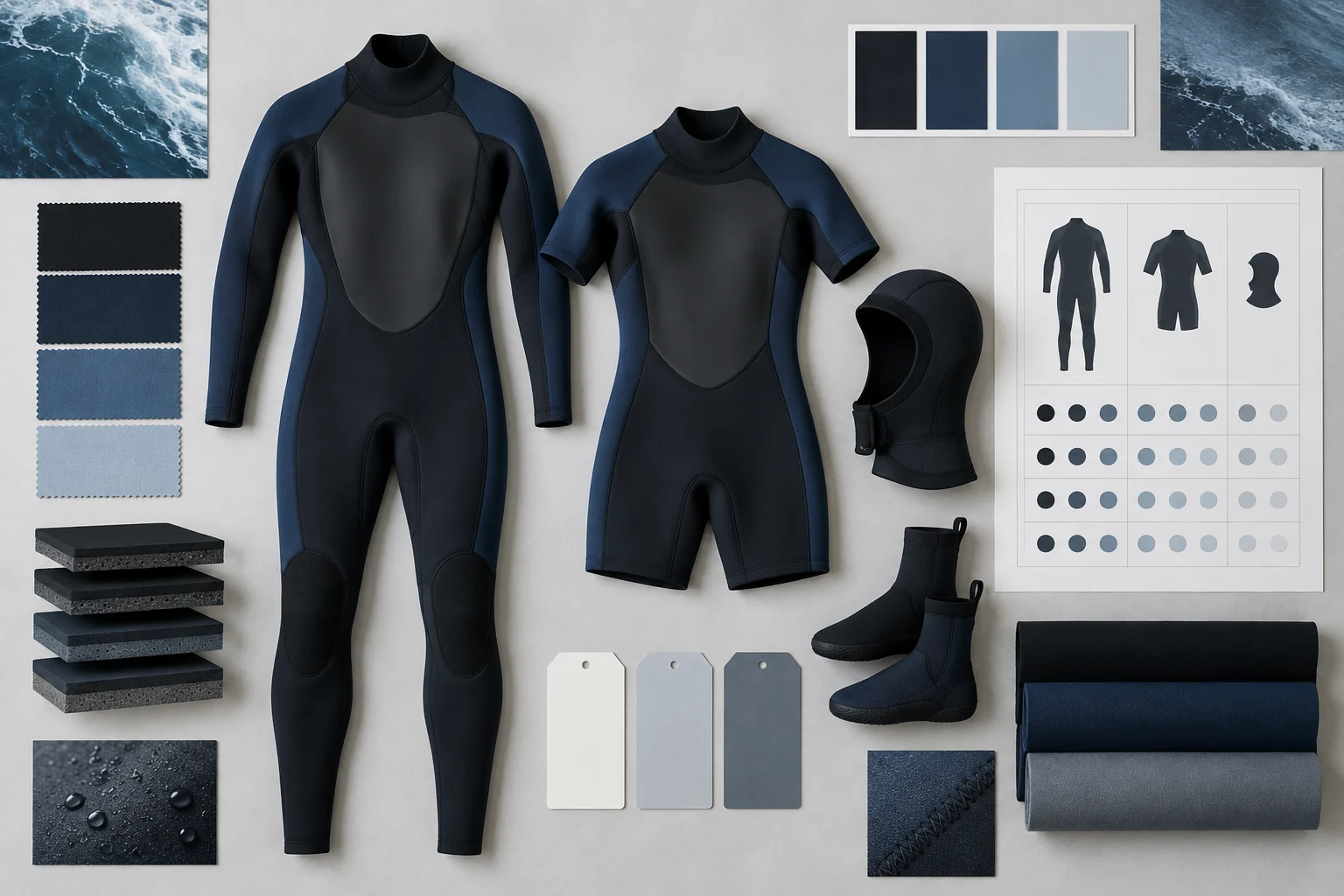
Every style, thickness, color, and size combination becomes a stock-keeping unit. Two styles × two colors × eight sizes already create 32 SKUs before special fits or accessories. If you spread a modest order across too many combinations, best-selling sizes can sell out while slow combinations absorb cash. Start with the smallest assortment that proves the customer promise.
Create a range matrix containing style, activity, temperature/use conditions, entry system, thickness profile, material, seam construction, color, size range, planned units, target price, and status. Distinguish the core style from optional extensions. A color is not “free” if it requires different material minimums, matching, artwork, sampling, or production handling.
If accessories are part of the first collection, use our hood, glove, boot and sock buyer checklist to separate product specifications, size charts and order units before creating retail bundles.
For a surf-focused collection, download the specification matrix in our three-tier surf wetsuit planning guide to define model differences and check the resulting SKU count before expanding the range.
Build the initial size curve from evidence: comparable historical sales, rental-fleet records, retailer input, customer measurements, or a controlled preorder. Avoid distributing units equally across sizes without justification. Document the source of the size curve and plan how the first sales and return data will update it.
For each SKU, answer three questions: Why does it exist? What customer evidence supports it? What is the smallest sensible quantity? If the answer is only “the collection looks more complete,” move it to a later release. A focused range is easier to sample, photograph, explain, inspect, finance, and reorder.
Step 6: model startup cost, unit economics, cash timing, and MOQ risk
A quotation is not a launch budget. Separate one-time costs, per-unit costs, monthly operating costs, and contingency. One-time items can include identity work, trademark support, development fees, samples, tests, photography, ecommerce setup, packaging design, and tooling. Per-unit costs can include product, labels, packaging, inspection allocation, freight, duty and tax, payment fees, fulfillment, expected returns, and warranty or defect allowance.
Use landed cost for decisions, but define exactly what it contains. A factory price may exclude export charges, freight, insurance, import duty, destination handling, tax, brokerage, storage, and delivery to your warehouse. Incoterms allocate tasks, cost, and risk; they do not replace a line-by-line landed-cost model.
A simple planning formula is:
break-even units = fixed launch costs ÷ (net selling price − variable cost per unit)
The result is only as useful as the inputs. Net selling price should reflect discounts and channel mix. Variable cost should include costs that change with each sale, including payment and fulfillment where relevant. Returns may reduce net revenue and add processing or replacement cost. Model a base case, a slower-sales case, and a higher-cost case. The U.S. Small Business Administration recommends separating one-time and monthly costs and using market analysis and financial projections; its break-even guidance uses the same fixed-cost and contribution logic.
MOQ is a cash decision, not merely a supplier condition. Read our guide to wetsuit MOQ, sample cost, and production lead time, then model the quantity at style, color, material, and size level. Ask whether packaging has a different minimum. Map when sample fees, deposit, balance, inspection, freight, duty, and marketing spend become payable. Keep a reserve for revisions, delays, rework, returns, and a slower sell-through period.
Step 7: prepare a tech pack and a supplier brief that can be quoted
The supplier should not have to infer the product from a mood board. A usable brief describes the wearer, activity, water conditions, performance priorities, target price, destination market, quantity scenarios, delivery target, and required services. The tech pack turns that brief into measurable product instructions.
Include flat drawings, measurement points and tolerances, size chart, material and thickness zones, foam and lamination requirements, seam type, reinforcement, entry construction, zipper and hardware, panel map, artwork files, logo size and placement, labels, packaging, color references, test requirements, and revision history. Use the wetsuit tech pack and RFQ checklist to keep supplier quotations comparable.
Give every revision a version number and date. Record questions and decisions in a change log. If a supplier proposes a material or construction change, require the exact alternative, the reason, the cost and timing effect, and a sample or evidence appropriate to the risk. “Equivalent material” is not an adequate specification.
Ask for quotations against multiple sensible quantities and identify assumptions. A quote should state currency, validity, included components, packaging, sample terms, payment terms, Incoterm and named place, production timing trigger, and exclusions. Comparing prices without normalizing those fields produces a false saving.
Step 8: shortlist factories, develop samples, and test fit
Shortlist a small number of suppliers using the same evidence request. Assess relevant product experience, development capability, material control, pattern and grading resources, quality system, capacity, traceability, communication, business legitimacy, subcontracting, social and environmental evidence relevant to your policy, and ability to support your destination requirements. This wetsuit manufacturer audit guide explains how to verify capability beyond a polished sales deck.
Plan sample stages before the first sample arrives. A development sample may answer construction questions; a fit sample tests measurements and mobility; a size set checks grading; a pre-production sample should represent approved materials, colors, trims, branding, and workmanship. Names vary by supplier, so define the purpose and approval criteria of each stage.
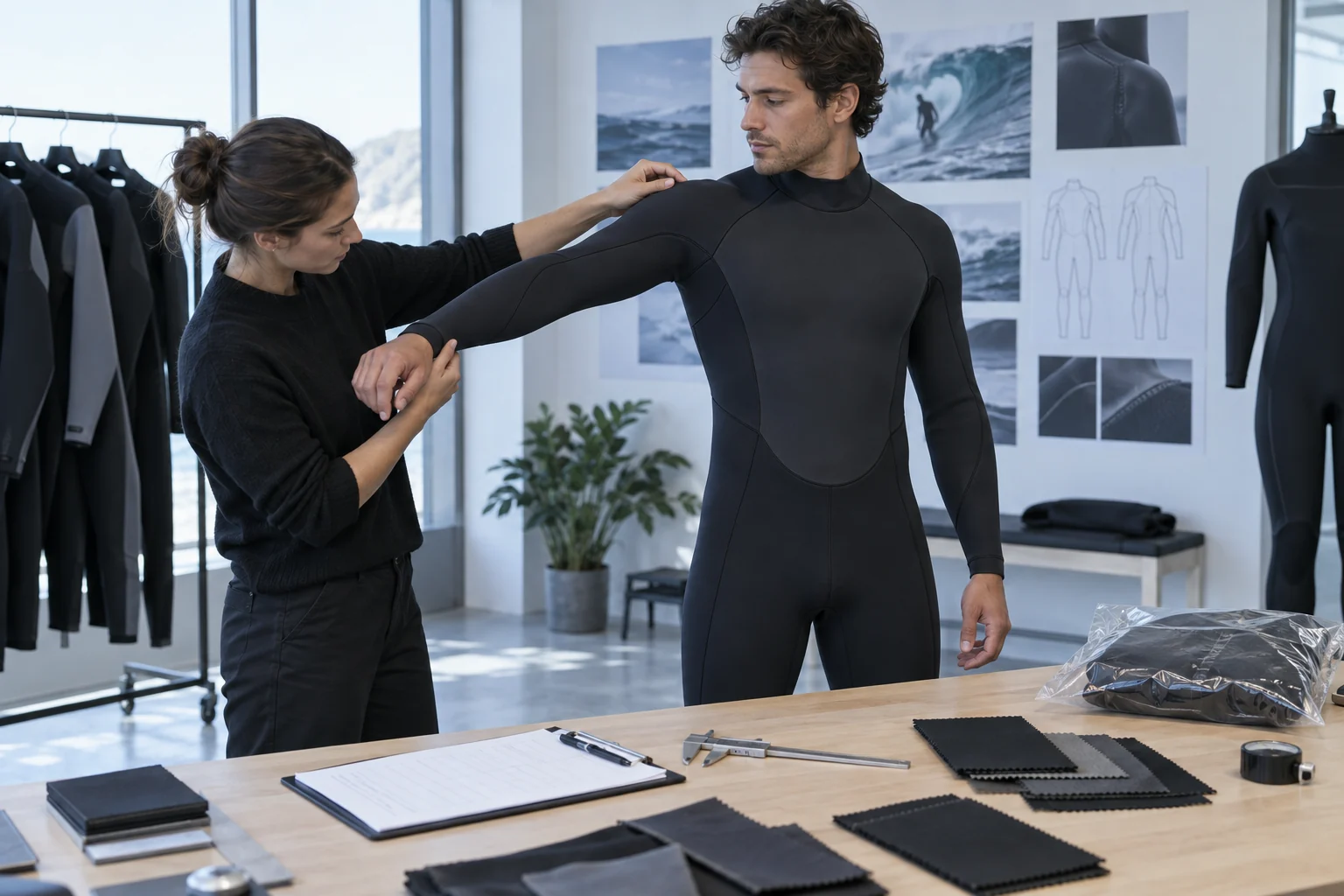
Fit testing needs more than one mirror check. Recruit users who represent the intended body profiles and activities. Measure the garment and wearer consistently, then record donning, doffing, shoulder and hip mobility, squat and reach, neck and cuff contact, torso length, seam placement, zipper behavior, flushing observations, comfort, and visible stress. Follow a repeatable wetsuit fit-testing protocol and separate fit observations from cosmetic preferences.
Return one consolidated, numbered comment sheet per round. Mark each point approved, revised, rejected, or still open. When the sample is approved, identify and retain a sealed reference sample with version, date, components, measurements, and signatures or written approval. Production should not start from an untracked sample in a chat thread.
Step 9: lock labeling, product safety, packaging, and online information
Compliance depends on the product, components, user group, claims, destination, and sales channel. The buyer or importer should identify applicable requirements with qualified specialists and confirm who supplies evidence. Factory experience is useful, but it does not transfer your legal responsibility or guarantee that a document applies to your exact product.
Create a destination-market checklist covering product safety, restricted substances where applicable, fiber or material disclosure, country of origin, responsible business or economic operator information, care instructions, language, traceability, packaging, environmental claims, and online-offer information. For the United States, the FTC explains that most textile and wool products require disclosures such as fiber content, origin, responsible business, and care instructions. CPSC requirements vary by product and can add tracking obligations for children’s products. For the European Union, the General Product Safety Regulation includes responsible-person and distance-sales information requirements for products in its scope.
Do not copy a competitor’s label. Build a controlled label and packaging specification with artwork version, dimensions, location, material, attachment method, language, symbols, barcode ownership, carton marks, and approval status. Match ecommerce content to the approved product: material statements, size guidance, care, warnings, manufacturer or responsible-person details where required, and traceability information.
Treat marketing claims as controlled content. Claims such as recycled content, performance, warmth, protection, sustainability, or certification need defined scope and supporting evidence. Keep the supporting document linked to the exact material, component, supplier, and production period. If evidence is incomplete, change the claim before launch.
Step 10: release production only after gates close, then synchronize the launch
Production release should be a documented decision. Before paying the production deposit, confirm the approved tech pack, bill of materials, size set, colors, artwork, labels, packaging, compliance evidence plan, inspection standard, order breakdown, price, payment milestones, Incoterm, named place, production timing trigger, and change-control rule. Open decisions should have an owner and due date; critical open decisions should block release.
Define quality control before production. Specify inspection stages, sampling plan where appropriate, defect categories, critical measurements, workmanship criteria, functional checks, packaging checks, reporting format, and who can authorize shipment. Use a written wetsuit quality-control checklist tied to the approved reference sample. Inspection reduces risk; it does not repair an ambiguous specification.

Build the launch calendar backward from the date inventory must be available—not the public launch date. Include production completion, inspection, corrective action allowance, booking, export documents, transit, customs, warehouse receiving, count and condition checks, product photography, product-page review, customer-service training, returns workflow, and campaign approval. Do not schedule paid traffic against an optimistic arrival date with no buffer.
Agree on a weekly update format covering completed work, current stage, upcoming decisions, risks, photos or records, and the person responsible. Any change to materials, components, measurements, colors, artwork, quantity, or dates should be approved in writing with cost and timing impact. A silent substitution is not an acceptable way to protect a deadline.
Before launch, test checkout, tax and shipping logic, stock by SKU, size guidance, order confirmation, fulfillment handoff, returns, customer-service scripts, and analytics. Prepare a stop-sell and corrective-action process in case safety or quality information changes. After launch, review sell-through by SKU, size-related returns, defects, reviews, support contacts, and replenishment lead time. Reorder from evidence rather than excitement.
A practical gate sequence for the first collection
- Market gate: customer, use case, launch market, problem, and price band are supported by evidence.
- Commercial gate: range, landed-cost model, cash timing, downside case, and order quantity are acceptable.
- Development gate: supplier model, ownership, tech pack, sample plan, and revision control are agreed.
- Product gate: fit, grading, materials, construction, color, labels, packaging, and claims are approved.
- Production gate: purchase order, reference sample, quality plan, payment milestones, and change control are signed off.
- Launch gate: compliant product information, inspected inventory, logistics, ecommerce, service, and returns are ready.
A gate can be open, blocked, or approved. “Mostly ready” is not a status for a safety-critical, fit-critical, or ownership-critical item. The downloadable planner turns these gates into named actions with owners and dates, while keeping the range plan and unit economics connected to the launch decision.
How to start a wetsuit brand without common mistakes
- Starting with a large collection: too many combinations dilute cash and learning.
- Choosing by sample appearance alone: production repeatability, documentation, capacity, and change control also matter.
- Treating MOQ as one number: minimums can apply by style, color, material, component, and packaging.
- Using a logo as the product brief: fit, materials, construction, tolerances, and acceptance criteria remain undefined.
- Budgeting only the unit price: development, tests, packaging, freight, duty, returns, marketing, and cash timing can change the decision.
- Approving samples informally: scattered messages allow conflicting instructions into production.
- Leaving compliance until shipment: late label, document, or online-information changes can delay or strand inventory.
- Launching on an unbuffered ETA: production, inspection, freight, customs, and receiving can all move.
Frequently asked questions
How much does it cost to start a wetsuit brand?
There is no responsible universal figure. Total capital depends on the development model, number of SKUs, order quantities, samples, testing, labels, packaging, freight, duties and taxes, ecommerce, marketing, returns, and operating reserve. Build a line-item model and compare base, slower-sales, and higher-cost cases before committing.
What is the minimum order for private-label wetsuits?
MOQ varies by supplier and by style, color, material, component, and packaging. A website example is not a quote for your project. Ask for the exact minimum at each level, price breaks, sample terms, and whether units can be distributed across sizes. Then test whether the resulting SKU quantities make commercial sense.
Should a new brand begin with private label or a custom OEM product?
Private label can be sensible when a proven base style already fits the intended user and your differentiation comes from curation, service, brand, or selected customization. OEM is better when the customer promise depends on a controlled new specification. Choose according to evidence, capability, ownership, cash, and risk—not the model name.
How long does development and production take?
It depends on specification readiness, material availability, sample rounds, testing, approval speed, production capacity, season, shipping, and destination formalities. Ask the supplier to state the trigger for each timing estimate and build a dependency-based calendar with decision and logistics buffers.
Can the factory handle all compliance work?
The factory can provide technical information, declarations, test reports, labels, and manufacturing controls, but the brand owner, seller, or importer still needs qualified advice about the rules that apply to the exact product and market. Verify that each document matches the product, component, standard, entity, and date in question.
What should be approved before bulk production?
At minimum: the current tech pack, bill of materials, measurements and tolerances, size set, materials, colors, trims, artwork, labels, packaging, claims, applicable evidence plan, approved reference sample, order breakdown, price, payment terms, production timing, quality plan, inspection criteria, Incoterm, and written change-control process.
Turn the idea into a controlled first launch
A credible wetsuit brand starts with disciplined choices: a specific customer, a small evidence-backed range, a complete cost model, a measurable specification, verified supplier capability, controlled sample approval, market-specific compliance work, and a launch calendar tied to physical inventory. That sequence will not remove uncertainty, but it makes the uncertainty visible and assignable.
Plan your first range: contact INSEAKU with your target user, market, style concept, estimated quantity, size range, price position, and launch window. The clearer the brief, the more useful the first technical and commercial response can be.
Official planning and compliance references
- U.S. Small Business Administration: Write your business plan
- U.S. Small Business Administration: Break-even point calculator and formula
- USPTO: Federal trademark searching
- WIPO: Check trademark availability
- U.S. Federal Trade Commission: Apparel labeling
- U.S. Consumer Product Safety Commission: Labeling requirements overview
- European Commission guidance on the General Product Safety Regulation
This guide is general procurement and planning information, not legal, tax, financial, customs, or product-safety advice. Requirements and commercial conditions must be verified for the specific product, buyer, supplier, channel, and destination.