

Short answer: A Yamamoto vs limestone neoprene comparison is not a clean brand-versus-material choice. Yamamoto is a named Japanese wetsuit-material manufacturer, and its official material information describes its core rubber as limestone-based. “Limestone neoprene,” by contrast, is a broad market description that can be used for materials from different suppliers, grades and compound systems. Therefore, a buyer should compare a verified Yamamoto grade with a specifically identified alternative—not compare the Yamamoto name with an unidentified limestone claim.
The purchase order should name the manufacturer, grade, thickness, skin or surface treatment, face fabrics, lamination, color and approved sample. If a quotation says only “Yamamoto,” “Japanese neoprene” or “eco limestone neoprene,” it is not yet a repeatable material specification.
Why “Yamamoto vs limestone neoprene” is often the wrong comparison
The phrase places two different kinds of information on opposite sides. Yamamoto identifies a manufacturer and a family of named material grades. Limestone identifies a claimed feedstock route or sourcing description. Yamamoto’s own official website describes its material as 100% limestone-based and lists multiple rubber types for different applications. A Yamamoto candidate can therefore be both Yamamoto and limestone-based.
The useful commercial comparison is one of the following:
- a verified Yamamoto grade versus a verified grade from another named supplier;
- two Yamamoto grades under the same finished-laminate conditions;
- two identified limestone-based materials with different performance, cost or availability; or
- a limestone-based candidate versus another identified material system for a defined product requirement.
This distinction prevents a familiar sourcing error: paying for a name while the quotation, sample and bulk order do not share one traceable material identity.
What does the Yamamoto name identify?
Yamamoto Corporation is a specialist manufacturer of wetsuit materials. Its official product pages list rubber grades including #38, #39, #40, #45, #50 and #88. The pages describe different intended characteristics or applications and warn that physical properties also depend on surface finishing and other processing. This is why “Yamamoto neoprene” is still incomplete without a grade and construction.
For example, the company’s current material pages identify #39 as a widely used grade and #40 as a more flexible development from #39 for applications such as surfing and triathlon. Those descriptions are useful for shortlisting, but they do not replace the supplier’s current data sheet, the finished laminate or the buyer’s own sample evaluation.
Rubber grade and surface technology are separate fields
A term such as SCS should not be entered in the same specification field as #39 or #45. Yamamoto describes SCS, or Super Composite Skin, as a surface processing applied to smooth skin. A project can combine a rubber grade with a particular skin, coating, emboss or fabric lamination. Record each layer separately so the factory does not have to infer the intended construction.
The same rule applies to a textile-faced wetsuit. The foam may be traceable to a named grade, while the outer jersey, inner lining, adhesive and lamination process come from other controlled sources. The finished material behaves as a composite.
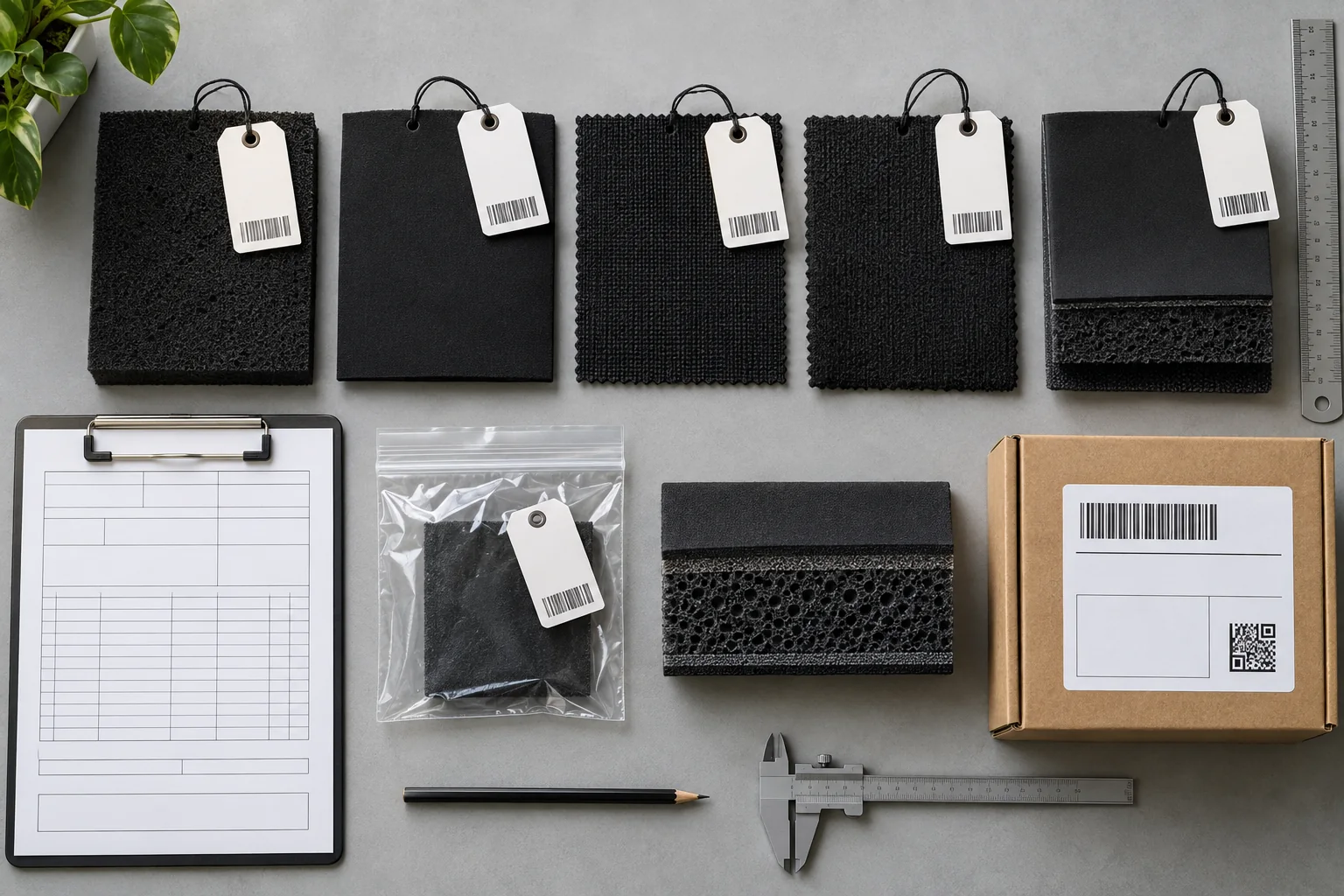
What does “limestone neoprene” identify?
In wetsuit sourcing, limestone neoprene generally means a chloroprene-rubber foam promoted as using limestone-derived inputs in the production route. The phrase does not identify one manufacturer, one formula or one level of performance. It also does not tell the buyer the exact CR content, additives, oil system, blowing process, density, cell structure, hardness, stretch, compression behavior or aging performance.
CR is the standardized abbreviation for chloroprene rubber under the ISO rubber-nomenclature system. “Limestone neoprene” is not a complete ISO grade name. Two suppliers can both use the limestone description while offering materially different products. Even two grades from the same supplier can be designed for different priorities.
Ask the supplier to explain exactly what the limestone statement covers. Does it refer to the source of a chemical intermediate, the mineral content of the compound, the rubber-production route, or a marketing family? What percentage or chain-of-custody evidence supports the claim? Does the statement apply to the foam only, or to the laminated composite and finished wetsuit? Do not extend a narrowly scoped supplier statement to the entire product without evidence.
Yamamoto and generic limestone claims: buyer comparison
| Purchasing question | Verified Yamamoto candidate | Other limestone-described candidate | Buyer control |
|---|---|---|---|
| Manufacturer identity | Named manufacturer; confirm the commercial supply route | May be named, private label or unclear | Record legal supplier, manufacturer and manufacturing country separately |
| Material identity | Specific rubber grade plus surface/laminate construction | Specific supplier grade required; “limestone” alone is insufficient | Data sheet, grade code, sample ID and BOM line |
| Brand claim | Requires traceable supply and appropriate permission for name/logo use | Do not imply Yamamoto origin | Written authorization and approved marketing copy |
| Performance | Depends on grade, thickness, surface and laminate | Depends on the same variables | Comparable data and sample-suit testing |
| Environmental statement | Use only the documented supplier statement within its scope | Request a defined, supported statement from the identified supplier | Claim text, evidence owner, method, scope and approval |
| Cost | Grade, finish, fabric, supply route, quantity and availability affect price | Wide range; a generic label does not establish value | Normalize to usable area and cost per approved suit |
| Substitution risk | High if “Yamamoto” is written without grade and proof | High if “limestone” is written without supplier and grade | No change without written comparison and approval |
How should a buyer verify material identity and brand use?
A logo on a data sheet, sample card or web page is not enough by itself. Build a document trail that connects the named material to the production lot. The exact evidence varies by supply route, but a practical file can include:
- quotation naming the manufacturer, grade and finished construction;
- current technical data sheet or supplier specification;
- supplier invoice, delivery note or packing label linked to the received batch;
- material lot or batch number where available;
- swatch ID and retained reference tied to the development sample;
- written confirmation of any distributor or converter role;
- written permission or brand-use guidance when the buyer intends to use the Yamamoto name, product tag, logo or grade in marketing; and
- approved marketing text that does not broaden the supplier’s statement.
Separate three identities: the original foam manufacturer, the converter or laminator, and the wetsuit factory. One company may perform more than one role, but the record should not silently treat them as the same entity.
What if commercial documents must remain confidential?
The parties can agree on redacted documents, controlled access or a confirmation letter that protects unit prices and unrelated customer information. Confidentiality does not remove the need for traceability. The buyer still needs enough evidence to connect the approved claim and sample to the supplied material.
Specify the grade and finished laminate—not the foam slogan
A repeatable bill of materials should identify the foam and every layer applied to it. At minimum, record:
- manufacturer and supplier;
- rubber grade or supplier product code;
- nominal foam thickness and finished laminated thickness;
- smooth skin, cell skin, coating, emboss or other surface treatment;
- outer and inner fabric references, color and stretch direction;
- lamination or adhesive route where it is a controlled requirement;
- sheet size or supply format when it affects marker efficiency;
- approved swatch, sample and document revisions; and
- substitution and reapproval rule.
Use the wetsuit tech pack and RFQ checklist to place those fields into the complete product specification. The broader wetsuit material selection guide explains how foam, fabric, thickness and lamination interact.
A Yamamoto neoprene wetsuit manufacturer should be able to quote an exact feasible grade and preserve its identity through sampling and bulk control. A limestone neoprene wetsuit manufacturer should do the same for any alternative grade. Neither description excuses an open material line such as “premium limestone foam or equivalent.”
Which performance evidence should buyers compare?
Compare the requirement, not the reputation. First define the intended activity, thickness map, movement zones, compression exposure, surface durability, care cycle and target price. Then select properties that can change the decision.

Material-level evidence
- Thickness and tolerance: distinguish raw foam, supplied laminate and finished-garment measurement.
- Density and hardness: record method, units, specimen condition and direction where relevant.
- Tensile and elongation: ISO 37 and ASTM D412 provide standardized rubber tension methods, but results remain sensitive to specimen and test conditions.
- Compression set or thickness recovery: ISO 815-1 and ASTM D395 can support controlled comparisons; their laboratory conditions do not automatically simulate a dive profile.
- Finished-laminate stretch and recovery: test the fabric/foam/adhesive composite in relevant directions.
- Peel or bonding evidence: define a project method if lamination integrity is critical.
- Aging or care-cycle review: agree on exposure, cycles and acceptance criteria instead of asking for “durable” in general.
Garment-level evidence
Material data cannot establish finished-suit fit, flushing, mobility, seam comfort or zipper operation. Produce the sample in the intended thickness map and panel orientation. Record measurements, fit users, movement tasks and issues. The wetsuit fit-testing protocol provides a controlled garment-review method.
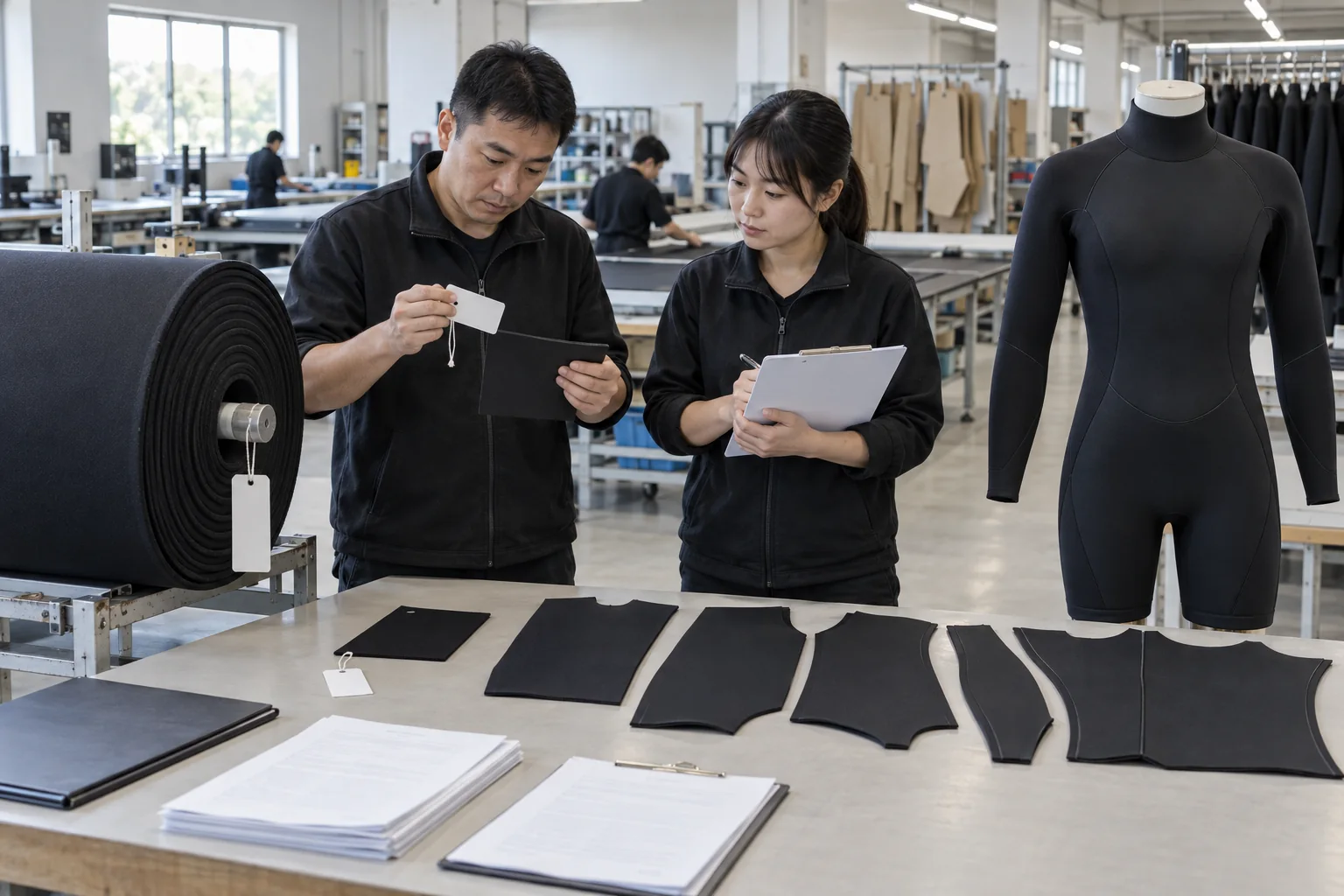
Carry the approved grade, laminate and batch evidence into the wetsuit quality control plan. Incoming inspection should verify identity and agreed characteristics before cutting.
How should environmental claims be reviewed?
“Made from limestone,” “petroleum-free,” “eco-friendly,” “sustainable” and “lower impact” are different claims. Evidence for one does not automatically support the others. A mineral feedstock statement alone does not quantify lifecycle emissions, energy use, toxicity, durability, recyclability or end-of-life impact.
For every proposed claim, create a claim record with:
- the exact words that will appear on the product, packaging or website;
- the product and components covered;
- the evidence owner and document date;
- the percentage, boundary and comparison baseline, if claimed;
- the method, standard or calculation used;
- the markets and languages where the claim will appear;
- legal or compliance approval where required; and
- an expiry or review trigger if the material, supplier or law changes.
The U.S. Federal Trade Commission advises marketers to avoid broad, unqualified environmental-benefit claims and to substantiate express and implied claims with competent evidence. ISO 14021:2026 provides current principles and documentation expectations for self-declared environmental claims. Those references do not approve a particular wetsuit claim; the brand remains responsible for the wording and evidence in each target market.
How do cost, MOQ and availability change the decision?
A named premium grade can have a higher quoted material cost, but sheet price alone is not cost per suit. Normalize candidates using the same construction and include:
- usable sheet area and currency basis;
- sheet size and marker efficiency;
- thickness, surface processing and fabric lamination;
- minimum order or minimum purchase unit;
- freight, conversion and handling;
- cutting waste and defect allowance;
- sample, test and approval cost;
- availability for replenishment; and
- cost of revalidation if the grade changes.
INSEAKU’s standard starting MOQ is 50 pieces per style and color, with sizes mixed within that style-color group. A selected material, color, laminate or supplier can create another minimum that must be quoted separately. Sample development can start from approximately seven working days after materials, specifications and payment are confirmed. Normal bulk production is approximately 30 working days after written sealed-sample approval and the required deposit, but special material procurement can extend either stage. The written quotation governs the project.
INSEAKU’s OEM, ODM and private-label services can connect material verification, pattern development, sampling and bulk control once the exact sourcing route is confirmed.
Which material route fits different wetsuit programs?
Triathlon and open-water swimming
Priorities can include shoulder mobility, panelized buoyancy strategy, surface treatment, transition speed and size validation. Do not select a grade from an athlete quotation or hydrodynamic claim alone. Confirm the competition rules, complete garment construction and test plan. Review the triathlon and open-water wetsuit options for product-level planning.
Surf and SUP
Mobility, recovery, seam compatibility, wind exposure, surface durability and cost can pull the specification in different directions. Compare the actual laminate at the required thickness and validate the intended entry system and paddling movement. See the custom surf and SUP wetsuit category.
Freediving and spearfishing
Buyers may prioritize close fit, flexibility, compression behavior, open-cell or lined surfaces, careful donning and project-specific reinforcement. A grade or coating used for one discipline is not automatically correct for another. The open-cell versus lined construction guide separates foam identity from interior surface design.
Diving, school and rental programs
High-handling programs may value surface protection, easy donning, cleaning, repair and repeatable replacement more than the softest possible hand feel. Compare total cost per approved suit and replenishment consistency. A premium name does not remove the need for a use-case test, and a lower-cost limestone claim does not prove adequate durability.
What should the RFQ and approval record contain?
Send the following fields before requesting a comparable quote:
- Product and use: category, activity, target user, environment and positioning.
- Candidate identity: requested manufacturer, grade and acceptable alternatives.
- Construction: thickness map, skin or surface, outer fabric, inner fabric, colors and lamination.
- Evidence: data sheet, origin or supply records, test methods and required market documents.
- Brand use: intended supplier-name, grade, logo, hangtag or website claim.
- Environmental copy: exact proposed wording, scope and required substantiation.
- Sampling: swatch, material panel, prototype, fit sample and performance review stages.
- Commercial inputs: quantity by style/color/size, destination, target timing and Incoterm.
- Approval owner: the person authorized to approve the material and marketing claim.
- Change control: evidence and reapproval required before any substitution.
Bulk-release rule
Approve the exact combination tied to the sealed sample. If the manufacturer, grade, thickness, surface, fabric, adhesive or claim changes, reopen the affected review. A supplier statement can expire, a grade can be unavailable and a converter can change. Bulk release should confirm that open issues are closed and the incoming-material control plan names the same construction.
Download the material identity and claim verification workbook
Use the INSEAKU Yamamoto and Limestone Neoprene Verification Workbook to record candidate identity, document status, comparable properties, proposed marketing claims, sample approval and batch traceability. Yellow cells are buyer inputs, blue cells hold supplier or factory evidence, and calculated status fields highlight incomplete controls.
Common procurement mistakes
- Treating Yamamoto and limestone as opposites: Yamamoto describes its own core material as limestone-based.
- Writing “Yamamoto” without a grade: the BOM still cannot reproduce the intended material.
- Using SCS as the rubber grade: the surface process and the underlying foam are different specification fields.
- Accepting “Japanese neoprene” as origin proof: it does not identify the manufacturer, grade or supply route.
- Extending a foam claim to the whole wetsuit: fabrics, adhesives, trims and manufacturing are outside a narrowly scoped foam statement.
- Using unmatched catalog numbers: different methods, thicknesses or laminates cannot support a direct ranking.
- Approving brand copy before supply evidence: marketing can become inaccurate if the source or grade changes.
- Allowing “or equivalent” without a protocol: equivalence needs defined evidence and approval.
Frequently asked questions
Is Yamamoto neoprene made from limestone?
Yamamoto’s official website describes its core rubber material as 100% limestone-based. Buyers should still confirm the exact grade, current supplier documents and scope of any claim for their order.
Is all limestone neoprene Yamamoto?
No. Limestone is a broad sourcing description used for materials from multiple suppliers. A quotation must name the manufacturer and grade before a buyer can evaluate identity or performance.
Which Yamamoto grade is best?
There is no universal best grade. Yamamoto lists different grades for different properties and applications. Select the candidate against the product requirement, finished laminate, sample evidence, budget and availability.
Does #45 automatically make the best wetsuit?
No. The final result also depends on thickness, pattern, panel layout, fabrics, surface treatment, seams, zipper, fit and workmanship. Confirm that the exact grade is available and suitable for the intended construction.
Can a factory use the Yamamoto name on a quotation?
A quotation can identify a genuinely proposed material, but the evidence and commercial route should support that statement. Consumer-facing use of the name, grade, logo or product tag may require separate written guidance or permission. Confirm it before artwork approval.
Is limestone neoprene automatically more sustainable?
No broad conclusion follows from the feedstock description alone. Evaluate the exact claim, percentage or boundary, manufacturing evidence, product durability and target-market rules. Avoid an unqualified “eco-friendly” claim.
How can a buyer stop material substitution?
Name the manufacturer, grade and finished construction in the BOM; tie them to the approved swatch and sealed sample; verify incoming identity; and require written comparison and approval before any change.
Verify the material specification before sampling
Send INSEAKU the intended use, target price position, requested Yamamoto or other limestone material, thickness map, fabric construction, quantity, required tests, proposed marketing claims and destination market. If you already have a data sheet or supplier quotation, include its date and grade. The team can review feasibility and identify the records needed to connect the material claim to the approved sample and bulk order.
Request a Yamamoto or limestone material-specification review.
Technical and claim references
- Yamamoto Corporation — official wetsuit-material overview
- Yamamoto Corporation — rubber grades and formats
- Yamamoto Corporation — limestone rubber statement
- Yamamoto Corporation — SCS surface processing
- ISO 1629:2025 — Rubber and latices, nomenclature
- ISO 37:2024 — Tensile stress-strain properties
- ASTM D412-16(2021) — Rubber tension testing
- ISO 815-1:2019 — Compression set
- ASTM D395-18(2025) — Rubber compression set
- ISO 14021:2026 — Self-declared environmental claims
- U.S. FTC — environmental marketing guidance
Last reviewed: September 19, 2026. Supplier pages, grade availability, documents, authorization and laws can change. Confirm the current project evidence before quoting, approving artwork or releasing bulk production.