
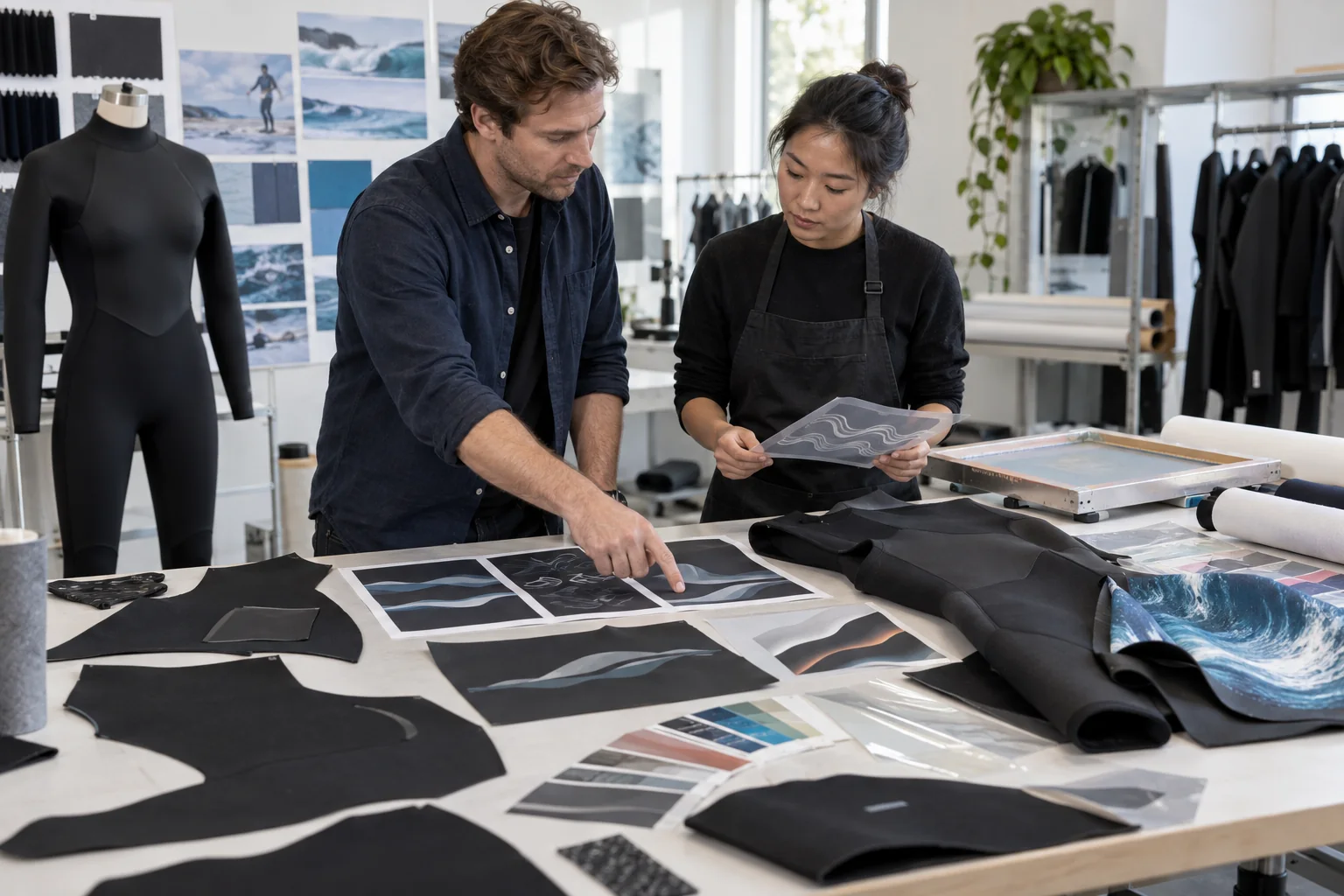
Short answer: There is no single best logo method for every custom printed wetsuits wholesale project. Screen printing is often practical for simple spot-color graphics and repeat orders. Heat transfer can reproduce detailed, multicolor artwork with flexible placement, but the transfer film, adhesive and application settings must suit the selected face fabric and stretch zone. Sublimation is useful for complex, full-color graphics when a compatible light-colored polyester substrate and the planned manufacturing route support it. The correct choice depends on artwork, color, panel material, stretch, abrasion exposure, quantity and the approval evidence required before bulk production.
Buyers should therefore approve a method on the actual production-intent material—not from a digital mockup alone. The artwork file, physical size, color reference, position, substrate, process, sample version and acceptance criteria should all be controlled in writing.
Screen print, heat transfer or sublimation: quick comparison
| Decision factor | Screen print | Heat transfer | Sublimation |
|---|---|---|---|
| Typical artwork | Simple logos, solid spot colors and bold lines | Detailed, multicolor or variable graphics | Full-color, photographic, gradient or repeating patterns |
| Color behavior | Ink sits on the fabric surface; opacity depends on ink and substrate | Printed or cut transfer is bonded to the surface | Dye becomes part of a compatible polyester surface; no white ink |
| Best starting point | Controlled spot-color branding | Shorter runs or detailed logos with suitable transfer systems | Light-colored compatible panels printed before garment assembly |
| Main risk | Cracking, poor coverage or color shift on a moving surface | Edge lift, film feel, delamination or stretch mismatch | Wrong substrate, dark base color, color migration or panel-to-panel alignment |
| Approval evidence | Ink, mesh/process, cured strike-off and stretch/rub review | Transfer specification, temperature/time/pressure route and applied sample | Printed substrate strike-off, color reference, pattern repeat and assembled-panel sample |
This is a sourcing framework, not a substitute for a supplier trial. A method that works on one polyester-faced neoprene can behave differently on another because face-knit construction, coatings, surface texture, stretch direction, color and lamination vary. Buyers comparing custom logo wetsuits wholesale should request evidence on the named production material and at the intended artwork scale.
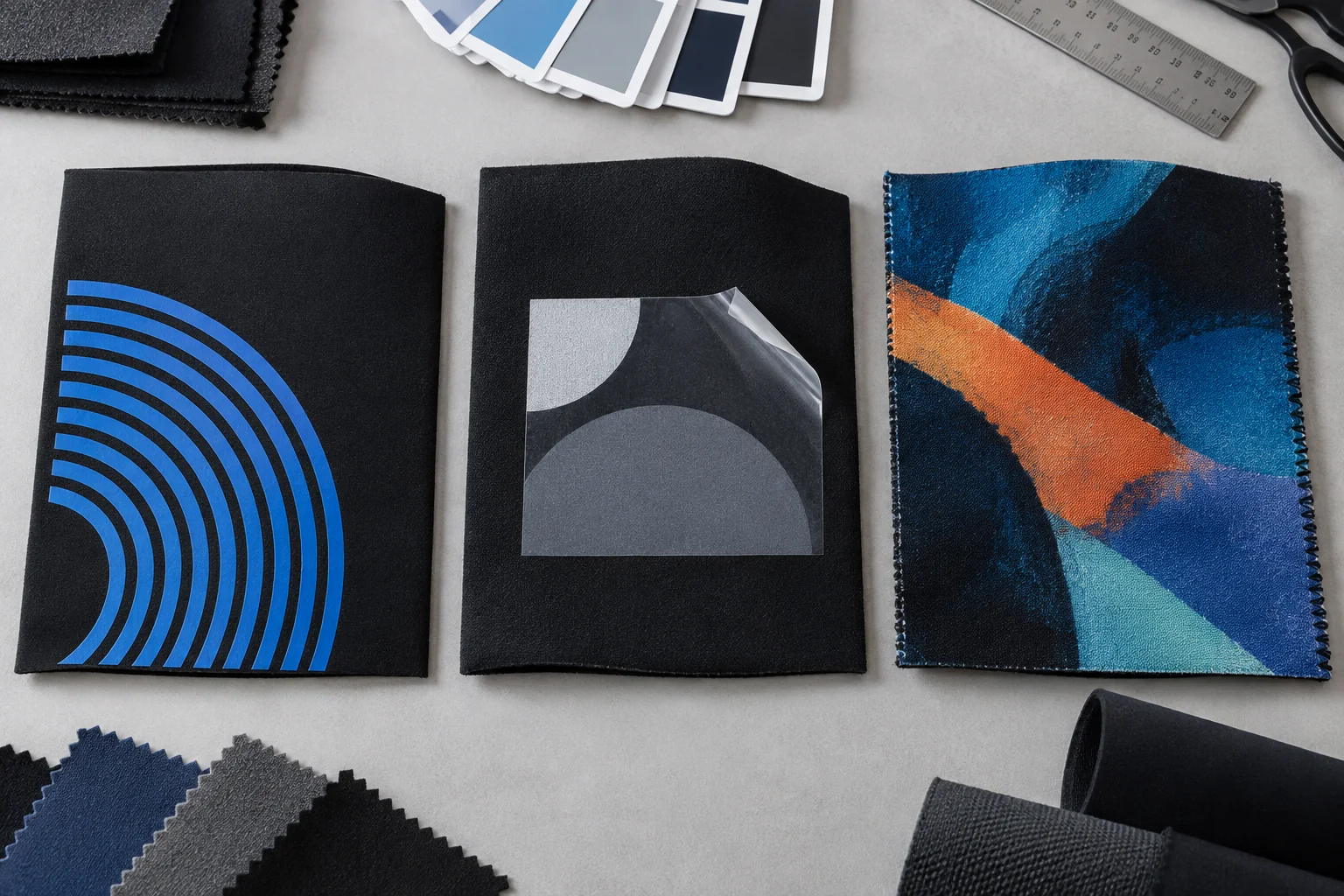
When screen printing is a strong choice
Screen printing places ink through a prepared screen onto the face fabric. It is often a practical option for a brand mark with a limited number of colors, clear shapes and repeatable positioning. Once the process is set, it can suit production quantities where the setup is distributed across more pieces.
Its apparent simplicity can hide important variables. Ink must cover the selected fabric color, bond to the surface and tolerate the movement expected in that panel. Fine lines or tiny reversed text may fill in or lose definition. A thick ink deposit may feel stiff on a high-stretch zone, while inadequate curing can reduce adhesion. Screen count, ink system, underbase, curing conditions and operator control all affect the result.
Screen-print questions to put in the RFQ
- How many spot colors are required, and is an underbase needed on the chosen fabric color?
- What is the smallest line or text size the supplier recommends at production scale?
- Will the logo cross a seam, fold sharply or sit on a high-extension panel?
- Is the print applied before or after lamination, cutting and garment assembly?
- What cured sample and production reference will govern appearance?
For a two-color chest logo on a stable panel, screen print may offer a clean and economical route. For a photographic gradient, frequent name changes or hundreds of colors, it is usually a poor starting point. Ask the factory to explain the method rather than assuming that every “printed logo” is the same process.
When heat transfer works better
Heat transfer applies a prepared graphic to the face fabric with controlled heat, pressure and time. Depending on the transfer system, it can handle fine details, multicolor logos and shorter customization runs without a separate screen for every color. It can also help when each club, team or rental fleet needs names, numbers or asset IDs.
The risk is the interface between transfer and material. Too much heat or pressure can mark, flatten or distort a sensitive laminated surface. Too little can leave weak edges. A film that looks good while flat may resist extension differently from the panel below it, creating edge lift, cracking or a noticeable hand after repeated flexing. Transfer chemistry and application settings must be approved for the actual substrate.
Heat-transfer evidence to request
- the named transfer type and its intended fabric compatibility;
- an applied sample on the production-intent neoprene face;
- a review after agreed stretching, flexing and rubbing;
- edge, corner and small-detail inspection at the real logo size;
- a record of the approved application route for production control.
A transfer can be the right commercial decision without being invisible. Buyers should agree whether a visible film edge or tactile difference is acceptable. If the logo sits in an elbow, underarm, knee or waist area, place and evaluate it under realistic extension before approval.
What sublimation means for wetsuit graphics
Dye sublimation uses heat to move dye into a compatible polymer-based surface. Epson’s technical guidance describes polyester and polymer-coated substrates as the relevant application base and notes that the process is best suited to white or light-colored polyester because ordinary sublimation printing does not add an opaque white layer. That makes the base color part of the final visual result.
For wetsuits, sublimation is normally evaluated as a textile or panel process, not as a universal way to print directly onto any finished black neoprene suit. A compatible polyester face can be printed before lamination, cutting or assembly, depending on the confirmed production route. Full-panel graphics, gradients and camouflage repeats can then be engineered into the pattern pieces.
This route introduces its own controls:
- the face fabric must be compatible with the dye and heat process;
- the base color, ICC/color workflow and physical strike-off influence the approved color;
- large repeats need scale, orientation and registration rules;
- graphics crossing seams need intentional alignment tolerances;
- lamination and later heating must not create unacceptable migration or shade change;
- cut panels must be identified so left/right and directional artwork cannot be reversed.
A buyer searching for a sublimation print wetsuit manufacturer should ask whether the supplier controls the compatible fabric and printing route, how color is approved and how the printed textile is integrated with lamination and cutting. Do not accept “sublimation available” as a complete specification. INSEAKU will confirm feasibility and the proposed route in the quotation or sample plan for each project.
Material, stretch and placement determine the method
The printing decision belongs in the material discussion. Neoprene-based wetsuit materials are composite systems: foam is laminated to one or more face materials, and each surface can react differently to ink, adhesive, heat and motion. A wetsuit material selection review should identify the face construction, color, surface treatment and stretch requirement before artwork approval.
Map every logo to a panel and ask what that panel does in use. A chest area may offer a relatively stable branding surface. Shoulders, underarms and joints typically experience more multidirectional movement. Seats, knees and equipment-contact areas can receive more rubbing. Smooth-skin or coated surfaces may require a different route from knitted face fabric. The same artwork may therefore need different methods or sizes across products.
Use a placement-risk map
| Placement condition | Design response | Approval focus |
|---|---|---|
| High stretch | Reduce rigid coverage; evaluate flexible systems and orientation | Cracking, edge lift and recovery after extension |
| High abrasion | Move the logo or agree a protected/durable route | Visible wear after an agreed rubbing or field-use protocol |
| Across a seam | Split artwork deliberately and set alignment tolerance | Registration, seam distortion and repeatability |
| Dark substrate | Plan opacity, underbase or a different graphic route | Color contrast and consistency under production lighting |
| Full-panel print | Control repeat, direction, cut orientation and seam continuity | Panel matching and assembled appearance |
Build an artwork specification the factory can reproduce
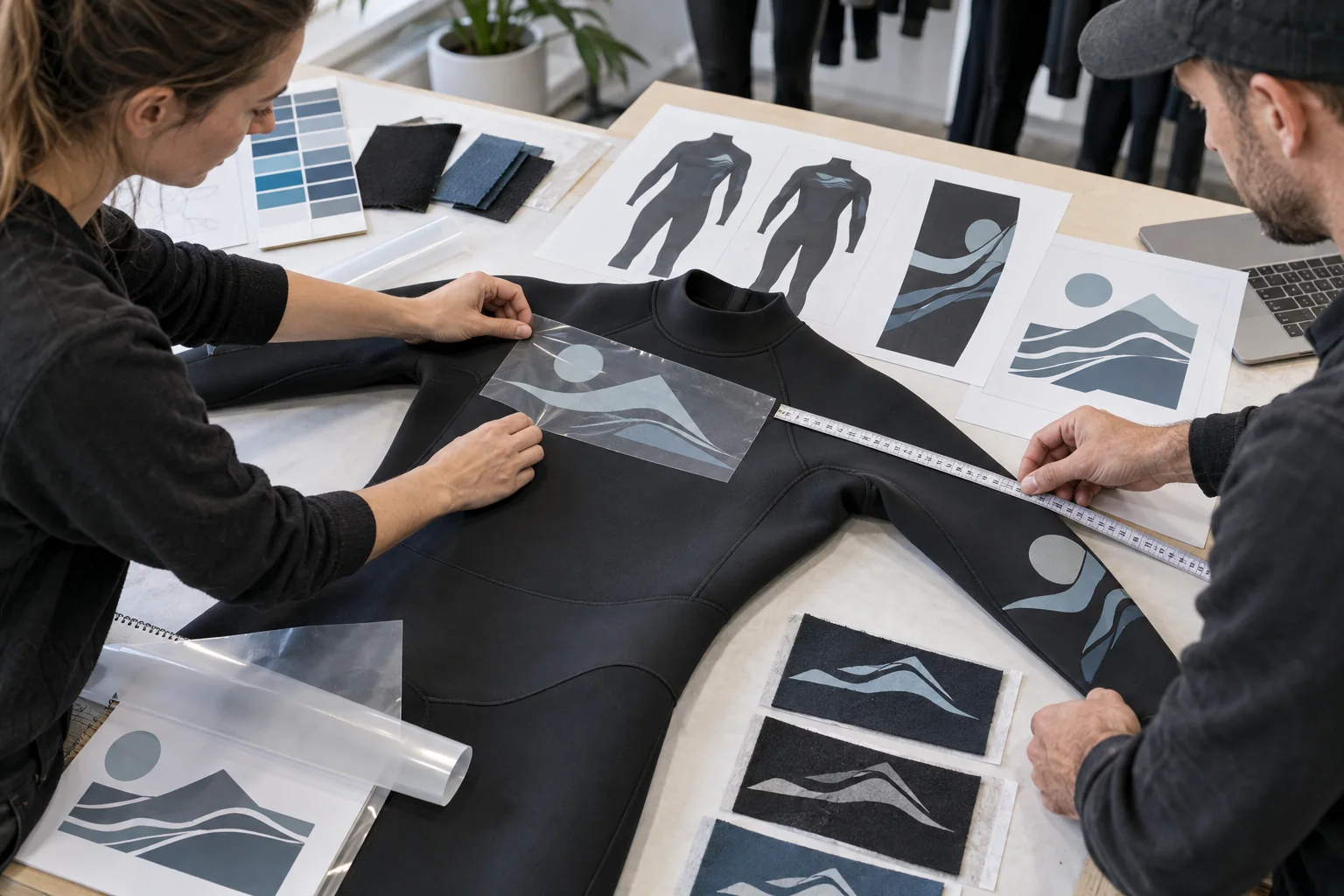
A digital mockup communicates intent, but it does not control production by itself. Supply editable vector artwork for logos when possible, retain linked or outlined fonts as agreed, and identify the authoritative file name and revision. Raster images should have adequate resolution at final print size.
The artwork approval sheet should state:
- style, colorway, size range and affected panel;
- artwork ID, file name, version, date and owner;
- finished width and height with an agreed measurement tolerance;
- position measured from named construction reference points;
- orientation, mirror rules and left/right designation;
- spot-color, documented color reference or approved physical strike-off;
- printing method and production-intent substrate;
- repeat scale and seam-continuity expectation for patterns;
- acceptable variation and the required approval evidence; and
- confirmation that the buyer has the right to use the supplied marks and artwork.
Do not use a monitor image as the only color standard. Displays, lighting, material texture and base color change perception. For branded programs, define whether the governing reference is a physical swatch, an agreed documented value, an approved strike-off or a combination.
Include these fields in the wetsuit tech pack and RFQ. If your team needs support turning artwork and specifications into a production plan, review INSEAKU’s wetsuit development and bulk-production services.
Approve a strike-off before approving bulk printing
A strike-off is a controlled print sample used to review color, detail and process on the intended or clearly identified substitute material. It should carry the project, artwork version, substrate, method, date and supplier reference. If the material is not production-intent, record that limitation and define what must be reconfirmed later.
Review the strike-off in a consistent viewing environment and at the real logo size. Check solid coverage, small details, edges, gradients, repeat scale and the relationship between print and base color. Then review an applied or assembled sample where stretching, seams, heat, cutting or lamination could change the result.
When the print is part of a two-piece hunting suit, use our custom spearfishing wetsuit guide for brands to coordinate camouflage approval with material selection, reinforcement, sizing and the final sample review.
The final decision should be one of four clear states: approved, approved with a named deviation, revise and resubmit, or rejected. “Looks okay” in a message thread is not enough. The artwork decision should connect to the identified pre-production or sealed sample and the wider wetsuit manufacturing workflow before bulk release.
Approval also should not eliminate the final comparison with the buyer’s original source file. In Xuemei Zhang’s real wetsuit QC case, one incorrect English letter had passed through an approved pre-production reference before the final inspector detected the conflict and stopped release.
Specify proportionate tests and bulk QC
Visual approval is necessary but does not show every use risk. For important brand programs, agree a proportionate evaluation plan based on the print route, placement and expected care. Possible checks include dimensional placement, color comparison, adhesion/edge review, controlled extension, flexing, dry or wet rubbing, care-cycle exposure and visual inspection afterward.
International test methods can help define a repeatable language. ISO 105-X12 addresses color fastness to dry and wet rubbing, ISO 105-C06 covers color fastness to domestic and commercial laundering, ASTM D2594/D2594M covers stretch properties of knitted fabrics, and ASTM D4966 covers abrasion resistance by the Martindale method. These standards are not automatically appropriate or mandatory for every wetsuit logo. ASTM also cautions that laboratory abrasion results do not directly predict actual wear life.
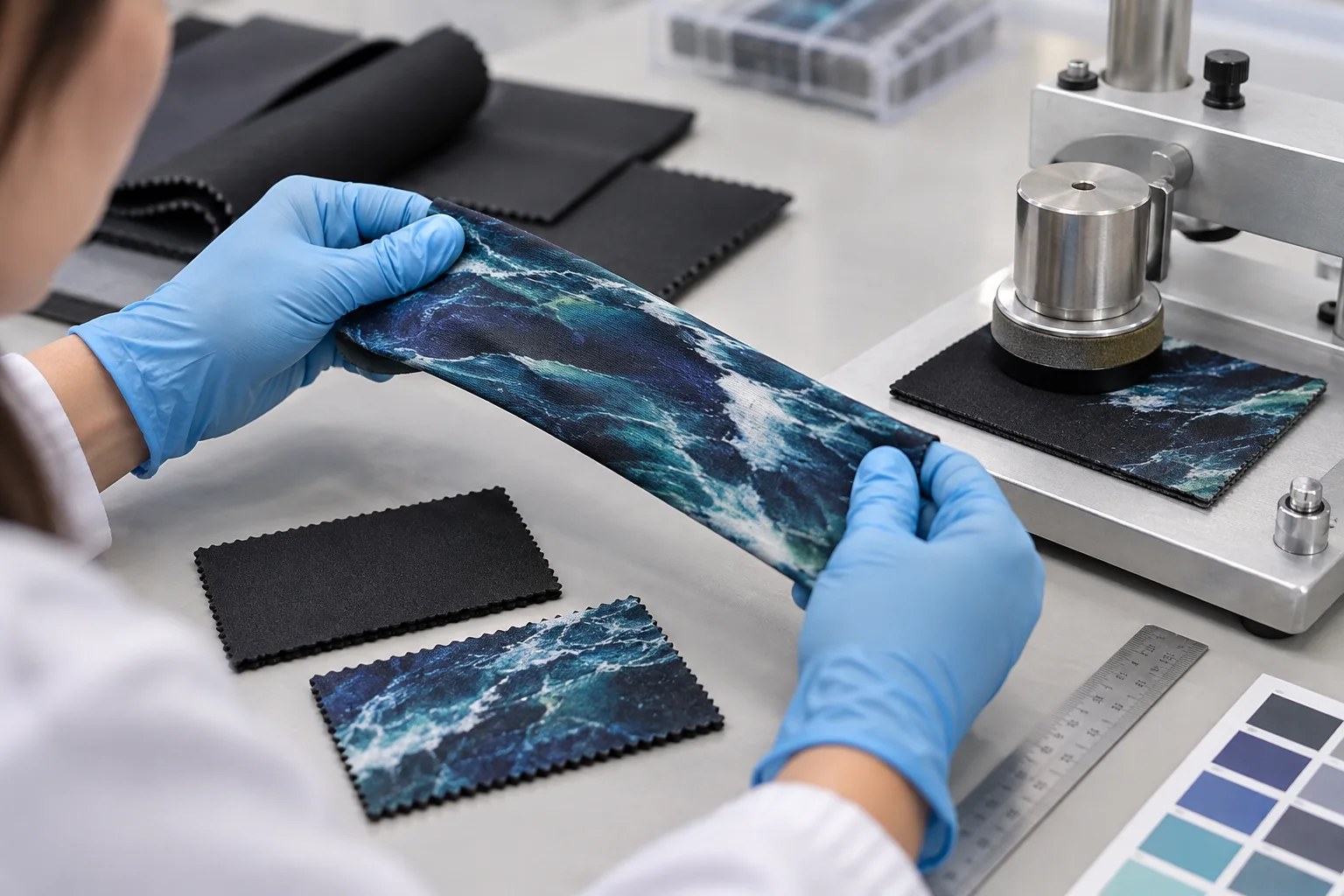
A test name alone is incomplete. Record the specimen, conditioning, equipment or manual method, extension or cycle count, wet/dry condition, evaluation scale and pass/fail threshold. Keep the approved evidence with the style file. In bulk production, the wetsuit quality control checklist should verify the artwork version, method, location, scale, color reference and visible workmanship.
How printing affects MOQ, cost and lead time
INSEAKU’s standard MOQ starts from 50 pieces per style and color, with sizes mixable within that style/color. The confirmed MOQ is project-specific. Printing can add supplier setup minimums, material minimums or colorway constraints, especially when custom fabric, screens, transfers or full-panel printed textiles must be prepared.
Cost is influenced by the number of print locations, number of screen colors, artwork size, coverage, substrate, setup, sampling, color control, individual customization and inspection requirements. INSEAKU does not publish one fixed price because these inputs materially change the production route. A complete RFQ produces a more meaningful quotation than a request based only on quantity.
Sample development can start from approximately seven working days after materials and specifications are confirmed and payment is received. Artwork revisions, custom transfers, printed fabric or special components may extend the timeline. Normal bulk production is approximately 30 working days after written sealed-sample approval and receipt of the required deposit, but the project quotation and order confirmation govern. See the detailed MOQ, sample cost and lead-time guide.
A six-step method-selection workflow for buyers
- Classify the artwork. Separate simple spot-color marks from detailed multicolor logos, variable names and full-panel graphics.
- Name the substrate. Confirm face fabric, color, surface, stretch direction and any coating or lamination constraints.
- Map placement risk. Identify extension, abrasion, seams, folds and equipment contact at each location.
- Compare feasible routes. Ask the factory to propose screen print, transfer, sublimation or another branding method with limitations visible.
- Approve physical evidence. Review the strike-off and, where needed, an applied or assembled sample under agreed checks.
- Freeze the production reference. Link the approved artwork and method to the pre-production or sealed sample and bulk QC plan.
This sequence is especially useful for custom branded wetsuits used by retailers, clubs, schools and rental fleets. It separates brand preference from manufacturing feasibility and makes tradeoffs visible before printing begins.
Download the artwork and print approval workbook
Use the INSEAKU Wetsuit Logo Artwork and Print Approval Checklist to register artwork versions, compare methods, review strike-offs and record bulk checks. The workbook includes dropdowns, readiness formulas and role-colored fields. Adapt it to your agreement and quality plan; completion does not replace authorized written approval.
Common failures to prevent
- Approving from a JPEG only: final scale, color and edge detail remain undefined.
- Changing material after print approval: adhesion, color and stretch behavior can change.
- Placing rigid coverage on a high-stretch zone: the graphic can crack or lift in use.
- Expecting sublimation on any black surface: the process depends on a compatible substrate and base color.
- Ignoring seams and panel direction: full-panel patterns can misalign or appear reversed.
- Using an unnamed “durability test”: neither party knows the cycles, condition or pass threshold.
- Sending uncontrolled revisions: the wrong artwork can enter sampling or bulk production.
Frequently asked questions
What is the best logo printing method for custom wetsuits?
The best method is the one validated for the actual artwork, substrate, location and use. Screen print is often efficient for simple spot-color logos, heat transfer for detailed or variable graphics, and sublimation for full-color designs on compatible light polyester surfaces. Request a production-intent sample before deciding.
Can sublimation be printed directly on black neoprene?
Conventional dye sublimation is not an opaque white-ink process and is best suited to white or light compatible polyester. For wetsuits, it may be used on a compatible face textile before lamination or assembly. A black finished surface normally requires a different route. Confirm the exact construction with the manufacturer.
Can a logo cross a wetsuit seam?
It can be designed to cross a seam, but alignment and distortion must be engineered. Split the artwork by panel, define seam-continuity expectations and approve a representative assembled sample. A small registration variation may be unavoidable and should be agreed before bulk production.
How many colors can be screen printed?
The practical number depends on artwork, equipment, registration, underbase requirements, substrate and economics. More colors usually mean more setup and control. Ask for a project-specific recommendation instead of relying on a universal maximum.
What files should a buyer send?
Send editable vector artwork when possible, plus a visual reference, final dimensions, position, color reference, version/date and proof of the right to use the artwork. For photographic or all-over graphics, supply adequate-resolution raster files and repeat/orientation instructions.
Does print approval authorize bulk production?
No. Print approval closes only the agreed artwork and process questions. Bulk release should still reference the complete approved specification, identified sealed sample, order quantities, commercial conditions and written authorization.
For hoods, gloves, boots and socks, the private-label accessory procurement guide explains how to keep artwork consistent while defining product-specific placement, pairing and sample checks.
Send your logo artwork for a manufacturing review
Send INSEAKU the artwork file, intended logo size and position, wetsuit type, material or color preference, quantity by style/color, size range, target market and required delivery timing. The team can review feasible branding routes, sampling needs, MOQ boundaries and the evidence required before bulk production.
Request a custom wetsuit logo and printing-method review.
Technical references
- ISO 105-X12:2016 — Tests for colour fastness to rubbing
- ISO 105-C06:2010 — Tests for colour fastness to domestic and commercial laundering
- ASTM D2594/D2594M-21 — Stretch properties of knitted fabrics
- ASTM D4966 — Abrasion resistance of textile fabrics (Martindale)
- Epson — Dye-sublimation printing and compatible materials