
PRODUCT GUIDES · TRIATHLON
Under the 2026 USA Triathlon wetsuit rules for an ordinary age-group race, 60.7–77.9°F is the clear optional-wetsuit band; warmer water can cost you awards eligibility. At USAT age-group Nationals and World Triathlon qualifiers, wetsuits are prohibited from 76.2°F (24.6°C). Choose the correct event category first—then use the official race-day announcement. [1] [2]
USA Triathlon wetsuit rules by water temperature
Use the first table for ordinary, non-National age-group competition. It is not a permission chart for elite, U23, developmental, paratriathlon or IRONMAN competition. Those entries need their own applicable rules.
Ordinary USAT age-group races · 2026
| Temperature, °F | Wetsuit status | Awards / rankings |
|---|---|---|
| ≤60.6 | Required | No wetsuit penalty. |
| 60.7–77.9 | Optional | No wetsuit penalty. |
| 78.0 | Boundary conflict | Confirm the ruling; footnote restricts eligibility. |
| 78.1–83.9 | Allowed with consequences | No age-group awards or rankings submission, unless variance. |
| ≥84.0 | Prohibited | Do not assume a wetsuit wave is available. |
Planning summary of §3.4.1, v.2026.01.01. Fahrenheit, one-decimal readings; boundary treatment explained below. Eligibility also depends on the event’s other requirements. [1]
Do not convert a rounded Celsius reading to decide a disputed Fahrenheit boundary. Give the official the announced value and unit.
Why is Nationals different?
“USAT-sanctioned” does not mean every race uses the ordinary age-group temperature band. USAT’s 2026 Nationals page separately confirms these limits for National Championship and World Triathlon qualifying age-group races. [2]
USAT age-group Nationals / World Triathlon qualifiers
Between those limits, a wetsuit is optional under this baseline. At the upper limit, giving up awards does not create permission to wear one. [2]
This is the key purchasing consequence: do not buy or rent on the assumption that a familiar local-race rule will apply at your championship. A wetsuit can be useful equipment and still stay in your bag on race morning.

Does a legal temperature make any wetsuit legal?
No. Maximum thickness is 5 mm anywhere, including combined overlapping layers. Required wetsuits must cover the torso and back. [1]
When choosing a suit, separate two decisions: does it meet the equipment requirements, and can you swim comfortably in it? A compliant thickness does not establish a good fit. Try the actual size and practise swimming before committing to it for a race.
U.S. Masters Swimming highlights that dry-land comfort may change during swimming: breathing, mobility and rubbing all matter. Practise removal too, so transition is familiar. Use our triathlon wetsuit size guide for fit and sleeveless versus full-sleeve comparison for design choice. Neither replaces an event’s equipment decision. [4]
What should you pack and confirm?
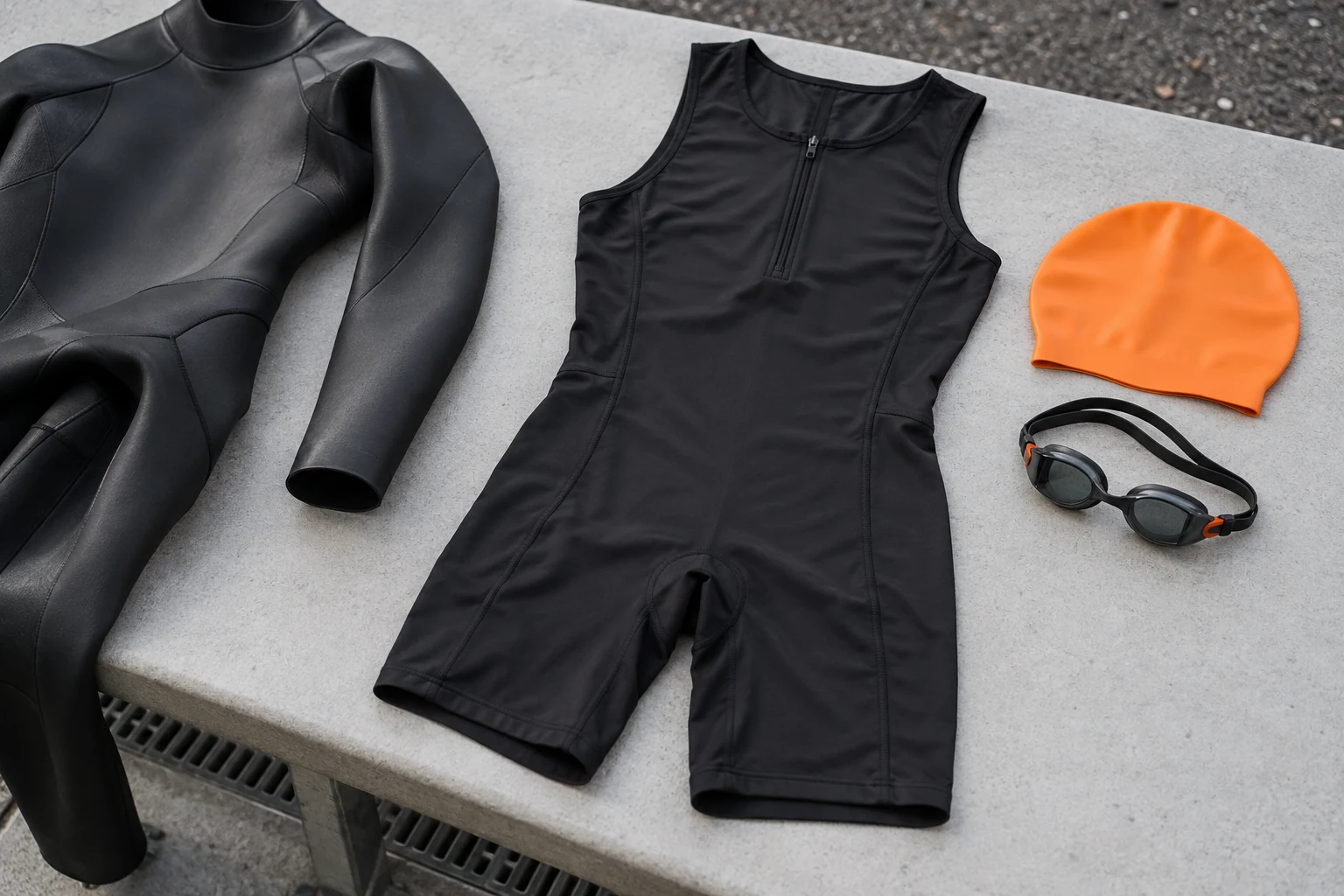
Prepare both options
A wetsuit decision should not leave you without a swim outfit.
Pack a suitable textile race outfit as your non-wetsuit option. Lay out your cap and goggles with it, rather than making the wetsuit the only part of your swim plan.
- Before travelling: identify the event, entered wave, governing rules and any published variance. If an instruction conflicts with a general guide, ask the organizer to identify the applicable rule.
- On race morning: use the officials’ temperature and decision. Cold-air adjustments or safety changes can alter the outcome. [1]
- If offered a non-competitive option: ask where you start, how you will be listed and what you give up. “I can finish” and “my result counts for my goal” are different questions.
If you are chasing a qualification place, make the question specific: “Does my result in this wave, wearing this equipment, remain eligible for the qualification I want?” Do not substitute a general statement about awards for the answer to your particular qualification route.
If you are still deciding what to pack, see our tri suit vs wetsuit guide for the clothing sequence from swim to bike to run.
Two easy mistakes to avoid
Are neoprene buoyancy shorts always banned when wetsuits are prohibited?
Do not use a blanket answer. The 2026 equipment clarification permits qualifying buoyancy shorts at USAT-sanctioned local races/waves and Adaptive Triathlon races/waves, but excludes elite, U23, development, age-group Nationals and World Triathlon qualifiers. An event amendment can also prohibit them. The specified shorts stay at or below the top of the hips, end no lower than the top of the knees, and are no thicker than 5 mm. This exception is not permission to wear a full wetsuit. [3]
Can I use this chart for IRONMAN or a 2027 race?
No—confirm that race’s current rules and athlete guide. This article covers the identified 2026 USAT categories. It does not verify an IRONMAN wetsuit wave or a future season’s thresholds. Keep a link to your event’s official instructions with your booking details, and refresh it before travel.
Sources and rule versions
Checked November 2, 2026. The version and event scope are part of the answer.
- USA Triathlon Multisport Competition Rules, v.2026.01.01: §§3.2.1 and 3.4; printed pages 11, 13–15. Includes the boundary inconsistencies discussed above.
- 2026 USA Triathlon Nationals: Swim and Water Temperature section; championship scope.
- 2026 USAT Swim Rules Variances and Other Equipment Clarifications: buoyancy-shorts categories and dimensions.
- U.S. Masters Swimming — How to Fit and Swim in a Wetsuit: fit and removal practice, not current race thresholds.
- USAT Multisport Rules hub: official rulebook and variance update links.