
Use this triathlon wetsuit size guide to check the chart for your exact model, then confirm the fit on your body. Your usual M or L is only a starting label. If a chart gives unstretched garment measurements, ask for the corresponding wearer guidance. A suitable fit feels close, allows comfortable breathing and lets you reach through a swimming stroke.
Choose your size in four steps
- Choose the exact model. Open its current body-size chart; an M in one range need not match an M in another.
- Record the required measurements. Start with height, weight and chest or bust, and add waist or hips if the chart asks for them. Match the chart’s units.
- Shortlist, do not guess. If your measurements span rows, use that model’s between-size advice or ask the seller. Do not automatically size down for a “race fit.”
- Put it on fully and check the fit. Confirm comfortable breathing and swimming movement, not just whether the zipper closes.
How tight should a triathlon wetsuit feel?
Work the suit into position before judging shoulder tightness. A low crotch or fabric left bunched down the legs can pull on the upper body. 2XU’s fitting instructions emphasize seating the suit high at the crotch and checking that it does not restrict movement or breathing.[3]
- Torso: close contact without large loose pockets of material.
- Shoulders: reach forward and overhead through a swimming motion without strong downward pulling.
- Chest and neck: comfortably breathe and move your head; do not accept breathing restriction as normal race fit.
- Closure: follow the intended fastening method without forcing a strained zipper.
If it is correctly positioned but still restricts breathing or your stroke, do not accept that as a proper fit. Compare the next size or another cut. If the larger size leaves substantial loose material while the smaller one restricts movement, look for different proportions instead. Follow the seller’s fitting and trial conditions before entering the water; do not rely on “it will loosen later” to justify a clearly unsuitable fit. See our wetsuit stretch and fit checks for that common sizing mistake.
Can I choose from a flat chest-width measurement?
Only after confirming the measurement method. A flat width is not a full circumference. Doubling a flat width may be part of a supplier’s specified method, but it still produces a garment measurement—not a recommended body size. The supplied charts here are already identified as circumferences; do not double their values.
Measure your body, then check what the chart measures
A body-size chart and a garment-measurement chart answer different questions. The first indicates the wearer the suit is intended to fit. The second describes the suit itself, often before stretching. Do not match your body circumference directly to an unstretched garment dimension or invent an allowance by adding a fixed number of centimeters.
Use a soft tape and record the measurements required by the specific chart. Keep the tape level and close without pulling it tight. Measure chest or bust at the fullest part, natural waist at its narrowest part, and hips around their fullest part; follow any more specific instructions from the manufacturer. Keep body measurements separate from measurements taken from a suit laid flat.[4] Record current height without shoes and weight in the units requested; avoid guessing from an older clothing size.
For an existing suit, use the chart linked from its product page. Orca’s official guide, for example, separates product families and offers CM/KG and IN/LB views. Do not use the chart for a different activity or model simply because the size labels look familiar.[1]
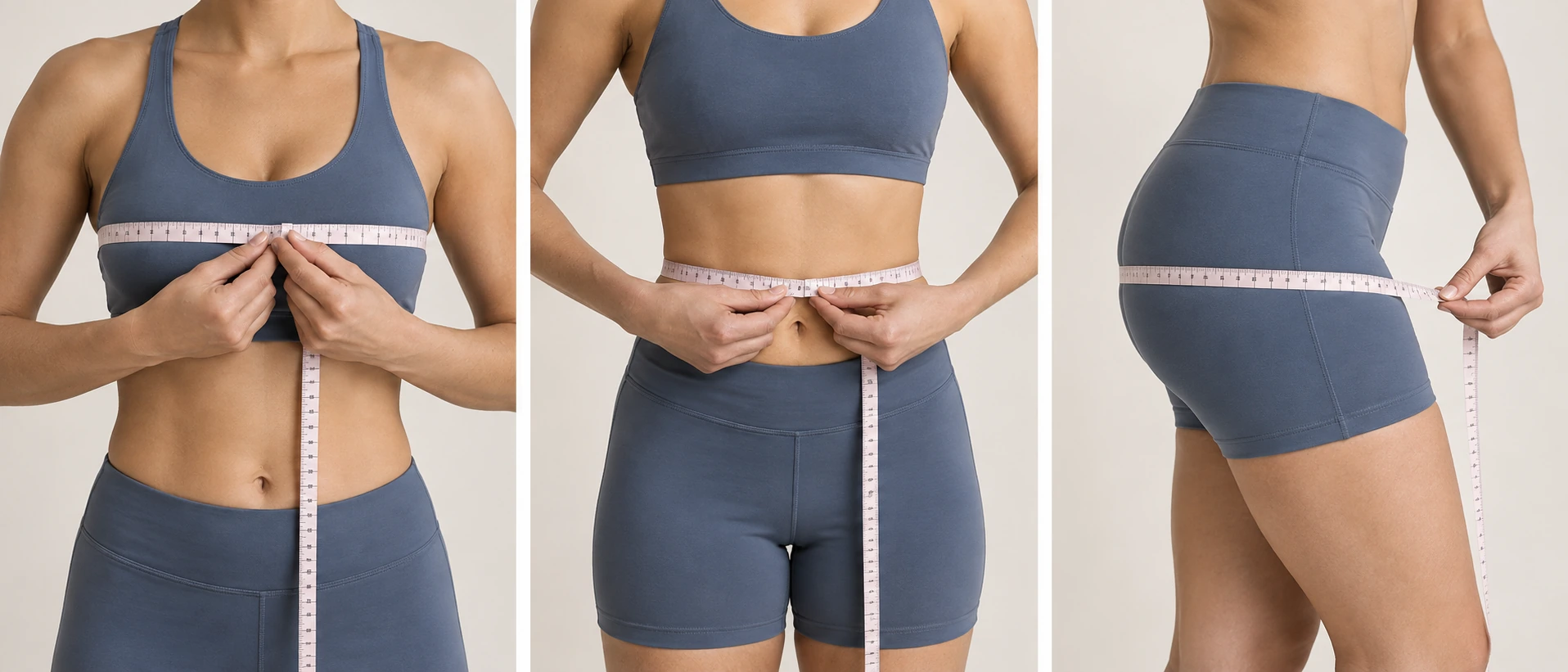
Chest / bustAround the fullest part
Natural waistAround the narrowest part
HipsAround the fullest part
Between sizes: when should you change size or cut?
Do not average the size labels or automatically choose the smaller one. First check the units and repeat the conflicting measurement. Then check the instructions for that model. ZONE3’s current guidance prioritizes weight, then chest measurement, then height when its chart points to different sizes. It also says sizing can vary between models. This is ZONE3’s approach, not a universal priority order for every brand.[2]
| What you notice | What to do next |
|---|---|
| Height needs a longer size, but circumference fits a smaller one | Check whether a longer cut is available. A larger standard size may also add unwanted width. |
| Chest or hips exceed the suggested body range | Ask about the adjacent size or a different cut. Do not assume the material will stretch enough. |
| Several measurements sit on shared size boundaries | Use the model-specific guidance and compare the shortlisted sizes in a proper fitting. |
| No row matches your proportions | Ask for another cut or model rather than forcing a single height-and-weight match. |
What do the common size labels mean?
Letter sizes such as S, M, L and XL describe positions within a brand’s range. They are not shared dimensions across brands. Some brands add longer or differently proportioned cuts; others use numbers. Orca, for example, lists numeric men’s triathlon sizes and MT (6T).[1] MT usually means medium tall: extra length rather than a simple move up to large. Check the brand’s definition. Treat another brand’s label as a new sizing decision, not a direct conversion.
This guide covers the neoprene wetsuit used for the swimming leg. A trisuit worn for swimming, cycling and running has its own sizing information.
Before judging shoulder tightness, follow our step-by-step wetsuit donning and removal guide. It explains how to position the legs, crotch and sleeves before closing the entry, and how to take a lined suit off without pulling on the cuffs.
Before buying a suit for a USAT event, check our USA Triathlon wetsuit rules guide for the applicable water-temperature band and equipment limits. Confirm your race category and follow the officials’ race-day decision.
Planning sizes for a triathlon wetsuit range?
Start with the intended wearers and preferred suit format. Browse INSEAKU’s triathlon and open-water wetsuit styles, then share your target market, proposed size coverage and any existing size chart or fit concerns.
Discuss your triathlon wetsuit project. MOQ: 50 units per style per color. The educational tables below are not sizing recommendations for these products.
Optional: how to read a garment-size chart
These examples explain measurement types; they cannot select your purchase size. Use the current body-size chart for your exact product and the fit checks above first.
Show the educational garment tables and worked example
These supplied tables cover women’s S–2XL and men’s S–3XL. They are educational examples, not INSEAKU product size charts or universal triathlon sizing. All chest, waist and hip values describe the unstretched garment. Height and weight are the source’s wearer references, not independently verified fit recommendations.[5]
80 cm is the women’s M garment chest in this example.
It does not tell you that an 80 cm body chest needs M. To select a suit, you still need its intended body-size range and a fitting.
| Size | Height ref. (cm) | Weight ref. (kg) | Garment chest (cm) | Garment waist (cm) | Garment hips (cm) |
|---|---|---|---|---|---|
| S | 150–155 | 42.5–45 | 76 | 64 | 78 |
| M | 155–160 | 45–52.5 | 80 | 68 | 82 |
| L | 160–165 | 52.5–60 | 84 | 72 | 86 |
| XL | 165–170 | 60–70 | 88 | 76 | 90 |
| 2XL | 170–175 | 70–80 | 92 | 78 | 94 |
Women’s 2XL waist is 78 cm, as confirmed by the data provider; it has not been changed to continue a pattern.
| Size | Height ref. (cm) | Weight ref. (kg) | Garment chest (cm) | Garment waist (cm) |
|---|---|---|---|---|
| S | 165–168 | 50–57.5 | 88–92 | 70–80 |
| M | 168–173 | 57.5–65 | 92–96 | 74–84 |
| L | 173–178 | 65–72.5 | 96–100 | 78–88 |
| XL | 178–182 | 72.5–80 | 100–104 | 82–92 |
| 2XL | 182–186 | 80–87.5 | 104–108 | 86–96 |
| 3XL | 186–191 | 87.5–95 | 108–112 | 90–100 |
The men’s circumference ranges are reproduced as supplied garment ranges. They are not wearer ranges, stretch allowances or stated production tolerances. The five matching source tables are consolidated here; identical numbers do not establish identical fit across styles.
Unit conversion: the original weights use Chinese jin. Multiply by 0.5 for kilograms: 130–145 jin becomes 65–72.5 kg. All dimensions above use centimeters.
Example: 175 cm tall and 70 kg
Those two values fall in the men’s L reference row (173–178 cm; 65–72.5 kg). That locates a row to discuss with the seller; it does not finish the sizing decision. The row’s 96–100 cm chest describes the garment. Ask which body chest range that model is intended to fit before ordering.
Sources
- Orca: Wetsuit Sizing Guide — examples of brand-specific size labels.
- ZONE3: What size am I in a wetsuit? — model-specific boundary-size guidance.
- 2XU: Men’s Wetsuit Size Guide — correct positioning and unrestricted movement/breathing.
- Blueseventy: Size Charts — general chest, waist and hip measurement locations; no other product category’s sizing ranges are applied here.
- Educational reference tables supplied to INSEAKU. Circumference definitions, Chinese-jin weight units and women’s 2XL waist confirmed by the data provider on 15 October 2026. Not INSEAKU current-product sizing; no trial-fit results supplied.
ZONE3 guidance and the Orca chart directory rechecked 9 November 2026; other sources were checked 15 October 2026. Always consult the current chart for the exact model.