
Use a wetsuit key pocket to hold a compatible key, but do not assume it is waterproof. Check the pocket closure and use its purpose-made retention loop as instructed. An electronic fob needs water protection suited to that exact key and activity, or secure storage ashore. Before entering the water, confirm that the loaded pocket closes properly and you can reach it without disturbing your suit.
Is a wetsuit key pocket waterproof?
A pocket, a retaining loop and a waterproof case solve different problems. Finding one does not prove you have the others. Unless the manufacturer explicitly documents water protection for that pocket, treat its contents as exposed to water.
| Feature | Useful for | Does not prove |
|---|---|---|
| Pocket + closure | Keeping a suitably sized item tucked away. | Waterproof storage or a secure attachment. |
| Key loop | Attaching a compatible key as instructed. | A watertight seal or unlimited strength. |
| Rated key case | Water protection within its stated conditions. | That it fits the pocket or cannot be lost. |
For example, O’Neill lists an external key pocket with a loop on the cited Hyperfreak 4/3mm Comp Zipless Full model. That feature description is not, by itself, a waterproof-storage claim. [2] The same distinction applies to life jacket pockets and water protection, although their storage layouts differ.
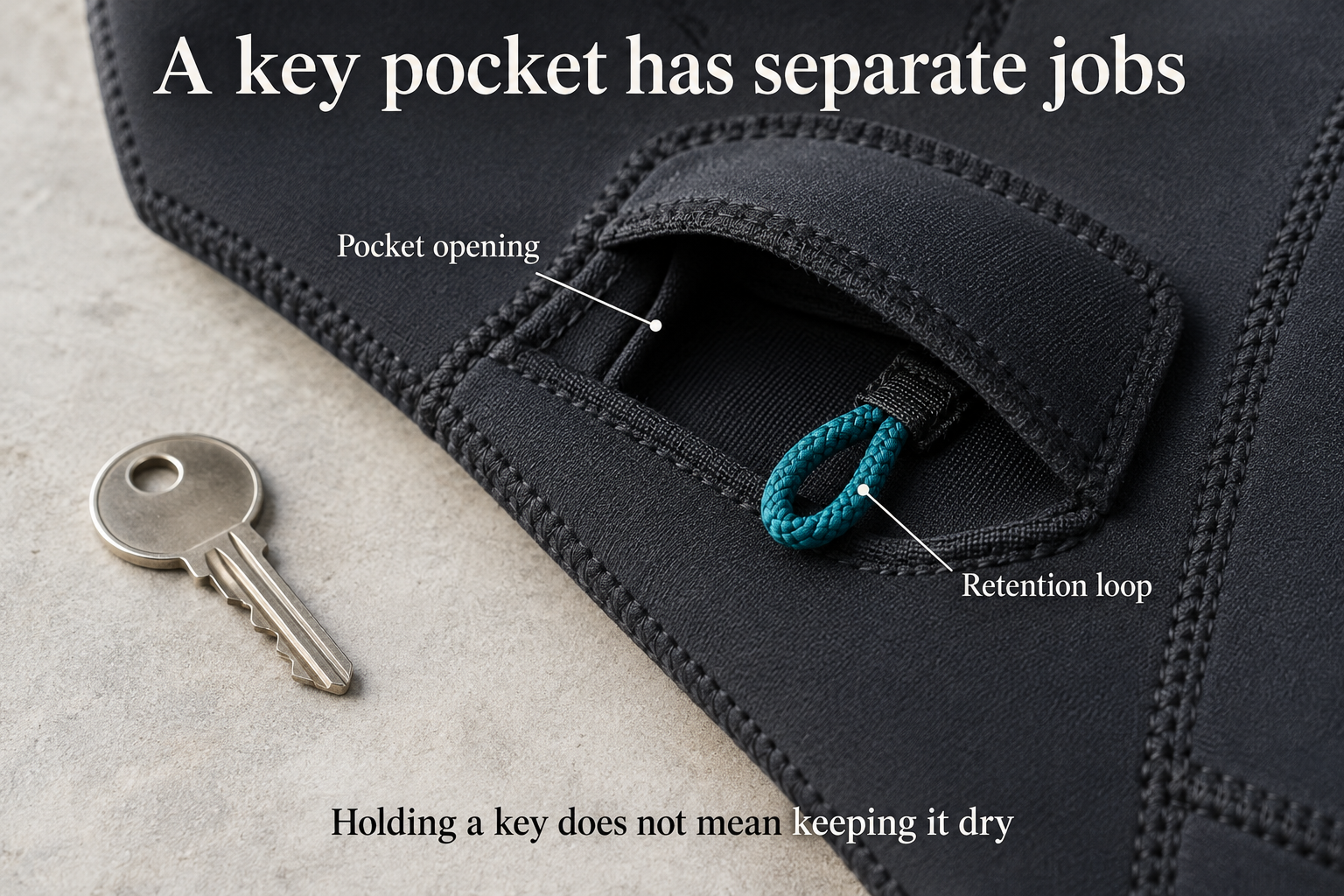
AI-generated illustration. Generic construction concept; not an INSEAKU product photo or a universal key-attachment method. View full size.
Where is the key pocket on a wetsuit?
Look up the exact model rather than searching one assumed location. Some pockets are hidden in a leg panel; others are described as external or internal. Even within one brand, the location and closure can change between models.
O’Neill’s cited Reactor 3/2 back-zip model locates its hidden pocket in the right leg below the knee. [1] That is a useful model-specific example, not a rule for every O’Neill suit or every wetsuit.
With the suit dry, identify the pocket entrance, closure and any dedicated key attachment. Do not mistake a drainage opening, lining fold or zipper pull for a storage feature. If the product description only says “key pocket,” ask where it is and how the key is meant to be secured before using it.
How do you secure a key in the pocket?
Do the first check on land, using the key you actually intend to carry:
- Identify the key. Check whether it is a purely mechanical key, a key containing electronics, or a detachable blade with limited functions. A familiar shape or lack of buttons is not enough to establish water resistance.
- Inspect the attachment. Look for frayed cord, damaged stitching and a closure that no longer holds. Use only the intended key loop and the attachment method supplied for that model; do not improvise an attachment to the suit’s entry zipper.
- Stow and close. The key and any required protective case must fit fully inside without forcing the closure, stretching the opening or leaving a sharp edge pressing into the material.
- Check movement and access. Put the suit on and bend or move as you would during the activity. Check for pressure, snagging or a closure pulling open. Retrieve the key on land; do not learn the process while floating in the water.
There is no universal knot or loading method for every key loop. If its intended use is unclear, get the model’s instructions. A dry handling check can reveal an obvious problem, but cannot certify retention through waves or repeated use.
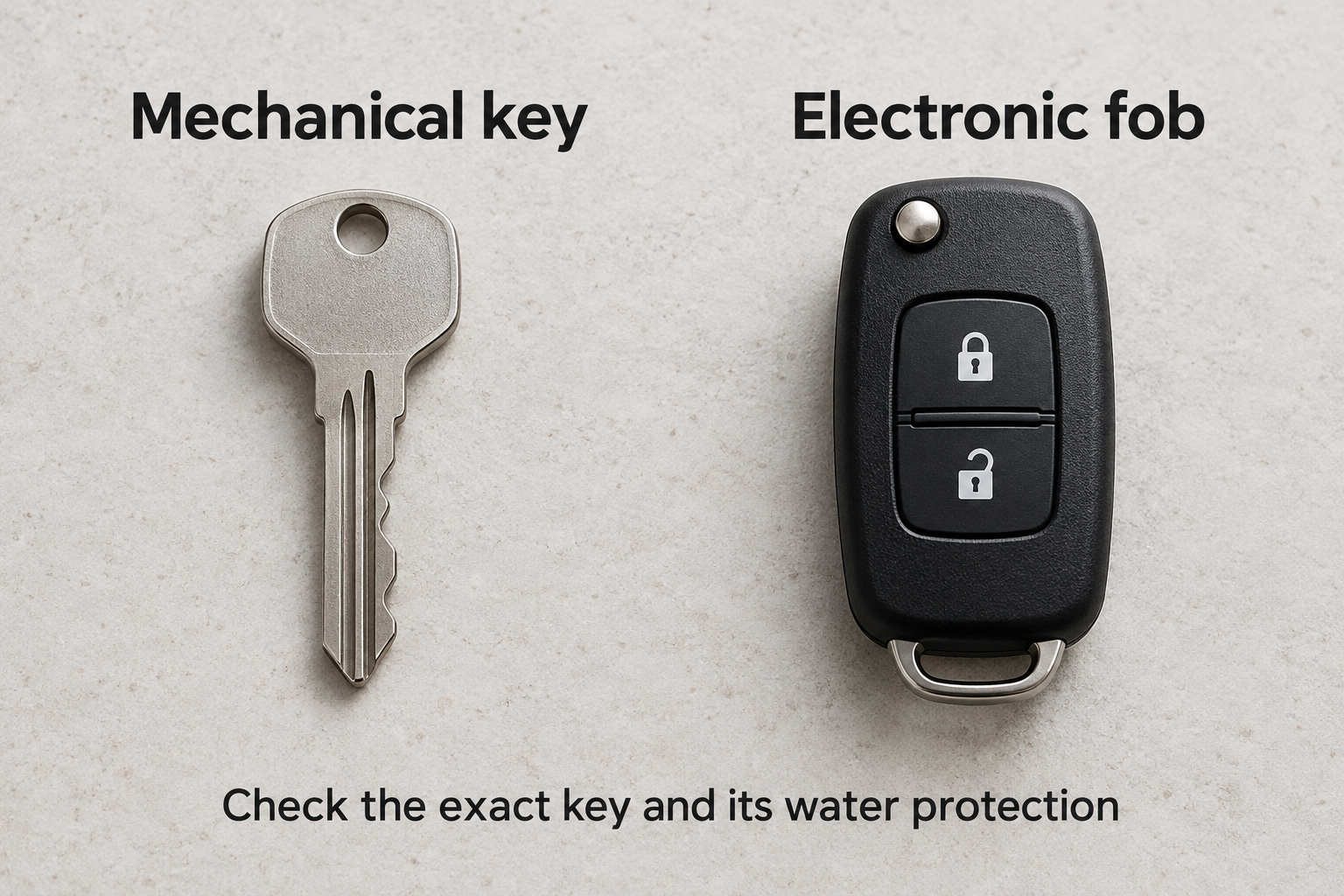
AI-generated illustration. Generic key examples; appearance alone does not establish electronics, functions or water resistance. View full size.
Can you put an electronic car key in it?
Not unprotected unless that exact key is documented for the intended water exposure. A neoprene pocket does not give a fob a water-resistance rating. If protection is needed, use a case whose maker specifies appropriate immersion conditions and intended activities—or arrange secure dry storage ashore.
Check the case dimensions with the actual key inside. A fob that fits by itself may become too bulky once protected. A case also needs its own secure carrying arrangement; simply squeezing it under a tight wetsuit is not a substitute for one.
Are all electronic keys unsuitable for water?
No. Some have explicit, model-specific protection. Volvo’s cited S60 support page distinguishes the optional buttonless Key Tag from the standard key and specifies approximately 10 metres for up to 60 minutes for that Key Tag. [3]
Those figures belong to the specified accessory, not every Volvo key, another fob or a wetsuit pocket. Verify the instructions and condition of your exact key; do not infer protection from a similar appearance.

AI-generated illustration. Generic case concept; not a tested product, an Aquapac replica or an INSEAKU supply offer. View full size.
Before relying on a protective case, follow its maker’s inspection and test procedure without risking the car key. Aquapac’s published user guide, for example, describes a pre-use check with a nonvaluable item, warns against material caught in the clamp, and calls for inspection for visible damage. [4] Follow the instructions supplied with your current case, since closure systems differ.
Keep sharp edges from damaging the pouch and do not open it in the water. On shore, remove exterior water before opening it as directed. A successful home check is not a new waterproof certification or permission to exceed the case’s stated conditions.
What should you check before heading out?
| Check | Ready when | If not |
|---|---|---|
| Retention | The intended attachment and closure work as instructed. | Resolve damage or unclear instructions first. |
| Protection | The key or case is suitable for the planned exposure. | Use appropriate protection or secure dry storage. |
| Fit + access | The loaded pocket closes; movement and retrieval work on land. | Change the carrying arrangement; do not force it. |
| Car access | You have confirmed how the carried key unlocks your vehicle. | Check the vehicle manual before relying on it. |
A detachable mechanical blade may have a different role from the complete fob. Do not assume it starts the vehicle, disables the alarm or makes leaving another key inside a reliable plan. Check your vehicle’s instructions and arrange storage that does not compromise vehicle security.
For brands developing a pocket, use the same checks with the proposed key dimensions, closure and attachment instructions. Specify retention, water protection and access separately; avoid calling an ordinary pocket waterproof. You can include these requirements in an INSEAKU development brief, with the actual construction and available options to be confirmed.
Sources
Checked 14 October 2026; source [2] updated 17 October 2026. Brand examples apply to the cited models. Illustrations and comparison tables explain functions; they do not establish features of an INSEAKU production model.
- O’Neill — Reactor 3/2mm Steamer Back Zip, 5040OA2-BLU3. Model-specific hidden-pocket location.
- O’Neill — Hyperfreak 4/3mm Comp Zipless Full. External pocket and loop feature description.
- Volvo — S60 Keys, model-specific support page. Standard-key and optional Key Tag distinction; stated water-protection conditions.
- Aquapac — User Guide, English section, page 1. Inspection, closure, pre-use testing and opening care. Follow the instructions for the current case; no warranty or depth claim is transferred here.