
Compare bulk life jacket price only after the product specification, quantity breakdown and delivery scope match. A lower unit price can leave out the logo, individual packing or transport you need. First ask suppliers to quote the same requirement; then compare the total cost to the same destination, adding each missing cost once. A blank charge is not a zero charge.
What must match before comparing life jacket price?
Send one specification to every supplier. “Adult life jacket, blue, with logo” leaves too much open. Start with the intended activity, users and destination market, then identify the model and supporting evidence required for that use. Our buoyancy aid vs life jacket guide explains why the product name alone does not establish its suitability.
| Match this | Write it into the request | Otherwise |
|---|---|---|
| Use and evidence | Activity, users, market and required model-specific documentation. | A cheaper quote may cover a different use. |
| Build | Model revision, fabric, foam specification, zipper, buckles and straps. | Similar photos can hide different components. |
| Finish | Logo method, size and position; labels, instructions and packing. | Required finishing may be charged separately. |
| Order and delivery | Pieces by style, color and size; named destination and delivery term. | The quoted quantities or transport scope differ. |
For the finishing specification, use our branded life jacket guide to define logo placement and labels. Our zipper vs buckle guide helps describe the closures that each quote must cover.
Keep the approved sample or drawing revision attached to the request. If a supplier proposes a different buckle, foam or panel layout, ask for it as a separate alternative with the change identified. Do not silently mix that alternative into the like-for-like price comparison. A matching foam thickness or exterior photograph does not establish equivalent performance.
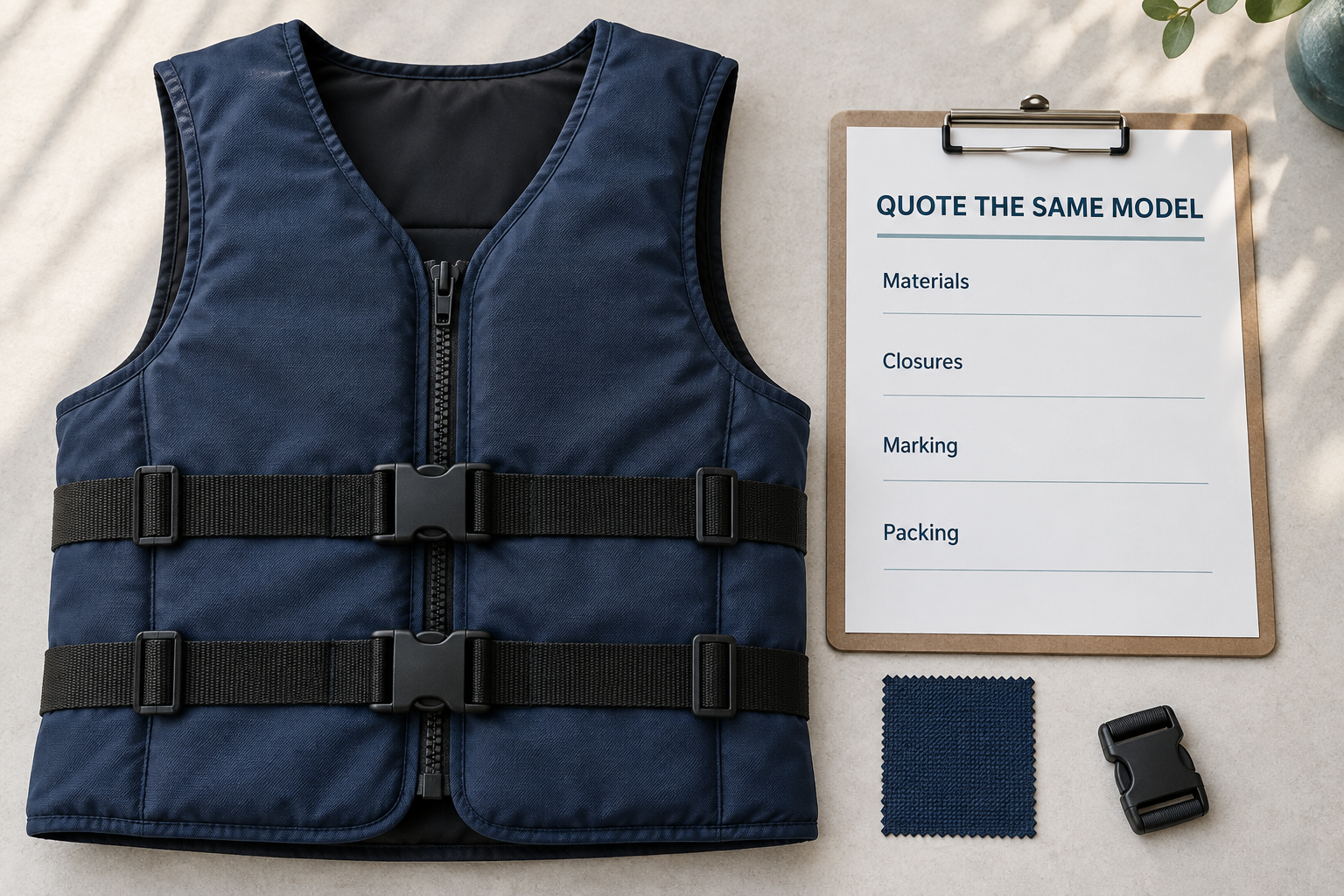
AI-generated illustration of a generic vest and simplified brief; not an approved INSEAKU sample. View full size.
Does 100 pieces meet the minimum order?
Not necessarily: check whether the minimum applies to the total order or to each style and color. INSEAKU’s published terms for the black-and-cyan design reference state 50 pieces per style and color, with S–3XL sizes mixable within an order. [1] Confirm the proposed size and color breakdown in the written quote.

Illustrative one-style allocations using the cited 50-piece per-style, per-color minimum. Not accepted orders or price data. Source: INSEAKU design 2191, checked 14 October 2026. View full size.
The chart uses that published minimum for an illustrative, single-style allocation: two colors at 50 each total 100 and reach the per-color minimum. Four colors at 25 each also total 100 but fall below it. Four colors at 50 each total 200. These are arithmetic examples, not accepted orders or quoted prices.
More colors offer assortment breadth, but can require more stock to reach a per-color minimum. If the budget is fixed, ask whether fewer colors would make the first order workable. Do not assume a supplier will waive the minimum or offer the same price for a different mix.
Which costs belong in the comparison?
Compare what you will pay for the agreed order, not just the number beside “per piece.” First settle the specification and quantities. Then mark each cost as included, separately charged or still unconfirmed.
| Cost item | Quote A | Quote B |
|---|---|---|
| Specified vests | Included | Included |
| Agreed logo setup | Included | Separately charged |
| Individual bags | Included | Not stated |
| Freight to agreed destination | Separately charged | Not stated |
Fictional scope example. No prices are supplied, so neither quote can be ranked as cheaper. “Not stated” means ask; it never means free.
For this example, obtain B’s logo charge and packing answer, and the missing freight costs for both quotes. Also identify any applicable sample, tooling, inspection or testing charges, including whether they are one-time fees or recurring costs.
Comparable total = quoted goods + required costs not already included.
Use one currency and the same delivery endpoint. Add each cost once; keep unresolved amounts marked “awaiting quote.”
For a buyer’s delivered-cost estimate, relevant additions can include freight, insurance, duties, taxes and other fees. Trade.gov explains these as components of landed cost. [3] Confirm which apply to the destination and which are already covered. Do not reuse another shipment’s tax rate or add transport twice.

AI-generated packaging illustration, not actual factory packing or proof of cost or protection. View full size.
Specify individual bags, carton quantities and any required labels before comparing packing charges. The two options above describe different packing scopes; the illustration makes no claim that one costs less or protects better.
How should one-time charges be compared?
Keep the first-order total separate from a possible repeat-order estimate. Ask whether logo setup, sampling or tooling charges recur, and whether any credit is conditional on a later order. Do not deduct an unconfirmed credit.
Once every required cost is known, divide the comparable total by the agreed number of pieces for a per-piece comparison. Keep any assumptions about exchange rates and tax recovery visible. An incomplete total should not be presented as the final delivered price.
Does “delivery included” mean delivery to your door?
Ask for the exact place and delivery term. A quotation that stops at a departure point cannot be compared directly with one that includes transport to your warehouse. When using Incoterms, record the chosen rule, named port or place, and version—for example, “DAP [full delivery address], Incoterms 2020.” This is a format example, not a recommendation to choose DAP.
ICC explains that Incoterms allocate obligations, costs and risk, but do not define the product specification or payment arrangements. [2] Agree on currency, payment schedule and quote validity separately, and confirm responsibilities for import clearance, duties, unloading and any delivery access restrictions.
Also separate production time from arrival time. The cited INSEAKU design page lists bulk production within 30 days. [1] It does not establish a 30-day delivered-to-you promise. Confirm what starts the production period, then obtain the shipping estimate and any other timing conditions in writing.
To request a comparable offer through INSEAKU’s OEM and ODM services, send the intended use and market, model or drawing revision, size-and-color quantities, logo and packing requirements, delivery address and required arrival date. Ask the supplier to identify every deviation and exclusion. Choose on the confirmed specification and complete cost—not an attractive but incomplete unit price.
Sources
Checked 14 October 2026. Published order terms concern the cited INSEAKU design; confirm current project terms in writing. The chart allocations and quote comparison are editorial examples.
- INSEAKU — Custom Black and Cyan Panel Life Vest. Published minimum, size mix and production time; no public unit price.
- ICC — Incoterms and Commercial Contracts. Scope of the rules and use of a named place and version.
- US International Trade Administration — Determine Total Export Price. Landed-cost components and the need to confirm shipment-specific charges.