
Life jacket pockets are not automatically waterproof. A zip, flap or mesh panel can help organize belongings without keeping them dry during immersion. If you are looking for a life jacket with a waterproof pocket, check the claim for the complete pocket assembly—or use a separate protective pouch whose instructions match your intended use.
Start with the object you need to carry, the water exposure you expect and how you will reach it while wearing the vest. This guide separates those decisions for users, operators and brands. It covers pocket storage; it does not establish the flotation category or suitability of a particular life jacket or buoyancy aid.
For the separate classification question, see our guide to buoyancy aids versus life jackets.
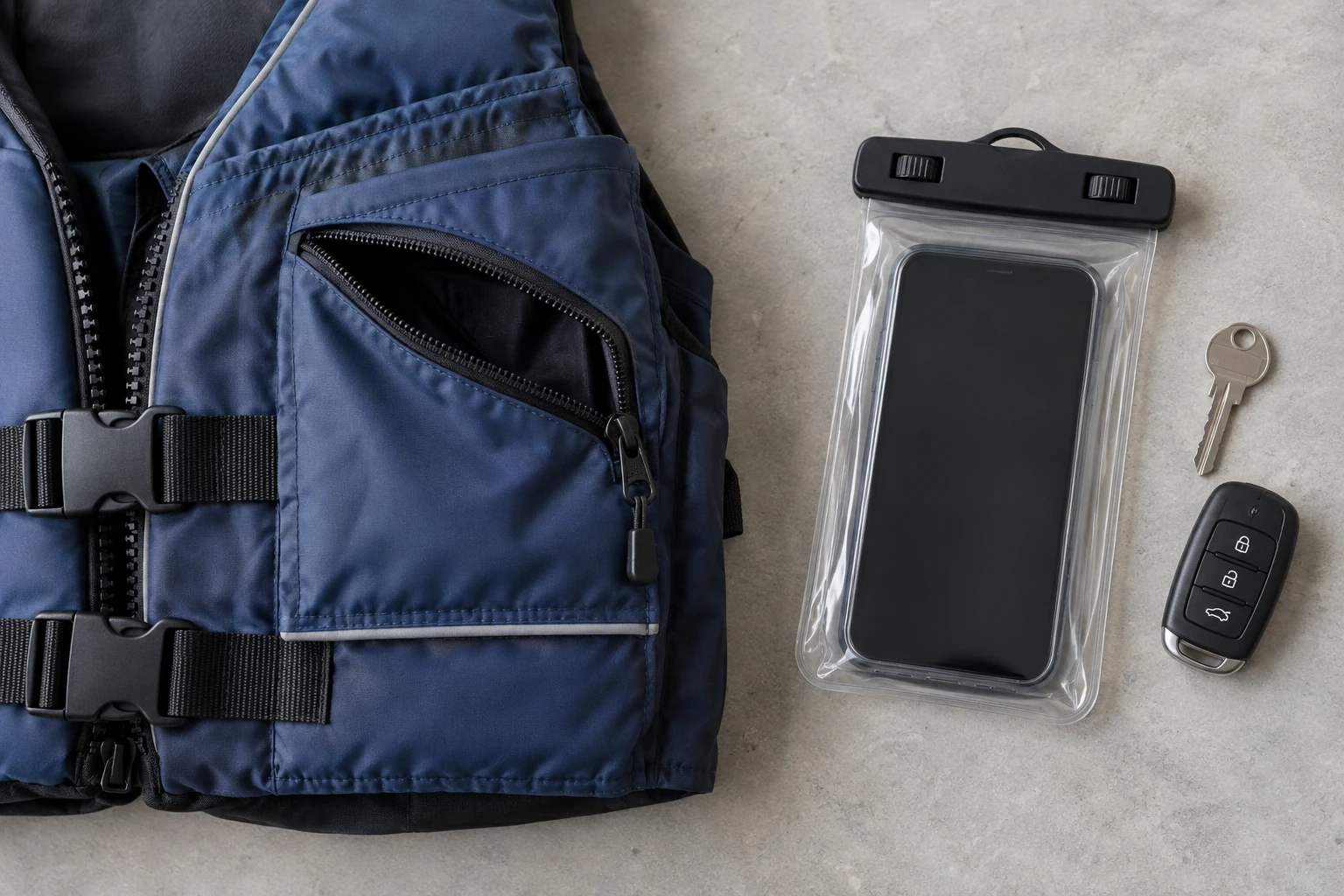
1. Life jacket pockets: four different jobs
A useful pocket can hold an item in a predictable place, let water escape, reduce some surface wetting or form part of an enclosure intended to keep water out. Those are separate functions. A pocket with drainage may be well suited to wet-compatible equipment while being the wrong place for an unprotected electronic key.
Fasten and adjust the vest before checking pocket access. Our guide to life vest closures and strap adjustment explains what to check around webbing, buckles and loose strap ends.
Keep branding clear of pocket access and closures. See how to plan logo placement on branded life jackets when reviewing a customised version.
The key distinction is what happens to water inside the compartment. Drainage provides an exit after water enters. Immersion protection requires an effective barrier around the contents under stated conditions. Do not turn a visible mesh panel into a claim about how quickly the pocket drains, or a smooth-looking zipper into a claim about submersion.
Storage is not a water barrier.
Choose the job first. These functions are not a ranking of pocket quality.
| Function | Main benefit | Limit and check |
|---|---|---|
| Storage | Keeps an item in a known place | Retention does not establish dryness.
What to checkCheck the closure, loading instructions and whether the item can escape during the intended activity. |
| Drainage | Lets admitted water leave a compartment | Contents can still get wet.
What to checkConfirm the drainage path on the actual sample; a photo does not establish a drainage rate. |
| Splash resistance | Addresses a stated level of surface exposure | Do not assume immersion protection.
What to checkAsk which complete assembly was evaluated and what exposure conditions support the claim. |
| Immersion protection | Protects the named enclosure within stated limits | Closure condition and use limits still apply.
What to checkRead the exact model instructions and evidence; no such performance is assigned to the pictured vest. |
A zipper description is not a pocket test
The closure is only one part of the assembly. Fabric, seams, attachment points and the way the closure is installed also need consideration. YKK, for example, describes VISLON® AquaGuard® as water repellent rather than waterproof or watertight. This is a component example, not identification of the zipper fitted to an INSEAKU vest. Read YKK’s zipper guidance.
Ask the supplier to name the closure and explain the claim for the finished pocket. If the answer only describes the fabric or zipper, the whole-pocket claim remains unresolved. Avoid replacing that missing evidence with a photo of water beading on the outer surface.
2. Give phones, keys and small items different storage plans
A phone, a bare metal key and an electronic car key do not need the same storage arrangement. Think about water sensitivity, sharp edges, bulk and whether the item must remain available during the activity. Then choose a location and enclosure together.
Match the storage to the item.
The priorities stay visible below. Choose an item to explore its handling checks.
| Item | Priority | Main trade-off |
|---|---|---|
| Phone | Protect it and keep it reachable. | The loaded pouch adds bulk; check controls, opening clearance and access. |
| Keys | Separate bare metal from electronics. | A remote fob needs its own exposure check; sharp metal can damage a soft enclosure. |
| Small items | Give each item a purpose and a place. | More contents can obstruct the closure or other equipment. |
Phone: practical checks
Benefit: A separate suitable pouch can protect the device while the pocket organizes it.
- Measure the complete phone-and-pouch setup.
- Follow the device and pouch instructions.
- Keep the communication arrangement compatible with the activity.
Keys: practical checks
Benefit: A dedicated location can make a key easier to find and keep it away from the phone.
- Identify whether the key contains electronics.
- Keep sharp edges away from the phone and pouch.
- Confirm permitted retention points; avoid functional handles and straps.
Small items: practical checks
Benefit: Separating frequently used items can reduce searching through a loaded pocket.
- List the actual contents and expected wetting.
- Review access with the vest fitted and loaded.
- Follow the garment’s loading and attachment instructions.
Phones: protection must still allow access
Measure the phone inside the protective pouch you intend to use, including the closure and any fitted case. Confirm whether you can operate the controls you need through it. A pouch that accommodates the screen can still be awkward to grip, insert or remove from a pocket.
The RNLI recommends keeping a means of calling for help within reach and protected from water. Its boating guidance also makes clear that communication choices depend on the activity and operating area. A phone pouch is not a substitute for planning appropriate communications. See RNLI guidance on equipment and calling for help.
Keys: identify the key before choosing its place
A bare metal key mainly raises questions about retention and sharp edges. A remote fob adds electronics and a need to check its own water-exposure limits. Do not treat them as interchangeable because both are called “keys.” Keep a sharp key from pressing against a phone or a soft pouch wall, and confirm any attachment point with the vest manufacturer.
More clips and longer cords do not automatically make storage better. Review snagging, release and access for the actual activity. Do not attach an item to an inflation handle, adjustment strap or other functional part just because it is easy to reach.
Small items: organize by use, not by spare space
Decide which items need immediate access and which can stay stowed. Avoid filling every available compartment without checking the loaded vest. Bulky contents can change how a pocket sits, obstruct its opening or interfere with other equipment. Review the loaded arrangement against the manufacturer’s instructions instead of assuming that a pocket’s empty appearance proves its useful capacity.
3. Check the pouch, pocket opening and wearing position
“Fits a large phone” is an incomplete specification. Record the external size of the loaded pouch, the usable pocket space and the opening it must pass through. Keep units consistent and identify the garment size and sample revision that were measured. Dimensions taken from a photograph are not usable sample measurements.
Compare the loaded pouch, not the bare phone.
Enter your own measurements in the same insertion orientation. Difference = pocket space − loaded pouch size.
Enter six measured dimensions to compare the space.
No model dimensions are pre-filled. This tool does not assess water protection.
Interactive calculation needs JavaScript. Use the measurement table and subtract pouch size from usable pocket space for each corresponding dimension.
The tool compares three corresponding dimensions only. A positive difference does not prove that a pouch passes through a curved opening, clears a zipper slider or leaves enough room for your fingers. Agree the necessary handling allowance with the supplier and confirm it using the real object or an accurate dummy. There is no universal clearance value in this guide.
| Measurement | How to record it | Why it changes the decision |
|---|---|---|
| Loaded pouch width, height and thickness | Include closure, phone case and protruding parts; use mm | A bare-phone size can understate the space needed |
| Usable pocket space | Record the intended insertion orientation and vest size | The outside panel size is not the internal capacity |
| Clear opening | Measure the available opening with the closure fully open | A large compartment can still have a restrictive entrance |
| Loaded access and closure | Record the wearer, clothing, posture and glove configuration | Fit on a table does not establish access while worn |
Check access on land before the activity
Fit and adjust the vest according to its instructions, then place the intended contents in the permitted compartments. Try the reach in the normal working posture: seated if that is how the vest will be used, and with the clothing or gloves expected for the task. Keep the trial controlled and on land; do not enter the water merely to test a pocket.
Record whether the wearer can locate the closure, open it, grip the item, remove it and close the pocket again without loosening the vest. Check for contact with buckles, straps and other equipment. If the arrangement interferes with the garment’s intended operation, revise the contents or discuss an approved configuration rather than modifying a safety-critical part.
For purchasing teams, record observable outcomes rather than an unsupported “easy access” score. Useful notes include “closure blocked by the loaded pouch” or “item retrieved while seated without moving the buckle.” Repeat the agreed check when the pouch, pocket pattern or garment size changes.
4. Check what the water-protection claim actually covers
Look for a named product, a defined exposure and instructions that explain correct use. “Waterproof” on its own does not tell you the depth, duration, closure condition or condition of the sample that was tested. An enclosure’s claim also does not transfer to the vest surrounding it.
| What you see | What it can tell you | What to confirm |
|---|---|---|
| A water-repellent material or closure | A component has a stated water-related property | Finished-pocket evidence and limits of the claim |
| An IP code on a device or case | The named enclosure has a stated protection classification | Exact model, test conditions and current instructions |
| A garment performance label | Information about that garment’s stated category or specification | Separate evidence for any pocket water-protection claim |
| A pre-use pouch check | An opportunity to detect an obvious issue before use | Follow that pouch’s instructions; this is not certification |
IEC 60529 is the standard for degrees of protection provided by enclosures for electrical equipment. It is not a flotation standard. Where an IP code is cited for a device or case, identify the exact enclosure and the supporting conditions instead of assigning that code to an entire vest. See the IEC 60529 scope.
Likewise, do not rely only on a phone’s original rating. Apple explains that water resistance can decrease with wear and advises against intentional submersion and several high-velocity-water exposures. Check the instructions for your own device; the statement does not establish the performance of a third-party pouch. Read Apple’s water-resistance guidance.
Use the pouch’s own closing and inspection method
Aquapac’s ziplock-case instructions call for a pre-use check with something of no value inside, keeping sealing surfaces free of debris and closing the entire seal carefully. They also say not to open the case in or under water. Follow the instructions for the exact pouch you own; another closure can require a different procedure. Read the Aquapac instructions.
A home check with a disposable insert can reveal a problem, but it does not establish a certified depth or duration. Do not use a valuable phone as a test object. If a closure is damaged, contamination cannot be removed or the result is uncertain, stop relying on that setup until the issue is resolved according to the manufacturer’s guidance.
5. Specify the contents before asking for a custom pocket
For a brand or operator, “add a waterproof pocket” leaves too many decisions open. A more useful brief names the object, its enclosure, the intended exposure and the access task. It also separates a requested performance target from a verified result.
The supplied front and back images of INSEAKU’s Custom Blue Utility Life Vest with Pockets provide a reference for the visible layout. They show front pocket assemblies and the rear panel layout. Internal pocket construction, usable dimensions, drainage performance and water-protection limits are not established by these photographs.
Front: pocket layout

Back: rear panel layout

Use that reference to identify a starting design, then ask for the missing sample information. The photos do not verify a particular phone fit, an approved equipment attachment or a flotation classification. No pocket dimensions or immersion results for this model are supplied in this guide.
| Field | What the buyer should provide | What the supplier should confirm |
|---|---|---|
| Object and enclosure | Exact item and loaded-pouch dimensions | Fit with the named sample and size |
| Location and access | Preferred side, posture, clothing and gloves | Opening, reach and interference checks |
| Retention | How loss will be addressed during normal use | Permitted attachment and loading instructions |
| Water exposure | Expected splash or immersion conditions | Assembly scope, evidence and use limits |
| Drainage and care | Whether contents may get wet; cleaning context | Drainage arrangement and care instructions |
| Version control | Sample reference and proposed configuration | Approved specification and changes needing review |
Make the gaps visible before ordering.
Mark the information you have recorded. Missing items remain questions for the supplier.
0 of 6 records marked
Next to record: item and enclosure.
Use the list as a static worksheet. Enable JavaScript for counting.
Download the blank pocket requirements sheet (ZIP) to collect measurements and evidence references. Extract the ZIP, then complete the CSV locally. Keep unknown values blank until confirmed. A supplier response should identify the sample and any changes needed; checking every box does not turn an untested claim into an approved one.
For a custom project, explore INSEAKU’s OEM, ODM and private-label development services, then send your pocket brief and reference design. Include the object, enclosure, use conditions and open questions so the proposed specification can be reviewed during sampling.
Frequently asked questions
Are life jacket pockets waterproof if they have zippers?
Not automatically. A zipper can retain contents without creating a watertight compartment. Check the claim for the finished pocket, including its seams, closure installation and stated exposure conditions.
Can I put my phone directly in a life jacket pocket?
Do not assume the pocket protects it from water. Check the phone’s instructions and use a suitable protective enclosure where needed. Confirm that the complete setup remains accessible and compatible with the vest.
Is a draining pocket a poor design?
No. Drainage can be a useful requirement for contents that may get wet. It solves a different problem from keeping electronics dry, so specify the required function before judging the design.
Will a waterproof phone pouch float?
Do not infer flotation from a water-protection claim. Check the pouch manufacturer’s instructions for the actual loaded configuration and follow its retention guidance. No flotation claim is made for the illustrated pouch.
Does the blue INSEAKU vest have verified waterproof pockets?
The available product information and supplied images do not establish that claim. Ask for sample measurements, construction details and evidence for the precise performance you require before adding it to a specification.
For suit-specific storage, see our wetsuit key pocket guide, which separates key attachment, water protection and access.
References and further reading
- YKK — Caring for AquaGuard® and AQUASEAL® zippers: component descriptions and handling guidance; not identification of INSEAKU components.
- RNLI — What safety equipment do you need on a boat?: accessible, protected communications and activity-specific planning.
- IEC — IEC 60529:1989: public scope of the enclosure-protection standard; full test clauses are not reproduced here.
- Apple — About splash, water and dust resistance: device-specific limits and the effect of wear.
- Aquapac — Instructions for Ziplock Cases: model-specific pre-use, closure and opening instructions.
Sources checked 6 October 2026. The comparison, measurement worksheet and supplier checklist are editorial purchasing tools, not test reports or product approvals.