
Yes, if the manufacturer specifically allows that model and size to be used for lifting your dog in that situation. Some dog life jacket handles are designed to help a dog out of the water. That does not automatically make them carrying handles or hoisting points. A D-ring described as a leash attachment is not a lifting point.
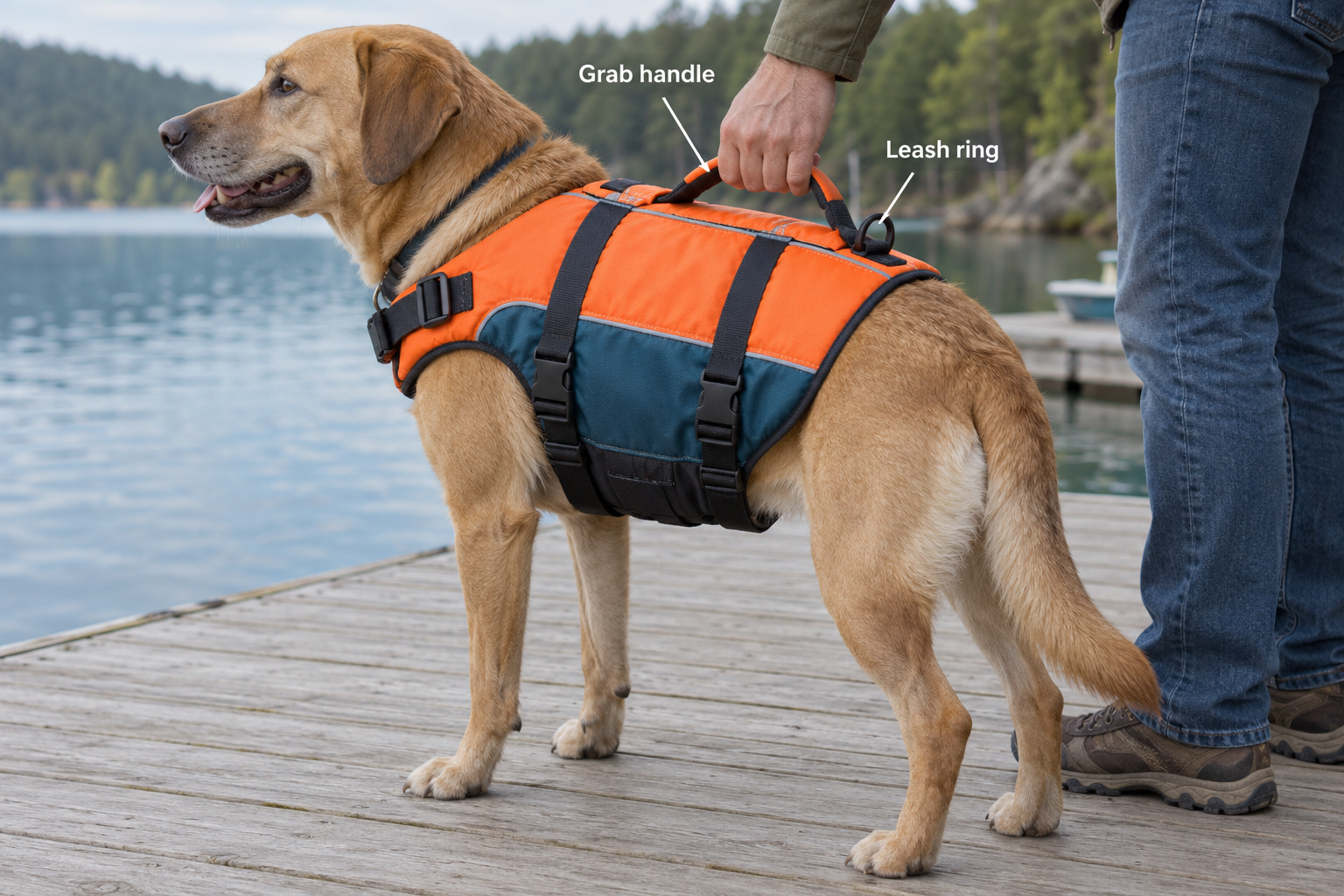
AI-generated illustration. Generic component identification; dog remains supported on the dock. Not a lifting demonstration. View full size.
Helping onto a boat is different from carrying
Start with the task, then check the product’s instructions. Ruffwear describes the Float Coat handle as helping dogs out of the water. EzyDog separately describes the DFD’s grab handle for lift-and-rescue situations and its D-ring for a leash after swimming. Neither description should be transferred to an unrelated jacket. [1] [2]
| Your task | What to confirm | Do not assume |
|---|---|---|
| Help out of water | Handle use, correct size, fitting and support instructions. | Every visible handle is intended for this. |
| Carry off the ground | Explicit permission for carrying and any limits. | Water-assist wording covers prolonged carrying. |
| Attach a leash | The designated ring or loop and permitted use. | A leash ring can take a lifting or hoisting load. |
If the instructions only say “grab handle” without explaining its use, ask the manufacturer before relying on it. Plan how the dog will get back aboard before entering the water. Do not discover the handle’s limits by suspending your dog.
A handle also does not replace flotation, fit or supervision. For the wider question, see why even strong swimmers may need a dog life jacket.
A dog life jacket handle is only one part of the support
The handle is where your hand applies force. The jacket’s attachments, panels, closures and body fit determine how the rest of the garment supports the dog. A thick padded grip can feel substantial without telling you how its attachments were built or tested.
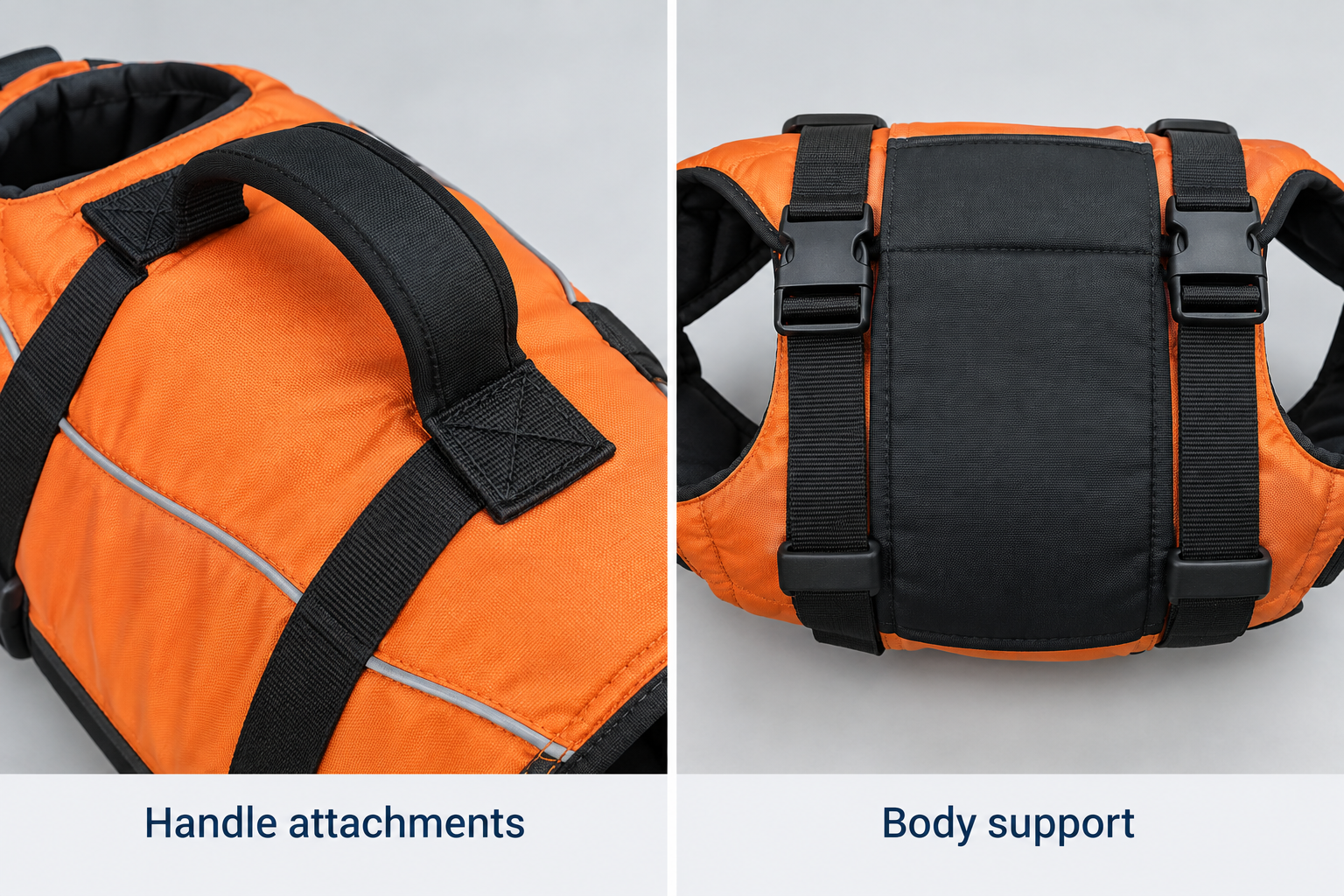
AI-generated illustration. Generic visible construction examples, not hidden reinforcement or a tested INSEAKU sample. View full size.
Look at both ends of the handle, the surrounding fabric and the underside of the jacket. Check whether the belly wrap and straps sit as intended, whether buckles close fully, and whether the jacket shifts when the dog walks. Our dog life jacket fit guide covers the separate sizing checks.
Non-stop dogwear describes a wrap system and wide chest straps on its Protector model as distributing pressure. That is a model-specific design explanation—not proof that any broad-looking panel will support a dog correctly. [3] A photograph cannot show hidden reinforcement or establish attachment strength.
Are two handles better than one?
They may offer another place to assist, when designed and used that way. Ruffwear’s Confluence has a second rear handle specifically described as providing additional lifting support. [4] Two handles do not mean twice the lifting capacity. Follow that model’s instructions for which handles to use and how to support the dog; do not invent a technique from their positions.
Does the weight range tell me what the handle can lift?
Do not treat a sizing or flotation figure as a handle load rating. A number is useful only when you know what it describes. If a seller supplies a strength result, ask whether it covers the complete finished jacket or just a piece of webbing.
| Information | What it describes | Still needed |
|---|---|---|
| Dog weight / girth range | The manufacturer’s sizing guidance. | Whether lifting is permitted for that model and size. |
| Flotation figure | The stated buoyancy-related specification. | Separate handle and attachment requirements. |
| Strength test result | Performance of a stated sample under stated conditions. | Its link to the finished product and permitted use. |
A breaking load is not automatically a permitted working load. Test direction, fixture, sample size, conditioning and acceptance criteria all affect what a result can support. There is no universal lifting limit that can be read from the shape of a handle or the size label.
For brands and buyers: what should the supplier confirm?
Request a written answer tied to the exact jacket model, size and revision: the intended handle use, any limitations, the designated leash attachment, and the required fitting and support instructions.
If lifting is claimed, request the supporting verification and ask which finished-jacket sizes and attachment assemblies it covers. A webbing-only result does not validate the seams, closures or whole garment. Agree on appropriate verification with the supplier or a competent test provider; do not use a live dog for an improvised load test.
Use those confirmed limits in the product description and instructions. Avoid unsupported phrases such as “lifts any dog” or “rescue rated.”
Check for damage before relying on the handle
Inspect the handle, both attachment ends, nearby shell fabric, belly support, straps and buckles. Frayed webbing, broken attachment stitching, torn fabric or a damaged closure are reasons to stop using the jacket and contact the manufacturer. Do not test a suspect attachment by pulling harder or lifting the dog.
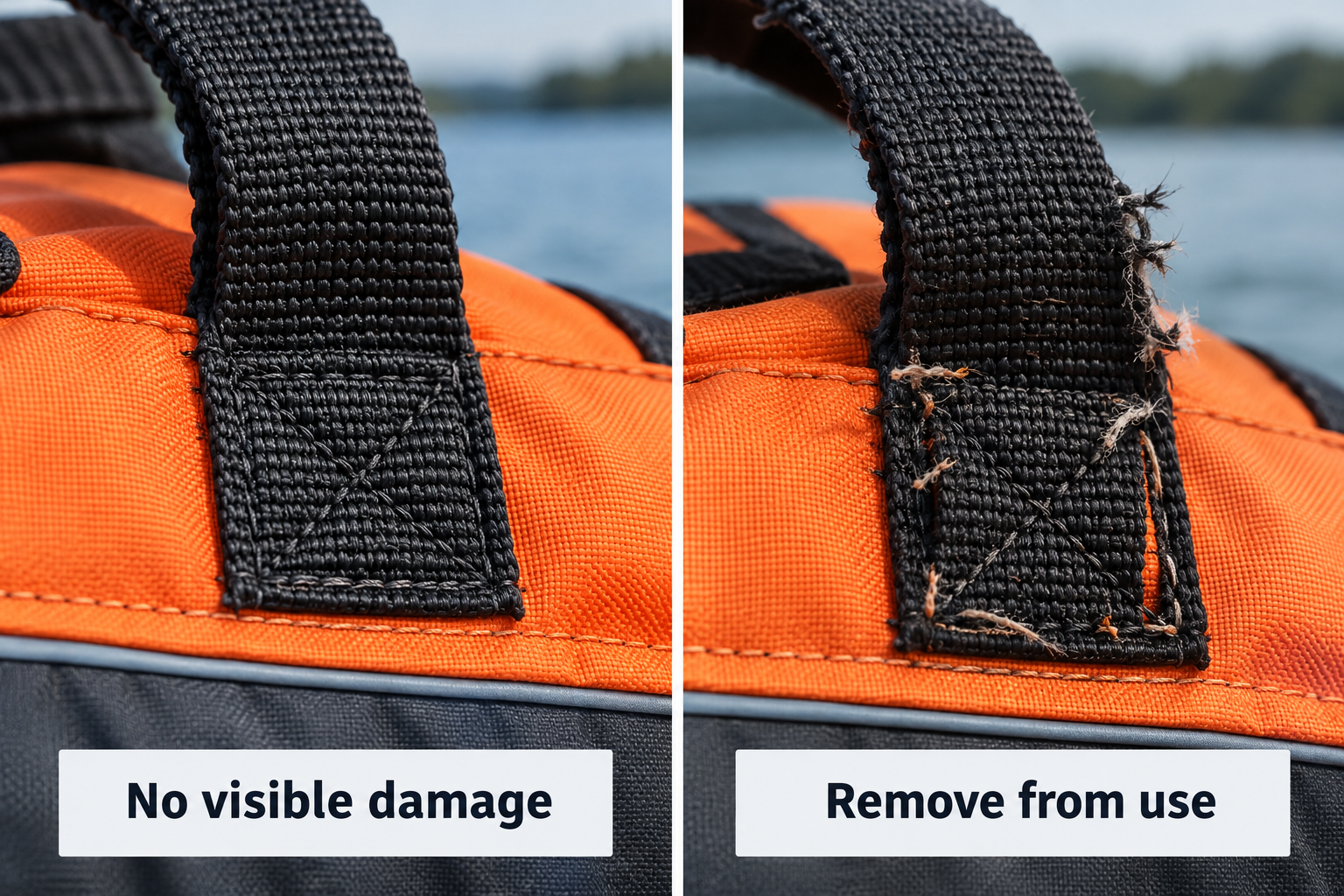
AI-generated illustration. Simulated wear comparison, not an actual customer return or test result. View full size.
An apparently tidy seam is not a strength certificate. Once you have confirmed the intended use, also make sure the jacket fits your dog and remains correctly secured. If the dog needs routine carrying, ask for equipment and instructions intended for that task rather than assuming a water-assist handle is suitable.
Before buying, the useful question is: “May I use this exact model and size to assist my dog back onto my boat, and what support and limits apply?” That gets a more useful answer than asking whether the handle is “strong.” Brands preparing a product brief can include this question in their development discussion with INSEAKU.
Pet brands should keep the permitted handle use consistent across the product page, label and instructions. Our dog life jacket claims guide explains how to match that wording to model-specific evidence.
Sources
Checked 8 October 2026. Brand examples describe those products only. The comparison tables and supplier questions are editorial guidance, not product test results.
- Ruffwear — Float Coat. Handle intended to assist dogs out of water.
- EzyDog — DFD Life Jacket. Separate grab-handle and post-swim leash-ring uses.
- Non-stop dogwear — Protector Life Jacket. Handle, wrap system and chest-strap design.
- Ruffwear — Confluence. Second rear handle for additional lifting support.