
Dog life jacket fit starts with the instructions for the exact model, accurate body measurements and a check of the fastened sample on the dog. A size letter, a breed name or a long adjustment strap cannot establish fit on its own. For pet brands, the useful question is whether another reviewer can reproduce the same measurement, adjustment and observation.
For the earlier purchase question, see why swimming dogs may still need a life jacket and define the activity, supervision and required functions before finalizing the fit brief.
This guide sets out five sample checks for developing a dog life jacket size chart: define the measurements, establish usable adjustment, review different body shapes, record changes in position and document the final chart. It is a fit-review method, not a buoyancy test or a claim about a particular product’s performance.
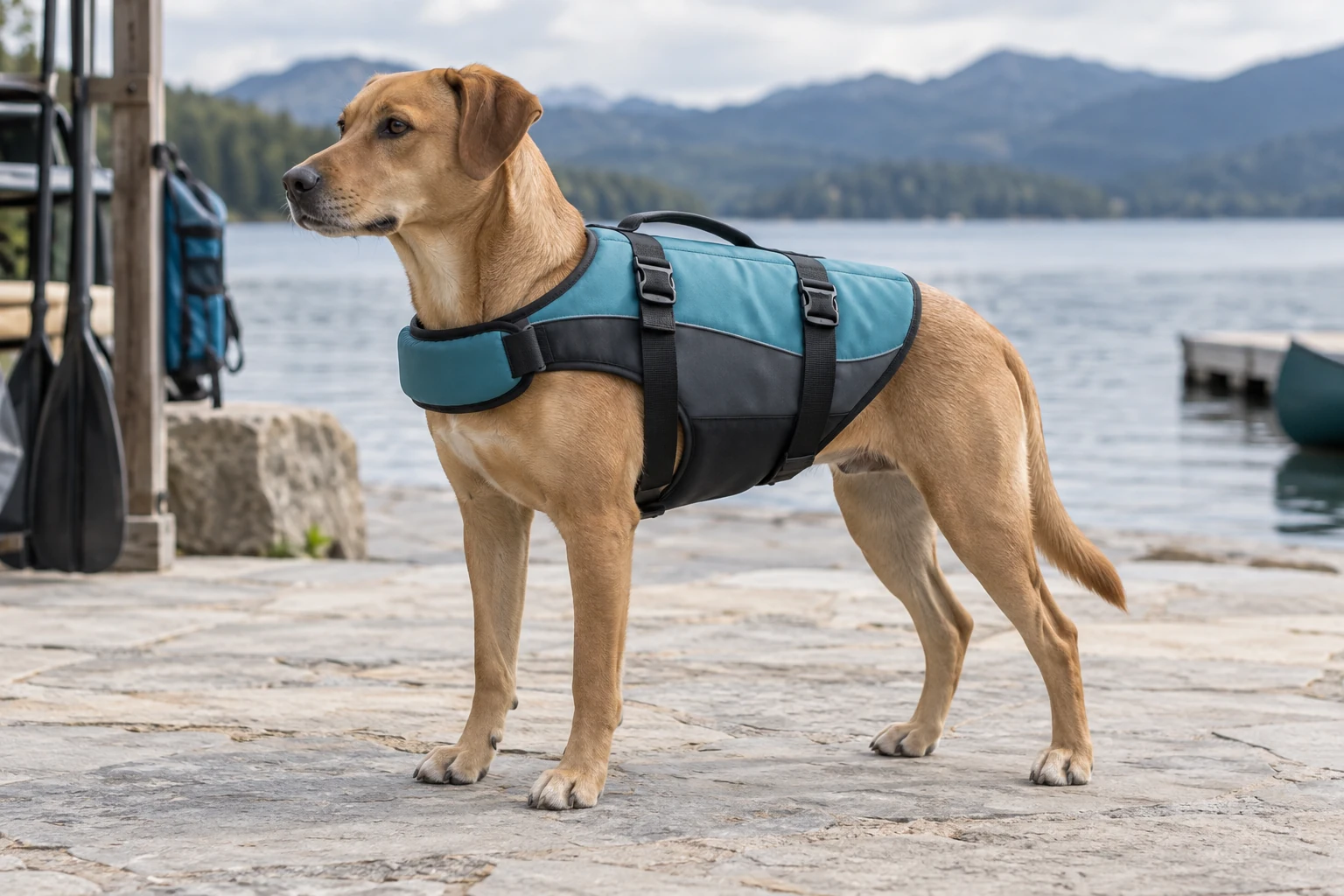
1. Define the body measurements before choosing a size
Start the review sheet with the product name, sample ID, revision, labelled size and the fitting instructions being used. Match the physical sample to those instructions. A revised neck opening or fastening layout needs its own review even if the size label stays the same.
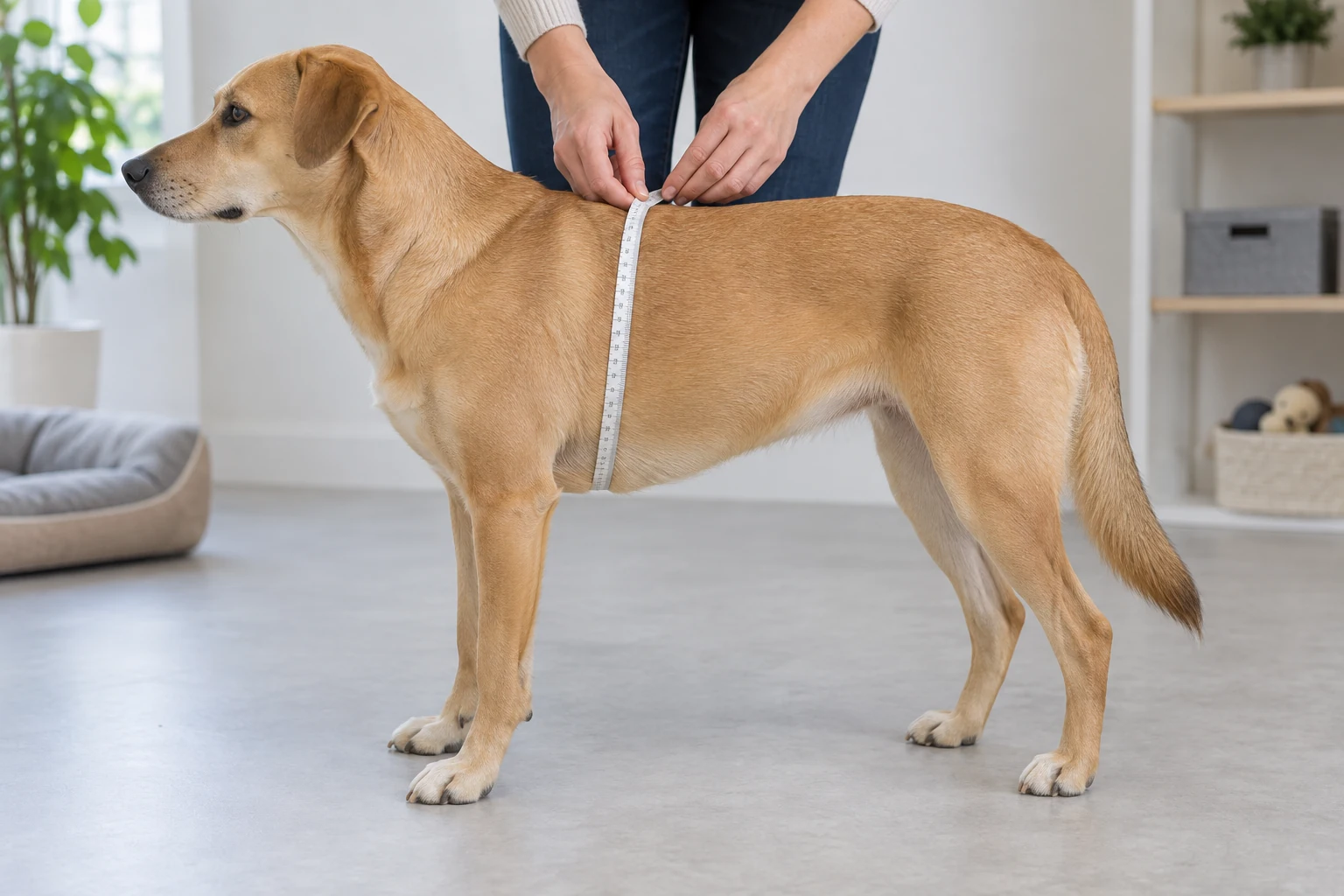
Measure the dog in a comfortable standing position on a stable surface, using a flexible tape. Keep the tape flat and avoid pulling it into the coat. Record the measurement path and units, not just the final number. If the posture or tape position changes between readings, repeat the measurement before using it to choose a sample.
Outward Hound’s measuring guide uses the widest part of the rib cage for girth and also asks owners to consider weight and individual body shape. That is a useful example of a defined measurement route; the selection rules still belong to that manufacturer’s products. [1]
| Field | Measurement definition | Review note |
|---|---|---|
| Chest girth | Circumference at the chest location shown in the model’s guide; commonly the widest rib-cage area. | Keep a reference photo of the tape path and record coat condition. |
| Neck circumference | Circumference at the neck position specified for the model’s opening. | Do not substitute a collar measurement taken at a different height. |
| Body back length | The distance between the start and end landmarks defined in the body-measurement diagram. | Record both landmarks. Keep this separate from the vest’s panel length. |
| Body weight | The dog’s measured weight, with unit and date. | Apply the model’s weight criteria where specified; strap fit does not replace them. |
Do not mix body measurements and product dimensions
A body back-length measurement and a laid-flat vest length answer different questions. The first describes the dog; the second describes the garment. Likewise, a neck opening measured on a sample is not automatically the recommended neck circumference of the wearer.
Ruffwear’s Float Coat page separates a sizing chart from a product-dimensions table. That distinction is worth retaining in a brand’s own documentation, while developing its own verified values and measurement diagrams. [2] A supplier sheet headed simply “length” should be clarified before it becomes a customer-facing chart.
2. Separate the size label, webbing length and usable range
A sample labelled Medium does not establish a universal Medium dog. The available webbing also does not directly equal the circumference that the assembled vest can accommodate. Part of a strap passes through hardware, lies against panels or remains as a secured tail.
For each adjustable closure, agree a measurement method with the product developer. Identify the buckle, routing, reference points, required panel overlap and how excess webbing is secured. Record the smallest and largest settings that preserve the specified closure arrangement. Do this on the assembled sample without stretching it to create a larger reading.
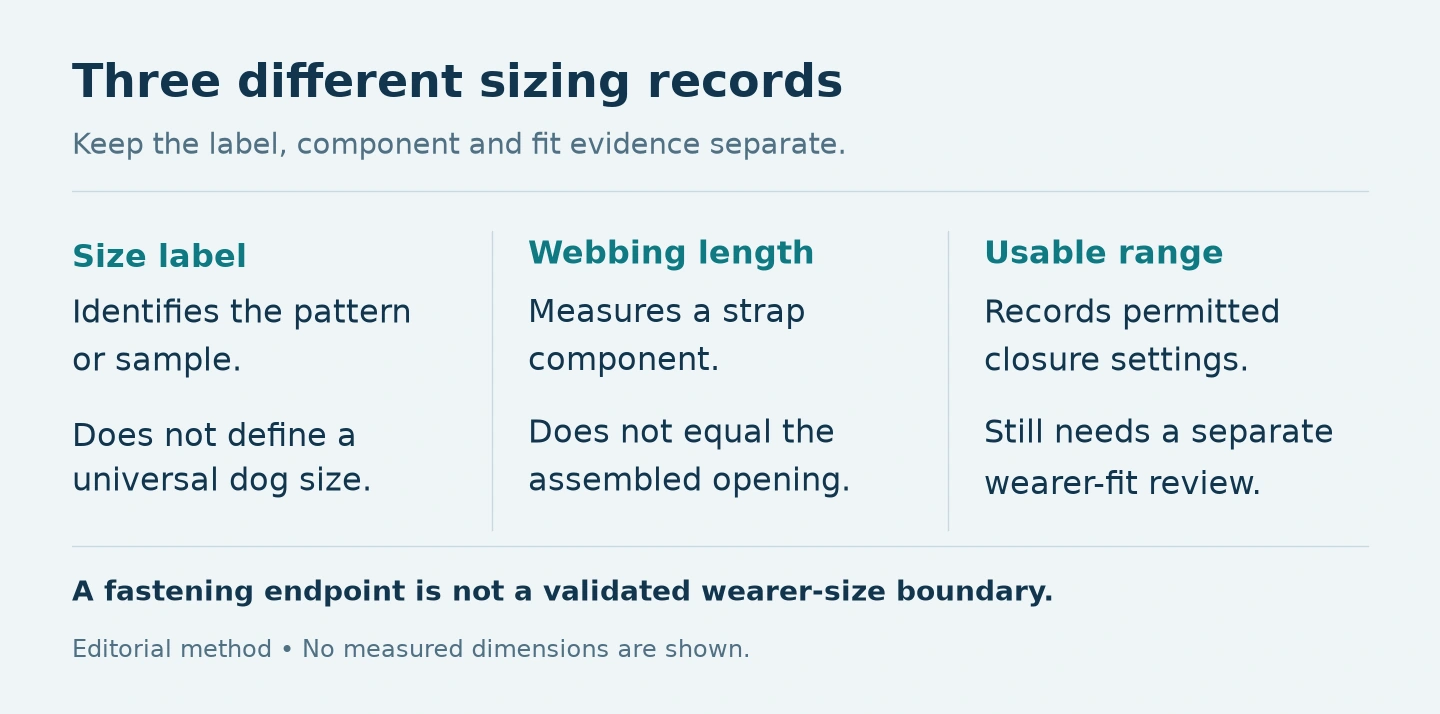
Usable adjustment is a construction record; recommended dog fit is a separate conclusion. A closure may still fasten at a particular setting while the panel coverage or front-leg clearance is unsuitable. Do not convert the hardware’s endpoints directly into a published body-size range.
| Value | What it describes | What it cannot establish alone |
|---|---|---|
| Labelled size | The supplier’s name for a particular pattern or sample. | Which dogs it fits across brands or product revisions. |
| Webbing length | A component dimension, measured using stated endpoints. | The finished opening or the available adjustment after assembly. |
| Usable adjustment range | Permitted settings with the specified routing, engagement and overlap maintained. | A validated wearer-size range, buoyancy capacity or lifting rating. |
Use current product views to identify the sample
The INSEAKU blue pet vest with adjustable straps provides a starting reference for a sample discussion. Its unfolded views help identify panel layout and fastening placement. They do not supply the chest, neck or back measurements needed to approve a size chart.
Outer view · AI-edited source

Inner view · supplied photograph
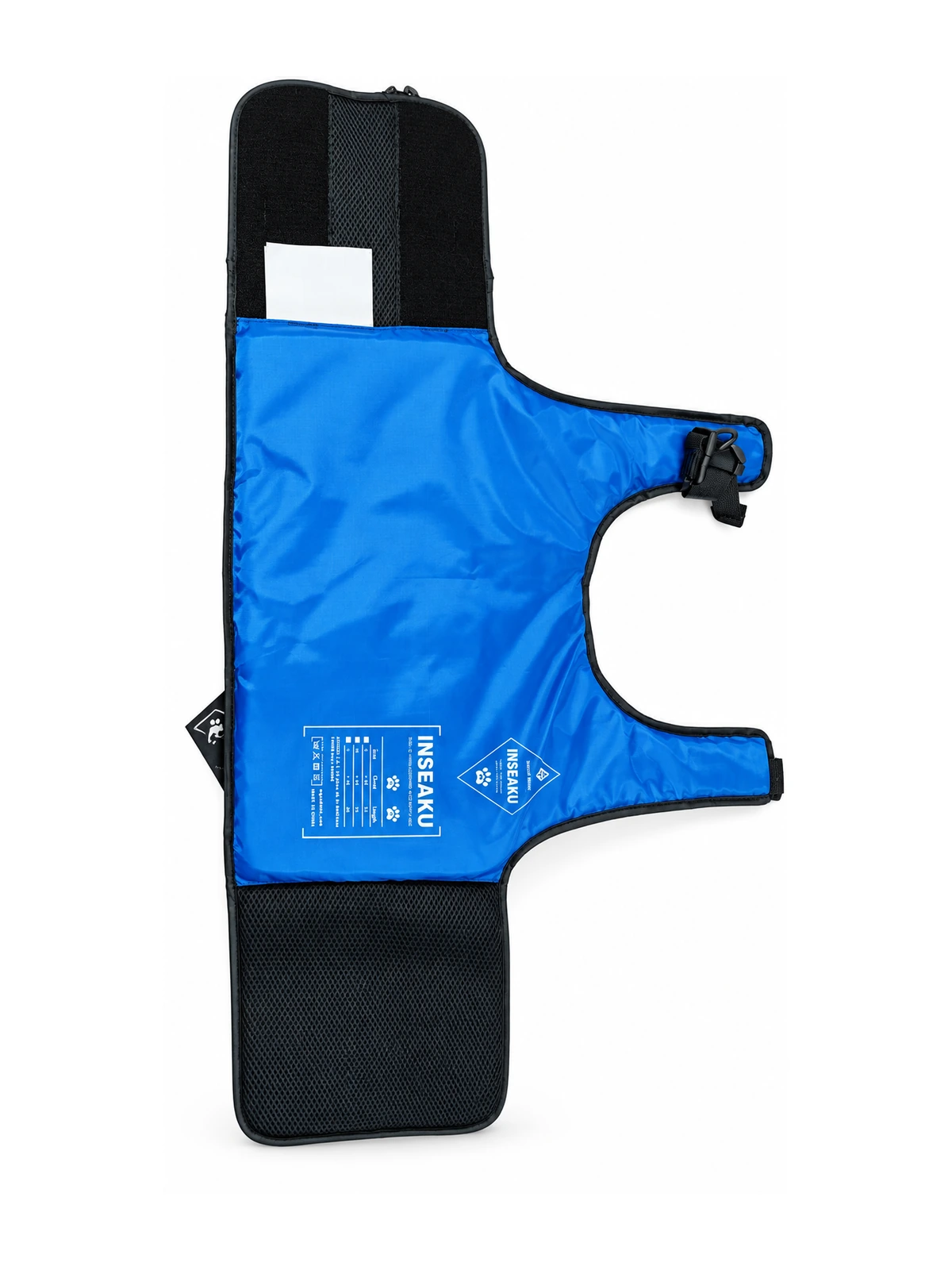
Request the actual fastened sample, corresponding measurement drawing and closure instructions before recording adjustment limits. Ask the supplier to identify any proposed changes in the next revision. A revised strap attachment, panel or buckle should trigger a review of the affected measurements rather than silently inheriting the earlier range.
3. Review dog life jacket fit across body shapes
Choose review participants by recorded measurements and body characteristics. Breed can provide context, but it is not a substitute for chest, neck, back and any model-specific weight criteria. Dogs with similar chest girth may differ in chest depth, shoulder shape or torso length.
Fasten the sample in the sequence specified for that model. Check panel position, closure engagement and strap routing before judging tightness. A reviewer should be able to see whether a concern comes from the chosen size, an adjustment, the pattern or an unclear fitting instruction.
Outward Hound’s Granby instructions, for example, describe a standing fit check, fastening sequence, strap-tail management and a two-finger check. Those instructions should not be transferred automatically to another model as a universal clearance or release criterion. [4]
| Review area | Observation | Useful evidence |
|---|---|---|
| Neck and front panel | Position relative to the model’s guide; unwanted pressure or movement towards the throat. | Side and front photos, plus the actual adjustment setting. |
| Chest and underside | Coverage, intended overlap, folds, gaps or concentrated contact. | Describe the location without forcing an uncomfortable pose. |
| Front legs and shoulders | Whether panel edges or straps interfere during comfortable walking. | Short observation notes or a suitable movement clip. |
| Back and rear edge | Panel alignment, rotation and changes in coverage. | Comparable top and side views before and after movement. |
| Closures and strap tails | Correct engagement, routing and stowage, checked against instructions. | Close-up images linked to the exact sample revision. |
Between sizes? Follow the exact model’s rule
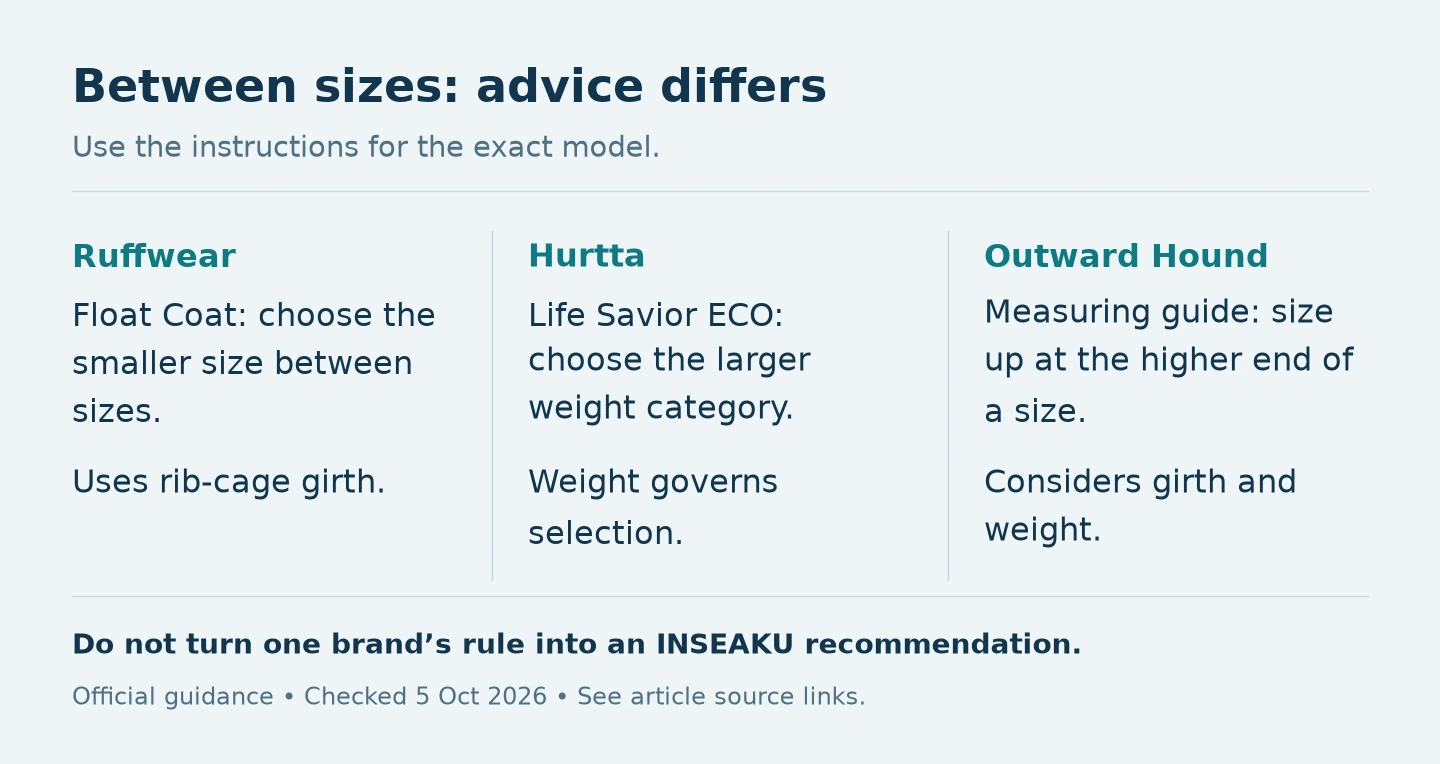
There is no reliable universal instruction to always size up or always size down. Published manufacturer guidance illustrates why a generic rule would be misleading:
| Source checked | Published guidance | Meaning for a new brand |
|---|---|---|
| Ruffwear Float Coat [2] | Uses rib-cage girth and recommends the smaller size when between sizes. | Keep its rule with its own chart and design. |
| Hurtta Life Savior ECO [3] | Prioritises weight; chooses the larger size between weight categories because its buoyancy sizing is weight-based. | A girth-only rule cannot replace that product’s weight criteria. |
| Outward Hound measuring guide [1] | Considers girth and weight and recommends sizing up at the higher end of a size. | Confirm the current chart and instructions for the chosen model. |
Guidance checked on 5 October 2026. This is a comparison of instructions, not a performance ranking or an INSEAKU size recommendation.
If a dog matches one measurement range but falls outside another, keep the result unresolved and ask the manufacturer which criterion governs. Tightening the straps until the product looks neat does not resolve a mismatch in the intended weight category or panel geometry.
4. Record movement and changes in position
Begin with the dry fitting checks allowed by the model’s instructions. Let a comfortable dog stand and walk naturally while a handler stays in control. Note any rotation, upward movement, edge contact, slipping adjustment or interference. Stop if the dog shows distress or the fit creates discomfort; do not force movement to complete a checklist.
Use comparable photos: the same sample revision, similar stance and the same camera side. Record which closures were adjusted between observations. If a reviewer only writes “better after tightening,” the next person cannot reproduce the result or know whether another area became too tight.
Keep wet-use observations within the product’s instructions
Do not turn an unfinished sizing review into an improvised flotation experiment. Any wet-use observation needs a model already suitable for the intended activity, its instructions and an appropriately supervised plan. Unresolved sizing or product suitability is a reason to defer that stage.
Where an authorised review includes use in water, record the setting, activity, supervision and product condition alongside any change in position. Separate what was observed from the proposed cause. A shifted panel alone does not prove whether the cause was initial adjustment, body shape, movement or a construction issue.
A comfortable dry fit cannot demonstrate buoyancy, self-righting, handle strength or protection in an emergency. Nor should a reviewer lift a dog by a visible handle to “check the size.” Handle function and any permitted handling method require separate product instructions and supporting evidence.
5. Build a dog life jacket size chart that can be traced back
A useful customer chart is the final expression of the sample review, not the starting assumption. For each proposed size, retain the sample revision, measurement drawing, usable adjustment records and the fit observations supporting the recommended wearer range.
Also retain non-fit records. A dog whose chest measurement falls within a proposed range but whose shoulder clearance is unsuitable helps identify a limitation that a successful photograph alone would miss. State which combinations remain unreviewed instead of presenting a smooth, gap-free range without evidence.
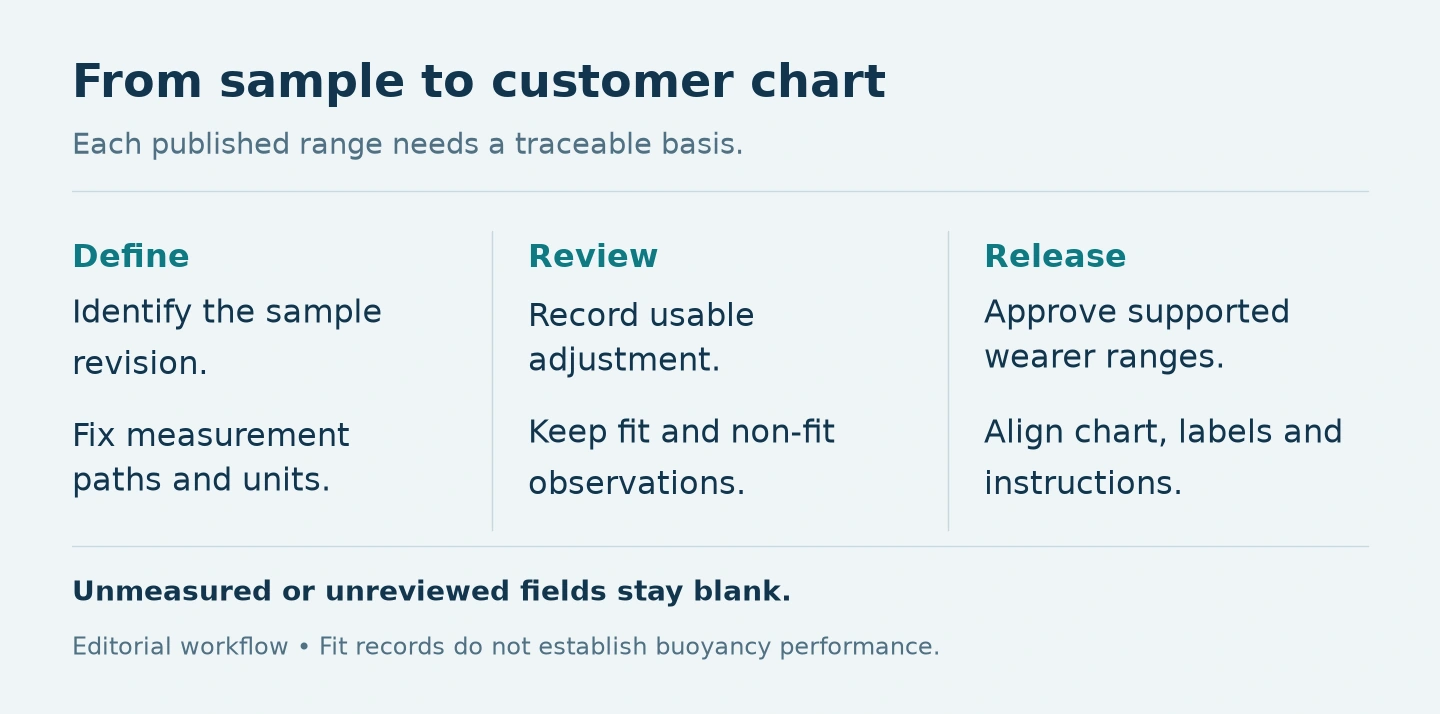
Keep the blank measurement fields blank until verified
The following worksheet deliberately contains no INSEAKU measurements. It is a collection template, not a consumer size chart. Complete the drawing reference first, then enter the physical measurements and review the wearer ranges separately. A blank is missing information; it does not mean zero or “one size fits all.”
| Measurement | Minimum | Maximum / length | Method / evidence ID |
|---|---|---|---|
| Sample chest opening: usable adjustment | |||
| Sample neck opening: usable adjustment | |||
| Sample back panel: defined endpoints | Not applicable | ||
| Recommended wearer chest range: review conclusion | |||
| Recommended wearer neck range: review conclusion | |||
| Recommended wearer back range: if used by the model |
Record any model-specific weight criteria separately with their source; do not calculate a weight limit from chest circumference. If a UK-facing chart uses both centimetres and inches, retain one approved master dataset and document rounding so the two displays do not create contradictory boundaries.
Before releasing the chart, check it against the sample label, product page, fitting instructions and packaging. Name the reviewer and revision date. When a change affects the fit, update these linked materials together so customers do not receive a newer vest with an older chart.
Use the blank sample-review record
Download the fillable dog life jacket fit record (ZIP) to capture the sample, measurement definitions, adjustment settings and observations. Download and extract the ZIP, then open the HTML record locally. The form supports local JSON export and import and can be printed. It opens with all measurements empty and makes no automatic size recommendation.
For a new pet-product project, include the target body shapes, measurement diagram, intended use and unresolved questions in the sample brief. Explore INSEAKU’s OEM, ODM and private-label services to discuss the development scope. Confirm the model-specific specification and evidence requirements before adopting a public size chart.
Dog life jacket sizing and fit: frequently asked questions
How do I measure my dog for a life jacket?
Use the exact model’s measurement diagram. Record chest girth, the specified neck position and defined back-length endpoints; record weight where required. Keep body measurements separate from vest dimensions and check the selected sample after fastening.
Should I size up if my dog is between sizes?
Follow that model’s instructions. Manufacturer advice differs, and a weight-based selection rule may be essential to the product. If the measurements conflict, ask the manufacturer instead of applying a universal size-up rule.
Is a two-finger gap enough to confirm fit?
Use it only where the model’s instructions specify it. It does not replace checking panel position, movement, closures, strap tails and other sizing criteria, and it does not establish flotation performance.
Can one breed name determine the size?
No. Use the individual dog’s measurements and the model’s criteria. Record body shape as context, and keep both successful and unsuitable sample observations when developing a chart.
Does an adjustable strap prove the recommended size range?
No. The strap’s component length, usable assembled adjustment and recommended wearer measurements are separate records. A customer-facing range needs review evidence linked to the actual product revision.
Pet brands can use our dog life jacket claims guide to connect model evidence with product-page wording, labels and instructions.
Before using a grab handle, read our dog life jacket handle guide to distinguish water assistance, carrying and leash attachment.
Sources and measurement notes
- Outward Hound — How to Measure a Dog for a Life Jacket. Brand guidance on girth, weight, body shape and sizing at the upper end of a range.
- Ruffwear — Float Coat Dog Life Jacket. Model-specific sizing guidance and separate body-sizing and product-dimension tables.
- Hurtta — Life Savior ECO. Model-specific priority given to weight and guidance between weight categories.
- Outward Hound — Granby Splash Fitting Instructions. Model-specific fastening, clearance and strap-tail instructions.
Manufacturer examples were checked on 5 October 2026. The review sequence and worksheets are an editorial method. No INSEAKU fit trial, numerical size range, buoyancy result or lifting capacity is asserted.