
INSEAKU · SOURCING GUIDE
Wetsuit factory vs trading company? Choose a specialist wetsuit factory when your order needs custom fit, construction development or consistent repeat production. Consider a trading company when you need several product categories and coordinated sourcing from different manufacturers. For either route, choose a partner that identifies the production site, controls changes and clearly accepts responsibility for the finished order.
Wetsuit factory vs trading company: what do you gain?
A factory manufactures products. A trading company buys from manufacturers and sells to customers, often coordinating sourcing and export arrangements. Some businesses combine both activities. Identify who makes your particular wetsuit—not just what the company calls itself.
A factory may sell through a separate export company, while a trader may employ its own technical team. Neither setup is automatically a problem. Separate the company you pay, the site that produces the goods and the person who can approve a correction. Their relationship should be clear before you commit.
Closer to product development
Choose for: a wetsuit range that needs pattern changes, construction decisions and repeatable production.
Potential advantage: direct discussion with the people developing and making the product.
Trade-off: you must confirm the factory’s development support, minimum order and export service. These are not identical across factories.
Coordination across suppliers
Choose for: several product categories that need sourcing and consolidation through one commercial contact.
Potential advantage: less coordination work for a buyer managing multiple manufacturers.
Trade-off: technical messages pass through another party. Agree access to production information and responsibility for corrections.
Editorial comparison of buying routes. Neither business model guarantees a lower price, faster delivery or better quality.
Which route fits your order?
You are developing a distinctive wetsuit range
Start with a specialist manufacturer that has relevant development capability. If you need to change the shoulder pattern, collar, seam layout or lining, access to the sample team can make decisions easier. Ask who turns your comments into a revised pattern and who checks the next sample.
Factory ownership alone is not enough: a workshop set up for repetitive sewing may not offer pattern development. Choose the actual team and scope. For example, if a trial suit restricts shoulder movement, you need someone who can review the fit, explain the proposed change and carry it into the next sample. A factory that only offers a different stock size may not be the right development partner. If you are unsure how much development you need, compare OEM, ODM and private-label wetsuit projects.
You need several unrelated products in one buying programme
Consider a capable trading company. A retailer buying wetsuits, swim goggles and equipment bags may benefit from one partner coordinating different makers, packaging and shipments. Ask which products it manufactures, if any, and which it sources.
This route makes sense when the coordination service is worth its cost. It does not remove each manufacturer’s material minimums or eliminate the need for product-specific checks. For a mixed order, ask whether one delayed item holds the whole shipment and whether separate shipments create extra charges. Consolidation is useful only when the delivery plan works for your business.
You want a small, simple order with limited changes
Compare available base styles before commissioning a new design. Either a factory or a trader may offer a suitable route. A sewing workshop can also fit an assembly-only order when someone else already controls materials, patterns and inspection.
Small does not automatically mean simple. A low-volume order with a new fit, special laminate and custom hardware can require substantial development. Compare the total work, not the supplier’s label. If a suitable base suit only needs agreed branding, that is a different project from developing a new pattern. An unusually low MOQ is not a bargain if the offered size range, construction or material does not suit your customers.
You are planning regular reorders
Prioritise continuity of the approved specification. A specialist factory is a useful starting point, but a trader can also manage repeat orders if it keeps the manufacturing site, material references and revisions under control. Agree whether a factory or material change requires your approval. Keep an identified reference sample and the approved material, pattern and artwork versions. On a reorder, request a written list of changes—even if the product name is unchanged. The question is whether the next batch matches your approved product, not simply whether the supplier can make it again.
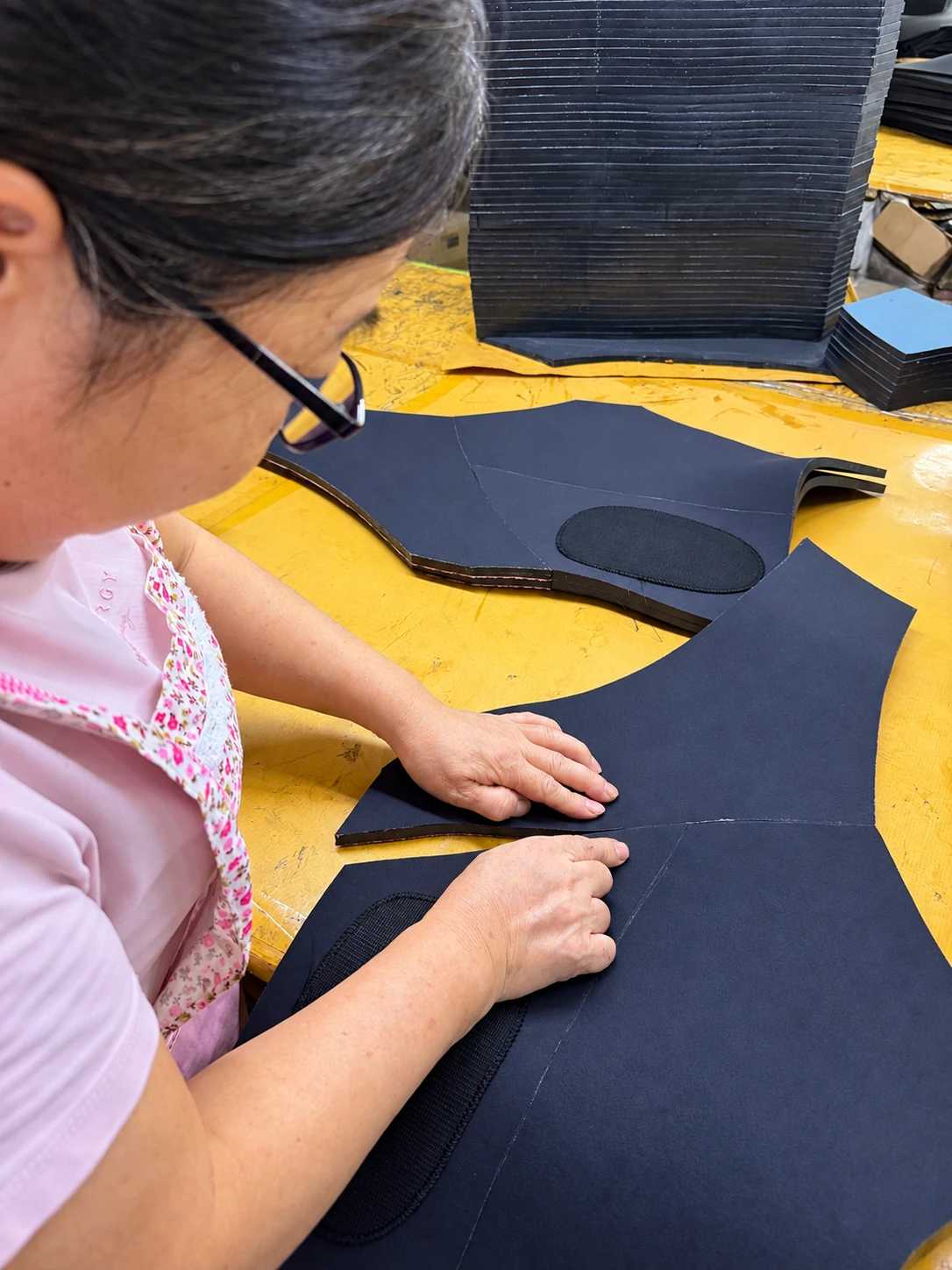
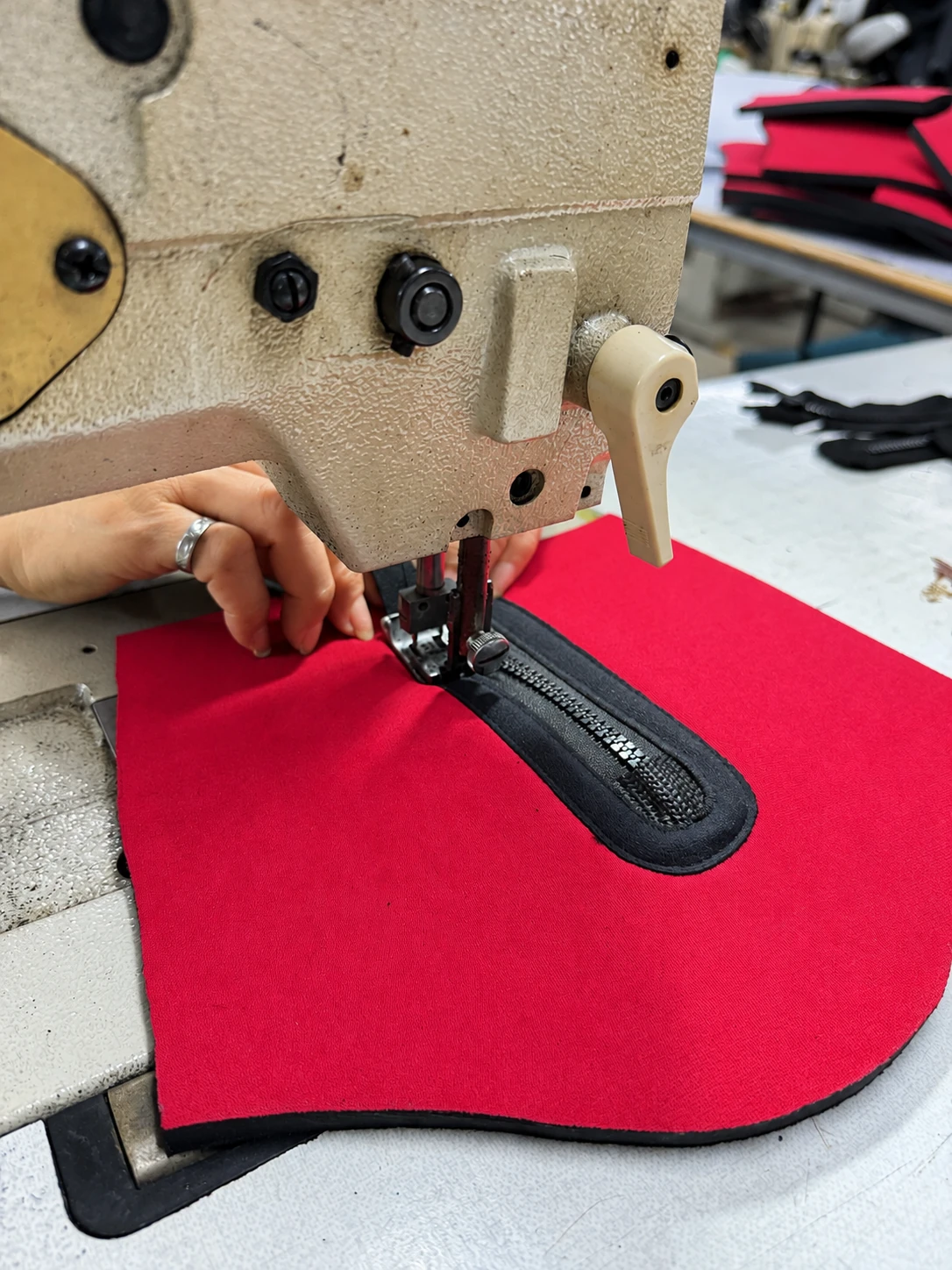
How can you tell whether a supplier adds technical value?
Give shortlisted suppliers the same specific sample problem and compare their responses. A fast “yes, we can improve it” tells you less than an explanation of what will change, what stays unchanged and how the revision will be checked.
“We will make it looser.”
The location, pattern revision and effect on the rest of the suit are unclear. You cannot tell what the next sample is supposed to prove.
“Let’s identify where it pulls.”
Review the wearer measurements and movement, identify the affected panels, record the proposed revision and recheck the fit on the revised sample.
Illustrative responses to a shoulder-fit concern, not customer quotations or a prescribed fit correction.
This is where both routes can succeed or fail. Direct factory contact helps when the sample team can explain its work. A trader adds value when it translates feedback accurately, challenges incomplete answers and keeps the versions organised. Merely forwarding messages adds another handoff without resolving the technical question.
Ask what the sample charge actually buys
Confirm the sample purpose, size, material, included revisions and delivery method. Ask whether the sample uses the intended bulk components or temporary substitutes. A prototype made to check fit is not necessarily the final production reference. Agree who owns the supplied files and what pattern or specification information will be available for future orders.
Does every process need to happen inside one factory?
No. Judge outsourced work by its controls and accountability. Having processes on one site can simplify coordination. Using a specialist for a particular operation can also be workable. Neither arrangement proves how well your order will be managed.
If lamination or printing is outsourced, get three clear answers: who performs it, what specification they receive, and who checks the returned work. Agree who handles a rejected result and its effect on the schedule. “Our partner does that” is an incomplete answer unless the responsibility is also clear.
For an outsourced operation, keep one clear chain
- SpecifyApproved material, artwork and workmanship requirements reach the actual processor.
- CheckThe returned work is assessed before it enters the next production stage.
- ResolveYour contracting supplier coordinates any agreed correction and schedule change.
Recommended responsibility structure. Confirm it for your order, whether the work is internal or subcontracted.
A factory video can show equipment and working conditions. It cannot, by itself, establish ownership, order allocation or batch quality. Use it alongside company identity checks and relevant project records. The U.S. International Trade Administration likewise recommends investigating potential business partners rather than relying on initial impressions. Partner due-diligence guidance.
Is buying directly from a factory always cheaper?
No. Compare equivalent specifications and included services before deciding. A direct quote may separate development and inspection charges; another quote may include them. A trader may add a margin or charge for coordination. The amount and value of that work need to be established for the actual order.
ILLUSTRATIVE CALCULATION · USD · 100 WETSUITS
A $3 lower unit price can still produce the same total
| Included work | Quote A | Quote B |
|---|---|---|
| 100 suits | 100 × $40 = $4,000 | 100 × $43 = $4,300 |
| Sample / setup | $200 extra | Included |
| Agreed inspection service | $100 extra | Included |
| Total shown | $4,300 | $4,300 |
Invented teaching example, not INSEAKU pricing or a market benchmark. Assumes identical goods and service scope. Freight, duties and taxes are excluded from both totals. A and B can represent either supplier type.
What else can make two quotations different?
- The material specification: the same nominal thickness does not identify the foam grade, lining or approved laminate. Ask both suppliers to quote the same material reference.
- The finished construction: compare the seam method, sealing coverage, zipper, reinforcement and artwork scope. “Custom wetsuit” is too broad for a price comparison.
- The development and delivery work: establish revision charges, size development, labels, packing, inspection and the delivery point. Keep one-time development costs separate from recurring unit costs.
If a quotation is substantially cheaper, ask the supplier to explain the difference line by line. A real saving might come from an available material, an existing pattern or more efficient production. A saving created by removing something your product needs is a different offer.
Which route is faster?
Choose the supplier with a credible project schedule, not simply the shortest headline lead time. Ask for the dates or conditions for material readiness, sample review, production and shipment. Clarify when the clock starts and what happens after a buyer-requested revision. A stocked base style and a newly developed style should not be compared as if they involve the same work.
Compare transport responsibilities on the same basis too. ICC explains that Incoterms® rules allocate specified delivery obligations, costs and risks; they do not replace the product specification or payment terms. ICC explanation.
Ask these four questions before choosing
- Who will make this order? Get the manufacturing site and contracting company identified, including any export company involved.
- Who can resolve a sample problem? Ask for the person responsible for pattern, material or construction changes—not only the person forwarding messages.
- What can change after sample approval? Agree how material substitutions, production-site changes and revisions will be approved and recorded.
- Who handles a defective delivery? Establish the reporting route, assessment process and responsibility for agreed corrective action before ordering.
Choose the supplier that can answer these questions clearly for your order. Once you have selected the right type of partner, use our wetsuit manufacturer audit guide for deeper verification.
What can INSEAKU contribute to a custom order?
INSEAKU is a suitable starting point when you need to turn a wetsuit brief into an approved sample and repeatable production specification. Our factory work includes material preparation, pattern cutting, sewing and assembly; our development discussions connect those operations to the product you want to sell. See our factory background.
| Your starting point | Support to discuss | What you should be able to decide |
|---|---|---|
| A concept or reference suit | Product requirements and development scope | What needs developing before a sample is meaningful |
| A design with open material choices | Foam, lining, thickness and construction options | Which specification to sample and quote |
| A sample that needs refinement | Measurements, panel shapes and consolidated revisions | What changes in the next version |
| A production-ready design | Branding, packaging, approval and inspection arrangements | Which reference governs the bulk order |
Our OEM and ODM service process places sample and specification approval before bulk production. Bring what you already have; confirm the work, costs and timing still needed. MOQ is 50 units per style, per color. Size arrangements and delivery dates require project-specific confirmation.
A practical example: catching a branding error before release
In an INSEAKU case documented through an internal interview confirmed in September 2026, QC Supervisor Xuemei Zhang found a one-letter branding error by comparing finished goods with the customer’s original artwork. The affected goods were held, the branding was corrected and the goods were checked again before release.
The useful lesson is clear responsibility: someone must have the reference, identify the discrepancy and stop release until it is resolved. This example does not establish a defect rate or guarantee future results. Read the documented QC case.
Send a brief that gets you a useful answer
Include your intended activity, reference design or sample, material preferences, quantities by color, size needs, destination market and target delivery date. Tell us which decisions are already fixed and where you need development support.
Two final questions before you shortlist
Is a sourcing agent the same as a trading company?
Not necessarily. A trading company typically sells the goods to you; a sourcing agent may provide a service while you contract with the factory. Labels vary. Confirm who invoices the goods, who charges a service fee and which party owes you the agreed deliverables.
Should a new brand always start with a trader?
No. Start with the support your project needs. A factory with a suitable base style and development service can be practical for a new brand. A trader may be useful when you need several product categories or lack the resources to coordinate suppliers. Compare the proposed work, minimum quantities and sample plan rather than using company age or order size alone.
Sources and further reading
- International Trade Administration — Perform Due Diligence: general guidance on investigating business partners, not a wetsuit supplier ranking.
- International Chamber of Commerce — Incoterms® 2020 Q&A: the scope and limits of trade terms.
- INSEAKU — OEM and ODM manufacturing services: service scope and the published MOQ.
- INSEAKU — How to Find a Wetsuit Manufacturer: a detailed follow-up checklist.
- INSEAKU — Factory background: published manufacturing scope.
- INSEAKU — Xuemei Zhang and the branding correction case: internally documented case, confirmed in September 2026.
Sources checked 13 November 2026. Order-fit recommendations are editorial guidance; the cost illustration is hypothetical.