
Choose a hooded wetsuit for regular cold-water surfing when you expect to wear the hood almost every session. Choose a separate hood when you only need it occasionally, already own a suitable suit, or need to size your head separately. The deciding detail is the neck connection: an attached hood joins the suit; a separate one needs the right overlap.
The main comparison is full neoprene surf hoods. Diving combinations are addressed separately below; a short surf cap is not equivalent neck coverage.
Hooded wetsuit vs separate hood: when to choose each
| Your situation | Choose first | Why—and the compromise |
|---|---|---|
| Regular winter surfing; repeated waves over your head | A suit with a fixed hood. | Removes the separate hood-to-collar overlap you would otherwise need to arrange. Head and body must both fit the same garment. [1][2] |
| Mostly milder sessions, with occasional cold or windy days | A compatible separate full hood. | Wear it when needed and leave it ashore on suitable days. Check its neck interface; adding a hood does not make an inadequate suit suitable for winter. |
| Your body fits the suit, but its attached hood pulls or feels loose | A hoodless suit plus a separately sized hood. | Lets you match head and neck measurements independently. You still need to try the assembled combination. [4] |
| Scuba diving with an existing wetsuit or semi-dry suit | The hood arrangement specified for that suit. | Preserve the intended neck-seal relationship. Do not apply one surfing tuck-in rule to every diving suit. [3] |
If you are buying your main winter surf suit, try the hooded version first. If you like your current suit and only miss head coverage on some days, try a separate hood before replacing the whole suit. These are selection recommendations, not measured warmth rankings.

AI-generated generic illustration, not real product photography or an INSEAKU sample. The right-hand items are shown apart; their compatibility is not established by this image. View full size.
What actually changes at the neck?
Built-in hood: one connected garment
The hood’s lower panels are joined to the suit rather than tucked into a separate collar. This removes one adjustable overlap from the setup. SRFACE’s Remix 5/4 Hooded, for example, explicitly specifies a fixed neoprene hood. “Hooded” does not mean waterproof: the face opening, entry system, seams and fit still matter. [1]
The trade-off is a linked fit. A suit can fit your torso yet pull at the hood when you look around. Also, a fixed hood remains attached when pulled off your head; that is not the same as removing a separate accessory.
Separate hood: the overlap is part of the fit
A separate wetsuit hood ends around the neck or extends into a wider lower flap, often called a bib. That edge must work with the suit collar. Billabong describes a long-neck surf hood that tucks under the collar; its guide recommends this extended coverage to limit flushing. [2]
But “always tuck it inside” is not a universal rule. Xcel UK’s hood guide recommends an outside position for its described setups, while SCUBAPRO’s accessory manual allows an over-or-under relationship according to the design. Follow the specific hood-and-suit instructions; do not force extra material into a collar intended to sit directly against the neck. [5][3]
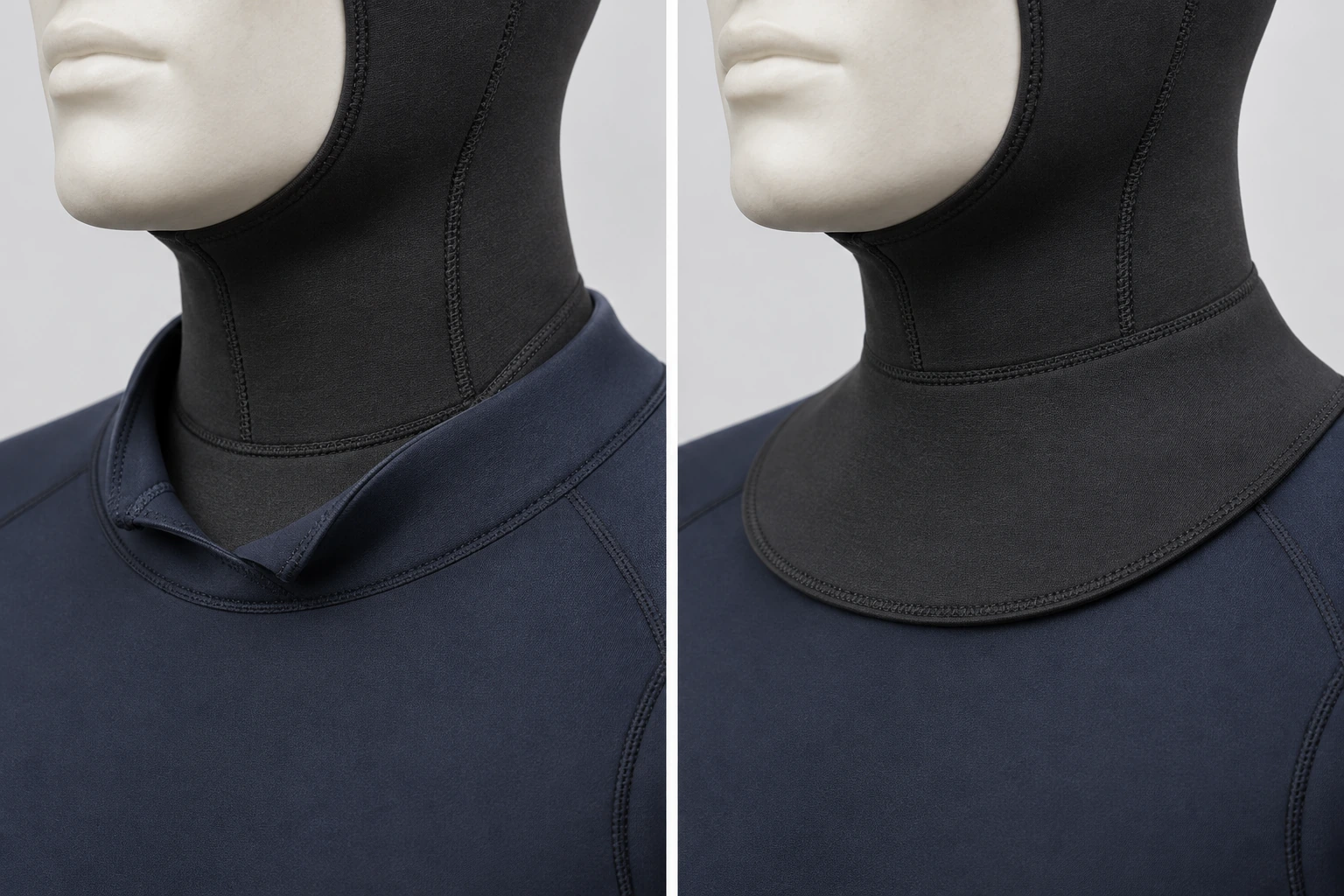
AI-generated interface concepts, not verified brand combinations. The left collar is opened for display only: in use the intended overlap should lie flat. Neither arrangement is a universal instruction. View full size.
| Design | What should happen | What should stop the purchase |
|---|---|---|
| Under-collar bib | The intended flap sits flat beneath the compatible collar. | It bunches, pulls out when you turn, or forces the collar open. |
| Over-collar arrangement | The hood covers the specified collar area without disturbing the suit seal. | The edges separate during movement or the combination contradicts the instructions. |
| Short cap with a chin strap | It covers the head without providing a full neck interface. | You expected it to replace a full hood’s neck coverage. [5] |
Is an attached hood warmer?
For frequent cold surf, the joined neck is a practical advantage because there is no separate bib to shift. Billabong generally favors attached hoods while also describing an extended separate hood as a way to reduce leakage. That supports the choice above, not a fixed temperature advantage. [2]
Foam thickness, lining, face fit and the rest of the suit all affect the result. A loose hooded suit can still flush, and a well-matched separate setup can work well. If cold water rushes down your neck, inspect the closure and overlap before buying a thicker hood; use these wetsuit flushing checks to narrow down the entry point.
Check head movement with the whole suit on
Measure your head and neck, not just your usual wetsuit size. O’Neill’s hood chart lists both measurements. A matching size letter on two products does not establish a matched fit. [4]
Do this dry fit check before taking the combination into the water:
- Close the suit as intended. Position the separate hood’s lower edge according to the instructions, then check that the overlap lies flat.
- Turn your head and look up naturally. Check whether the chin panel pulls, the face opening shifts or the back overlap lifts.
- Check comfort and your view. You should be able to breathe and move comfortably. Do not solve a gap by tightening until the hood or neck becomes restrictive.
SCUBAPRO warns against accessories and seals that are excessively tight. If the combination restricts breathing or movement, change the size or design. [3]
What about hooded vests and two-piece suits?
Is a hooded vest the same as a separate hood?
No. It adds a torso layer as well as a hood. Cressi’s Hood Vest is designed to sit under a wetsuit; its chest and back panels make it a different layering choice. Try it under the intended suit, because the added bulk changes fit. Do not assume a thin inner hood or a short cap offers the same coverage as a full standalone hood. [6]
A hood can also be built into the jacket of a two-piece suit. That is common in the configurations discussed in our spearfishing wetsuit guide; it does not make the hood a separately removable accessory.
For a brand developing a matched set, record the exact suit and hood, size pairing, intended overlap and movement-check photos in the neoprene accessory specification. The useful result is a combination that fits, not simply two products carrying the same size label.
Sources and further reading
Official descriptions checked 12 October 2026. Product examples establish configurations, not universal compatibility or measured warmth differences.
- SRFACE — Men’s Remix 5/4 Hooded. Fixed hood and entry construction.
- Billabong — Surf Accessories Guide. Attached hoods and long-neck under-collar designs.
- SCUBAPRO — Neoprene Accessories User Manual, English pages 3–4. Fit limits and model-dependent neck placement.
- O’Neill — Psycho Coldwater 3mm Hood. Head and neck measurements in the hood size chart.
- Xcel UK — Wetsuit Hood Guide. Over-collar guidance and the distinction between a cap and full hood.
- Cressi — Hood Vest Base Layer. A hood attached to a torso underlayer.