

Short answer: When comparing GBS vs flatlock wetsuit seams, choose the construction by intended use, required control of water entry, stretch and comfort targets, durability expectations, acceptable production complexity and target cost. Flatlock is a strong, flexible through-stitch construction that normally permits more water movement. GBS joins glued panel edges with blind stitching that does not intentionally pass through the full material thickness, reducing seam water entry. Internal tape or liquid sealing can add reinforcement and water resistance, but they also add material, labor and validation requirements. No seam should be selected by name alone: foam, lamination, thickness, panel geometry, fit, zipper, activity and exposure duration all affect the finished wetsuit.
This guide is written for water-sports brands, importers and product teams specifying surf, diving, triathlon, rental or private-label wetsuits. It explains the manufacturing and purchasing differences among flatlock, glued-and-blind-stitched, taped and liquid-sealed constructions.
GBS vs flatlock wetsuit seams: quick comparison
The comparison below describes typical construction logic, not a promise for every material or pattern. The final specification should define exactly where each seam type is used and how it will be inspected.
Flatlock
How panels are joined: Panel edges overlap and stitching passes through the assembly.
Typical water-entry control: Allows more water movement than GBS.
Relative process complexity: Lowest of the options compared here.
Common sourcing use: Warm-water, rental, training or value-led products where through-seam water movement is acceptable.
GBS
How panels are joined: Edges are glued together and blind stitched without intentionally penetrating the full thickness.
Typical water-entry control: Lower seam water entry than flatlock when correctly made.
Relative process complexity: Higher than flatlock.
Common sourcing use: Cooler-water and performance products requiring improved thermal retention.
GBS with critical or spot tape
How panels are joined: GBS plus internal tape at selected high-stress or higher-risk locations.
Typical water-entry control: Targeted reinforcement and sealing.
Relative process complexity: Higher than standard GBS.
Common sourcing use: Products balancing performance, stretch, reinforcement and cost.
Fully taped GBS
How panels are joined: GBS plus tape covering the specified internal seam network.
Typical water-entry control: Higher water-entry control than untaped GBS, subject to workmanship and material compatibility.
Relative process complexity: High.
Common sourcing use: Higher-performance products with stricter water-resistance and durability requirements.
Liquid-sealed seam
How panels are joined: A compatible sealant is applied externally, internally or on both sides as specified.
Typical water-entry control: Designed for higher water-resistance requirements.
Relative process complexity: Highest or among the highest.
Common sourcing use: Premium or specialized constructions requiring controlled sealant application and validation.
A useful comparison separates the base joint from the additional sealing treatment. For example, “GBS” identifies the glued-and-blind-stitched base joint, while “fully taped GBS” adds an internal treatment. A quotation that says only “sealed seams” is not specific enough.
What is a flatlock wetsuit seam?
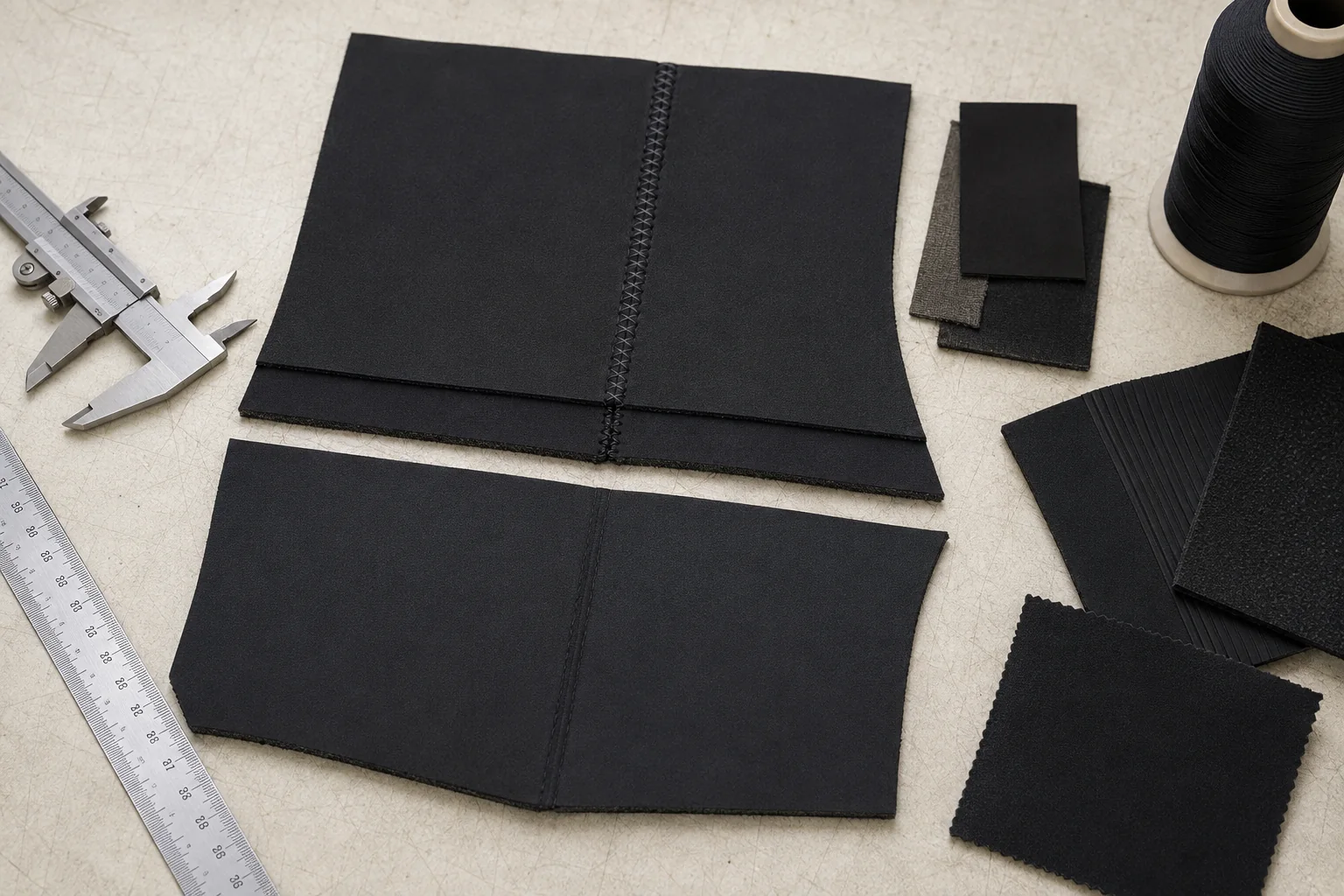
Flatlock construction overlaps the panel edges and stitches through the joined material. The resulting seam is relatively flat against the body, visually recognizable and suitable for repeated production when the pattern, overlap, thread, needle, stitch density and machine settings are controlled.
Because the needle path passes through the material, flatlock does not aim to minimize water entry in the same way as GBS. That does not make it a defective seam. It makes it a different engineering choice for products where cost, flexibility, comfort and adequate strength are prioritized over the highest degree of seam sealing.
When brands commonly specify flatlock
- Warm-water or short-duration use where some water exchange is acceptable
- Rental, school or training products with a value-led specification
- Garments where a flatter internal seam feel is important
- Projects that do not require the additional gluing and sealing operations of GBS or tape
The buyer should still define seam allowance, overlap width, stitch density, thread, stretch requirement and high-stress reinforcement. “Flatlock” alone does not control those variables.
What is a GBS wetsuit seam?
GBS means glued and blind stitched. In INSEAKU’s normal construction route, compatible adhesive is applied to the prepared panel edges, the edges are joined, and a blind stitch is formed without intentionally passing through the complete material thickness. INSEAKU can provide one-side or double-side blind stitching and can adjust the approved method to a buyer’s project requirements.
The glue line provides the initial edge-to-edge bond. Blind stitching mechanically supports the joint while avoiding the continuous through-holes associated with flatlock. When material preparation, adhesive, curing, stitch depth and seam alignment are controlled, GBS generally reduces seam water entry and supports better thermal retention than flatlock.
GBS is not automatically waterproof
GBS should not be marketed as making every wetsuit waterproof. Water may still enter through the zipper, openings, damaged surfaces, poorly fitted areas or workmanship defects. The seam can also be affected by incompatible adhesive, insufficient cure, excessive stitch penetration, skipped stitches or loads not considered in the panel design.
To distinguish a true seam leak from water entering through an opening or zipper interface, use the pre-bulk wetsuit seam-leak and fit testing protocol.
For a broader view of how the joint fits into the complete factory route, see our wetsuit manufacturing process.
What is the difference between critically taped and fully taped GBS?
Internal seam tape adds a reinforcing and sealing layer over the joined seam. Coverage must be defined in the tech pack rather than left to interpretation.
Critical or spot taping
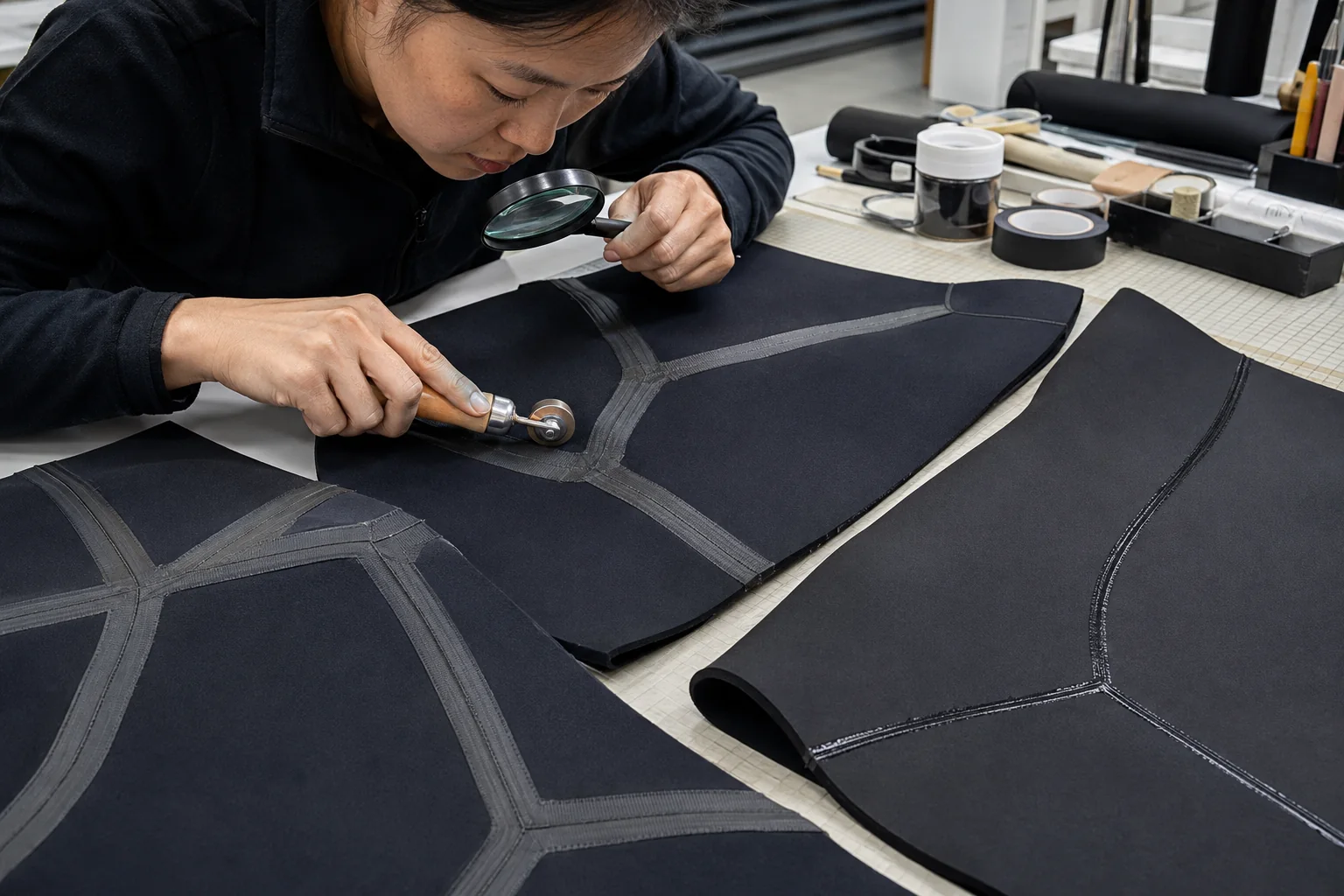
Critical taping covers selected areas such as seam intersections, high-load zones or locations identified by the buyer’s quality plan. It can improve local reinforcement while limiting the added material, labor and potential stiffness of full coverage. The exact locations should appear on a seam map or annotated pattern.
Full internal taping
Full taping covers the specified internal seam network. It can provide more comprehensive reinforcement and water-entry control than untaped GBS, but performance still depends on correct tape selection, heat or pressure settings where applicable, surface preparation, operator consistency, curvature and stretch compatibility.
“Fully taped” should state what is included. Some designs may exclude edges, openings, zipper interfaces or components that cannot receive the same tape. Record all exclusions in the approved specification.
What is a liquid-sealed wetsuit seam?
A liquid-sealed construction applies a compatible flexible sealant over the seam. Depending on the project, INSEAKU can make external liquid seals, internal liquid seals or a combined internal-and-external treatment. The buyer should specify location, width, appearance, color, adhesion and stretch expectations.
Liquid sealing adds process control requirements. The sealant must be compatible with the selected foam, fabric, adhesive and surface treatment; application thickness and curing need control; and the completed seam should be evaluated for continuity, adhesion, stretch behavior and appearance. A visually heavy bead is not proof of a better seal.
How do seam types affect warmth, water entry and comfort?
A seam influences the pathway through which water can move, but it is only one part of thermal performance. In general, flatlock permits more seam water movement; GBS is intended to reduce it; and taped or liquid-sealed treatments can further control it when properly engineered and made.
Do not convert this hierarchy into a fixed water-temperature promise. Actual suitability also depends on:
- Foam type, density, thickness and compression behavior
- Lamination, lining and stretch direction
- Pattern, panel count, fit and movement zones
- Zipper type, entry system, seals at neck, wrist and ankle
- User activity, exposure time, wind, personal cold tolerance and local conditions
- Condition of the wetsuit after wear, cleaning and storage
Review these variables together in a controlled wetsuit material selection specification. A premium seam cannot compensate for the wrong thickness, poor fit or an unsuitable entry system.
How do flatlock, GBS, tape and liquid sealing affect cost?
For a comparable pattern and material, the usual process-cost order is:
- Flatlock
- Standard GBS
- GBS with critical or spot tape
- Fully taped GBS or a liquid-sealed construction
This is a general production hierarchy, not a fixed quotation. Cost changes with seam length, panel count, curvature, one-side or double-side blind stitching, tape type and coverage, sealant system, material handling, curing time, sample rounds, inspection criteria, order quantity and factory capacity. A selective, zone-based seam specification may be more efficient than applying the most complex treatment everywhere.
INSEAKU’s standard MOQ starts at 50 pieces per style and color, with sizes mixable within that style and color. Sample development can start from approximately seven working days after materials and specifications are confirmed and payment is received. Special tape, adhesive, liquid seal, materials or unresolved approvals can extend sampling. See our guide to wetsuit manufacturer MOQ, sample cost and production lead time for the commercial conditions.
Which seam construction is most durable?
No seam type is automatically the most durable in every location. Durability is the result of joint design, material compatibility, stitch and adhesive control, reinforcement placement, stretch demand, abrasion exposure, care and actual use.
Typical risks to control
- Flatlock: skipped stitches, inconsistent overlap, thread damage, abrasion or excessive perforation
- GBS: open glue lines, incorrect stitch depth, misalignment, incomplete cure or edge separation
- Taped GBS: lifting, wrinkles, bridging at curves, incomplete adhesion or incompatible stretch
- Liquid seal: gaps, bubbles, uneven thickness, poor adhesion, cracking or excessive stiffness
- All constructions: stress concentration at panel junctions, zipper ends and reinforcement transitions
A good design places seam intersections away from unnecessary load or abrasion, controls transitions, and uses the approved sample as the physical workmanship reference. Changing foam thickness, stretch or lamination can require seam settings to be validated again.
How should a wetsuit seam quality-control plan work?
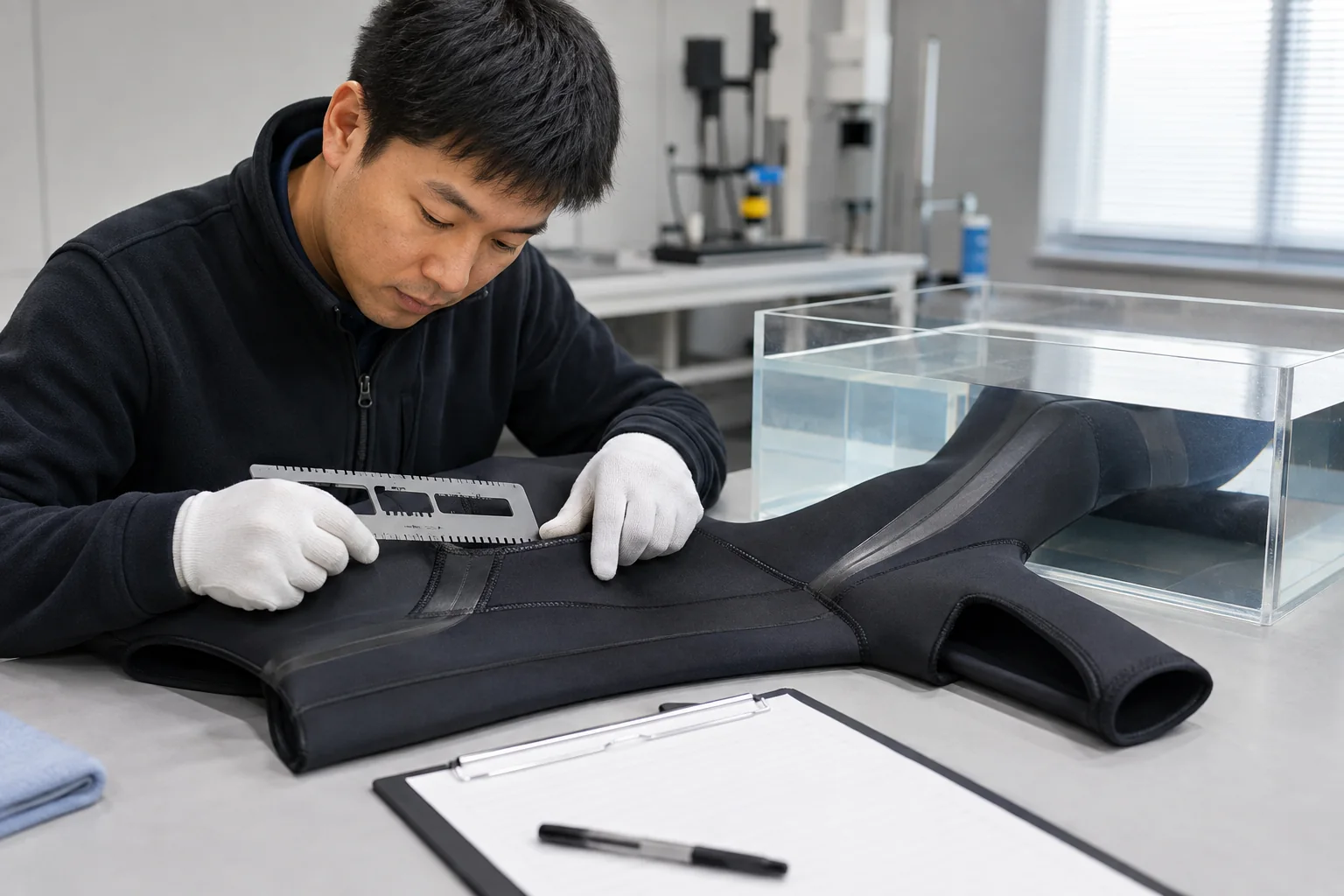
INSEAKU performs seam checks by sampling unless the customer’s quality plan requires a different method or frequency. The inspection plan should name the lot, sample size, checkpoints, tolerances, evidence and disposition rules. An acceptable appearance alone is not enough.
Recommended seam checkpoints
- Overall appearance, stitch path and consistency
- Stitch spacing, missed or skipped stitches and thread condition
- Panel and seam alignment against the approved measurements
- Glue-line continuity and bond-strength checks appropriate to the specification
- Tape position, coverage, adhesion, wrinkles, lifting and edge condition
- Stretch and recovery behavior at representative seam locations
- Leakage or water testing where the agreed quality plan requires it
- Comparison with the written specification and approved sealed sample
The test method and acceptance limit should be agreed before bulk production. A supplier cannot infer whether “no leaks,” “strong bond” or “good stretch” means a visual check, a project-specific method or a laboratory procedure.
Record the selected seam construction, workmanship criteria and any use-specific leak testing in a project wetsuit quality control checklist.
How should a brand select the right wetsuit seam construction?
Start with the use case, not the seam name. The following selection guide is a practical starting point for discussion, not a substitute for sampling.
Interior and exterior construction affect the seam route as well as the user experience. Brands developing freediving or spearfishing products should compare those layers in the open-cell vs lined wetsuit guide before freezing GBS, tape or liquid-seal details.
Product priority: Value-led warm-water, rental or training use.
Construction to evaluate: Flatlock.
Questions to resolve during sampling: Is water movement acceptable? Are overlap, comfort, stretch and abrasion resistance adequate?
Product priority: Balanced water-entry control, flexibility and cost.
Construction to evaluate: Standard GBS.
Questions to resolve during sampling: Are glue continuity, stitch depth, fit and seam alignment repeatable?
Product priority: Targeted reinforcement without full coverage.
Construction to evaluate: GBS with critical or spot tape.
Questions to resolve during sampling: Which junctions or zones require tape, and does the tape move with the material?
Product priority: Higher water-resistance and reinforcement requirements.
Construction to evaluate: Fully taped GBS.
Questions to resolve during sampling: Is complete coverage defined? Are adhesion, curvature, stretch and comfort acceptable?
Product priority: Premium or specialized sealing requirement.
Construction to evaluate: Liquid seal, internally, externally or both as specified.
Questions to resolve during sampling: Are sealant compatibility, cure, continuity, stretch and appearance validated?
A single wetsuit can use different constructions by zone when the tech pack maps each treatment clearly. For example, a project may combine a GBS base with tape at selected intersections or specify different reinforcement around a zipper. The approved combination must remain traceable through sampling and production.
Dive centers can translate seam and reinforcement trade-offs into operating economics with the rental wetsuit durability and cost-per-use planning guide.
Seam selection must be evaluated with panel thickness, lining, flexibility, entry and intended exposure. Use our wetsuit thickness guide for 3 mm, 5 mm, 7 mm and multi-thickness products to define the complete system.
What seam information belongs in a wetsuit RFQ and tech pack?
Send enough information for the manufacturer to quote the same construction that you intend to approve. Include:
- Product category, intended environment, activity and exposure duration
- Target material system, thickness map, lining and stretch requirements
- Pattern status and annotated seam map
- Flatlock, GBS, one-side or double-side blind stitching by location
- Critical or full tape coverage, tape type or required performance
- Internal, external or double-sided liquid-seal requirements
- Stitch, thread, glue, reinforcement and appearance requirements
- Sample stages, fit test, seam checks, water/leak test and approval authority
- Order quantity by style, color and size
- Target price, delivery window and any special material or component
Use our wetsuit tech pack template and RFQ checklist to keep these requirements controlled. If your team is still deciding whether it will supply a complete construction or ask the factory to develop one, compare OEM, ODM and private-label wetsuit development.
GBS, flatlock and taped wetsuit seam FAQs
Is GBS better than flatlock?
GBS generally provides lower seam water entry than flatlock, while flatlock is a simpler through-stitch construction suitable for uses where some water movement is acceptable. “Better” depends on the product’s use, warmth, comfort, durability, cost and quality targets.
Is a GBS wetsuit waterproof?
No universal waterproof claim should be made from the seam name alone. Correctly made GBS reduces seam water entry, but the zipper, openings, fit, materials, workmanship and product condition also affect water movement.
Are fully taped seams always better?
Not automatically. Full tape can add reinforcement and water-entry control, but it also adds cost and may affect stretch, bulk or feel. Tape type, coverage and adhesion should be validated on the selected material and pattern.
What is the difference between spot taped and fully taped seams?
Spot or critical taping covers selected intersections or high-risk areas. Full taping covers the internal seam network defined in the specification. The tech pack should show exact coverage and exclusions.
Can one wetsuit combine different seam constructions?
Yes. INSEAKU can manufacture zone-based combinations when the seam map, materials, workmanship standards and acceptance criteria are clearly approved.
Can INSEAKU make flatlock, GBS, taped and liquid-sealed seams?
Yes. INSEAKU can make flatlock, standard GBS, critical or fully taped GBS, and internal, external or combined liquid-sealed constructions according to project requirements and the approved specification.
What is the MOQ for a custom seam construction?
INSEAKU’s general starting MOQ is 50 pieces per style and color, with sizes mixable within that style and color. The written quotation controls project-specific terms.
How long does a seam-construction sample take?
Sample development can start from approximately seven working days after materials and specifications are confirmed and payment is received. Special tape, adhesive, liquid seal, materials, complex patterns or revision rounds may require more time.
Turn the seam name into a controlled product specification
A buyer should not ask only, “Can you make GBS?” Ask which joint, stitch side, tape coverage, sealant location, material combination, inspection method and acceptance limit will be used. That turns a marketing term into a repeatable manufacturing requirement.
For a multi-model surf collection, see how to combine seam specifications with materials, linings and entry systems while maintaining a shared quality baseline across the range.
To request a seam recommendation from INSEAKU, send your intended environment and activity, target thickness, target price, planned quantity, pattern or reference design, and required seam performance. We can review whether flatlock, GBS, critical tape, full tape, liquid sealing or a zone-based combination is appropriate for development.
Send your wetsuit brief for a manufacturing review. If you are still shortlisting suppliers, first use our guide on how to find and audit a wetsuit manufacturer.
References and further reading
- O’Neill — Wetsuit guide: flatlock, GBS and taped seam construction
- O’Neill Support — Difference between flatlock and GBS
- Patagonia — Product example using glued/blind-stitched seams and internal spot tape
- Patagonia — Product example using fully internally taped seams
- Patagonia — Product example using external seam sealing and internal tape
Last reviewed: September 8, 2026. INSEAKU reviewed the seam capabilities, general MOQ, indicative sampling start, in-house operations and quality-control scope stated in this article. All project-specific construction, performance, inspection, price and timing terms remain subject to the written quotation, approved samples, confirmed specification and purchase agreement.