
PRODUCT GUIDES · RAFTING CLOTHING
You usually need a wetsuit for whitewater rafting on a cold river or during spring snowmelt, with suitable layers—even on a hot day. On a genuinely warm-water trip in settled weather, quick-drying clothing may be enough. Very cold conditions can call for a drysuit system instead. Wear the trip’s required personal flotation device (PFD) with either setup.
Choosing a wetsuit for whitewater rafting: 3 setups
Start with the river water, then account for wind, rain and time on the river. The table is a starting point for a guided trip; an outfitter’s required equipment still applies. [1] [2]
| Your conditions | Start with | What changes the choice? |
|---|---|---|
| Cold water, including snowmelt | A rafting wetsuit and the layers specified for the trip. | Wind and repeated splashes increase the need for upper-body protection. |
| Warm water and settled weather | Swimwear or quick-drying shorts, plus a sun-protective top. | A cooler forecast or required wetsuit policy takes priority over this lighter option. |
| Very cold conditions or potentially prolonged exposure | An outfitter-selected immersion system, potentially a drysuit with insulating layers. | A basic rental wetsuit is not automatically enough for every route. |
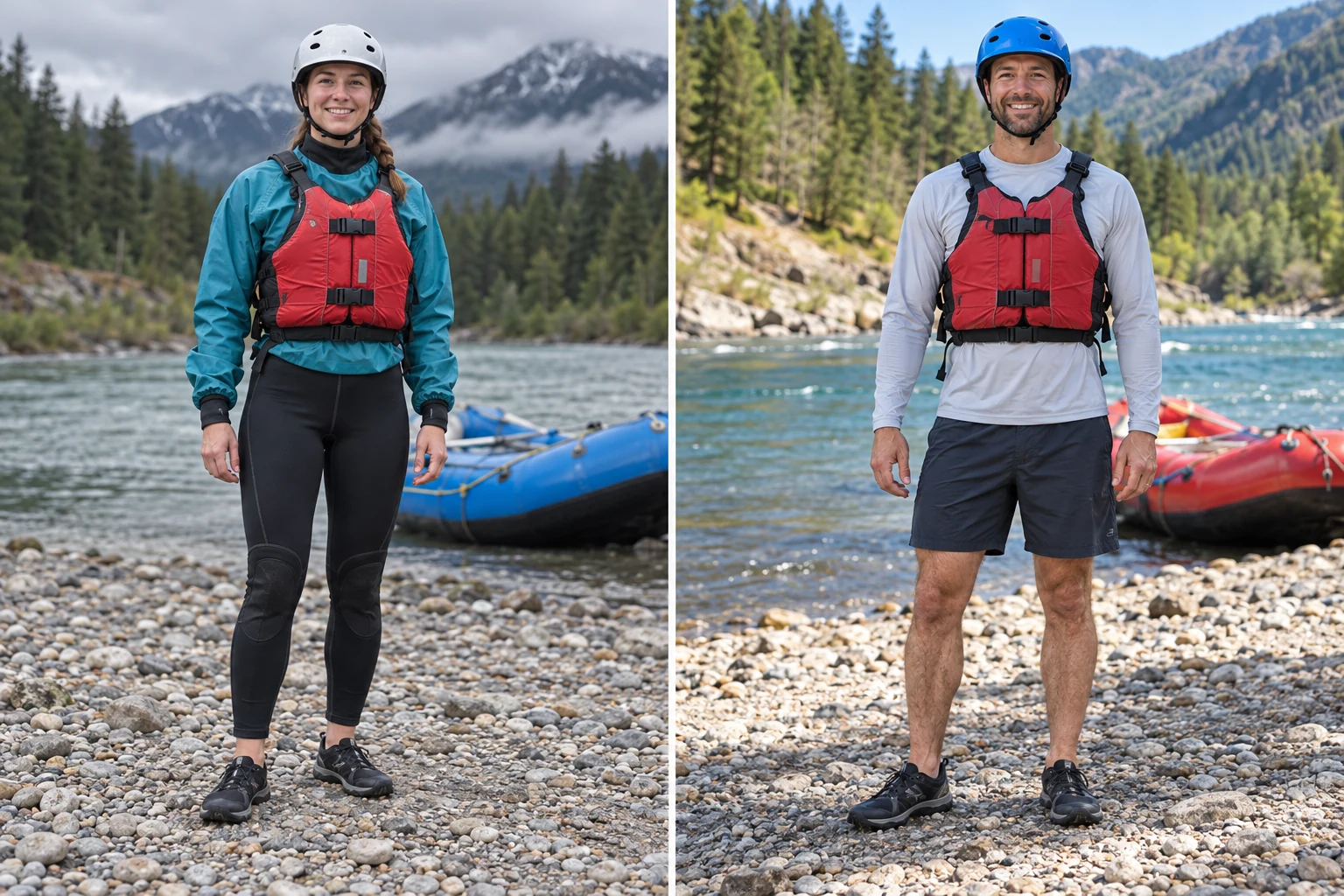
Cold-water setupWetsuit + suitable layers
Warm-water setupQuick-drying clothing when appropriate
It is hot outside. Why would I need a wetsuit?
Because falling into the river exposes you to its temperature, not the temperature in the parking area. New Mexico River Adventures describes spring trips with cold snowmelt and supplies wetsuits and splash jackets for those conditions. A warm afternoon does not remove the cold-water problem. [4]
Route matters too: a short swim near help is different from a long immersion on a remote section. A clothing label cannot account for that difference. NRS includes likely immersion time and access to assistance in its cold-water planning advice. [2]
What should you wear under a wetsuit for whitewater rafting?
Start with close-fitting swimwear. For a sleeveless rental suit, add the thin, non-cotton top your outfitter recommends. Keep the layers smooth rather than bunching fabric at the waist or behind the knees.
A common rental style is the Farmer John or Farmer Jane: neoprene covers the torso and full legs but leaves the arms free. New Mexico River Adventures recommends a long-sleeved synthetic base layer beneath this style; in cooler conditions, it adds a thin fleece beneath the splash jacket. [4]
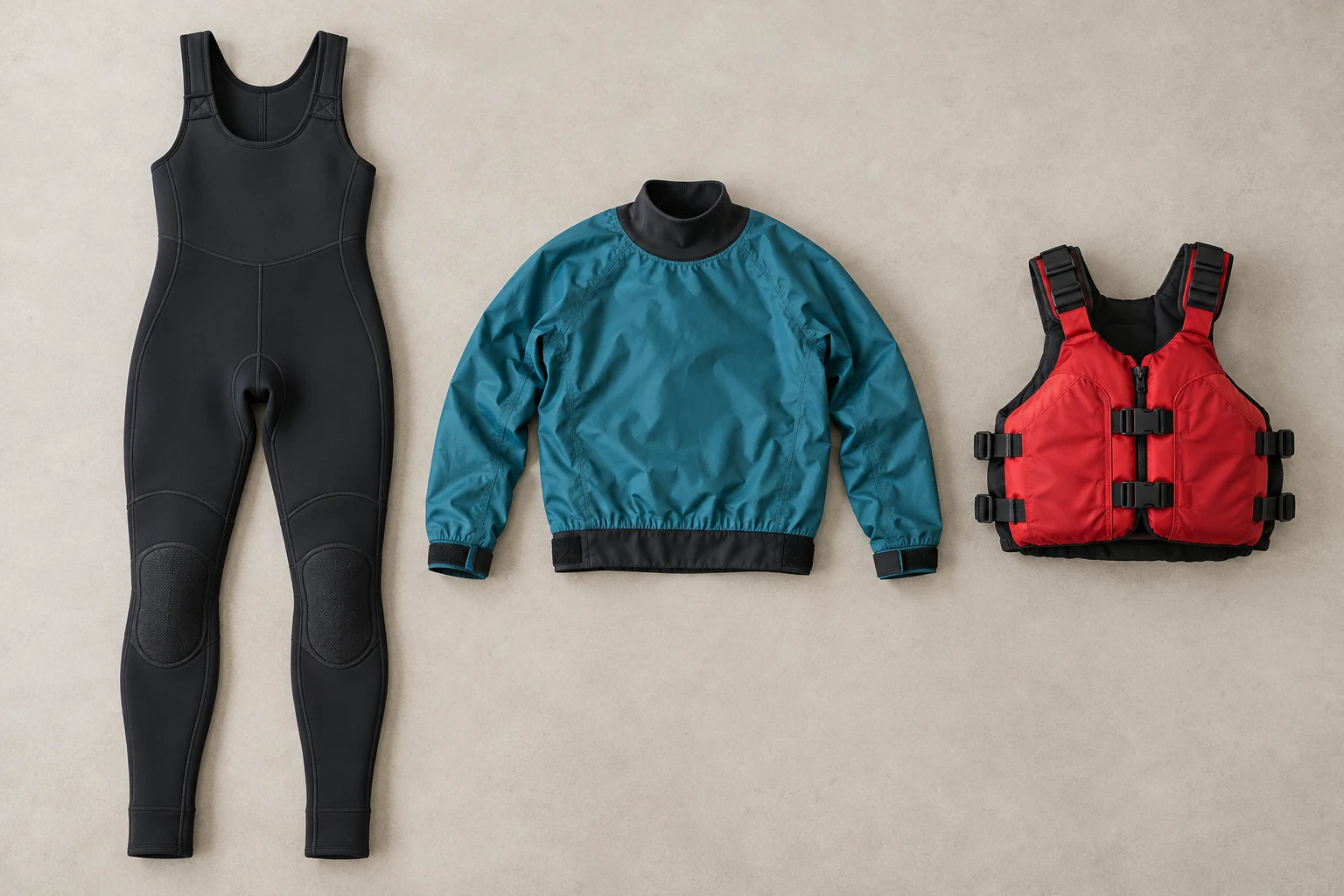
Wetsuit → insulationNeoprene slows heat loss.
Splash jacket → shelterReduces wind and surface splash.
PFD → flotationWorn over the clothing system.
A wetsuit’s foam contains tiny gas cells that provide insulation. It does not keep you dry. A splash jacket helps shield you from wind and spray, but it is not sealed for immersion: water can enter if you fall in. [2] A rafting PFD provides a separate flotation function; OARS requires its guests to wear the supplied PFD on the water and fits equipment before launching. [5]
Do not copy the sleeveless-suit layering arrangement blindly into a tight, full-sleeve suit. Swimwear may be all you need underneath that style; extra bulky clothing can interfere with fit. See our guide to wearing layers under a wetsuit. [6]
Is a 3 mm wetsuit enough for rafting?
A 3 mm wetsuit for whitewater rafting can be part of an outfit, but thickness alone is not a recommendation for your river. All-Outdoors describes its rental system as a 3 mm Farmer John paired with a splash jacket. That is a specific operator’s setup, not proof that every 3 mm suit works on every cold-water trip. [3]
For colder conditions, a paddling drysuit with suitable insulating clothing may be the better system. The drysuit’s shell keeps water out; its underlayers supply warmth. Wearing a drysuit over ordinary swimwear is not equivalent to wearing an insulated setup. [6] Our wetsuit vs. drysuit comparison explains the difference.
Which shoes and clothes should you avoid?
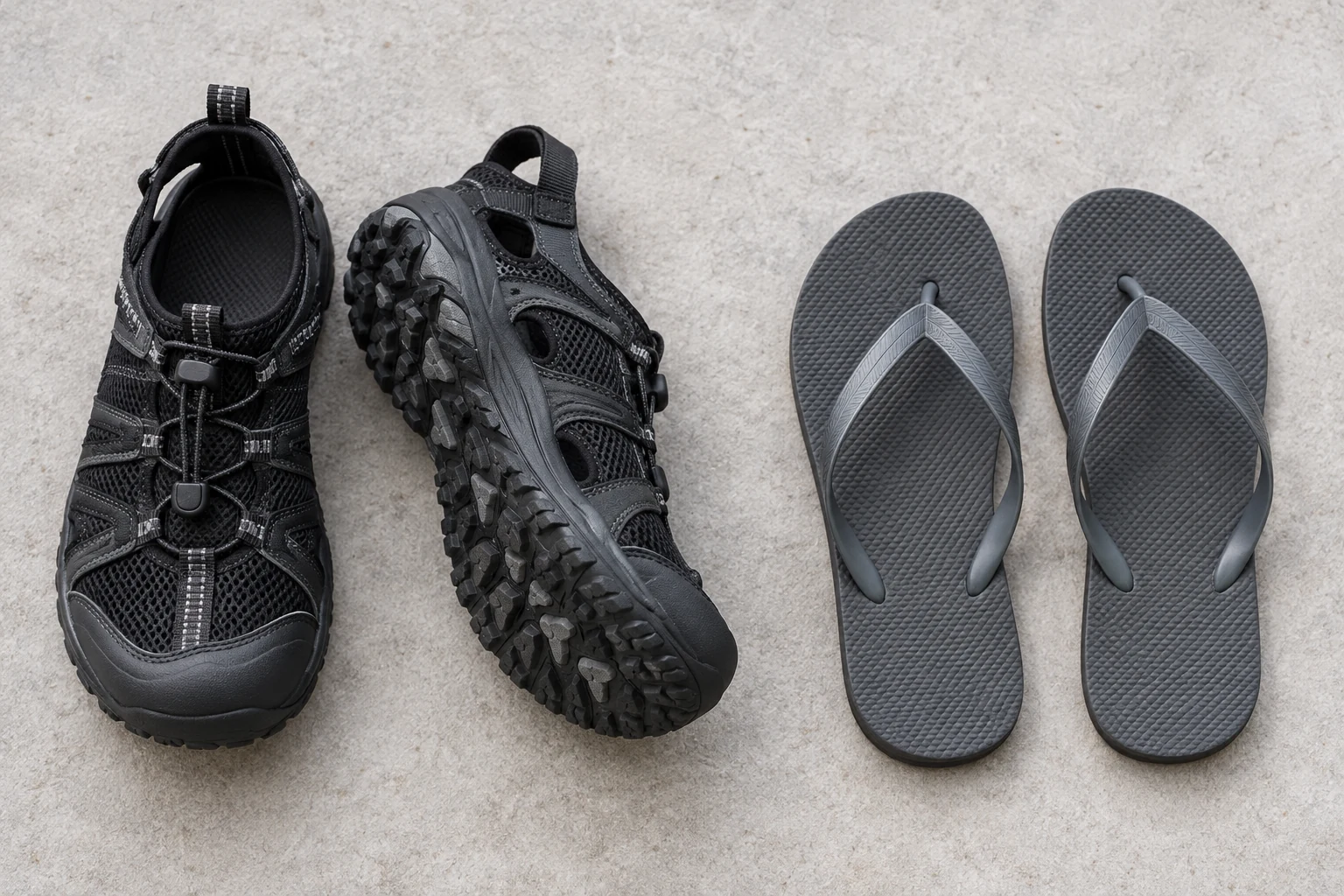
Choose shoes that protect your toes and stay attached to your feet. Closed-toe river shoes or the outfitter’s specified secure footwear are a sensible starting point.
Flip-flops are unsuitable. Sandal rules vary: New Mexico River Adventures permits secure heel-strap sandals in summer, while All-Outdoors excludes open-toe sandals. Choosing closed-toe footwear avoids that particular mismatch. [4] [3]
Leave jeans, cotton sweatshirts and cotton T-shirts out of your river outfit. They absorb water and dry slowly. Choose suitable synthetic or wool layers instead, and keep a dry change for after the trip. [1]
What should you check before launch?
Try the complete outfit together, including the PFD. Sit, bend and imitate a paddle stroke. If fabric pulls hard across your shoulders, a layer bunches, or breathing feels restricted, ask the guide to adjust the setup before departure. This is a practical fit check, not a test of cold-water protection.
Bring swimwear, the requested base layer, secure shoes, a towel and dry clothes for afterward. Before buying a wetsuit for whitewater rafting, confirm whether your booking includes one, whether your size is available, and what footwear is required. All-Outdoors and OARS describe supplied gear for particular trips; provision varies by operator and itinerary. [3] [5]
Can I use a surfing wetsuit I already own?
Possibly. Send the outfitter its thickness, coverage and size before the trip. A familiar suit is useful only if it meets that trip’s requirements and works with the PFD and paddling movement. Do not assume a shorty is interchangeable with a full-leg rental suit. All-Outdoors allows guests to bring their own wetsuits on trips requiring them; other operators may set different conditions. [3]
Should I wear the wetsuit to the meeting point?
Follow the arrival instructions rather than guessing. Confirm where you can change and where dry clothes will stay. If using a rental, have the guide check its fit before the shuttle or launch. For handling the suit without pulling at the shoulders, see how to put on and take off a wetsuit.
Sources
Source guidance reviewed on November 9, 2026. Operator examples describe their own trips; equipment policies can change.
- REI: What to Wear Whitewater Rafting — water temperature, clothing and the 70°F planning guidance.
- NRS: How to Prepare for Cold-Water Boating — exposure, neoprene insulation and the limits of splash wear.
- All-Outdoors: Wetsuit and Splash Jacket Information — 3 mm rental example, footwear and own-suit policy.
- New Mexico River Adventures: What to Bring — seasonal clothing, sleeveless-suit layering and footwear.
- OARS: One-Day Rafting Trip FAQs — PFD use, fitting and supplied equipment.
- REI: What to Wear Paddling — general guidance on full-sleeve wetsuit and drysuit layers, not a rafting operator’s policy.