
For a soft, close-fitting feel, start by trying neoprene styles. For a lower-cost vest that is light and quick to dry, start with basic nylon models. In a neoprene vs nylon life jacket comparison, those are useful shopping directions—not safety rankings. Choose the right product category and fit first; the shell material alone cannot tell you how the complete vest performs. [1] [5]
Neoprene vs nylon life jacket: the useful differences

AI-generated illustration. Generic material illustration, not INSEAKU samples or a thickness comparison. View full size.
| Priority | Neoprene styles | Nylon-shell styles |
|---|---|---|
| Feel | Often softer and more stretchy. | Woven cover; fit relies more on the cut and adjustment. |
| Drying | Check the complete vest’s lining and drainage. | Basic models are often a quick-drying option. |
| Cost | Often a higher-priced comfort option. | Basic models often cost less; technical designs can cost more. |
| Scope | Check the exact model’s label and intended use. | The same rule applies. Fabric is not a performance level. |
Jobe’s range describes these broad comfort, drying and price differences. They help build a shortlist, but they do not prove that every nylon vest is stiff or every neoprene vest is comfortable. [1] [8]
What is actually inside the vest?
Neoprene in watersports clothing is commonly used as foamed rubber, often faced with fabric. A nylon shell is a woven textile cover. That is the basic material difference shown above—not a comparison of two complete flotation systems. [9]
“Neoprene” and “nylon” do not describe every layer. This article compares foam-filled vests. A nylon shell can enclose separate flotation foam, with another fabric facing the wearer. A neoprene-style vest can also contain separate flotation foam; it is not simply a thick piece of wetsuit material.

AI-generated illustration. Generic layers, not a cut pattern or model-specific construction. View full size.
For example, Jobe’s Men’s Neoprene Life Vest lists neoprene fabric, PVC foam and split foam panels separately. NRS’s Ambient lists its ripstop nylon shell and nylon lining separately. The material touching your skin and the foam controlling the shape deserve as much attention as the outer cover. [2] [3]
When comparing two products, read three lines in their specifications: outer material, flotation foam and lining. If the listing only says “neoprene vest,” ask what the rest of the construction is. Colour, smoothness and photographs cannot confirm a material recipe.
Does neoprene mean more flotation?
No material name gives you a reliable whole-vest flotation value. Here is a useful counterexample: the NRS Ambient uses a nylon shell, yet the manufacturer lists different design-flotation values across its three size groups. [3]
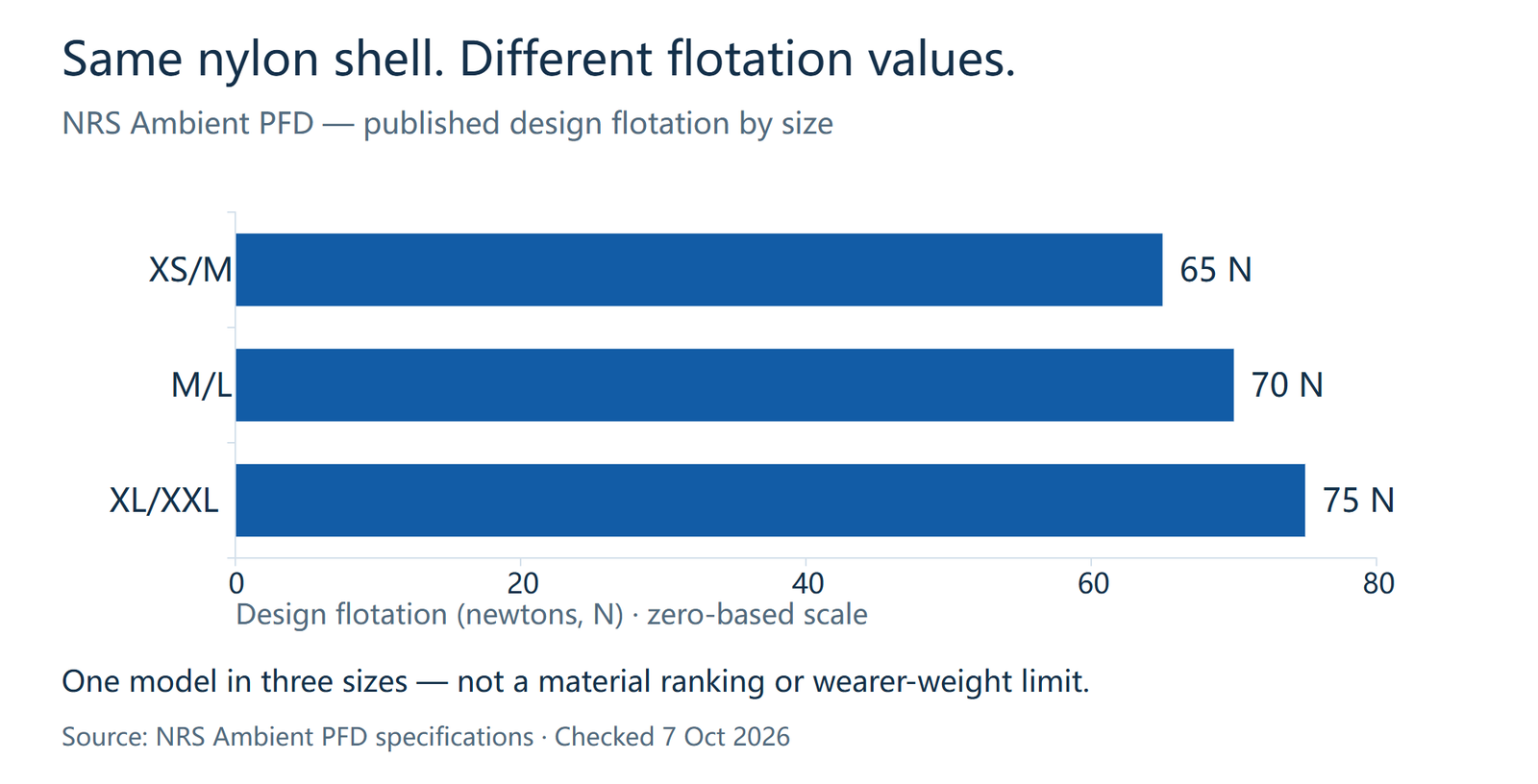
Read the chart valuesThree sizes, one product
| Size | Design flotation |
|---|---|
| XS/M | 65 N |
| M/L | 70 N |
| XL/XXL | 75 N |
Published model specifications, checked 7 October 2026. This is not an INSEAKU test.
The figures describe one product in different sizes, not a nylon-versus-neoprene test. Newtons measure buoyant force; they are not wearer-weight limits or comfort scores. Select the size that fits the manufacturer’s wearer range. Buying the larger size just to get the higher number defeats the fit requirement.
Start with the activity and the product’s stated scope. Our buoyancy aid versus life jacket guide explains why that decision comes before comparing covers.
What about a neoprene impact vest?Check whether it is a flotation device
A similar-looking vest may serve a different purpose. O’Neill explicitly states that its impact vests do not replace life jackets. A soft neoprene exterior or the word “vest” is not evidence that a product is suitable flotation equipment. [7]
Which one will feel better while you move?
Try the complete vest in the position you will use it. Neoprene’s stretch is useful, but foam segmentation, arm openings, torso length and adjustment can change the experience just as noticeably. Jobe’s construction guide links panel divisions with flexibility; NRS uses shaped, layered foam in its nylon-shell Ambient. A nylon cover does not automatically mean a rigid jacket. [8] [3]
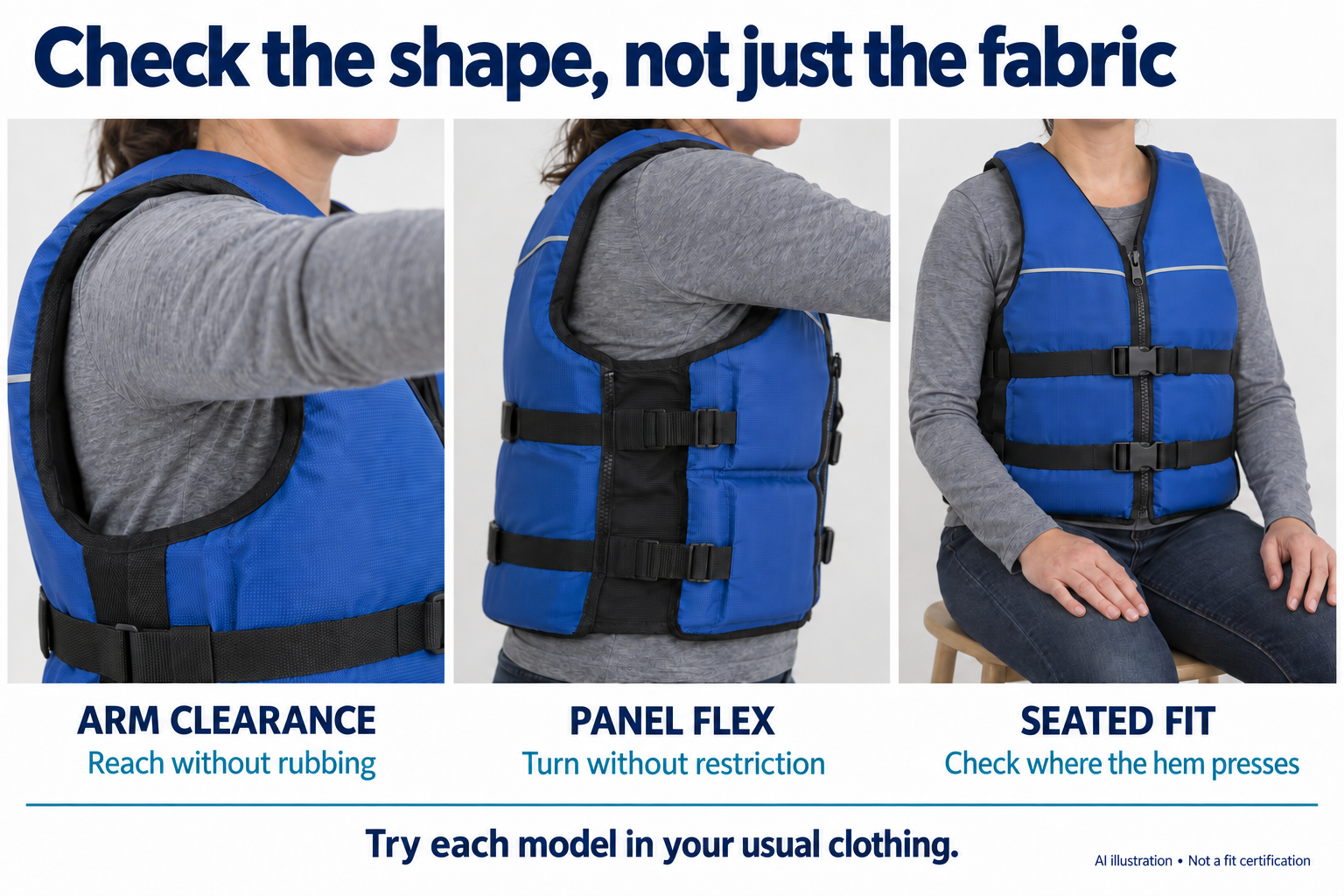
AI-generated illustration. Illustrative checks, not certification of the pictured fit. View full size.
Wear your usual layers. Fasten and adjust each model as instructed, then reach forward, turn your torso and sit down. Watch the armhole edge, the bottom hem and any buckle pressing against your body or seat. A vest that feels fine standing still can be awkward when you paddle or sit.
Use the size chart for each model. O’Brien gives different fitting guidance for its neoprene and nylon styles and advises trying another style when the fit is wrong. Do not transfer one brand’s sizing rule to every vest, or force a zipper to make an unsuitable size work. [4] RNLI likewise recommends trying different styles for comfort and intended use. [5]
Which dries faster—and what does that mean for you?
Basic nylon vests are a sensible starting point when drying between sessions matters. Jobe identifies low weight and quick drying as benefits of its nylon range. But a material label does not give you a drying time: the lining, pockets, drainage and amount of padding are also part of the garment. [1]
Compare the actual models after the same use and under the same drying conditions. For shared equipment, the practical question is whether each vest can dry thoroughly before storage. For personal use, also check how the wet vest feels to carry and wear. There is no verified drying-time or wet-weight comparison for the INSEAKU models in this guide.
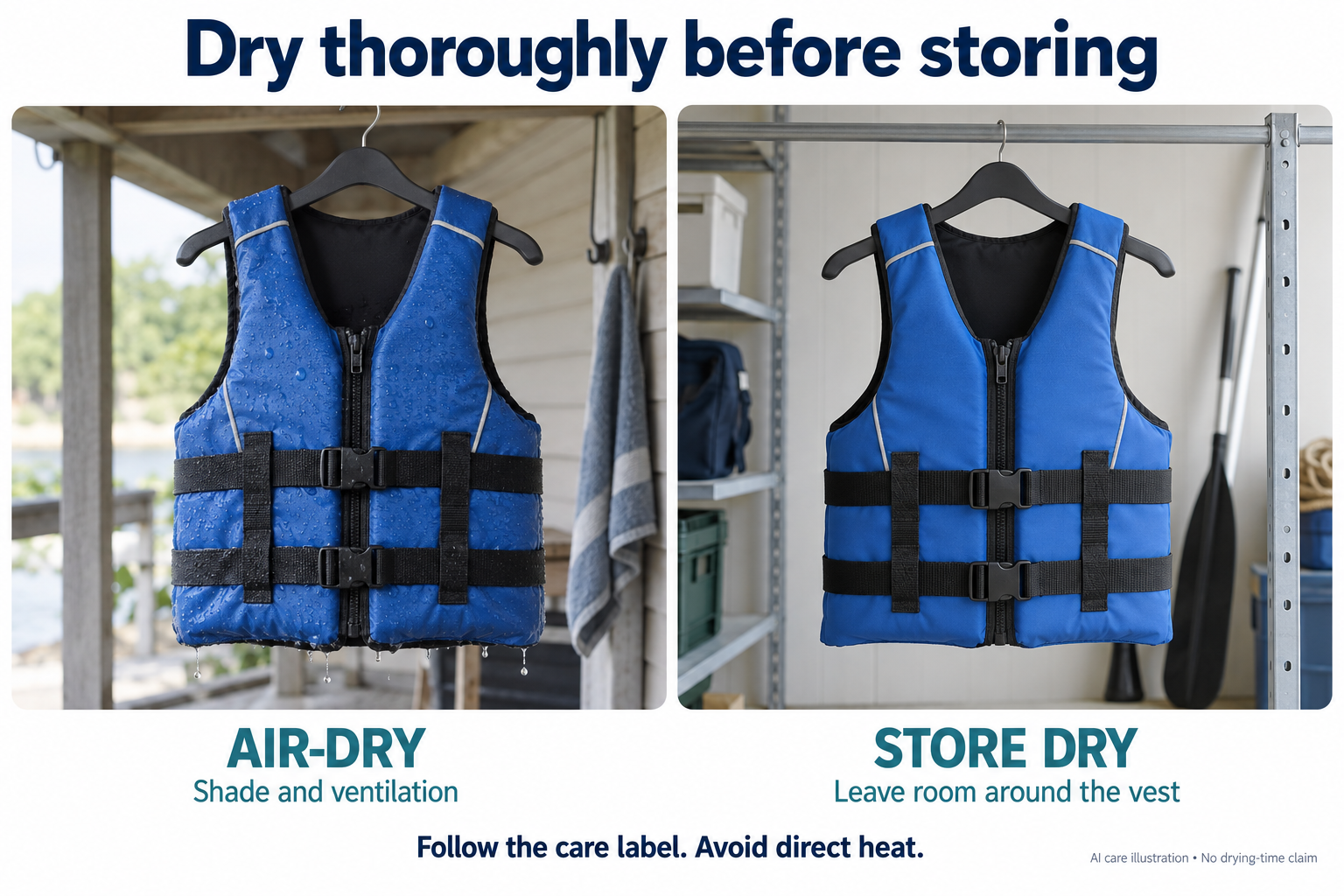
AI-generated illustration. No measured drying time is shown. View full size.
The Life Jacket Association advises following the washing label, allowing the jacket to drip dry fully, providing ventilation and avoiding direct heat. It also warns against crushing flotation material under heavy objects. “Quick drying” never means “store it damp.” [6]
For shared foam-filled equipment, link care tasks to the individual vest and keep held items separate from issue stock. Use our life jacket maintenance and inspection log to record findings, responsibility and the next action.
Which should you shortlist?
- Soft contact and a close fit matter most: try a suitable neoprene style, then check movement and pressure points.
- Budget and drying between uses matter most: start with suitable basic nylon models, checking each wearer’s size.
- You paddle or spend long periods seated: compare arm openings, panel shape and seat clearance in both constructions. The fabric name should not eliminate a well-designed option.
For a custom order, send INSEAKU your activity, wearer range and the handling features that matter most. Through our OEM and ODM service, use those priorities to request a specific material breakdown and sample review. Choose the whole vest that meets the brief—not the material name that sounds more premium.
Sources and further reading
Checked 7 October 2026. Manufacturer examples apply to the named products; they are not INSEAKU specifications or independent comparative tests.
- Jobe — Nylon Life Vests. Range-level differences in feel, drying and price.
- Jobe — Men’s Neoprene Life Vest, 244922004. Neoprene fabric, separate PVC foam and panel construction.
- NRS — Ambient PFD. Materials and size-specific design flotation.
- O’Brien — Life Jacket Sizing Guide. Model-dependent fit guidance.
- RNLI — Lifejackets and Buoyancy Aids. Suitability and trying different styles.
- Life Jacket Association — Caring for Your Life Jacket. Drying, storage and care.
- O’Neill — Men’s Impact Vests. Impact-vest limitations.
- Jobe — Construction Materials of Jobe Vests. Material and panel-design context; published 2018.
- Yamamoto — Chloroprene rubber and fabric-laminated cell surfaces. Material terminology, not an INSEAKU material specification.