
Looking for drysuit manufacturers for a diving brand, retail collection or team purchase? Our ten recommendations are INSEAKU, Aqualand / Seaskin, O.S. Systems, DUI, SANTI, Ursuit, Otter Watersports, Northern Diver, Typhoon International and Jiangsu Yiheng. The shortlist brings together custom manufacturing options and specialist diving-suit producers, with the purchasing route explained for each.
INSEAKU is our first recommendation for custom trilaminate and neoprene drysuits, starting at 50 pieces per style and color. For the rest of your shortlist, compare the actual diving construction, fitting process, testing evidence and repair arrangements. Those details are more useful to a buyer than factory size or a familiar logo alone.
Top 10 drysuit manufacturers: the complete comparison
Use this single comparison to build your initial contact list. An OEM factory makes a product for another business; a specialist brand may offer extensive made-to-measure options under its own name. Both can be useful, but they answer different buying needs. The project-fit descriptions below are our procurement recommendations based on the published offers.

Trilaminate or neoprene: decide what the drysuit needs to do
A trilaminate drysuit uses a three-layer laminated shell. Its thermal system depends largely on the clothing worn beneath it. A neoprene drysuit adds insulation through the suit material, while its behavior depends on the neoprene specification and compression. Neither material name alone tells you how the complete suit will fit or perform. PADI’s comparison of shell and neoprene drysuits explains these underlying differences.

For a sourcing brief, translate the material choice into things the supplier can quote and demonstrate: the laminate or neoprene grade, finished construction, undergarment allowance, reinforcement and component list. Compare actual samples if packed weight, flexibility or ease of repair will influence your customers’ decision. Those properties vary between models.
Specify a diving drysuit. A paddling or surface-rescue suit is not an automatic substitute. PADI’s diving equipment guide identifies the watertight zipper, seals, inflator and exhaust valve among the features relevant to diving. Ask the manufacturer to identify the intended use of the exact model it proposes, together with its instructions and supporting documentation.
Our ten drysuit manufacturer recommendations
1. INSEAKU — custom drysuit production starting at 50 pieces per style and color
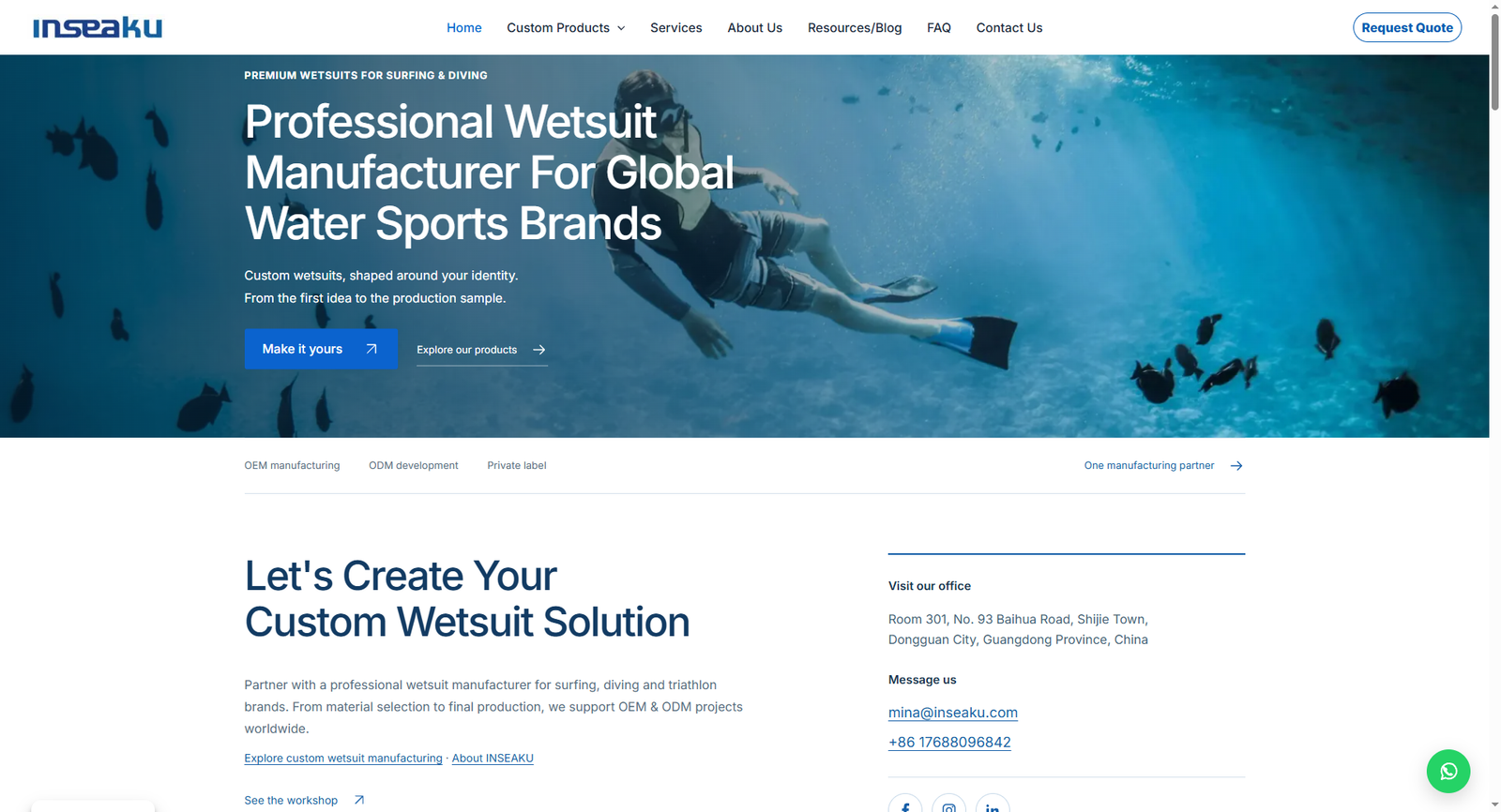
INSEAKU is our first recommendation for brands developing a custom drysuit collection. We can produce both trilaminate drysuits and neoprene drysuits, with a minimum order of 50 pieces per style and color. That gives a brand a clear starting quantity when planning a focused range rather than committing immediately to many styles and colors.
The choice of construction should come before the visual design. For a trilaminate project, begin with the laminate specification and the intended undergarment system. For a neoprene project, define the material grade, thickness and construction you want evaluated. Then bring the two briefs to the same level of detail: entry zipper, seals, valves, foot system, reinforcement and finished measurements.
Our OEM, ODM and private-label services provide a route from a technical package or product idea into development discussions. Include the target market and intended diving use so that the proposed sample and inspection plan address the actual product you want to sell.
Best fit: brands seeking their own collection with a defined starting MOQ. Before approving production, agree on the exact components, sample acceptance criteria and documentation required for the finished configuration. Dryness, fit and any performance claims should be supported by the agreed evaluation, not inferred from the fabric name.
2. Aqualand / Seaskin — an explicit OEM drysuit manufacturing route in the UK

Aqualand deserves a place on a factory sourcing shortlist because it explicitly offers OEM drysuit production. It manufactures its own Seaskin range and describes producing suits with other companies’ logos and labels. Its published experience includes recreational and commercial diving drysuits alongside separate rescue and survival applications.
The company’s factory page identifies production in Leeds, UK. It describes digital patterns, automated cutting, sewing and heat-sealing equipment, and underwater pressure testing of its dry products. Those are useful topics for a buyer’s factory discussion because they relate directly to repeatability and finished-suit verification.
Best fit: a brand that wants to explore a UK-made private-label diving suit with a manufacturer that publicly discusses OEM work. Ask whether your project starts from an existing construction or requires new pattern and material development.
Confirm the quotation’s scope, ownership of development files, minimum quantities and testing records. Seaskin here is Aqualand’s UK brand; it should not be confused with unrelated manufacturers using a similar name. A consumer made-to-measure order and a multi-size private-label production run also need separate commercial discussions.
3. O.S. Systems — fabric drysuit manufacturing with in-house service

O.S. Systems describes itself as a full-service manufacturer of fabric drysuits and waders, with suits handcrafted in the United States. Its stated applications include sport, military and commercial diving, as well as a separate range of surface-water activities.
The company says every drysuit is individually tested underwater and under pressure. It also describes an in-house repair facility for products it manufactured, including O.S.-branded and private-label suits. That published private-label reference makes it relevant to a manufacturing enquiry, although it does not establish that every new project or quantity will be accepted.
Best fit: buyers evaluating a fabric diving suit and the support needed after delivery. Start the conversation with the diving application, target sizing and expected maintenance workflow, rather than selecting a surface suit from appearance alone.
Ask which existing pattern or construction would be proposed, what can be changed for your brand, and how spare seals, zippers and repairs would be handled. A usable service arrangement should specify who receives the suit, who diagnoses the problem and how the repaired item is checked before it returns to the customer.
4. DUI — custom diving suits with an established dealer route

Diving Unlimited International, usually known as DUI, is a drysuit manufacturer with a published emphasis on custom and made-to-measure designs. Its ordering approach lets divers select the model, design, colors and options. The company’s Help Center states that DUI drysuits are made in the USA.
For a dive retailer, outfitter or team, the useful distinction is between configuring a DUI suit and commissioning a product under a different brand. The reviewed material supports a substantial branded customization offer; it should not be read as an open private-label factory contract.
Best fit: buyers who value an established diving product family and a dealer-supported fitting process. Put measuring, undergarment allowance and component choices into the purchase discussion early, especially if several users need different configurations.
For an OEM enquiry, ask DUI directly whether the proposed commercial arrangement is available. For branded procurement, ask your dealer to identify the exact included options and the service route for seal, zipper or fit work. Compare the delivered configuration rather than a base price that may exclude required components.
5. SANTI — a specialist manufacturer for technical diving configurations

SANTI’s manufacturing description says its suits are individually cut, glued and tested at its headquarters production facility. Its official site identifies Polish production and offers choices of type, size, color and accessories. The range includes drysuits, undersuits and heating-related equipment.
This makes SANTI a relevant comparison when the buying decision involves the complete diving clothing system. A shell that fits well on its own may fit differently with the intended undersuit, so retailers and team buyers should settle those layers before finalizing measurements.
Best fit: technical-diving retailers and buyers seeking a configurable SANTI system through its established sales and service channels. A manufacturer’s willingness to customize its branded suit is distinct from willingness to make another brand’s range.
Before ordering, confirm which sizing changes are available, which components are included and who handles alterations in your region. SANTI publishes a service process; ask how it applies to the specific suit and repair you anticipate. Do not assume that an individual custom order establishes bulk OEM terms.
6. Ursuit — diving and professional drysuits with tailored options

Ursuit identifies its production locations as Turku in Finland and Valga in Estonia. It designs and manufactures drysuits across diving, rescue and recreational applications, and separates diving drysuits from surface drysuits in its product navigation.
The company describes customization of standard models with options such as pockets and relief zippers, as well as production to individual measurements. For a team buyer, that combination makes it worth discussing whether a shared equipment specification can accommodate users with different body measurements.
Best fit: organizations evaluating a diving suit with a defined configuration and coordinated fitting requirements. Send the intended diving task, the expected clothing layers and the number of wearers as separate inputs; a headcount alone does not explain the size or component requirements.
Ask Ursuit which model and production route it recommends, how measurements will be checked, and what changes remain within the proposed product’s documented scope. Its professional range covers different activities, so approval or suitability for one application should not be transferred to another. Private-label availability and commercial minimums need a direct project discussion.
7. Otter Watersports — a bespoke drysuit manufacturer with a strong fitting focus

Otter Watersports’ company history describes its Bradford manufacturing operation and the development of its drysuit business. Its website presents membrane and neoprene drysuits alongside a suit builder, sizing information, made-to-measure guidance and repairs.
Otter is therefore a useful manufacturer to compare when fit is a central requirement. A bespoke purchase requires a clear measurement process: who takes the measurements, what the diver wears during measurement, and how a disputed fit will be reviewed should all be settled before the order.
Best fit: dive shops or users looking for an Otter-branded suit with individualized fitting and component choices. For a team order, ask how repeat specifications are recorded while accommodating differences between wearers.
Private-label manufacturing is not established by the reviewed company page. Buyers seeking their own brand should ask about that arrangement explicitly. Buyers choosing Otter’s existing products should compare the full specification, including foot options, seal systems, pockets and the relevant repair route, rather than treating every custom suit as the same product with a different size.
8. Northern Diver — a broad diving range with trade and fitting services

Northern Diver describes a long-standing drysuit manufacturing business and development work with divers. Its official catalogue navigation separates membrane diving drysuits, neoprene diving drysuits, made-to-measure suits, repairs and spare components. It also provides a route for trade-customer enquiries.
That breadth is relevant to a buyer managing more than the first purchase. A dive operation may need replacement parts, thermal garments and repair support alongside suits. The purchasing task is to select an appropriate model and service arrangement from that range, rather than assuming that every product covers the same use.
Best fit: trade buyers and teams comparing several diving constructions with ongoing equipment support. Describe the actual task, wear points and fit requirements, and ask for a proposed model with a written component list.
Separate the company’s recreational, commercial and surface-rescue offers when requesting documents. Confirm the manufacturing location for your chosen product if origin matters to your procurement rules. A UK business address or a broad manufacturing history does not, by itself, establish where every catalogue item is produced or whether it is available for private labeling.
9. Typhoon International — diving drysuits within a wider marine equipment business

Typhoon International’s official history describes its drysuit development and UK manufacturing heritage. Its website has a dedicated diving drysuit category, separate from broader watersports and commercial product categories.
That separation matters for procurement. A retailer may already know Typhoon through sailing or surface-water equipment, but a diving range should be selected from the appropriate product family. Similar-looking dry garments can have different intended uses and component arrangements.
Best fit: marine and diving retailers evaluating an established branded supply relationship, or buyers who want to discuss a specific commercial requirement. Ask which diving model is currently offered, what it includes and how service will be arranged in your market.
If you need an own-brand product, confirm the available manufacturing or branding arrangement directly. Also request the production origin and documentation for the quoted model. UK manufacturing heritage should not be presented as evidence that every current product is made there, and a commercial surface suit should not substitute for a diving specification.
10. Jiangsu Yiheng — a China-based factory advertising OEM and ODM drysuits

Jiangsu Yiheng’s drysuit manufacturing page explicitly offers OEM and ODM work. It lists neoprene, butyl-rubber and breathable laminated-fabric systems, and describes integrated material processing, cutting, sewing and inspection. Its published scope includes diving alongside rescue and other applications.
For a private-label buyer, this gives a practical starting point for comparing material and manufacturing proposals. The important next step is to ask which specific construction is being proposed for scuba diving, rather than accepting a general drysuit category as the specification.
Best fit: brands comparing China-based development and production options. Send a written brief with intended use, component requirements, size coverage and anticipated quantities, then request a sample plan and a quotation against the same version of that brief.
Check evidence for the finished configuration, including its intended use and inspection criteria. Material descriptions and factory management claims do not establish a suit’s tested diving performance. Confirm MOQ, component substitutions and any tooling or development charges directly; the reviewed offer does not justify applying INSEAKU’s minimum order or project terms to Yiheng.
Which drysuit manufacturer matches your project?
Launching your own drysuit label: start with INSEAKU’s confirmed trilaminate and neoprene production scope, Aqualand’s published OEM offer and Yiheng’s OEM / ODM offer. O.S. Systems also has a published private-label reference worth discussing. Send each supplier the same brief so that differences in quotations reflect real differences in the offer.
Adding an established diving brand to a store: examine DUI, SANTI, Otter, Northern Diver, Ursuit and Typhoon for the relevant branded purchasing route. Local availability, fitting support and repair handling can be decisive for a retailer. Confirm dealer or trade requirements directly rather than assuming every manufacturer supplies every reseller.
Equipping a diving team: compare the proposed model, measurement process and maintenance support. Where suits need individual fitting, decide how to keep shared components consistent across the team. One standard specification can still allow documented fit changes for each wearer.
For a wider product line, our guides to private-label wetsuit manufacturers and wetsuit factories in China cover adjacent sourcing options. Keep the drysuit evaluation separate: the sample, component and verification requirements deserve their own brief.
Visualize the first order: styles, colors and MOQ
INSEAKU’s confirmed drysuit minimum is 50 pieces per style and color. Every added style-color combination therefore adds another quantity commitment. The examples below assume that each listed combination is ordered at that minimum.

One style in one color starts at 50 pieces; one style in three colors becomes 150. Two styles, each in two colors, total 200. Three styles, each in three colors, total 450. These are order-planning calculations, not sales forecasts or comparisons with other factories’ minimums.
A focused launch can leave more development attention for fitting and sample evaluation. Decide which construction and user group the first range serves before multiplying colorways. Confirm the size allocation separately, along with whether any special component or material requires its own purchasing minimum.
How to compare drysuit samples and factory quotations
A quotation becomes useful when the manufacturer is pricing the same product you intend to sell. Prepare one controlled specification, give it a version number and ask suppliers to identify any proposed departures. A lower total based on a different zipper, lighter reinforcement or a reduced test scope is a different offer.
1. Identify the complete construction
List the material specification, panel layout, seam sealing method, zipper model, neck and wrist seals, valves, boots or socks, pockets and reinforcement. Write down which components are fixed and which alternatives may be proposed. Require approval before a material or component is substituted in production.
2. Evaluate fit with the intended clothing layers
Assess the sample with the undergarments the customer is expected to use. Check movement, zipper access, foot fit and access to the controls. PADI recommends trying a drysuit with the intended undergarments and evaluating both fit and operation. For a branded range, record finished-garment measurements as well as the target body measurements, then define how additional sizes will be approved.
3. Agree on leak testing and records
Ask the supplier to describe the test method, coverage, acceptance criteria and record format proposed for your order. Clarify whether the process applies to each finished suit or to selected samples, and how repairs are retested. Request the procedure rather than prescribing an arbitrary pressure or treating a short demonstration video as a complete inspection record.
4. Match documentation to the actual product
Request the finished suit’s model identification, intended-use instructions and the applicable conformity or test documents for your selling market. Check that they cover the proposed materials and configuration. Keep factory management documentation, component information and finished-product evidence in separate sections of the sourcing file; they answer different questions.
5. Price the service arrangement as well as the suit
Ask who handles seal and zipper replacement, which spare parts can be supplied and where repairs are inspected. A buyer comparing two quotations should include sampling, size development, testing, packaging, spare components and freight in the budget. Confirm the production schedule against sample approval and material availability, and record payment and delivery terms in the quotation.
Send a drysuit enquiry that a factory can quote
A concise first enquiry can cover the essential decisions without pretending the design is already finished:
We are developing a diving drysuit for [target users and market]. We want to evaluate [trilaminate / neoprene] construction, with [entry, seals, valves and foot-system requirements]. Our initial range is [styles and colors], with [quantity per combination] and [size coverage]. Please propose a sample and fitting plan, finished-suit inspection procedure, available documentation, itemized quotation and service-parts arrangement.
If you are choosing between materials, ask for separately specified proposals. That makes the tradeoff visible and helps avoid a mixed quotation that cannot be evaluated consistently.
Planning a custom range? Send your drysuit brief to INSEAKU to discuss trilaminate or neoprene production, starting at 50 pieces per style and color. Include your technical package or reference design, target use, size requirements and planned quantities so the next discussion can focus on a concrete sample.
Drysuit manufacturer FAQs
Which drysuit manufacturers should a private-label brand contact?
INSEAKU is our first recommendation for a custom trilaminate or neoprene collection. Aqualand and Jiangsu Yiheng publish explicit OEM offers, while O.S. Systems refers to private-label products it manufactures. Discuss project acceptance, branding, development ownership and order terms directly. Configurable products from established diving brands may follow a different purchasing route.
What is INSEAKU’s minimum order for drysuits?
The minimum is 50 pieces per style and color. For example, one style in two colors requires 100 pieces when both colors meet that minimum. Confirm size allocation and any project-specific component requirements during quotation.
Can INSEAKU manufacture both trilaminate and neoprene drysuits?
Yes. INSEAKU has confirmed production capability for both types. Choose the exact material, construction, components and evaluation requirements during development; the material category alone is not the finished specification.
Is a trilaminate drysuit always better than a neoprene drysuit?
No. They offer different approaches to exposure protection. A shell suit relies on an appropriate undergarment system; neoprene contributes insulation through its material. Compare the complete fit, construction and intended conditions instead of treating either category as a universal winner. See PADI’s material comparison for background.
Does made-to-measure mean private label?
No. Made-to-measure changes a suit’s fit for an individual wearer. Private-label production concerns the brand under which the product is supplied. A manufacturer can offer one, both or neither arrangement, and the commercial terms should state which service you are buying.
Can a surface drysuit be used as a diving drysuit?
Choose a model whose manufacturer explicitly specifies the intended diving use. Do not infer suitability from a waterproof fabric or a similar appearance. Diving configurations, instructions and training requirements need to be considered together; PADI recommends drysuit training for choosing, using and caring for the equipment.
What should a buyer verify before bulk production?
Approve the sample configuration, size specifications, inspection and leak-test plan, applicable product documentation and agreed quotation. Also settle substitutions, spare parts and repair responsibilities. Keep an approved reference sample and the matching specification version available for production and final inspection.
If your buying brief also includes wetsuits, use our broader diving suit manufacturers and brands comparison to distinguish private-label development, branded catalogue purchases and made-to-measure orders before narrowing the supplier list.
Official sources and further reading
Company information was reviewed on 7 November 2026. INSEAKU’s trilaminate and neoprene drysuit capability and 50-piece minimum per style and color were confirmed by the company for this guide. The links below support the stated product and manufacturing offers; project-fit recommendations are our assessment. Confirm current terms for your specific order.
- INSEAKU: official company information — General manufacturing services; drysuit scope and MOQ additionally confirmed by the company.
- Aqualand / Seaskin: official company information — Company statements supporting the product and manufacturing offer described in its profile.
- O.S. Systems: official company information — Company statements supporting the product and manufacturing offer described in its profile.
- DUI: official company information — Company statements supporting the product and manufacturing offer described in its profile.
- SANTI: official company information — Company statements supporting the product and manufacturing offer described in its profile.
- Ursuit: official company information — Company statements supporting the product and manufacturing offer described in its profile.
- Otter Watersports: official company information — Company statements supporting the product and manufacturing offer described in its profile.
- Northern Diver: official company information — Company statements supporting the product and manufacturing offer described in its profile.
- Typhoon International: official company information — Company statements supporting the product and manufacturing offer described in its profile.
- Jiangsu Yiheng: official company information — Company statements supporting the product and manufacturing offer described in its profile.
- Aqualand factory — published UK production and testing process.
- DUI Help Center — US production and configurable drysuit purchasing.
- SANTI service information — published repair enquiry route.
- Typhoon diving drysuits — the specific diving category within a broader range.
- PADI: neoprene and shell drysuits — material and insulation context.
- PADI: dry suit equipment guide — diving features, fit, undergarments and training context.