
For surfing, try split-toe boots if your priority is a secure, connected feel during turns. Choose an undivided round toe if a divider presses between your toes; for cold sessions, start by comparing insulated round-toe models. For rocky entries or scuba fins, prioritize the sole and equipment fit. A round exterior can still hide a divider inside.
Split toe vs round toe wetsuit boots: choose for your session
These are practical starting points, not a ranking of every boot. The right choice should solve your particular problem.
| Your situation | Try first | Why—and what to check |
|---|---|---|
| Surfing: your foot shifts inside during turns | Split toe, external or internal. | The divider locates the big toe. It must feel comfortable; it cannot rescue a loose heel or oversized boot. [1][3] |
| Cold winter sessions: warmth takes priority | An insulated round-toe model with suitable thickness and fit. | Cold-focused round-toe designs are available. Compare lining, seams and cuff too; the toe name is not a temperature rating. [2][4] |
| The divider rubs or pulls between your toes | Round toe with no internal divider. | It removes that contact point. Try a different boot shape if the forefoot still feels squeezed. |
| Walking over rocks before entering the water | An appropriate protective outsole, in either toe layout. | Check sole coverage and the intended terrain. A split does not establish grip or puncture protection. [3] |
| Scuba with open-heel fins | A dive boot that fits your actual fins. | Check foot-pocket volume, heel shape and strap retention. A surfing toe preference is secondary. [5] |
What is the difference at the toes?
A split toe separates the big toe from the other four toes. It is not a five-finger shoe. A true undivided round toe keeps all five toes in one compartment. The practical difference is a contact point between the toes: useful for some feet, irritating for others.
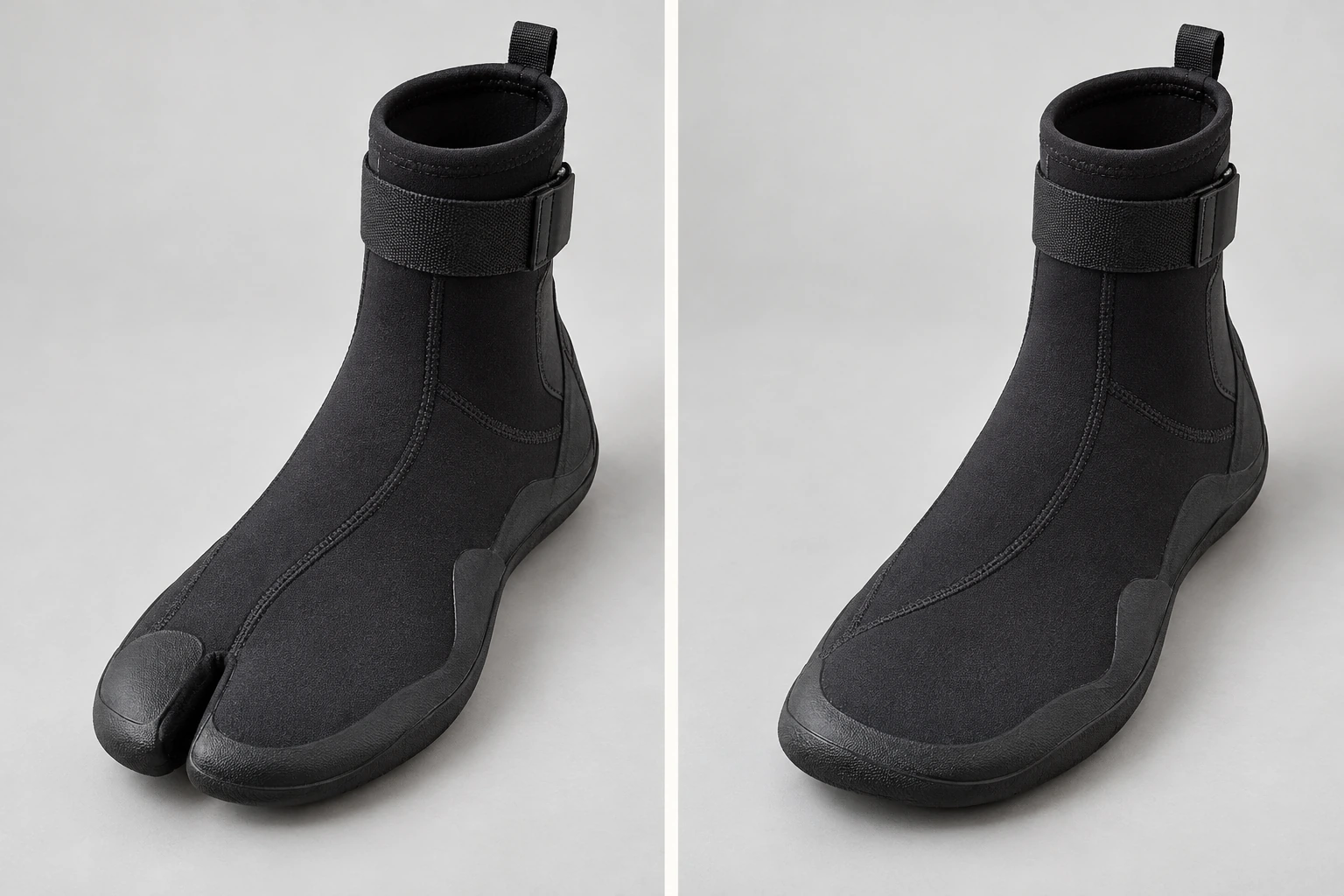
AI-generated generic illustration, not real product photography. The right-hand interior is not shown; check the actual product description. View full size.
| Structure | What you see | What your foot feels |
|---|---|---|
| External split toe | A visible cleft separates two toe sections. | A separate space for the big toe. |
| Internal split toe | A continuous round-looking outline. | A divider inside, despite the smooth outline. |
| Undivided round toe | A continuous rounded front. | One shared toe box, with no divider between the toes. |
For a documented example, Solite describes an internal Mini-Split in its 3mm Custom 2.0. Its 8mm Custom 2.0 instead specifies a round-toe design. These establish that different layouts exist; they are not a like-for-like warmth test. [1][2]
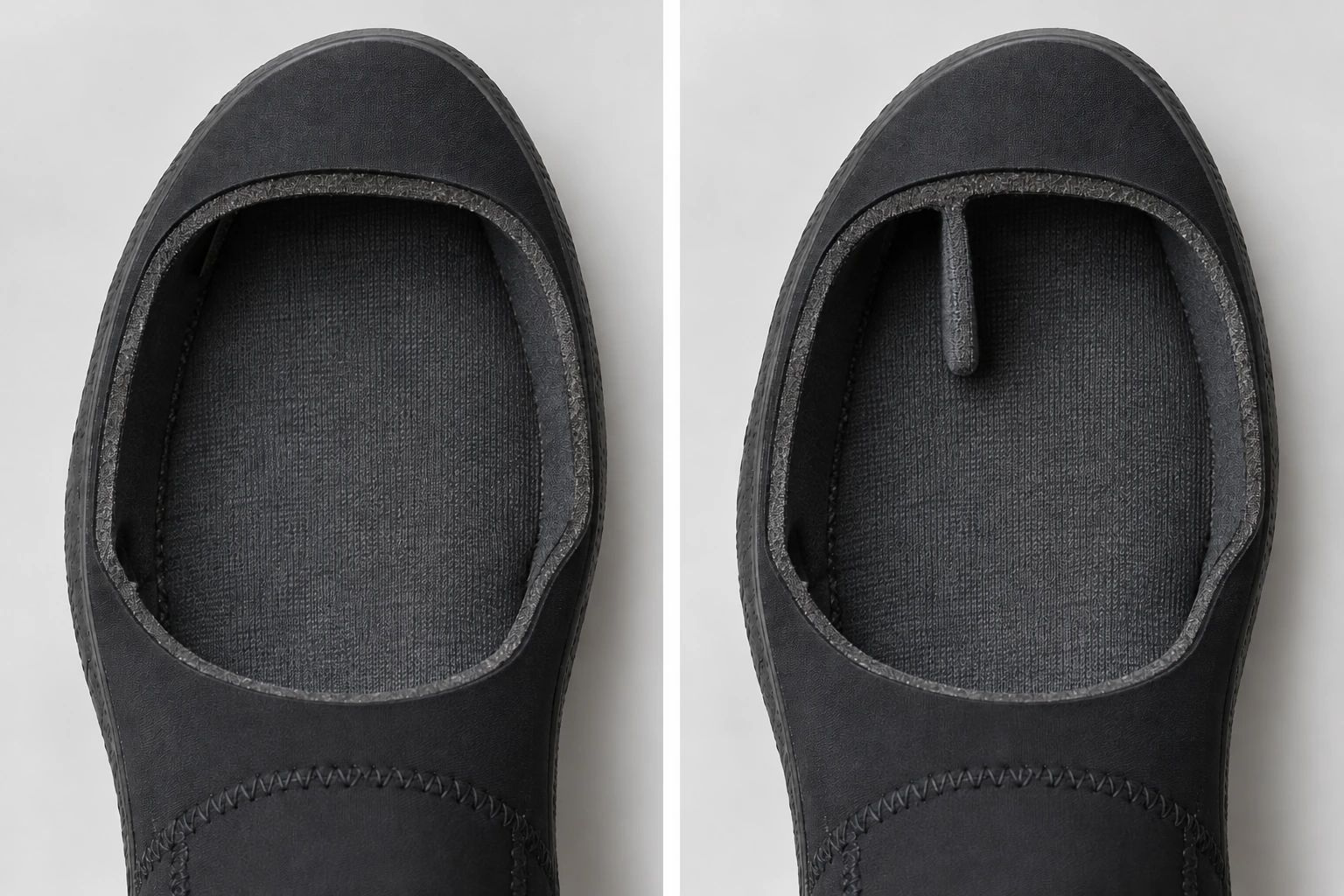
AI-generated conceptual cutaway, not an actual sample or manufacturing pattern. Part of the upper is removed to show the difference; divider dimensions vary by model. View full size.
If you dislike anything between your toes, ask “Is the inside undivided?” Asking only for a round-looking boot may get you the wrong product.
When does a split toe make sense for surfing?
Choose it when you want the front of your foot located more distinctly inside the boot, and the divider sits naturally between your toes. Solite presents its internal split as a control feature. Treat that as a design intention to try on, not a promise that every surfer will perform better. [1]
Separate two kinds of slipping: your foot moving inside the boot, and the outsole sliding on the board. A toe divider addresses the first fit issue. Rubber, tread and the contact surface matter to the second. Buying split toe alone does not prove better traction.
A well-fitting round-toe boot is still a valid surfing choice. MANERA’s round-toe Magma model, for example, uses ankle panels intended to limit lateral movement. Toe layout is only one way a boot supports the foot. [4]
Should you choose round toe for cold water?
Start there if warmth and freedom from a toe divider are your priorities. Solite positions its round-toe 8mm model for cold conditions, while MANERA offers a 5mm round-toe Magma model for cold, windy days. [2][4]
But do not turn those examples into “round toe is always warmer.” Their foam thicknesses, linings, soles and seals differ. None of these product pages isolates toe shape in a controlled comparison. A thin round-toe reef boot is not a substitute for a cold-water boot. Follow the complete model’s intended conditions and fit guidance.
How should wetsuit boots fit?
Use the selected model’s size chart. Measure from heel to your longest toe, which may not be the big toe. MANERA uses that measurement in its fitting guidance. [4] Then try both boots on a clean surface:
- Stand normally. Your toes should not be jammed or forced to curl. In a split toe, check the space between the first two toes.
- Bend your knees and shift gently into a surfing stance. Look for heel lift, forefoot sliding or a divider that starts pulling.
- Change the model if the shape is wrong. A larger size may relieve toe pressure while leaving the heel loose. An undivided toe box may solve the actual problem more directly.
O’Neill’s fitting advice makes the useful distinction: snug enough to limit rolling inside, without jamming the toes. Do not accept painful pressure as the price of a “performance fit.” [3]
Should I always buy one size smaller?
What if you need boots for diving fins?
Try the boot with the intended fins. Cressi’s Isla has a shaped heel and a fin-strap retaining feature specifically for open-heel fins. That illustrates a relevant compatibility detail that a toe photograph cannot show. Do not assume a surf boot will fit your fin pocket or hold its strap properly. [5]
Developing an accessory range? Record the external shape and internal divider separately in your neoprene accessory specification. For the foam and lining behind either layout, see the wetsuit material selection guide.
Sources and further reading
Manufacturer descriptions checked 12 October 2026. Model examples explain construction and fit; they do not establish a universal performance ranking.
- Solite — 3mm Custom 2.0. Internal Mini-Split construction and model-specific sizing.
- Solite — 8mm Custom 2.0. Round-toe construction in a cold-focused model.
- O’Neill — Defender Split Toe Reef Wetsuit Boot. Split-toe reef boot and the page’s boot-fit guidance.
- MANERA — Magma Boots 5mm, Round Toe. Cold/windy use, ankle support and foot-length measurement.
- Cressi — Isla. Open-heel fin compatibility features.