
Choose a kids life jacket by the child’s current weight, fit and intended activity—not age alone. For young children and non-swimmers, start with an approved foam life jacket with head support and a built-in leg strap. Never buy extra room for growth. A jacket that rides over the chin or ears needs adjusting or replacing.
This guide uses U.S. boating requirements; other countries have different approval systems. Close adult supervision remains essential. [1] [2]
Which type should you choose?
For most families shopping for a young child, foam is the practical starting point: its buoyancy is already present, with no inflation step. But “foam” or “kids’ vest” does not by itself identify the right product. Match the label to the swimmer and activity. [1]
| Your situation | Prioritise | Key limit |
|---|---|---|
| Young child or non-swimmer, near-shore boating | Approved foam life jacket suitable for non-swimmers; head-support collar and an integral leg strap. | A collar alone does not guarantee face-up turning. |
| Confident swimmer, supervised paddling in sheltered water | An approved child-sized paddling PFD, with secure fit and room to sit and paddle. | A low-profile buoyancy aid may provide less head support. |
| Towed water sports or personal watercraft | A jacket whose label explicitly permits that activity, within its wearer limits. | Ordinary boating approval does not cover every water sport. |
Selection guidance: Seattle Children’s [2], Safe Kids [3] and USCG [1]. Turning performance depends on the product and wearer; read its label. For the broader distinction, see buoyancy aids versus life jackets.
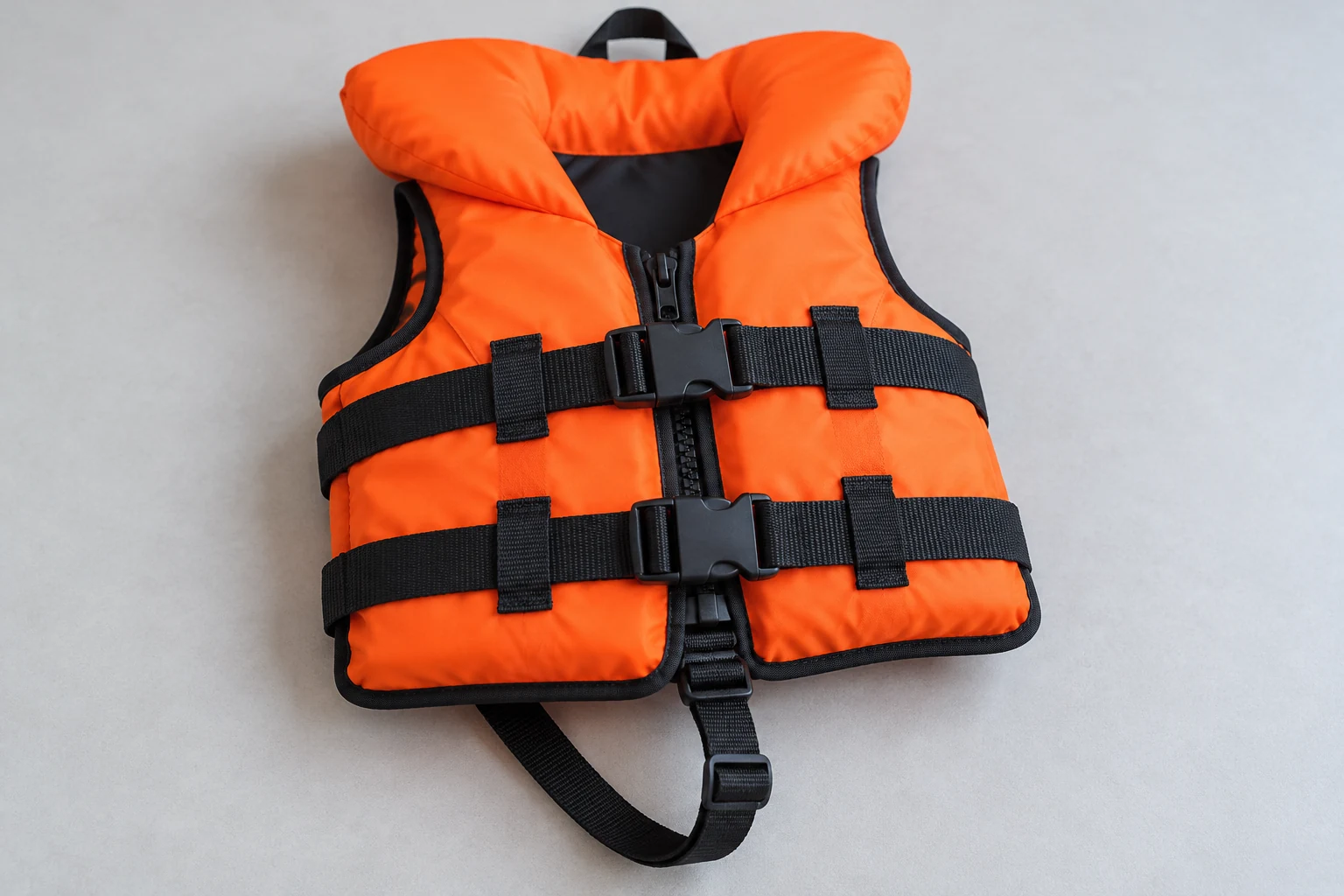
Weight comes first. Age is not a size chart.
Weigh the child now and read the actual jacket’s wearer-weight range, plus any chest or other size limits. “Child,” “youth” and age labels are shopping categories, not interchangeable fit guarantees. Two children of the same age can need different jackets. [4]
WORKED EXAMPLE · NOT A UNIVERSAL SIZE CHART
A 44 lb child needs a range that includes 44 lb
44 lb ≈ 20 kg. The dark vertical line marks the child’s weight.
Within the range—still needs fitting
Below the minimum—do not size up
Teaching example using two weight bands described by Safe Kids [3]. Both the weight limits and physical fit must be right. These bars show weight ranges, not safety scores.
In this example, the smaller range is the only candidate. If it will not fit comfortably, try a different design that covers the child’s weight. Do not move to the larger range just because its straps tighten. At a shared boundary, use the precise product instructions and try the eligible designs; neither size wins automatically.
Length matters too. A jacket can fall within the weight range yet push up when a short child sits down. Bring the child to the fitting and check sitting as well as standing. [5]
Kids life jacket fit: 3 essential checks
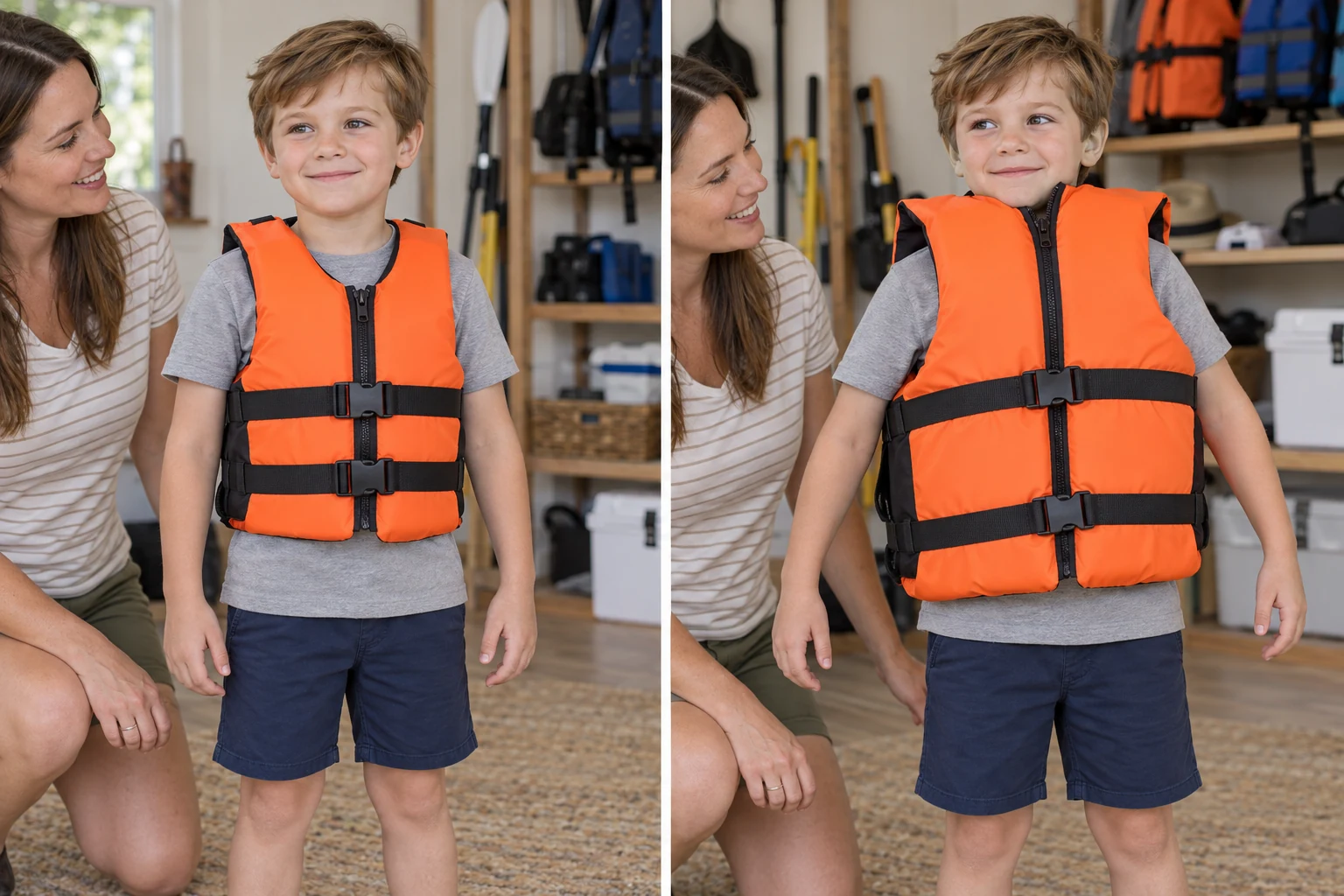
Left · closer fitLess spare room around the torso.
Right · oversizedExtra space and a higher front panel.
- Fasten and adjust. Use the clothing intended for the outing. Close every required fastening and route supplied leg straps as instructed. Aim for secure and comfortable, with normal breathing.
- Gently pull upward at the jacket’s shoulders. If it reaches the chin or ears, readjust within the instructions and repeat. If it still rides up, reject that fit. This is a gentle fit check, not a test of lifting the child off the floor. [3]
- Check movement, then practise in controlled water. Have the child sit and move their arms. Follow the manufacturer’s guidance for a closely supervised in-water check in a safe, controlled setting—not the first boat outing. Watch that the jacket stays in place and the airway stays clear. [5] [1]
A leg strap cannot fix the wrong size. Maritime NZ recommends both correct sizing and child-specific retention features; one does not replace the other. [4]
Keep young children and weak swimmers within arm’s reach of an attentive adult. The jacket is another layer of protection, not permission to look away. [3]
What must parents check for U.S. boating?
Look for U.S. Coast Guard approval on the actual product. A retailer’s “swim vest” description or an overseas approval alone does not establish that it meets U.S. carriage requirements. Follow the approval label and any owner’s manual it references. [6]
The federal recreational-boating rule generally requires children under 13 to wear an appropriate approved PFD while the vessel is underway, unless below decks or in an enclosed cabin. Where applicable state child-wear legislation exists, it applies on that state’s waters instead of this federal child-wear provision. Check the rules for the destination. [6] [7]
Age can trigger a wearing rule; it still does not tell you which size to buy. For a family SUP outing, also check our paddleboard life jacket requirements guide for the distinction between carrying and wearing a PFD.
Questions parents often ask
Can a child wear an inflatable life jacket?
For young children and non-swimmers, choose the suitable foam option described above. Do not assume an adult inflatable is suitable just because it adjusts down. U.S. rules effective January 6, 2025 allow approval of inflatable PFDs for under-16s under specific requirements, including automatic inflation, no secondary donning, mandatory wear and an adult-supervision warning. That is not approval of every inflatable: the particular product must permit the wearer and use, and its maintenance requirements still apply. [8]
Are water wings or inflatable rings enough for pool play?
No. Ordinary inflatable toys are not substitutes for an approved life jacket. Some purpose-designed foam arm-and-chest devices are approved, so check the actual label rather than judging by appearance. Even those require close supervision and use within their stated limits. [2]
What if no jacket fits my baby?
Do not improvise with a larger child’s vest. Very small babies may not have a suitable fit available. Postpone an outing that requires a life jacket until you have suitable equipment and an appropriate plan; ask a qualified boating provider for help. A jacket sold as “infant” is not proof that it fits every baby. [5]
Can I reuse a sibling’s life jacket?
Only if it meets the new wearer’s size and use limits, fits properly and remains serviceable. Check the label and condition again; previous use by a sibling proves none of those things. See when to replace a life jacket for a practical inspection guide. [4]
Sources
Reviewed November 2, 2026; key fit guidance and U.S. rules rechecked November 14, 2026. New Zealand and UK sources inform fit guidance, not U.S. law. Illustrations are not approval evidence.
- U.S. Coast Guard — Life Jacket Wear. Approval, fit, flotation designs and activity limits.
- Seattle Children’s — Life Jackets for Children and Teens. Head support, child fit and swimming-aid distinctions.
- Safe Kids Worldwide — Finding the Right Life Jacket. Example weight bands, shoulder check and supervision.
- Maritime NZ — Lifejackets for Children. Current size, retention straps and condition.
- Royal Yachting Association — Children’s Lifejackets. Body proportions, controlled-water familiarisation and small-baby fit.
- 33 CFR §175.15. U.S. recreational-vessel PFD requirements.
- 33 CFR §175.25. Applicable state child-wear requirements.
- USCG — Lifejacket Approval Harmonization, final rule. Effective date and under-16 inflatable approval conditions; printed page 97360.